Yamasan Sushi and Grill

Yamasan Sushi and Grill (https://www.yamasanorlando1.com/) is a beautiful little Japanese restaurant that has been around for a decade or so, in the Mills Park complex on Mills Avenue, just north of Virginia Drive.  I have driven by it literally hundreds of times, but never stopped in to eat until this past Monday, a rare weekday off.  My wife and I were already nearby and craving sushi, so we decided to try it, not knowing anything about the place.  (Longtime readers know I usually research restaurants and study menus in advance, but not always!)  Anyway, I’m so glad we did, since we had a wonderful experience.

Yamasan’s menu is absolutely huge, and they have all kinds of Japanese food, not just sushi.  They have hot and cold appetizers, bento boxes, noodle and rice dishes, poke bowls, hibachi grill options, and even a Japanese/French fusion menu.  The thing is, I’m a roll guy.  I love ornate sushi rolls, especially with raw fish and lots of ingredients to keep things interesting.  Most of the “Yamasan special rolls” are in the $15-$25 range, and some are even more expensive than that, so I figured it would be an expensive meal, but probably worth it.

However, our lovely server Maggie let us know that Yamasan recently began offering an all-you-can-eat menu, where for the price of $47.95 per person, you had a pretty large variety of selections to choose from — not the entire multi-page menu, but still a lot.  There is a 9o-minute time limit, and everyone in the party must choose the all-you-can-eat option.  Even my wife was on board, because if you were even thinking about ordering three rolls, you come out ahead, and we each ordered more than that!  If you show up hungry, it would be foolish not to.

I took the liberty of photographing both sides of the all-you-can-eat menu, since it isn’t available on Yamasan’s website as of now:

I am going to include the regular menu prices with each description below, just to show you how much money we saved by doing all-you-can-eat instead of ordering a la carte.

I started out with the tuna carpaccio appetizer ($21.95 on the regular menu), which was very small, but it’s all good, because we had a lot more food coming.  This was two pieces of lightly seared tuna topped with creme fraiche, black caviar, grated pecorino Romano cheese, fleur de sel (very posh sea salt), truffle oil, and capers, with wild field greens drizzled with raspberry dressing on the side.  Needless to say, there’s a lot going on in this little app!  It was so magnificent, I implored my wife to try the second piece, and she liked it so much she ordered another portion for herself (also $21.95). 

She got one piece of escolar sashimi ($12 for three pieces on the regular menu), and I got three pieces of mackerel sashimi ($12 for three pieces on the regular menu).  I love mackerel, because it is always lightly pickled, and I grew up eating pickled herring (one of the foods of my people). 

This was the Japanese mentaiko udon ($18.95 on the regular menu), a decadent noodle dish from the Japanese/French Fusion part of the menu.  These super-thick, super-chewy udon noodles were topped with salty salmon roe that pop in your mouth, finely shredded nori (roasted seaweed), more grated pecorino Romano cheese for an umami punch, and what I’m guessing was salty, punchy cod roe mayonnaise on the right side of the photo below.  That’s what they put on the mentaiko fries I tried many years ago at Susuru, anyway.  This was another dish that was as gorgeous as it was tasty.

I loved everything about this, and I was even considering ordering it before we discovered the all-you-can-eat menu (and that this was included in it).  Again, my wife impressed me by trying it and pleasantly surprised both of us by liking it.  But what’s not to like… unless you already don’t like salty, fishy flavors?

The rolls started to show up next.  This was a Dynamite roll ($11.95 on the regular menu), with tuna, yellowtail, wasabi, and scallions, a nice opening act for the superstars about to arrive.  It was dynamite!

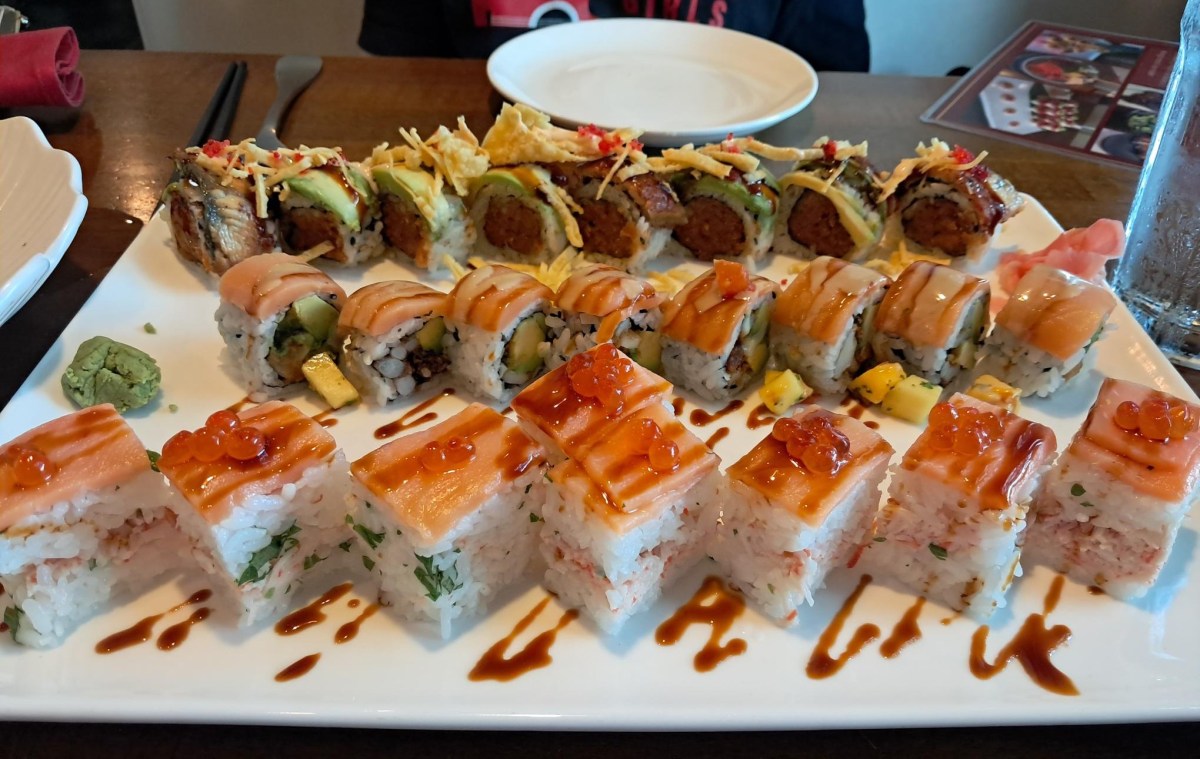
And here’s a gorgeous tray with three of my selections: the Salmon Tower roll in the front, the Capitan roll in the middle, and the Unforgettable roll in the back.  Lord have mercy!The Salmon Tower roll ($19.95 on the regular menu) is pressed into that rectangular shape, and it includes green shiso (perilla) leaves mixed with sushi rice, smoked salmon, salmon roe, kani (krab), mayonnaise, and eel sauce.  I wasn’t sure what shiso/perilla leaves were supposed to taste like, but my research tells me the flavor is a cross between basil and mint — both good flavors to go with the salty, smoky richness in this roll.

The very traditional Capitan roll ($18.95 on the regular menu) includes fried calamari, avocado, Cajun seasoning, topped with smoked salmon, wasabi, creme fraiche, mango salsa, and eel sauce.  Okay, so it isn’t traditional at all, but I love fusion cuisine, and I already said I’m a sucker for sushi with a lot going on!

I really should have turned the tray around for a better pic of the Unforgettable roll ($18.95 on the regular menu) in the back, but I forgot.  Yes, I forgot the Unforgettable roll.  I’m here all week, folks.  Anyway, it includes spicy tuna and barbecue eel, and it is topped with avocado, seafood sauce, eel sauce, crispy fried noodles, and masago (red flying fish roe).  Each of these was mighty fine.

Here were my wife’s first two roll choices, which curiously came out some time after my first three.  In front, you can see the Mango Tango roll ($17.95 on the regular menu), with tempura shrimp and cream cheese, topped with mango, shredded coconut, and eel sauce.  It’s always a crowd-pleaser.Behind it is the Sweet Sixteen roll ($17.95 on the regular menu), with shrimp, krab, cream cheese, and a rice paper wrapper, topped with mango and strawberries and drizzled with a “mayo sauce.”  I like some sweet flavors with my sushi, like eel sauce, and I’m never sad to see mango show up, but that one was a little too desserty for me.

This was her next roll, the Lover roll ($18.95 on the regular menu), with krab salad, topped with tuna, spicy mayo, a tiny Hokkaido scallop, and red caviar (masago) on top.  There was something else in this Lover roll that wasn’t listed that was brown and had kind of a funky flavor that didn’t fit.  At first, I feared the chef sneaked mushrooms into this roll, because it definitely wasn’t a fish.  The menu listed tempura flakes, but we didn’t see any or feel their familiar, pleasing crunch.  It turned out that it was inari, also known as bean curd, or fermented and fried tofu, a common sushi ingredient which she likes, but I don’t — especially when I’m not expecting it.  But once she got too full, I poked the inari out of each piece with a chopstick and dutifully finished the rest of the Lover roll.

And this was my last stand: the Dream of Dream roll ($20.95 on the regular menu), which you have to say in the old-timey newsman voice of the late, great David Lynch, as you can bet that I did.  It was a fitting way to end our unexpected feast at Yamasan, with tuna, salmon, shrimp, krab, tempura flakes, regular AND spicy mayo, eel sauce, and black caviar.  Back in 2009, David Lynch quoted The Upanishads on Twitter, in those days before it became one of the worst places on the Internet: “We are like the dreamer who dreams & then lives in the dream.”  Later, in his brilliant third season of Twin Peaks in 2017, Lynch’s character Gordon Cole had a dream in which Monica Bellucci repeated the line.  And that’s all I could think of while I ate the Dream of Dream roll.   

So if you add up the prices of everything we got, had we ordered a la carte:

Two tuna carpaccio appetizers ($21.95 x 2) +
Escolar sashimi ($12 for three pieces, since we would not have been able to order just one piece) +
Mackerel sashimi ($12 for three pieces) +
Japanese mentaiko udon ($18.95) +
Dynamite roll ($11.95) +
Salmon Tower roll ($19.95) +
Capitan roll ($18.95) +
Unforgettable roll ($18.95) +
Mango Tango roll ($17.95) +
Sweet Sixteen roll ($17.95) +
Lover roll ($18.95) +
Dream of Dream roll ($20.95) =
A whopping $232.45 (plus tax and tip)!

We would never run amok like that if we were ordering off the regular menu… or would we?  I always say we know how to party, and why doesn’t anyone ever party with us?

But instead, we paid $47.95 x 2 = $95.90 (plus tax and tip, of course)YOU’RE WELCOME.  And thank you to Yamasan Sushi and Grill!

Well, stalwart Saboscrivnerinos, I am thrilled to report that our first visit to Yamasan surpassed my wildest dreams (or dreams of dreams).  I would happily go back, because even if it isn’t a cheap dinner, you will eat like a king and go home satisfied and ready to crash for the night.  I feel like we got our money’s worth, and then some.  And it’s such a nice little restaurant (with comfortable booths!), I would recommend it even if you don’t go with the all-you-can-eat option, even though I personally think it’s a no-brainer.  Ask for Maggie — she was the only server on duty, so she was slammed, but she will take the best care of you, as she did for us.

Istanbul Grill

I love Turkish food.  It might be my second-favorite cuisine of all time, after Italian, and the insidious social media algorithms are always sending me reels of the most amazing-looking Turkish street foods that always make me hungry.  Unfortunately, Turkish restaurants don’t always last here in Orlando.  I was a big fan of Beyti and Cappadocia, but they didn’t survive.  Luckily, I have a new favorite, Istanbul Grill (https://istanbulgrillorlando.com/), but unfortunately, it isn’t close to home like Beyti was or close to work like Cappadocia was (especially because my work and home are now one in the same).  It is way far south on Orange Blossom Trail, south of the Florida Mall, south of the 528.  It’s a haul — about 45 minutes each way in good traffic on a weekend during the day.  But I’ve brought home takeout twice from Istanbul Grill, and it was so worth it both times.

It is a big attention-getter to order lavas bread in a Turkish restaurant.  They walk it out to your table, this big, beautiful bread puffed up with hot air like a football, and then you stab it with utensils to deflate it (and watch out for the hot steam escaping).  It is very soft, and you rip off pieces and use it for dipping and scooping.  Of course, if you get lavas bread to go, it deflates on the long drive home, but if you’re lucky, it stays warm and may stay soft overnight if you have any left.

And why do you need soft bread for dipping and scooping?  For this mixed appetizer platter!  Almost every Turkish restaurant offers a variety of cool, fresh, refreshing dips, and you can usually order some kind of assortment.  My favorite is spicy ezme in the top left, almost like Turkish salsa — a combination of fresh tomatoes, onions, parsley, green and red bell peppers, hot peppers, garlic, tomato paste, and lemon juice.  My wife wants nothing to do with ezme, so I get it all.  In the top right, the tabouli salad is all hers — crushed bulgur wheat, parsley, scallions. and tomatoes with olive oil and  fresh mint.  She told me this is her favorite tabouli from any restaurant, Turkish or otherwise.In the bottom left, we have baba ganoush — fresh smoked eggplant puree with tahini (sesame paste), olive oil, labneh (strained yogurt thickened into a cheese-like form), mayonnaise, garlic, and lemon juice.  We both love this one, but it is her absolute favorite.  In the cup in the middle, we have cacik — a dip of creamy yogurt, shredded cucumber, mint, dill,  and garlic, perfect for cutting spice and mellowing out rich meats.  And in the bottom right, we have the old classic hummus — chick peas, tahini, olive oil, garlic and cumin.
As great as this mixed appetizer bounty is, I do wish Istanbul Grill served two more dips that I rank even above ezme: soslu patlican (eggplant sauteed with tomatoes, onions, and peppers, like a spicy ratatouille) and taramasalata (a creamy dip made with salted, cured fish roe).

For my first visit, I made sure to order lahmacun, one of my Turkish favorites.  These thin, round flatbreads look like pizza without cheese, but they are much thinner than even tavern-style pizza and not as crispy, and aren’t sliced.  They are topped with a delicious mixture of ground lamb, tomatoes, onions, and peppers, and then baked.  Here you get three in an order.
I’ve made lahmacun from scratch before, and I think I’m going to have to do it again soon, since I have ground lamb in the freezer and want to use it up before hurricane season gets hot and heavy.  Mine are pretty awesome, but not quite as perfect as Istanbul Grill’s.

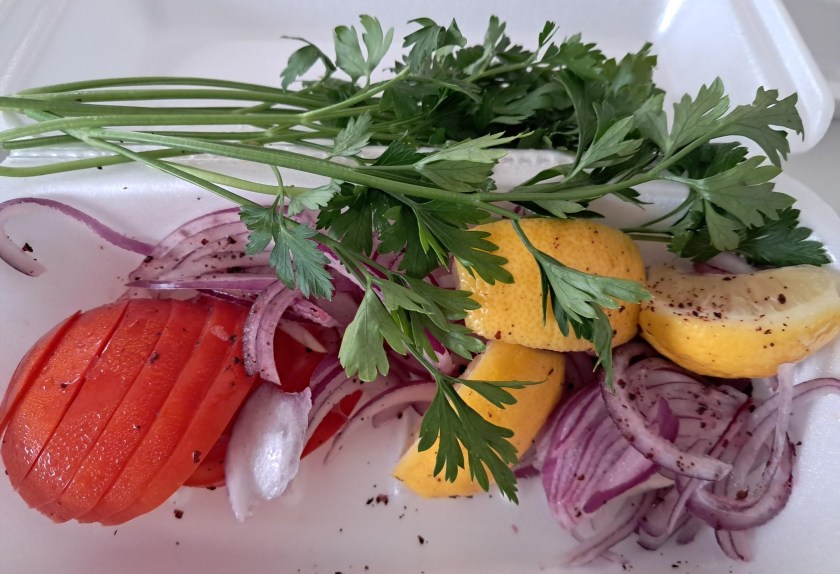
Instead of eating lahmacun like pizza, you are supposed to roll it up and fill it with sliced tomatoes, red onions, fresh cilantro, and a squeeze of lemon juice.  It is so refreshing and light, much moreso than you would think a pizza-looking thing would be.

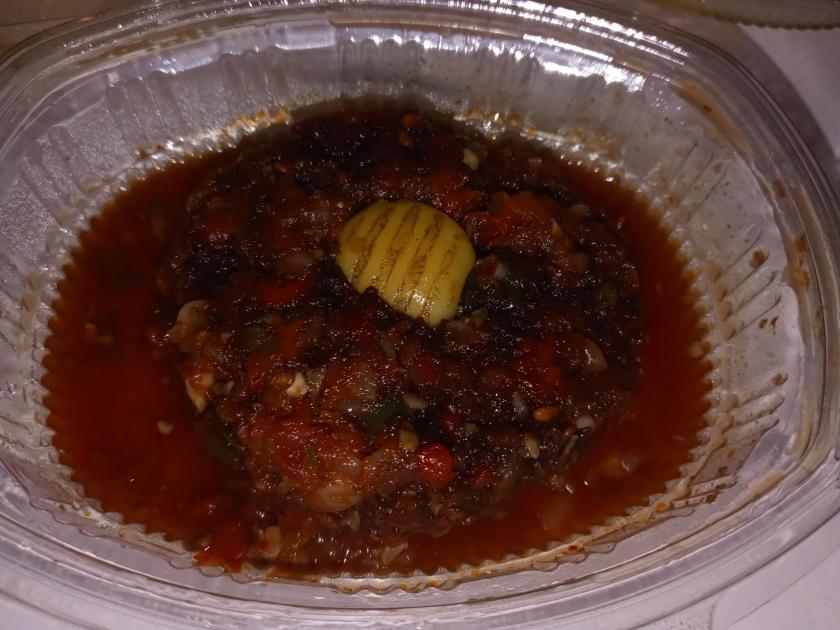
My wife ordered “mosakka” (often called moussaka on other restaurants’ menus), an oven-baked dish of eggplant with ground beef and tomato sauce, topped with mozzarella cheese.  If you’ve made it this far, you might be more familiar with the Greek version of moussaka, which is often assembled in layers and topped with a bechamel sauce, but both of us really love the tomatoey Turkish variant.  I tried a bite, and folks, you have to try this some time!  This is actually my preferred moussaka/mosakka.

It was hard for me to choose, but I made the game-time decision (standing at the counter placing my order) to go with lamb adana, grilled kebaps of ground lamb seasoned with red bell peppers.  Think of it as a grilled meatloaf with a firmer texture.  These were fine, especially when I added some of the house-made hot sauce, but I was hoping they would be a little more exciting, flavor-wise.  I almost always gravitate toward lamb dishes at Turkish, Middle Eastern, and Greek restaurants, but I probably would have been happier with the special beef adana, grilled ground beef shoulder kebabs tender seasoned with mint, red bell pepper, onions, chili flakes, and cumin.  There seems to be more going on in that one.  Leave it to me to choose the lesser adana!  Or maybe I should have tried a different lamb dish.  Luckily, there would be a next time.   They came on a bed of rich rice pilaf (which gets so much better with all the meat drippings soaking in) with a small salad and crunchy pickled red cabbage.

My wife had asked me to pick her a dessert, so instead of baklava, I brought home this kunefe, because she is in her pistachio-loving era.  This Middle Eastern dessert is a large “patty” of very fine shreds of dough that almost look like vermicelli strands, often with a sweet cheese filling, soaked in a sugary syrup and topped with crushed pistachios.  It looks a bit dry in this photo because the sugar syrup came in a separate little ramekin (not pictured) for us to pour over the kunefe when we got it home.  That definitely improved its looks, texture, and most importantly, its taste.  I didn’t try it, so I don’t know if this one had cheese inside or not, but she liked it, so that made us both happy.   

For our second visit, we got Istanbul bread instead of the fluffy, puffy lavas (that is actually quite thin once you rip it apart).  This was very similar to a thicker pita bread or a good pizza crust, minus toppings, and much thicker than the lahmacun.  It held up well dipping and scooping the mixed appetizer platter I brought home again.

My wife asked for an order of falafel, which came with four decent-sized discs and a little cup of tahini, which really surprised me when I took a big dip, expecting it to be hummus.  I like hummus (who doesn’t?), but straight-up tahini, not so much.    These looked darker than your average falafel, so she thought they were burned and ended up not having any after all.  I ate them a few days later, so I can vouch for them not being burned and actually being delicious.  I made them into two separate sandwiches (two falafels in each) on onion naan bread with homemade pickled cabbage, homemade pickled red onions, tomatoes, Istanbul Grill’s own hot sauce, and Flavortown Secret Sauce from my giant collection of condiments.  I should have taken a picture of one of those, because they turned out pretty.

One thing my wife ate with gusto was this order of four beautiful grilled lamb chops, seasoned to perfection.  I asked them to grill them as rare as possible.  Despite being very thin (much thinner than the thick lamb loin chops I buy at Costco), they were delicious, and seasoned so well.  The rice pilaf underneath them got better and better as it soaked up all those savory drippings.  She actually got four separate meals out of this, with one lamb chop and a little rice in each portion!

She surprised me by taking a big bite of the grilled pepper on the left, before I could warn her it would be too spicy for her.  It was.  She won’t do that again!  And I ate all the crunchy red pickled cabbage, of course.

This was my lamb shank, a tender, braised chunk of meat barely clinging to a large bone, which was stewed in a tomatoey gravy.  This is one of my favorite dishes to order at Turkish or Greek restaurants, but because I love it so much, I learned how to make braised lamb shanks myself at home, and my sauce is a lot thicker, spicier, and more robust overall, especially since I braise mine in the oven for five to six hours.  This was perfectly good, but just like I’m exceptionally picky about restaurant lasagna because I love my homemade version so much, I also like my lamb shanks a lot more than this one.  Sorry, Istanbul Grill.  It’s not you, it’s me. 

It came with a big styrofoam container of rice pilaf, which I dumped into the lamb shank’s somewhat thin gravy to soak it up. 

And this was the iskender style kebab, a dish I was introduced to a long time ago at Bosphorous, the first Turkish restaurant I fell in love with, and then Cappadocia (RIP) raised the bar even higher.  I didn’t eat this until the following day, but it consists of “signature house prepared meat” sliced  thin over “garlic bread” (I’m thinking fried Istanbul bread) topped with  a tangy, tomatoey “special sauce” and served with yogurt.  It is mildly spicy, acidic, and also creamy, and you get the crispiness of the fried bread underneath catching all those meat and sauce drippings.  The other Turkish restaurants used their doner kebap meat (think sliced gyro meat, all salty and garlicky usually grilled to make it a little firmer), but this was definitely different from those. 

Like I say at the end of too many of these reviews, we both really liked Istanbul Grill, but it is too far from home to return with any regularity, and too far to even drag my wife down there to dine in the restaurant.  But I recommend it, and I will challenge myself to keep ordering different things off the expansive menu whenever I return.  And FYI, there is a second location in Kissimmee, which is even further from me, but might be more convenient for some.

Lim Ros Thai Cuisine

Lim Ros (https://limrosthairestaurant.com/) is a new Thai restaurant in Maitland that opened in the fall of 2024.  According to the website, “Lim Ros” means “to taste” in Thai, and there is plenty to taste on the menu.  It is located on the bottom floor of a fancy-looking apartment building on the corner of State Road 17-92 (aka Orlando Avenue, which turns into Mills Avenue as you head south) and Lake Avenue.  The interior of Lim Ros is modern, spacious, and upscale, with high ceilings and lots of natural light that make the dining room look even larger.  When we went for lunch a few weeks back, it wasn’t very busy, but I imagine it is poppin’ on Friday and Saturday nights.

My wife started her meal with a Thai iced tea, as she will at any Thai restaurant.  This one was sweet, creamy, slightly smoky, and refreshing, as they should be.

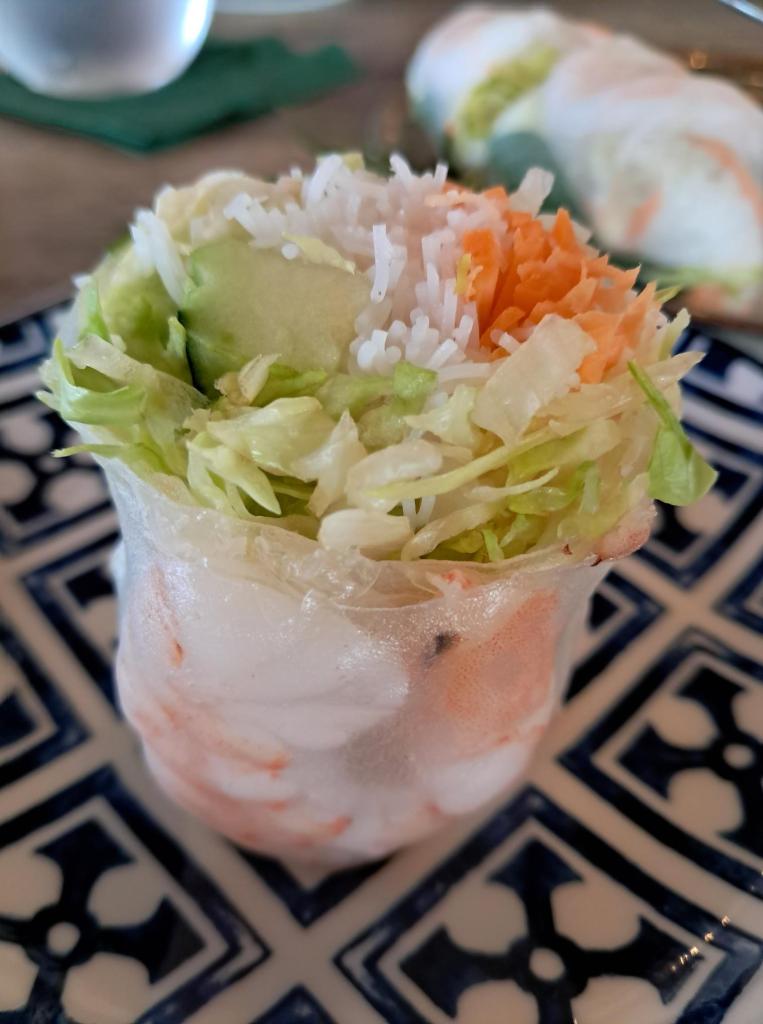
She also started with an order of summer rolls, her go-to appetizer at any Vietnamese restaurant we visit, so she wanted to try them on a Thai menu.  The soft rice paper wrappers held massive amounts of finely shredded lettuce, chewy rice vermicelli noodles, julienned carrots and cucumbers, Thai basil, and shrimp , but vegetarians and folks who keep kosher can also order them with tofu instead of shrimp.   That is peanut sauce on the top, even though it looks like it could have been cocktail sauce. 

I’m not a big summer roll guy, but she insisted I try half of one, and these were a lot more substantial than the usual summer rolls at Vietnamese restaurants.  Thicker.  Girthier, if you will.  Okay, that’s enough of that.

After being introduced to life-changing larb last year at Isan Zaap Thai Cafe, my favorite Thai restaurant in Orlando, I decided to try the larb gai here at Lim Ros.  It is a spicy, tangy, refreshing, cool salad made with ground chicken and various crunchy vegetables and fresh herbs: carrots, red onion, cilantro, mint, kaffir lime leaves, roasted rice powder, and served with cucumber slices for scooping and crisp iceberg lettuce leaves for making lettuce wraps.  Dig this gorgeous plating:

I must admit I preferred the taste and texture of the larb at Isan Zaap, which was made with ground pork and pork liver, as opposed to the ground chicken in this larb gai.  This one also seemed to have a lot of funkiness from fish sauce.  Trying to roll up some larb gai lettuce wraps was a messy business, and my fingers smelled like fish sauce for a day or two after this meal.

For entrees, we both ordered off the lunch menu, which has some nice specials.  Everything comes with a house seaweed soup and a crispy fried spring roll, so you get a filling meal with a couple bonus items for less than the price on the regular menu.

My wife defaulted to pad Thai, a safe choice for her because she isn’t into spicy food at all.  If the classic dish of rice noodles, eggs, bean sprouts, chives, peanuts, and pork sounds basic or unadventurous, I would disagree, because every restaurant’s pad Thai is different, and a truly great one can be a monumental discovery.  She said this one was just okay.  I tasted it, and she agreed with my criticism, that it lacked the acidic tang from citrus it needed to achieve perfect balance.  To be fair, that is my biggest complaint about most versions of pad Thai that I try. 

Since my go-to Thai dish, drunken noodles, wasn’t on either menu at Lim Ros, I decided to try something totally new (to me): Panang curry.  Here is the whole lunch platter:

This is the actual Panang curry, with Thai eggplant, Thai basil, kaffir lime leaf, chili, and pork (which I chose, but you can also choose chicken, tofu, or vegetables, or beef or shrimp for a $2 upcharge).   I wanted something spicy, and I would have to describe it as “medium hot,” but next time I will challenge myself with “Thai hot.”  I added all my rice to the bowl of curry and mixed it all up, so that alone dampened the heat level.   
I was surprised that the Thai eggplants were little, round, and green, not at all like the huge purple-black eggplants all of us are used to.  They looked like tiny round watermelons on the outside, and they had a texture similar to zucchini.

This was the house seaweed soup, which reminded me a lot of the standard miso soup served in Japanese restaurants, but with a delicious “roasted” flavor from the seaweed.  Umami?  Maybe your mommy.  There were tiny little white tofu cubes in there, along with all the seaweed, carrot, onions, and scallions.  It was a very nice soup, and it reminded me that I never order Thai soups, but I should branch out.

And the spring roll was a standard spring roll — no big surprises there — but you can’t go wrong with a spring roll!  I took the shredded cabbage and carrots home, mixed in with most of my larb gai, so I had a whole meal for the following day. 

We both thought Lim Ros was perfectly fine, but there are other Thai restaurants we like more, including another recent discovery I will be reviewing soon, so watch this space.  It’s a very nice restaurant and would probably be great for a date, a business lunch, or for bringing family and friends who are unfamiliar with Thai food and nervous about trying it.  If you want Thai and you’re already in Maitland or surrounding Fern Park to the north or Winter Park to the south, you can’t go wrong.  However, the next time my wife and I are craving Thai, I might drive farther in other directions.

Baar Baar (Los Angeles)

Baar Baar (https://www.baarbaarla.com/) in downtown Los Angeles (the locals call it DTLA) is the most upscale Indian restaurant I’ve ever been to, with a gorgeous dining room and a large, eclectic menu of gourmet dishes that definitely seemed “elevated” above the standard Indian cuisine I’m used to. This memorable meal goes back to late summer, 2023, when I was invited on my very first trip to L.A., joining our dean, an associate dean, and my director, only about a month after starting my current job.  I definitely felt like the odd man out, hanging with these big shots, but their warm welcomes and lack of pretension convinced me I belonged there.  Our dean, a very classy lady who knows how to throw a dinner party, ordered several dishes, mostly small plates meant to be shared.

These puffs were dahi puri, topped with tamarind, mango, yogurt mousse, and raspberry chaat masala.  These were very light and crispy (similar to pani puri I’ve had elsewhere), but the toppings added sweet flavor to go with the savory, lightly fried puffs.

These beauties were Kashmiri duck tacos, served birria-style, shredded with cheddar cheese, cilantro, and red onion — true fusion cuisine!   Instead of Mexican tortillas, the crispy taco shells were more like roti or parathas.  The four of us each got half a taco and savored every morsel.

These six gorgeous oysters came with guava and chili granita (almost like a sorbet), pickled cucumber, and shallots.  I love oysters, and these were so fresh and refreshing.  I would have been happy just having this platter to myself and nothing else, but of course we all shared these and everything else.

This fun and frizzy dish was sweet potato chat, an appetizer served with tangy-sweet tamarind chutney, sweet and sour yogurt (or “yoghurt,” according to the menu), and kale.

These were two lamb chop burrah kebabs (the second one is underneath, and you can see the bone), served with fresh mint, hemp seed chutney, and lachcha pyaz, a bright and pungent salad comprised of thin rings of red onion rings, ground spices, lemon, and fresh herbs.  I love onions, but raw red onions are intense, and so is the onion breath they create.  I was desperate to make a good impression on these three powerful, professional women, so I didn’t mess with the lachcha salad the way I normally would, dining on my own.  The lamb was wonderful, and the fresh mint really worked well with it.

This dish doesn’t seem to be on the menu anymore, but it was tandoori butternut squash, served with asparagus, millet khichdi (instead of rice as the base of this dish, it was a combination of millet and yellow moong dal, or mung beans), and rice papad, which are like very thin, airy, crispy crackers or wafers. 

While these look vaguely desserty, they were savory paneer pinwheels (notice how they look like three slices of something longer, rolled into a spiral), with makhani (a creamy, buttery, tomato-based sauce), topped with dollops of red pepper chutney, and pistachios.  I loved them. 

These were beef short ribs, always one of my favorite meats from any cuisine, served in Madras curry (a spicy British-Indian creation with a base of tomatoes and onions), with bone marrow Khurchan and baby  vegetables.  Between the tender short ribs and rich, unctuous bone marrow, which is like “meat butter,” I was in heaven with this decadent dish.

At Baar Baar, even a simple side of saffron rice was still cooked as perfectly as any rice could be.

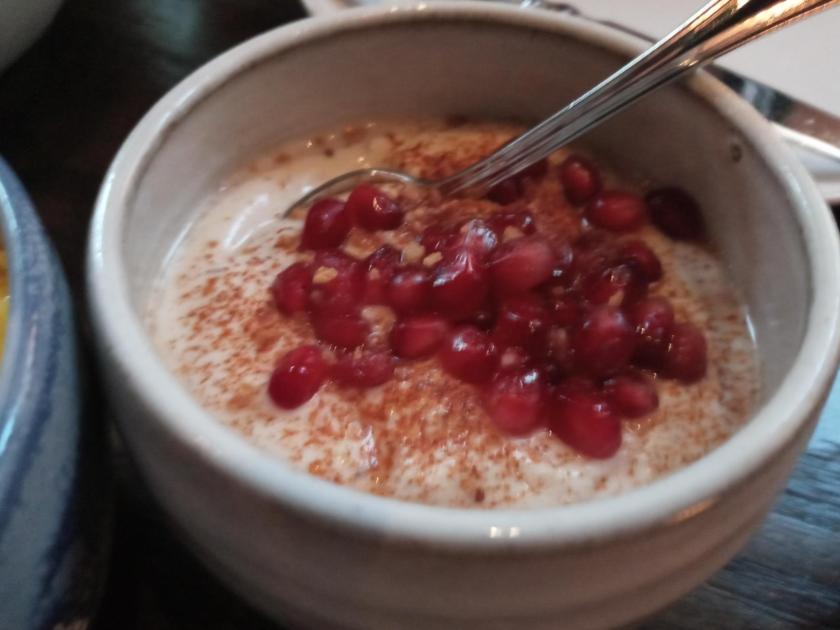
And this was a side of pomegranate raita: cool, refreshing, creamy, tangy yogurt topped with pomegranate seeds. 

This gorgeous dessert doesn’t seem to be on the Baar Baar menu anymore, but it was called mango ghewar, and it consisted of malai kulfi (Indian ice cream flavored with cardamom, saffron, and rose water), mascarpone cheese mousse, mango jelly, and crushed pistachios.

Needless to say, this was a sumptuous feast, even shared by four people.  Like I said, our dean is a class act who knows how to party!  Few things bring me as much joy as sharing a bunch of different dishes with people over good conversation, and that’s what our dinner at Baar Baar turned out to be.  Not only was it the finest Indian meal of my life, but it was a reminder that all the decisions I had made in my life to get to this moment in time — this job, working remotely, getting to visit our gorgeous school in L.A. once in a while, collaborating with these amazing people, even being part of this grand gustatory gathering — turned out to be right.  This dinner was almost two years ago, and ever since then, I have been grateful every day for the new direction my life has taken.  I’ve also been falling more and more in love with Los Angeles and its culinary culture.  Even though Orlando is my home, I’ve had so many great meals in L.A. (sometimes solo and sometimes with colleagues and friends, like this one), and I have so many more L.A. restaurant reviews yet to come!

Kai Kai

This week, I want to talk about Kai Kai (https://www.instagram.com/kaikai.bbq/), Jerry and Jackie Lau’s stall that serves up Cantonese barbecued meats, as beautiful as they are delicious.  Kai Kai is located inside Mills Market, the new Asian food hall on East Colonial Drive between Mills and Thornton Avenues in Mills 50, arguably Orlando’s best foodie neighborhood.  Last week’s review recipient UniGirl is one of Kai Kai’s neighboring stalls inside Mills Market, and so is former favorite Banh Mi Boy, that Vietnamese sandwich stall sandwiched between UniGirl and Kai Kai.
Before Mills Market opened last year, Kai Kai was located inside of iFresh Supermarket, the Asian market on the corner of East Colonial and Bumby Avenue (next door to Chicken Fire and Lam’s Garden!), but since then, Meng’s Kitchen has moved into the former Kai Kai space inside iFresh Market.

I swear I’m going to move on, but I feel the need to say that Kai Kai is not to be confused with Michelin-recommended Kai Asian Street Fare, one of my favorite restaurants in the Orlando area (just over the Casselberry border in Winter Park).  Everybody still with me?

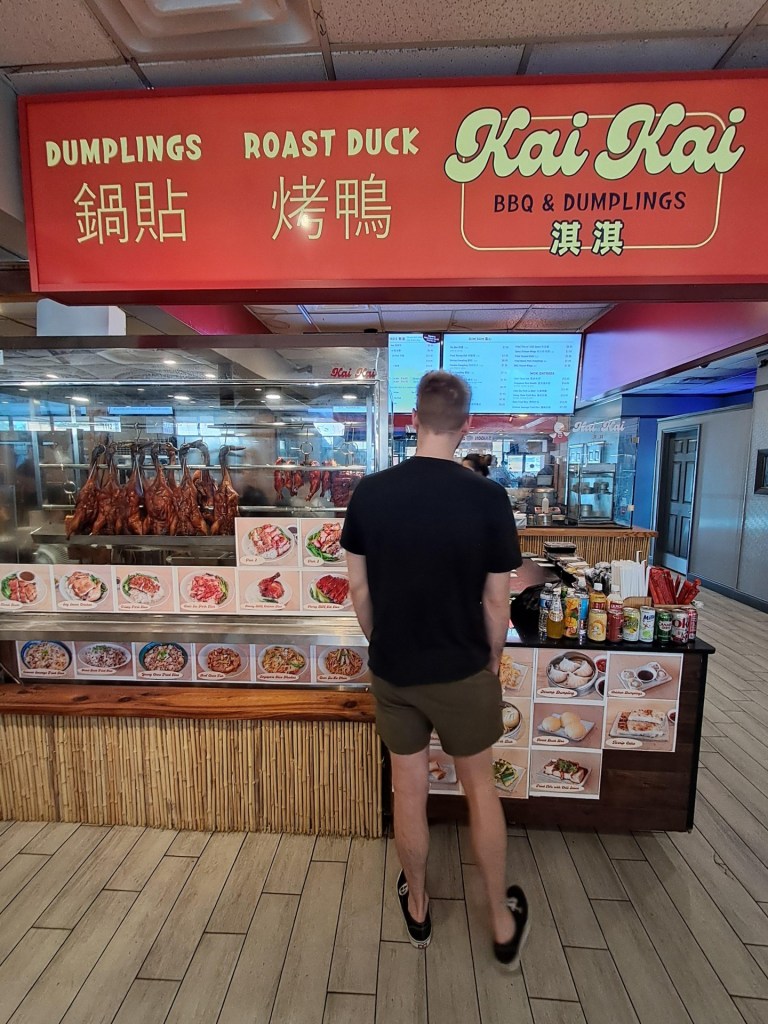
Well, I dare you to walk up to Kai Kai and not be entranced and enthralled by the barbecued ducks and chickens hanging on display… unless you’re a vegetarian, that is.

I appreciate that they have photos of all their dishes on display.  I honestly wish more restaurants would do this.

Something else I appreciate about restaurants is when they offer some kind of sampler plate with two or three items to choose from so you can try a few things.  I will almost always choose this option, whether it’s an American barbecue joint or a Cantonese restaurant like Kai Kai.  If you order a “rice box,” you can choose two or three of the six house specialty meats.  I, of course, went with three meats, which only costs $2 more than the two-meat option, so it seems like a no-brainer.  I treated myself to roast duck, honey barbecue char siu pork, and soy sauce chicken (from top to bottom in the photo below).

The sliced meats are served over white rice with some garlicky sautéed bok choy, but you can pay a small upcharge for either fried rice or Hainanese garlic rice.  I chose the garlic rice, and I have zero regrets.  I strongly encourage my readers to do the same.  But look at this gorgeous plate of food!  It is huge and heavy, so much so that even *I*, chronic overeater that I am, easily got two and a half meals out of it.

Just because this is a feast for all the senses, including the eyes, here is a close-up of that lovely roast duck with crispy, crackly skin, and the tender, sweet, slightly sticky char siu pork beneath it:

And here is that soy sauce chicken, with lightly crispy skin as well.

They also offer honey barbecue chicken, honey barbecue ribs, and “crispy pork,” either in these rice boxes or by the pound or half-pound, but I feel like I made great choices.  I’ll have to try the ribs next time, though!

I also brought home an order of beef chow fun — chewy, wide, flat rice noodles (made from scratch by Jackie Lau herself!) wok-fried with tender sliced beef, onions, and green onions in a savory brown sauce.  Forgive me for not snapping a “noodle pull” pic, but I ate it too quickly.  This is one of my go-to dishes at any Chinese restaurant, especially as a way to evaluate places that are new to me.  If they have beef chow fun on the menu, I consider it a good sign, and if they do a good job of it, I feel more confident that anything else that comes out of the kitchen will be equally solid.

Spoiler alert: they did a great job of it.

On top of everything else, Kai Kai also serves Singapore rice noodles (another dish I love, the spicier the better), char siu pork lo mein noodles, young chow fried rice with shrimp, chicken, and pork, duck fried rice, and Chinese sausage fried rice, which I love so much that I will definitely try their version next time.  But that’s not all!  They also have an entire scratch-made dim sum menu featuring siu mai, multiple dumplings and bao buns, spicy Szechuan wings, and even cucumber salad (regular or spicy) that is probably super-refreshing to balance out all those heavy barbecued and roasted meats and fried noodle and rice dishes.

Obviously I enjoyed the food at Kai Kai, but I’m far from the only one.  The latest round of Florida Michelin awards were announced on Friday, April 5th, and Kai Kai received a vaunted Michelin recommendation, alongside its Mills Market neighbors UniGirl and Banh Mi Boy, which both received Bib Gourmand awards.  Congratulations go out to Jerry and Jackie Lau, who are absolutely killing it at Kai Kai.  I look forward to returning, but in the meantime, there is magic happening in the stall kitchens of Mills Market.    Whatever restauranteurs Johnny and Jimmy Tung of the Bento Group are doing to build their brands and spread the word, it is paying off!

UniGirl

UniGirl (https://www.unigirlfl.com/) is an whimsically named food stall in Orlando’s relatively new Asian food hall Mills Market, located inside the former Tien Hung market on East Colonial Drive between Mills and Thornton Avenues.  It is even more adorable when you learn on the website that it was named after chef/owner William Shen’s shiba inu, a super-cute Japanese dog breed that looks like a fox.  A cartoony shiba inu appears as the official mascot of the restaurant.

UniGirl specializes in onigiri, tasty triangles of lightly salted koshihikari Japanese short grain rice (nicely chewy and sticky; the same kind of rice used for sushi), molded with some kind of filling, sprinkled with furikake seasoning (diced roasted seaweed and sesame seeds), wrapped with a piece of roasted seaweed to use like a handle.  They are served warm and best enjoyed that way.  I first tried onigiri a few years back at Ramen Takagi, still my favorite ramen-ya in the Orlando area, but nobody else has focused on onigiri until UniGirl opened in November 2024.  I had some fun on my first visit very recently!

This was the refreshing “daily mocktail” — so perfect on an unseasonably hot day in early April.  It was a blend of calamansi and passion fruit juices and jasmine, served over crushed ice, which we can all agree is the best kind of ice.  Calamansi is a tart little citrus fruit, similar to lime, that is very popular in Filipino cuisine, and passion fruit is one of my favorite fruits and flavors in general.

I got an order of three fried oysters while I waited, which were fried to order and to perfection.  These were listed on a chalkboard as a konbini special, with konbini serving as an abbreviation of konbiniensu sutoru, or “convenience store.”  Japanese convenience stores are supposed to be truly special places, 24/7 paradises where weary shoppers can pick up a variety of premade, fresh, tasty grab-and-go foods that are quite good, not just reheated junk food thrown together from the lowest-quality ingredients.  Even the 7-Eleven chain, ubiquitous in Japan, is known for really great food and snacks, far more over there than they are here.

Just as an aside, I am obsessed with lemons.  Whenever I get a lemon wedge served with my seafood, I eat it whole, just like normal people would eat an orange slice.

Anyway, the creamy, cool, slightly herby dipping sauce worked well with the golden, crispy exterior and almost creamy oyster centers.  The fry guy warned me they would be boiling lava hot, so I might want to wait a little while once they came up.  That was wise advice.  About five minutes later, they were still hot, but no longer capable of burning my mouth.  Did you hear about the hipster who burnt his tongue?  He ate UniGirl’s fried oysters before they were cool!

On to the star of the show: the onigiri!  I brought four onigiri home with me, but they had more than that to choose from, all individually wrapped and labeled.

As you can see, all the perfect little onigiri look similar, so thank goodness their disposable outer wrappers are labeled.  Once I got home and opened them up, I made a note of which was which.

The tuna onigiri in the top left was more like tuna salad, mixed with mayo (probably the eggy Kewpie brand) and a bit of mustard, rather than the raw ahi tuna I always expect, like you get in sushi or poke.  The miso tan tan (spicy crumbled pork) in the top right had a lot of flavor, including some mild spice.

The unagi (eel) onigiri in the bottom left was by far my favorite.  It was sweet and savory, not fishy at all.  In the bottom right, mentaiko (Alaskan pollock roe, from a fish in the cod family) was salty and spicy, with a subtle umami quality.  I first tried mentaiko years ago at Susuru, another unique Japanese restaurant here in Orlando, where they served mentaiko fries.

Finally, UniGirl advertised potato-egg salad as anther konbini special on the Saturday I went, and I thought it would be a nice little treat, especially since I’m such a fan of delicatessen fare.  I find it comforting that the Japanese like potato and egg salads too, and of course their versions are excellent.

Everything from UniGirl was a real treat — savory Japanese snacks meant for comfort and convenience, but so different from the conventional, familiar landmarks of Japanese cuisine like sushi, ramen, and udon.  I’m definitely not the only fan, because just the other day, on April 17th, 2025, UniGirl was awarded a prestigious Michelin Bib Gourmand award for “good quality, good value cooking.”  That is a huge honor for Chef William Shen (who also got an interview feature on the tire company’s website), for UniGirl, for the Mills Market (which houses a few other Michelin award-winning food stalls… STAY TUNED, stalwart Saboscrivnerinos!), and for Orlando in general.

An Vi

As all Orlando residents know, the vast majority of our Vietnamese restaurants are mostly located together in the Mills 50 district, centered around East Colonial Drive and Mills Avenue, east of downtown Orlando.  There are a few more in Orlando’s Chinatown, centered in Pine Hills on West Colonial Drive, west of downtown.  A few Vietnamese restaurants have come and gone in the Seminole County suburbs, closer to where The Saboscrivner lives, but they are never fantastic, and they rarely last.  So when An Vi (https://www.anvirestaurant.com/) opened relatively close to home in Casselberry (I think in 2023), we hoped for the best.  I am pleased to say it did not disappoint after two visits — one for takeout and the second for dining in.  Chef-owner Joseph Nguyen and his wife-partner Rose Nguyen opened An Vi after running two Vietnamese restaurants in Seattle, and my favorite city’s loss is our gain.

For our first takeout order, my wife requested lemongrass tofu with rice vermicelli noodles (bun).  I didn’t try any, but she loved it.

We ordered shrimp pad Thai noodles to share, since we hadn’t had pad Thai in a long time, and it always hits the spot, even from a Vietnamese restaurant.  Especially from this Vietnamese restaurant.  I love it when the pad Thai is a little bit tangy, even approaching sour, and An Vi nailed it.  Some places make it too sweet, without that acidic tang to balance it out.

We also shared an order of gumbo, that Cajun stew that usually contains shrimp, chicken, andouille sausage, and the “trinity” of onions, celery, and green bell peppers, served in a rich roux thickened with okra and ladled over white rice.  If getting gumbo at a Vietnamese restaurant sounds even weirder than getting pad Thai at a Vietnamese restaurant, consider that many Vietnamese immigrants settled along the Gulf Coast in Texas, Louisiana, and Mississippi, and there is a wonderful culinary fusion cuisine called Viet-Cajun.  (King Cajun Crawfish is one of several Viet-Cajun restaurants around Orlando that serves this style).
My wife and I both adore good gumbo (although I like mine much spicier than she does), and An Vi’s version did not disappoint either of us.

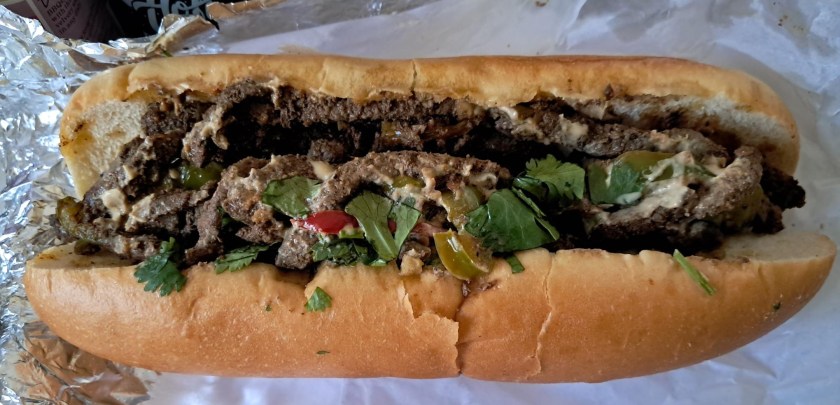
I am famous for my love of sandwiches, especially banh mi, the Vietnamese sub sandwich that is a product of French colonialism.  While the menu teased a ribeye French dip banh mi that sounded amazing, I was told it is no longer available.  I chose my standard, a house special pork banh mi, with a few different pork-based cold cuts, pickled carrot and daikon radish, and fresh cilantro and jalapeno peppers served cold on fresh, crusty French bread.  It is a surprisingly light and refreshing sandwich, compared to the heavy gut-bomb Italian hoagies and Jewish deli monoliths-on-rye I love so much.  I usually like a lot of mayonnaise (usually Kewpie brand) and pork liver pate on my banh mi, but I didn’t notice any on this particular sandwich.

Despite being a bit dry as a result, it was generously stuffed with the various meats and vegetables. 

About a month later, we were both hungry on a Friday night and climbing the walls after working from home (and eating at home) all week.  I took my wife to dinner at An Vi, since it is so close, and we knew we would get seated and served quickly.  My wife always loves summer rolls with peanut sauce at any Vietnamese restaurant, but we almost didn’t order these, since they were called “fresh rolls” (also known as goi cuon) on An Vi’s menu.  But when we saw them being walked out to another table, we asked, and she was glad we did.

She ordered a house special vermicelli platter that came with a lot of neat meats in addition to the rice vermicelli, but she didn’t love all of them.  Luckily, I did.

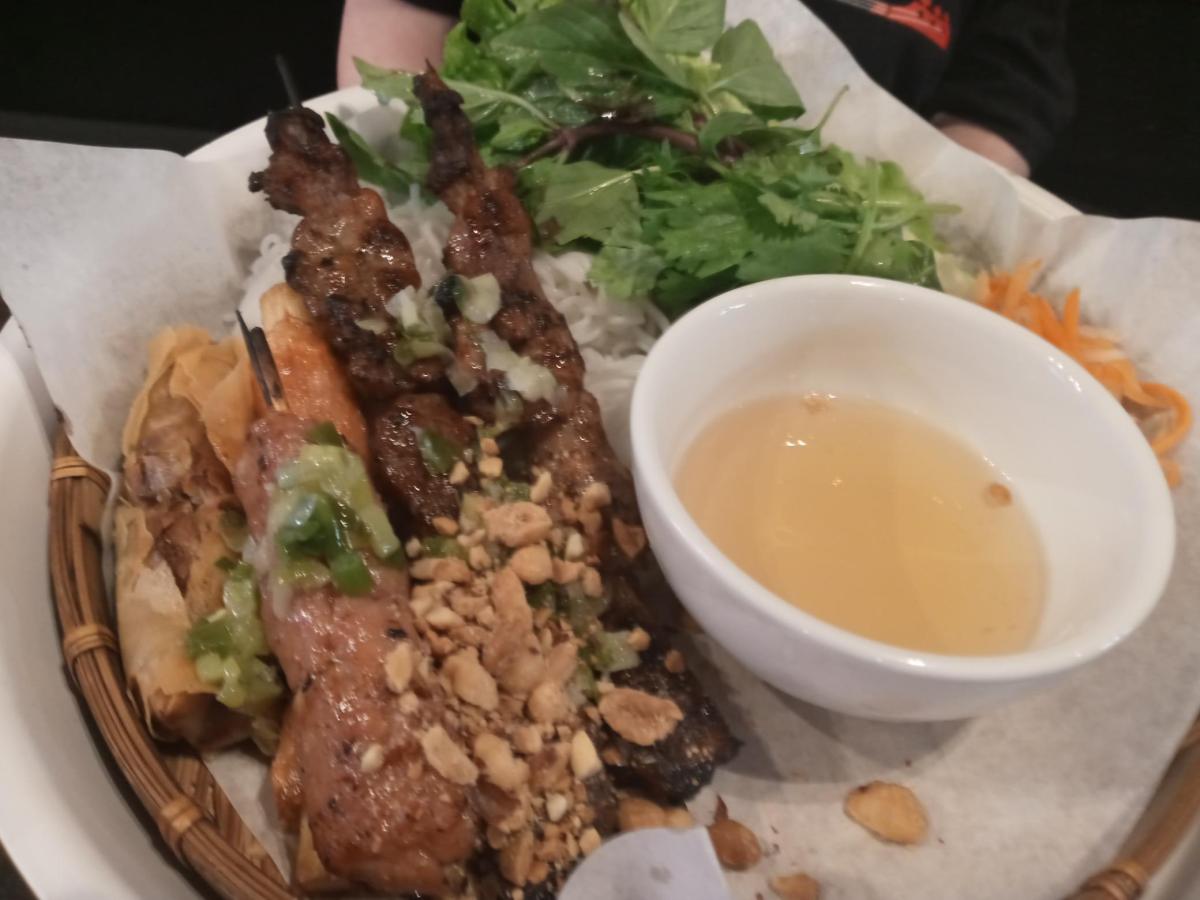
It included grilled beef, chicken, and pork sausage skewers, all with a slightly sweet, tangy, and funky flavor from being brushed with fish sauce.  There was also sugarcane shrimp, with ground shrimp brushed with fish sauce and reformed around a length of sugarcane before being grilled, and a fried spring roll stuffed with pork.  While she liked the vermicelli and all the crushed peanuts, I think the funky fish sauce flavor turned her off these grilled meats, so I happily devoured them.  I think I’ll order this exact dish for myself on our next visit to An Vi.

I had a feeling she might not love all those unique meats, so I ordered a fried catfish banh mi sandwich because I wanted to try it, but also because I know my wife always loves fried catfish and might end up preferring it.  I was right — it was good, and she loved it.  This banh mi almost reminded me more of a New Orleans-style po’ boy sandwich, the way it was dressed without the traditional butter, pate, or pickled vegetables.  The side of Cajun fries really hit the spot too.

Since Pho Huong Lan is my absolute, accept-no-substitutes favorite restaurant for pho, I tried the bun bo hue at An Vi instead of pho.  Labeled as Hue’s spicy beef soup on the menu, it was warm and refreshing, spicy without being overwhelmingly so.  I was so glad I had the foresight to wear an expendable shirt for all the inevitable splashing of the oily orange broth.It was good, but the bun bo hue at Pho Huong Lan still wins.

I ordered a side of French bread (the same bread they use for the banh mi) for dipping in the rich, spicy broth and for eating plain to cut the heat.

I hope An Vi makes it in Casselberry, where too many good restaurants that are considered “exotic” don’t last.  While our first impulse when we crave Vietnamese food is still to schlep down to Mills 50, I am glad An Vi is so close to us, and I’m sure we will be ordering plenty of takeout over the cooler months ahead.

Caravan Uzbek & Turkish Cuisine

Night and stars above that shine so brightThe mystery of their fading lightThat shines upon our Caravan
–“Caravan,” lyrics by Irving Mills, music by Duke Ellington and Juan Tizol

It took me 45 minutes to drive to Caravan Uzbek & Turkish Cuisine (https://caravanhalal.com/) on a late Saturday afternoon, arriving right at 5 PM to pick up takeout that I ordered online at 4:15.  The restaurant looked nice inside, but it was too early for dinner, so it wasn’t busy.  For this first visit, my wife didn’t feel like driving all the way to South Orlando with me, but I was more than happy to race back home with dinner in my heating bag.  I had been wanting to try Caravan ever since I first heard about it some time last year, since we both love Turkish food, and a lot of our old favorites had either closed or let us down.  And I’m obsessed with trying new cuisines, so I was even more excited to try Uzbek food for the first time.

Interestingly, the Central Asian nation of Uzbekistan isn’t even next door to Turkey.  While Turkey straddles Europe and Asia and borders the Black Sea to the north and the Mediterranean Sea to the south, Uzbekistan is further east and completely landlocked by five different countries: Kazakhstan, Kyrgyzstan, Tajikistan, Turkmenistan, and Afghanistan.  Since you were dying to know, Uzbek and Russian are the main languages spoken, and like Turkey, Islam is the majority religion, even though both countries are considered secular states.  Still, with majority Muslim populations in both Turkey and Uzbekistan, that explains why all the food at Caravan is halal.

We started out getting a mezze platter, the combination of cold dips that is so refreshing and rewarding at almost every other Turkish restaurant we have enjoyed in the past.  We got five different dips, all packaged conveniently in separate plastic containers with lids that snapped on tightly, leading to no spills or leaks on the way home, which is always nice.  Each dip was topped with a grilled olive, which was a nice touch.

Hummus, which you’ve surely had before, in one form or another:

Babaganush, the smoky eggplant dip that is my wife’s favorite:

Ezme, my personal favorite, which is like a spicy Turkish pico de gallo with  finely processed tomatoes, onions, bell peppers, hot red pepper paste, parsley, and lemon juice.  This was a terrific version of ezme, like some of the nicest, freshest salsa or pico ever.

Haydari, a creamy, yogurt-based dip with dill, mint, and chunks of walnut:

The website said we would also get spinach sautéed with onions as part of the mezze platter, but instead of that, we got cacik, another cool and creamy yogurt-based dip that is thinner, with cucumber, garlic, and mint.  I was curious about the spinach and onions, but the cacik was good, so no complaints from me.

Instead of puffy, fluffy lavas bread like we’ve had countless times from Bosphorous, Zeytin, and the late and lamented Beyti, we ordered a Turkish bread called ekmek.  We got two round pieces, dusted with light and black sesame seeds.  They were more like standard loaves of bread that hadn’t risen very much, as opposed to true flatbreads like lavas or pita.  I ripped off pieces of ekmek to dip with gusto, but my wife wasn’t super-into it.     

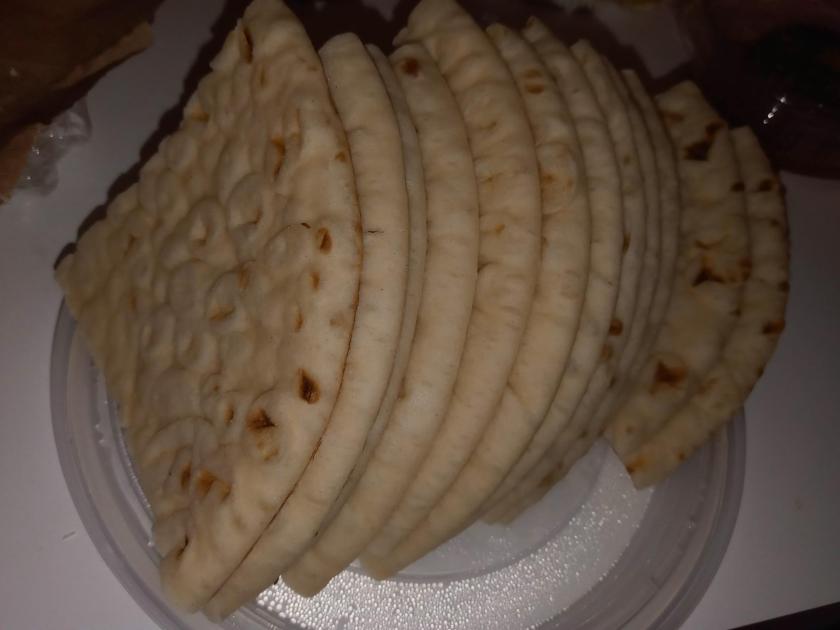
I also ordered Uzbek bread, but was a little disappointed that Caravan just gave us wedges of store-bought pita, like I have bought countless times at various grocery stores:

The entrees we ordered were all really good, starting with an order of semechki, or lamb ribs, from the shish kebob section of the menu.  I love lamb in all its forms, especially braised lamb shanks, but I realized I have never tried lamb ribs, despite being a gigantic fan of beef and pork ribs.  The grilled lamb ribs were pretty tiny, without a whole lot of meat on the small bones, but the meat that was there was very tender, with intense flavor from the grill.  There were six pieces in the order, and they were served on a soft flour tortilla that absorbed the delicious meat juices.

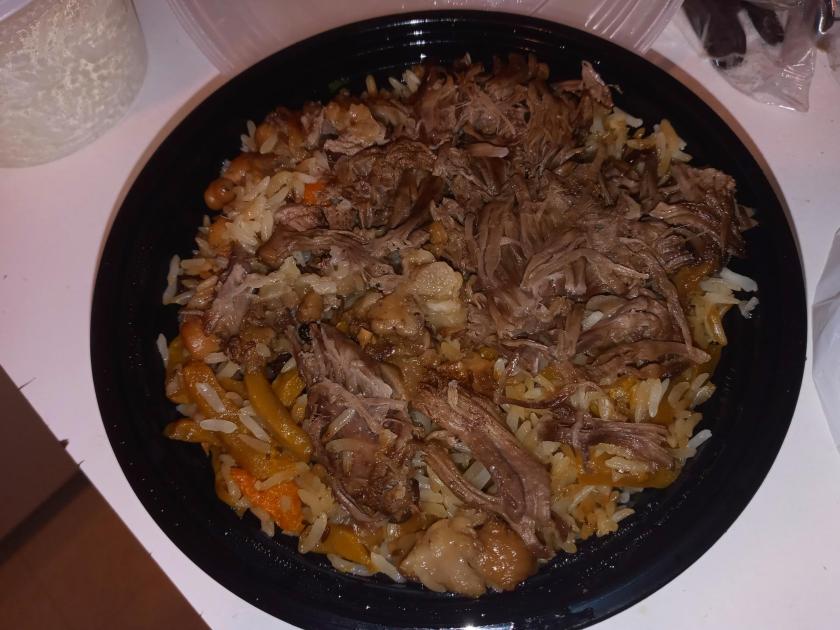
My wife chose the to’y osh, an Uzbek dish of Lazer rice seasoned with cumin, coriander, raisins, sautéed onions, and yellow carrots cooked until they were soft, tender, and sweet.  It was topped with shredded beef that must have been braised, because it was really tender too.  Like I said, this was our first time trying any Uzbek dishes, but it reminded me strongly of biryani, a popular Indian dish of rice mixed with meat and vegetables that may have Persian origins.  The to’y osh was very subtly seasoned, lacking the strong flavors of biryani rice, but it was a heart, savory dish with a nice combination of textures.

Even though we liked everything except the store-bought pita (which I’m still going to salvage by baking it in the oven on the convection setting to crisp it up), the biggest hit for both of us was the fried laghman, the dish I’ve seen almost everyone order in the handful of Caravan reviews I’ve read so far.  This was a dish of hand-pulled wheat noodles, and since I am a noodle nerd, the name laghman comes from the Chinese lamian (for hand-pulled noodles, like you would get at Mr. J Hand-Pulled Noodle in Ocoee), which also led to both lo mein and Japanese ramen.  These long, chewy, thick noodles were stir-fried in a wok with fresh vegetables and tender strips of beef with a soy-based sauce — almost like lo mein.  When I looked it up, I wasn’t far off — laghman comes from the Uyghur people, an ethnic, primarily Muslim minority who live in China (where they are horribly persecuted) and have other communities in Uzbekistan and the other Central Asian countries that surround it.  This was also our first experience trying any Uyghur cuisine.

The laghman noodles looked like they would be spicy, and I was hoping they would be spicy, but much to my wife’s relief, they weren’t.  The only spicy things we ended up with were the ezme and a chunky hot sauce that came with the lamb ribs.  And I was all ready to use the cool, creamy, refreshing haydari and cacik to put out fires in my mouth, too!

This was an interesting first visit to Caravan, one that inspired me to do some geographic research before writing this review.  I had been wanting to go there with a group for quite some time, so we could order a bunch of dishes and share everything, but that hardly ever happens anymore.  Bringing home takeout to share with my ever-patient wife worked just as well, and we ended up with plenty of leftovers.  I have no idea how often I’ll make it back to Caravan, just because it is so far from home, but I feel like we made some great choices for our first trip.

Kiko Japanese Cuisine

Kiko Japanese Cuisine (https://www.winterspringskiko.com/) is an unassuming little Japanese restaurant next door to our friendly neighborhood Publix in the Willa Springs Village shopping center, on the corner of Red Bug Lake Road and Tuskawilla Road in Winter Springs.  So many similar shopping plazas have little sushi restaurants like this.  Since I moved to Orlando 20 years ago, there have been two that came and went in this exact location: Nagoya, and more recently, Kabuto Sushi & Grill, which I actually liked a lot, but it closed near the end of 2022.  The locals may appreciate these restaurants, but they weren’t considered sushi destinations.  Nobody was driving to our neighborhood from the cooler, hipper ends of Orlando.  Nobody drives to Winter Springs for anything if they can help it.

But they’re missing out, let me tell you.  My wife and I were blown away by how great Kiko was after our first visit to the restaurant, and we liked it just as much after bringing home takeout even more recently.  This is a place that seems to have a devoted local following, but it should be a lot more popular and beloved than it already is.

We definitely overordered on our first visit, which included this insane sushi sashimi combo “for one,” in addition to all these other beautiful rolls.  We didn’t expect the combo for one to come on this attention-catching wooden boat, or to be as pretty as it was.  I’ve eaten a lot of mid sushi around this city, but every piece of sashimi and every sliced roll at Kiko was crafted with love, care, attention to detail, and the freshest possible ingredients.  The combo comes with ten pieces of sashimi, four pieces of sushi, and one “crazy” California roll. 

My wife is bigger on sashimi than I am.  She worries about carbs, and I never do, even though I should.  Here are the ten pieces of sashimi she got in the combo, serve on a bed of finely crushed ice concealing a pretty turquoise LED light.  Aside from salmon at 12:00 and tuna at 3:00, I’m not sure what the other two kinds of fish were.

Here were the four gorgeous pieces of nigiri sushi that came with her combo, delicate slices of fresh fish served over rice.  The top two are salmon and tuna, obviously, and the bottom one was topped with wonderful ikura, salty salmon roe that pop in your mouth.

This was the “crazy” California roll, topped with spicy surimi krab, in addition to the krab, avocado, and slivered cucumber inside.  I’m a sucker for surimi and anything spicy, so I enjoyed this, even though I never order California rolls.  

Since we figured that combo “for one” would be just for my wife, I ordered some rolls for myself, keeping in mind things she might like too.  This was the mango tango roll, with tempura fried shrimp, cream cheese, and cucumber inside, topped with paper-thin sliced mango, mango sauce, and eel sauce.  I know, it isn’t authentically Japanese at all, but it sure was delicious.  The tempura shrimp was fried to perfection, and the sweet-tart mango, warm and crispy shrimp, and cool, creamy, refreshing cream cheese fit perfectly together. 

This was a double-spicy roll, with spicy tuna and spicy salmon, deep-fried and topped with eel sauce and spicy mayo.  I love crunchy stuff in my rolls, but I didn’t pay close enough attention when ordering to realize the entire roll would be deep-fried.  It was tasty, but I feel like that throws off the delicate texture of the raw fish, and then it isn’t even raw anymore.  And oh baby, I like it raw.

On the plate below, this is a smoked salmon roll on the left, with smoked salmon, cream cheese, and cucumber, a favorite of your cream cheese and lox-loving Jewish author.  The one in the middle is the Sunset Blvd roll, named for one of Los Angeles’ most infamous streets (and Billy Wilder’s brilliant 1950 film noir that is my dude David Lynch’s favorite movie).  It contains spicy yellowtail, salmon, and crunchy tempura flakes and is topped with spicy tuna, avocado, plum sauce, and tobiko (flying fish roe, which is the rich red color).On the right is the glamorous Hollywood roll, with tempura soft shell crab and mango inside, topped with a layer of spicy tuna, avocado, and scallions, then finished off with masago (the orange smelt roe), eel sauce, and spicy mayo.  Crunchy, spicy, creamy — this roll had everything.

The Sunset Boulevard and Hollywood rolls were my favorites, but everything was awesome, even the deep-fried double-spicy roll.  That was the only one I wouldn’t order again, but we were both blown away by how amazing everything was.  We didn’t set out to overorder or indulge like this, but we also had no idea Kiko would be this good.  A random weekend lunch turned out to be a huge treat and a feast for all five senses, and we ended up with plenty of leftovers for later.

I returned a few weeks later to bring home some takeout.  We didn’t go as buck wild this time, but we still had fun.  This time my wife ordered the smaller sashimi dish, which included tuna, salmon, tako (octopus), tamago (egg, essentially like firm slices of an omelet), and a fish with firm white flesh that I didn’t try and she couldn’t readily identify.

I ordeered myself an appetizer called the spicy tuna twister, not knowing what it included or involved, but figuring I couldn’t go wrong.  When I got home, I was surprised to see two pretty little clusters of spicy tuna in almost a paste-like form, surrounded by beautiful spirals of thin-sliced avocado.  But what were they surrounded with?  These were tempura-fried onion petals, almost like pieces of a Bloomin’ Onion, only not as heavily seasoned, and a hell of a lot less greasy.  Long-time readers, the stalwart Saboscrivnerinos, know I’m an onion ring aficionado, but I never expected this!  They were fried to perfection (I know, I know, but they were!), and paired perfectly with the ramekin of spicy mayo for dipping.  These aren’t onion rings if you stick to the literal definition, but since they were a pleasant surprise of breaded, fried onions, I still give them one of my Ring the Alarm! shout-outs.   

This time, I tried the salmon skin roll (on the left), because salmon skin is so savory and crispy and awesome, and the spicy yellowtail roll (on the right), because I don’t eat enough yellowtail (also known as hamachi or Japanese amberjack), but I always love it whenever I do.  These rolls were slightly less ornate and ostentatious than the ones I got on my first trip to Kiko, but I liked them just as much, and I was able to focus on their core ingredients more.

We also got that mango tango roll again, because YOU KNOW WE HAD TO DO IT TO ‘EM!  This time, enjoying our Kiko feast at home, it was just as inauthentic, but just as good.

I am thrilled that Kiko Japanese Cuisine opened in 2023, so close to our home.  I’m sure pretty much anyone reading this who likes sushi already has their own favorite sushi restaurant — possibly even one for “everyday” sushi and a more upscale locale for a splurge meal.  Well, I hope I have convinced some people to give Kiko a try.  It is a great place for an “everyday” sushi restaurant, and easily good enough (and affordable enough compared to some of Orlando’s Michelin-affiliated darlings) that you can splurge there too.  I’m going to keep returning, and I hope to run into some readers there as I become a regular.


The Moderne

I guess I haven’t published a new review in about a month, since work has been keeping me so busy.  Working from home, I also haven’t been able to go out to eat quite as often, which means I’m cooking more and saving money (yet not losing any weight).  But this review is long overdue, from a date night about a month ago at one of the prettiest, swankiest, sexiest restaurant/bar/lounges in Orlando, The Moderne (https://www.themodernebar.com/) in the foodie dream district of Mills 50.  I’m sure a lot of my regular readers have already been here, but this was our first visit to The Moderne.  I had been wanting to try it for a while, since it features an eclectic menu of small plates — mostly pan-Asian dishes, but some include other international influences, ranging from Italian to Peruvian.

This was my wife’s beautiful mojito mocktail, served with a dehydrated lime slice as a garnish.  I tried a sip, and it was delicious.  The Moderne features an enticing cocktail menu, but we were both happy to see a few mocktail options for non-drinkers like us.  I guess you could call this one a “no”-jito.   My wife reminded me to mention that she first asked for a simple Shirley Temple, but the gorgeous, well-stocked bar did not have any grenadine syrup, something we both thought was odd at the time.

Our order of duck wontons came out first.  These hand-folded wonton wrappers were stuffed with shredded duck seasoned with Chinese five-spice powder and fried until crispy.  They were served with chili oil peanut sauce.  We both wished they had been served with more duck inside, even though they tasted good and were surprisingly not that oily.

This beautiful dish was the tuna kobachi, with spicy cubed tuna, avocado, Japanese-style marinated cucumbers, scallion, red tobiko, micro cilantro, and a dish of ponzu sauce for dippin’ and dunkin’.  I loved it so much.  I could eat this every day of my life and never get tired of it, although I’d hate to think of what my mercury levels would be.  It was my favorite dish that we tried, a perfect 10/10. 

Next came our chashu quesadillas, which were plated beautifully.  Quesadillas are the easiest thing to make at home, but my homemade ones never feature chashu pork, (like the kind of pork you get in a bowl of “real” (not instant) ramen), shredded cheddar and mozzarella cheeses, Japanese Kewpie mayo, chili amarillo sauce, and pickled onions.  Well, mine would have the cheeses and Barbie Dream House-pink pickled onions, but that’s where the similarities begin and end.

This was another hit with both of us: yellowtail (hamachi) ceviche, with cubes of cool, refreshing yellowtail in mango wasabi lime sauce, diced onion, serrano, red tobiko, micro cilantro, all encased in perfectly thin, crispy, delicate spheres of pani puri, the Indian street food classic (see my Bombay Street Kitchen review for authentic pani puri).  It was a gorgeous fusion experience that dazzled all of our senses.

My wife chose these miso cream noodles, which sounded like something she would love.  The dish featured thin pasta (like angel hair or vermicelli), that chashu pork again, mushrooms, miso, fried garlic, toasted bread crumbs, parmesan cheese, and scallions.  She admitted not really being into it and said it was both very rich and on the bland side — an interesting dichotomy, kind of like fettuccine alfredo from the Olive Garden (although this definitely had more flavor than that)!  She picked at it and brought most of it home, where I happily finished it after picking the mushrooms out.  I’m a pretty tolerant guy, but I have this unfortunate intolerance to mushrooms, and chefs freakin’ love throwing them into things.

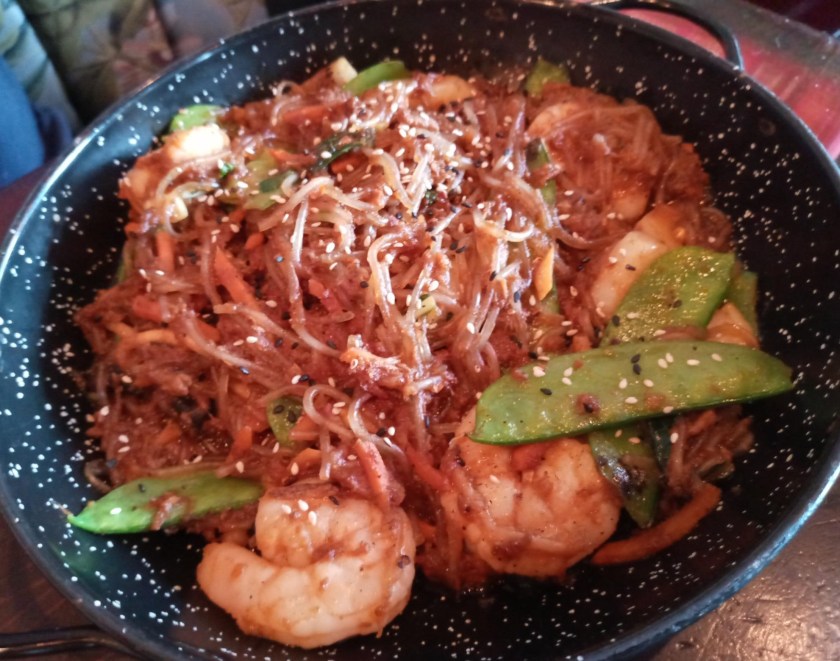
I chose a different noodle dish for myself that seemed like another fragrant fusion feast: seafood pappardelle, with pappardelle pasta (wide, flat noodles that are wider than fettuccine), shrimp, tamarind Nikkei sauce (Nikkei being a Peruvian-Japanese fusion due to all the Japanese immigrants in Peru), carrots, red peppers, onions, peanuts, and a cilantro-heavy “Asian herb salad.”  It was okay.  The sauce was a little sweet and tangy, not as spicy as I had hoped, and very thin.  I thought it was odd that the dish was called “seafood pappardelle” when the only seafood in it was shrimp.  This was a last-minute choice when the server was already taking our orders, but I think I would have enjoyed one of the other noodle dishes more.  Oh well, you live and you learn!

So that was our first experience at The Moderne.  I liked it and would go back, but my wife admitted it was not one of her favorite restaurants.  Oh well, people have different tastes and like different things — that is no surprise.  My favorites were the two dishes with raw fish, which is usually one of my favorite things to eat.  (This also explains why The Moderne’s neighbor a few doors down, Poke Hana, remains one of my favorite restaurants in all of Orlando all these years later.)  I might get those again, or other raw fish options, and I would definitely try a different noodle dish on a second visit.  Plus, after dinner at The Moderne, you can go next door and have some of Orlando’s finest ice cream at Sampaguita, which is exactly what we did on this date night!