Tuun (at Sea Thai)

Tuun (https://www.instagram.com/tuunorlando/) is essentially a restaurant operating within a restaurant, at Sea Thai (https://seathaiorlando.com/), located at 3812 East Colonial Drive, Orlando, FL 32803.  Sea Thai has been in that location near the Fashion Square Mall and Orlando’s Milk District neighborhood since 2007), so it was still new in the early days of my old job, when I had lunch there a few times.  I don’t know why I never worked it into my regular rotation, because it was always solid.

But I had been dying to get back over there to try the special menu offered at Tuun, coming out of the same kitchen as all of Sea Thai’s regular dishes.  It’s the brainchild of Chef Jack Jone Tawa Chavitranurak, the brother of the owner of Sea Thai.  He started Tuun in 2020, so it took far too many years to finally try it, but better later than never.

We got together with a super-cool couple for dinner (literally the coolest people we know), and it was the first time we’ve ever had a chance to sit and eat and chat, all four of us.  You see, I would run into them on the rare times I go anywhere cool or do anything fun in Orlando, first meeting them at a Kyle Kinane show at The Abbey in Thornton Park, then at Neko Case at the Beacham in downtown Orlando, then at J.G. Thirlwell at the Timucua White House, and I saw him flying solo at a Surfragettes show at Will’s Pub and a couple of comic conventions.  We’ve also had lunch at Black Bean Deli and Isan Zaap Thai Cafe before.  I’d always come home raving about how cool they are, and my wife finally met this mythical couple when we all saw Fred Armisen perform at The Abbey last year.  We’ve been wanting to hang out with them in a place we could talk and hear each other ever since, and we finally made it happen at Sea Thai!

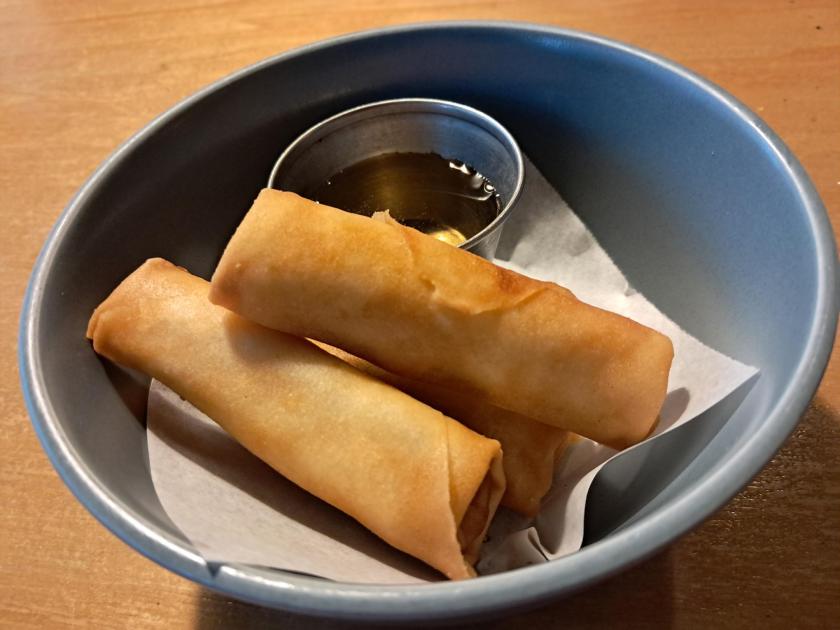
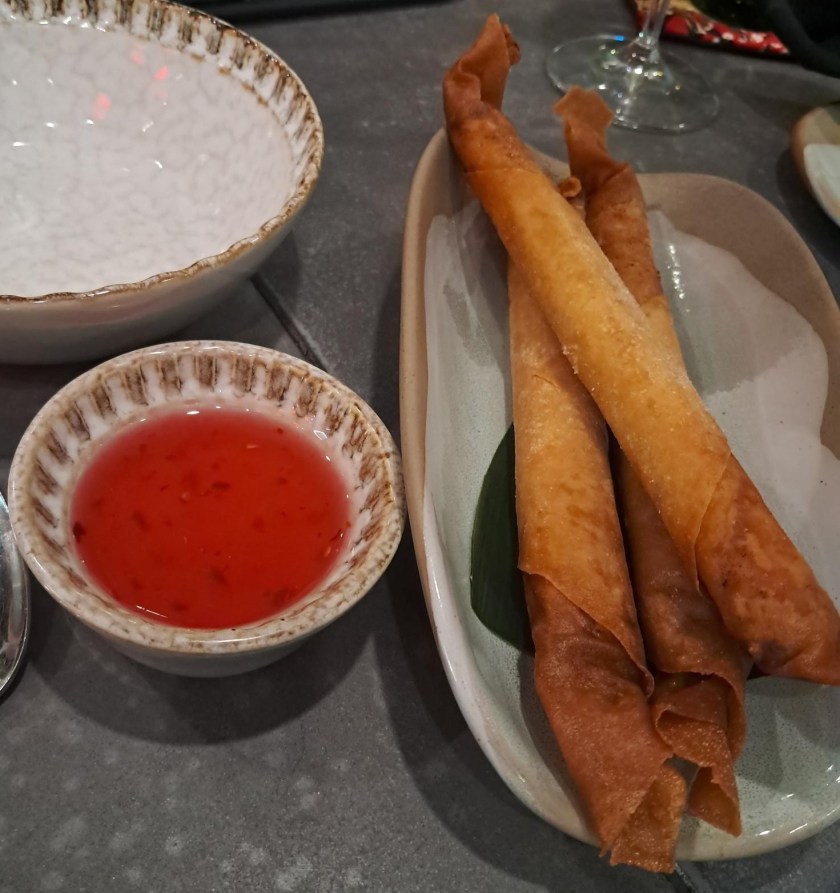
Our friends ordered these spring rolls off the regular Sea Thai menu to start with.  They are filled with glass noodles and mixed vegetables, fried in their tightly rolled wrappers until crispy, and served with plum sauce for dipping.

And here is a shot of the Tuun menu, since it isn’t on the Sea Thai website, and there isn’t a Tuun website:

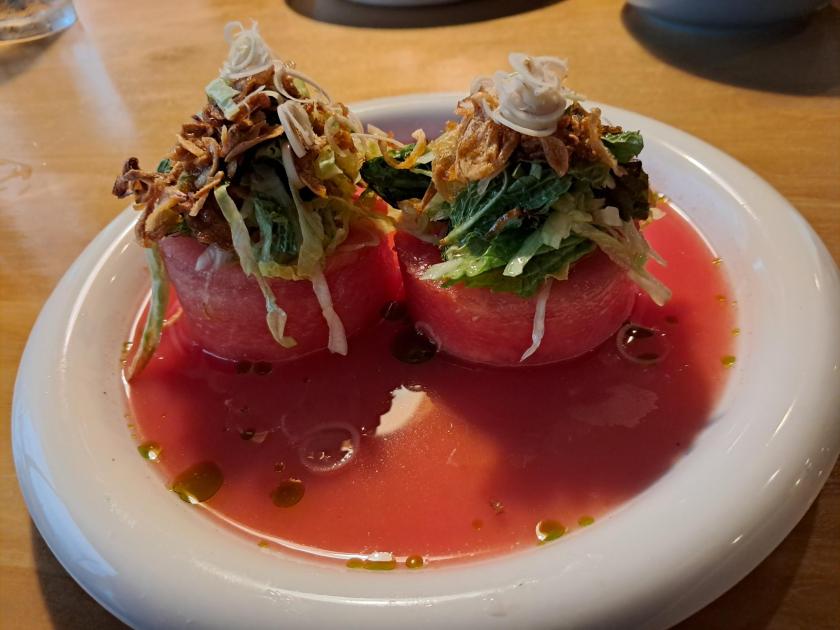
This is the watermelon salad, two round watermelon slices topped with lemongrass, kaffir lime leaves, fried shallots, and chili watermelon dressing.  Both couples ordered a watermelon salad to share, and I think everyone liked it a lot.  My wife enjoyed it even more than I.

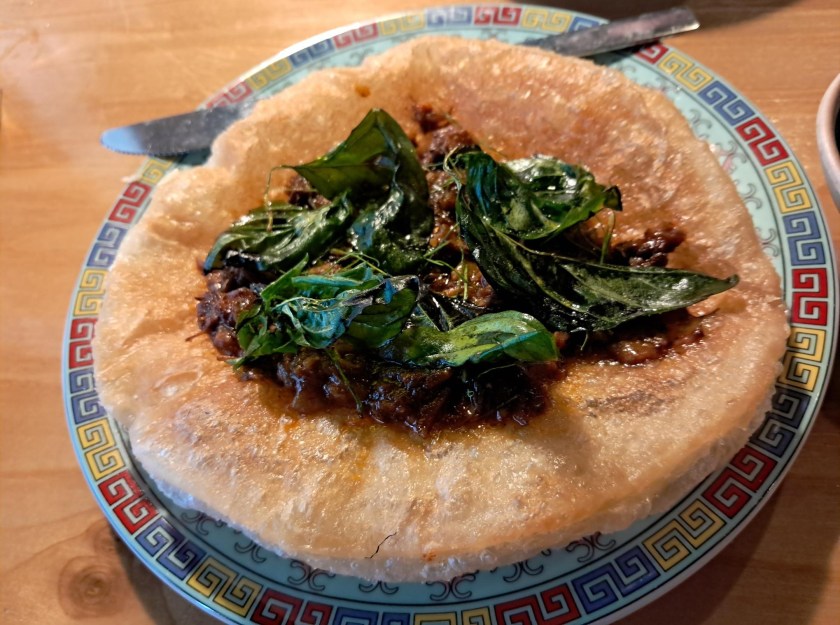
This was the roti, a crispy, crackly fried savory pastry topped with boneless beef short rib curry, chili oil, kaffir lime, and fried shallots.  It felt so much more delicate than the flaky, buttery roti canai that everyone always orders at Hawkers Asian Street Fare.  I’m not convinced the roti at Hawkers isn’t a frozen version, since I’ve bought very similar ones at Asian and Indian markets around Orlando.  But there is nothing like this roti anywhere, I promise you that!My wife has really been expanding her palate since some surviving some medical issues earlier this summer, and she loves trying new foods more than ever before, which is a joy to watch.  She was undaunted by the short rib curry, something she never would have messed with before, but it wasn’t spicy, just flavorful.

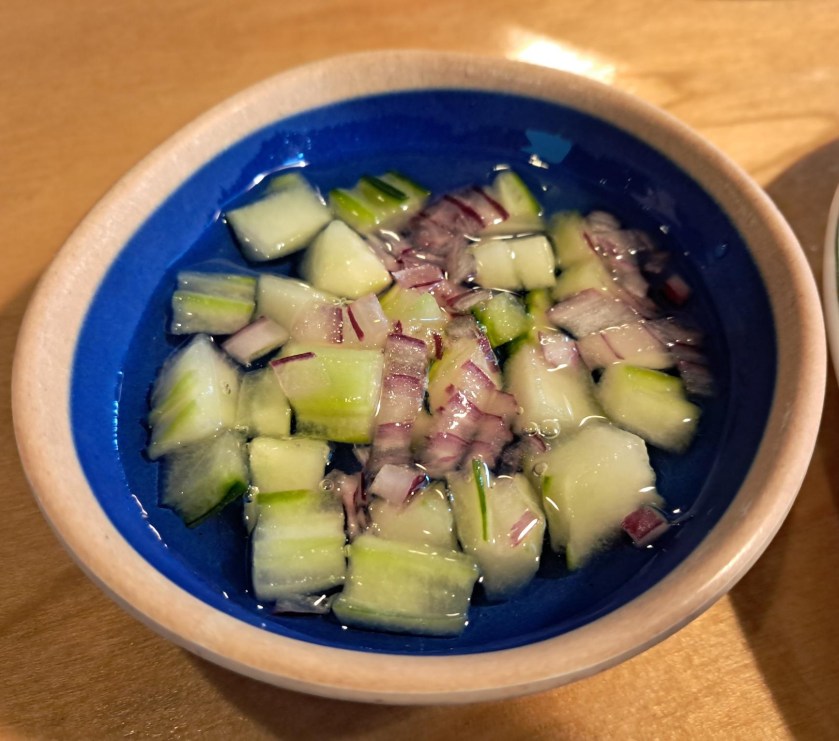
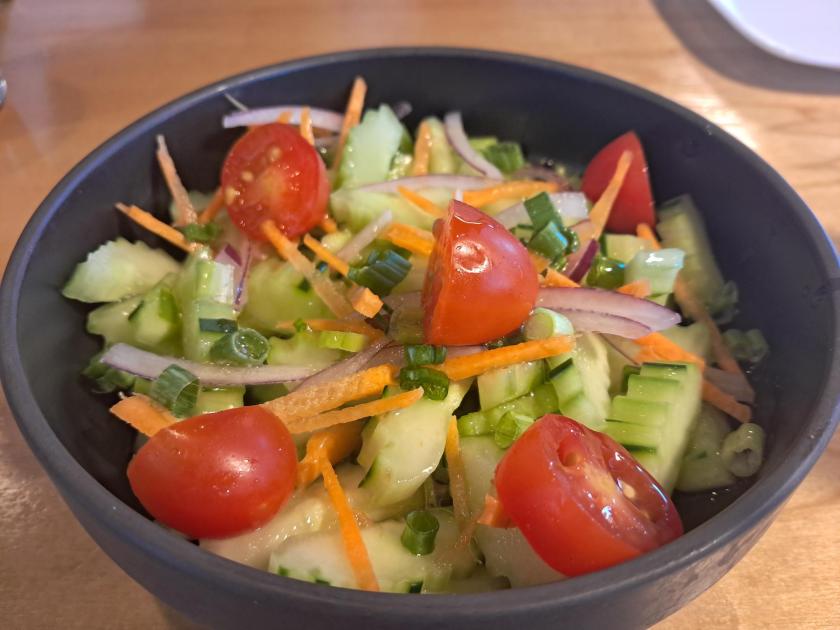
The roti was served with cool, crisp cucumbers and some thin-sliced red onions pickled in sweet vinegar.  As a fan of so many things pickled and vinegary, I just loved this.  It worked well for cutting the salty, fatty, spicy qualities of the other dishes. 

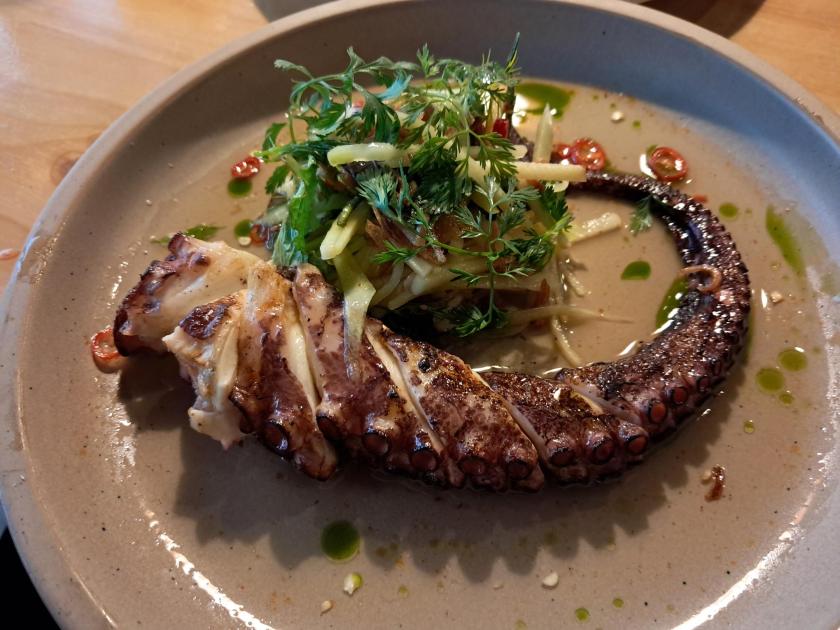
My wife is always an octopus lover, and she chose this beautiful, lightly grilled octopus tentacle, served with mango salad, fried shallots, cashews, and garlic lime dressing. 

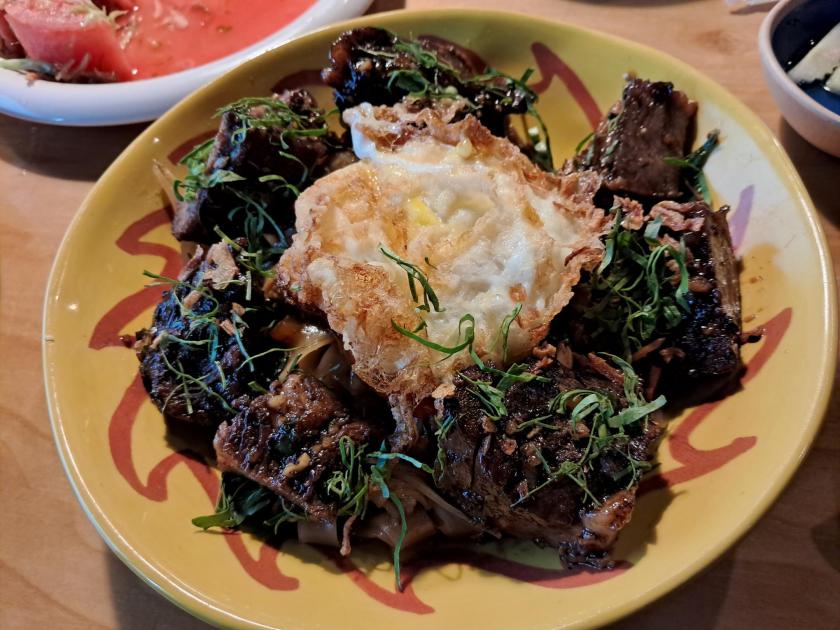
I ordered the Tuun noodles, assuming we would split them, but she didn’t really want any.  They were very similar to drunken noodles, also known as pad kee mao or pad kee mow, one of my all-time favorite Thai dishes, and these were served with spicy braised beef, bell pepper, basil, and a big fried egg in the middle.  They come with mushrooms too, but I asked our server to hold the mushrooms.  I’m sorry I didn’t take another photo to include a view of the flat, wide noodles, but you can kinda-sorta make them out around 6:00.  Funny thing, my wife and our friends thought I ordered “tuna noodles” and were surprised when I mentioned beef.  I remember eating tuna noodle casserole as a kid, but these Tuun noodles are a world apart from that.  Drunken noodle lovers (by which I mean lovers of drunken noodles), don’t sleep on these.

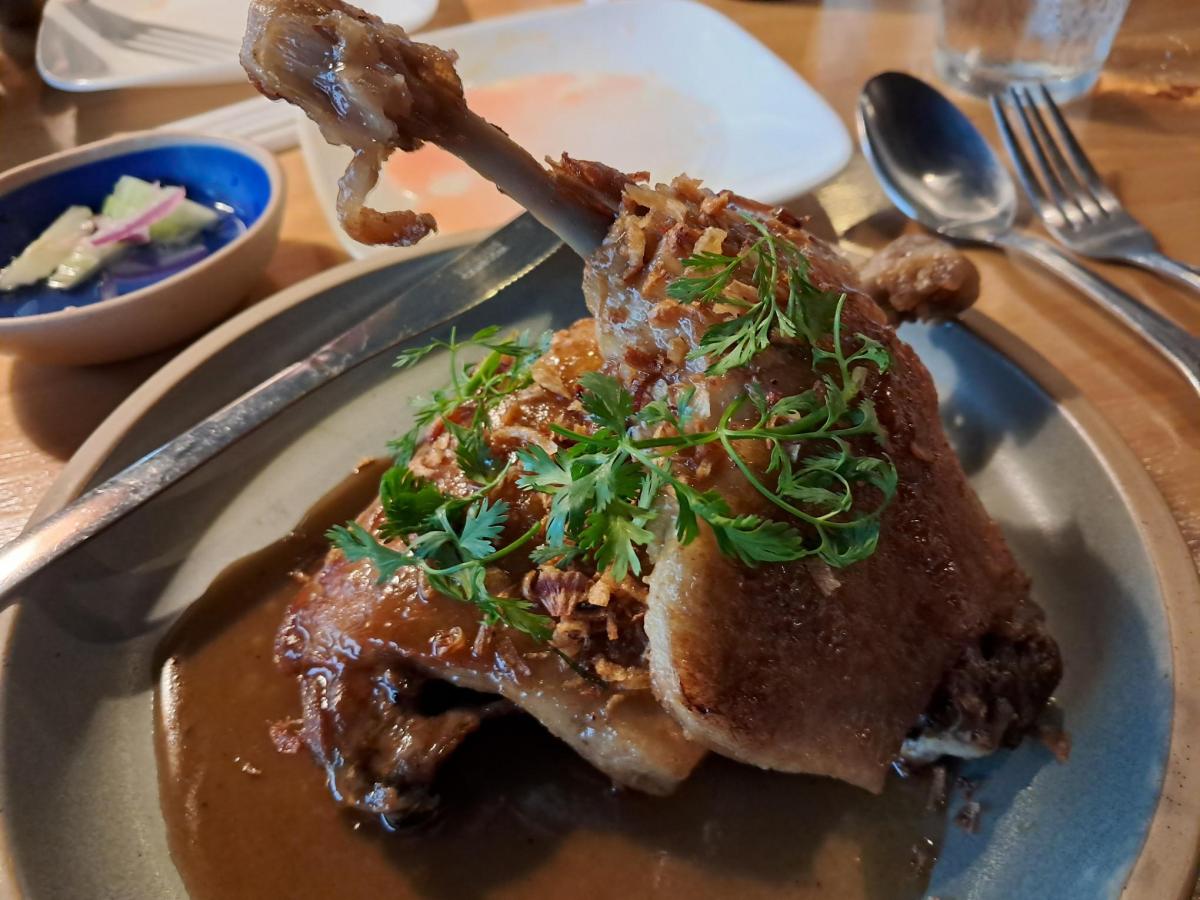
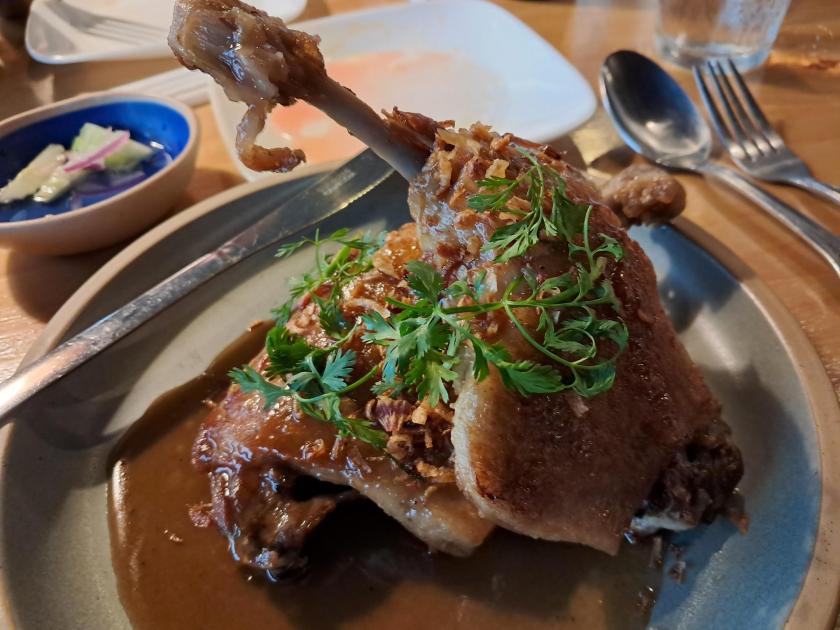
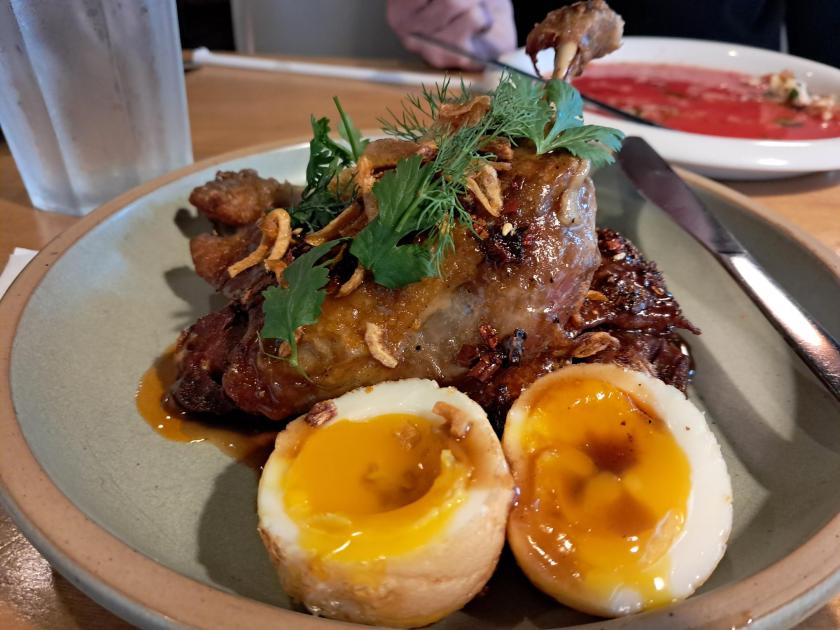
And now, seared duck confit, a dish my wife and I both loved.  She’s a superfan of it now, served with more of those fried shallots and tangy-sweet tamarind sauce.  I now realize it was supposed to come with fried eggs, but they left them out.  We didn’t even notice at the time, but the duck legs were so rich and decadent, cooked to perfection, that we were distracted. 

A few weeks later, we had to return to Sea Thai ourselves to go through that Tuun menu again and revisit some of those killer dishes.  My wife started with a creamy, smoky Thai iced tea, and this time I remembered to get a picture of it.

This was very much a “greatest hits” meal, because we couldn’t stop thinking about it.  I think my photo of the watermelon salad came out better this time.  But she loved it so much, I let her have it all.

I think my roti photi (sorry, photo) came out better this time as well.

And the sweet, pickled cucumbers were even more delicious and refreshing this time.

She got the duck confit again, and this time they included the egg, which were jammy in the center and lightly fried. 

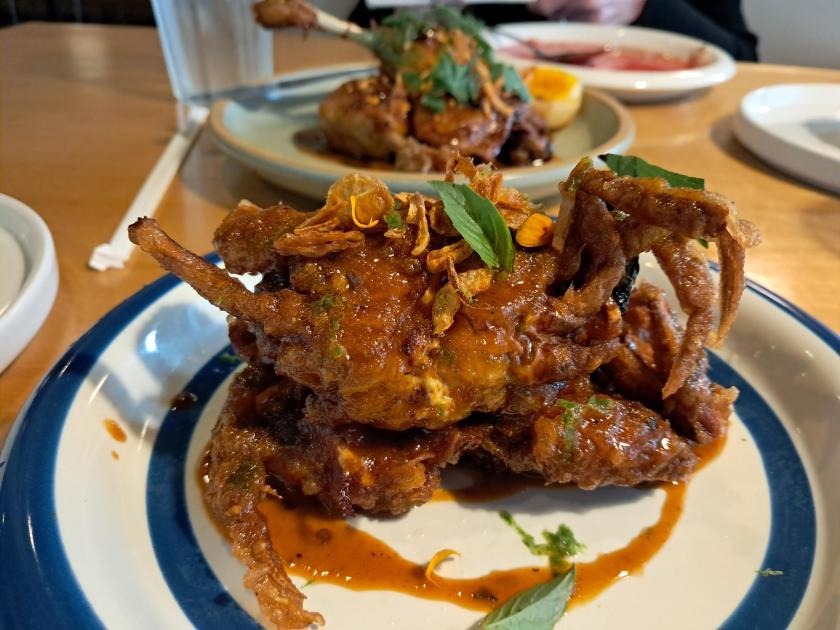
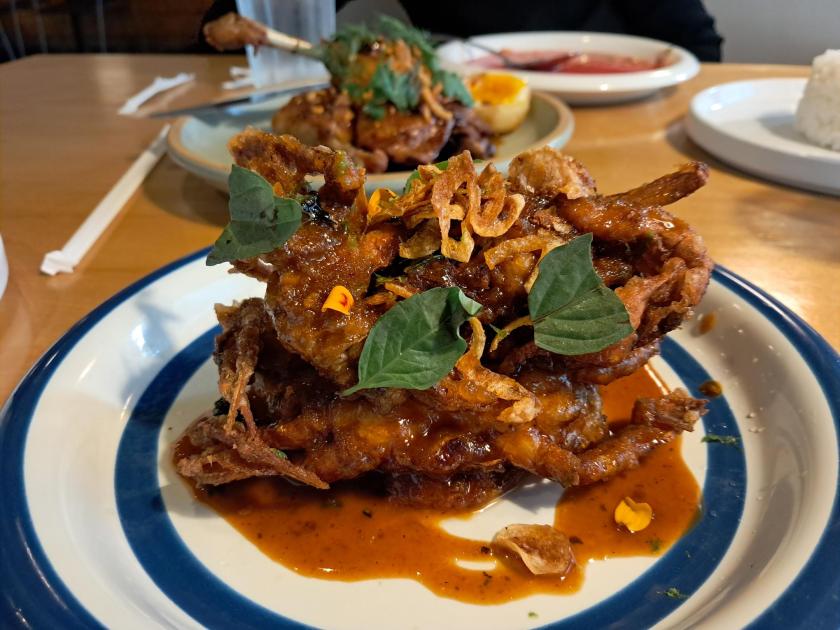
Me being me, I had to switch it up this time, so I tried Tuun’s stir-fried soft shell crab, with tom yum powder, kaffir lime, fried garlic, and fried shallots.  I always like crispy soft shell crab, especially at Thai restaurants, and I was not disappointed.  The sauce had a bit of tangy sweetness, maybe also from tamarind (I think the menu was the same on this second visit, but it didn’t mention it), and I swear I tasted ginger as well.   

Here’s another angle on the soft shell crab dish:

We will definitely keep returning to Sea Thai for those Tuun specialties, and next time, I might actually order some things off the regular menu.  I noticed they have khao soi noodles, which I fell in love with at Thailicious in Longwood last year.  But I tell ya, if you go to Sea Thai on a Friday, Saturday, Sunday, or Monday evening, you are doing yourself a disservice if you don’t sample some of the dishes off the special Tuun menu.  We are huge fans now, and I can’t imagine anyone could sample these gorgeous plates and not be blown away by their presentation and perfection.

Kaya

Kaya (https://www.kayaorlando.com/) is an upscale Filipino restaurant in Mills 50, Orlando’s best foodie neighborhood.  It is owned and operated by Chef Lordfer Lalicon and General Manager Jamilyn Salonga Bailey, who first made names for themselves with Kappo in Orlando’s East End Market food hall, then launched their award-winning omakase sushi restaurant Kadence.  I have not been lucky enough to go to either yet, but I’ve been aware of them for the longest time, and they seem like incredibly nice, hard-working, talented people who deserve all their accolades and local love.  Kaya first opened in 2022, and while I’ve been wanting to try it ever since, I finally made it there for the first time a few weeks ago.  Better late than never, because I had an unforgettable experience that I’ve been replaying in my head ever since.

I was actually meeting a friend for dinner on a rare weeknight I was off work: someone I also consider a mentor and a role model, Amy Drew Thompson, the food writer for the Orlando Sentinel.  This was my second time meeting Amy Drew in real life, and she is a delightful person who is so nice, so knowledgeable, and an amazing writer.  Kaya is one of her favorite local restaurants, and I was thrilled she was willing and able to meet me there.  Of course everyone at Kaya knew her, because she does so much for Orlando’s local food scene.  Jami came by to check on us a few times, and even Chef Lalicon (who everyone calls “Chef Lo”) popped out of the kitchen.  We sat at the bar, and the two bartenders, Daniel and a nice lady whose name I’m blanking on, took wonderful care of us.

They started us out with a mocktail called Hiraya, with white peony and marigold tea, pineapple juice, and lime juice, sprinkled with Sichuan peppercorns.  It was so refreshing!  It started with the unmistakable sweet taste of pineapple, but that quickly faded to something more botanical.  I’ve never tasted anything like those tea flavors, but it tasted like my wife’s shampoo smells (in a good way). 
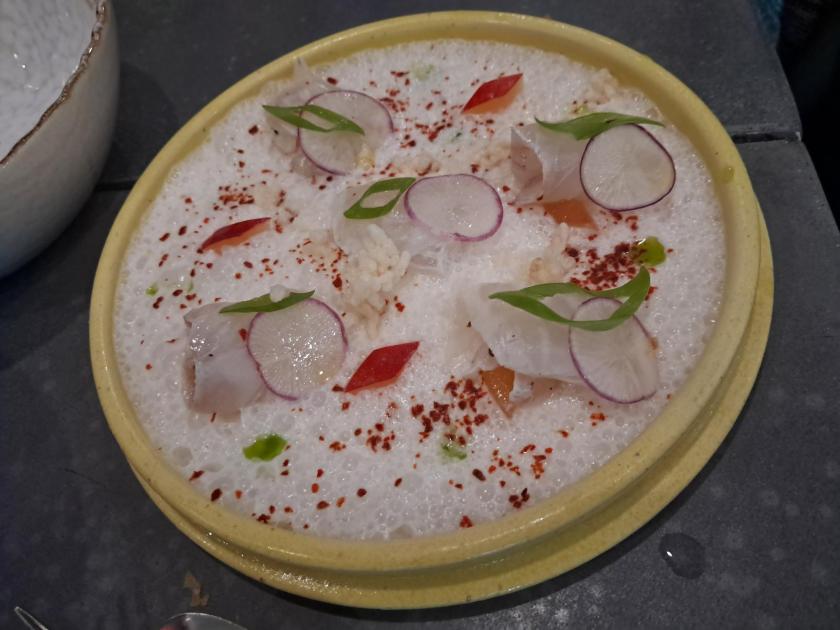
Kinilaw is a raw fish-based dish somewhat reminiscent of ceviche in Latin American countries, except where ceviche uses citrus juices to “cook” the fish, kinilaw utilizes vinegar for a similar purpose.  This gorgeous kinilaw incorporated madai, the Japanese word for red sea bream, a whole new fish I had never tasted before (although some of my research tells me the term is used interchangeably with red snapper, usually when it’s served as sushi).  Delicate raw slices of the madai were served with peaches, paper-thin slices of crunchy radish, coconut, and chili flakes, all arranged artfully on separate little crispy islands of puffed rice.  You can see five little radish slices, each one topping a piece of the madai, and there’s puffed rice under each one.  You would scoop up the whole little stack, and it is a perfect bite of food with so many textures and flavors.  Chef Lo used pinakurat, which is a spiced coconut vinegar (made from coconut sap).  I’ve bought the Suka Pinakurat brand before, at Orlando’s many Asian markets, since I love experimenting with different vinegars almost as much as I love mustards, but I never dreamed anyone could use it to create a dish on this level of complexity and beauty. 
This beautiful dish was Bicol Express mussels, served in a broth of coconut cream, Thai chilis, shallot, garlic, and bagoong, served with thick slices of pandesal toast for dipping in the rich broth.  I love mussels in any form, and this dish was the most unique way I’ve ever eaten them.  Bicol Express is a Filipino dish traditionally made with cubes of pork, rather than one of the best bivalves.
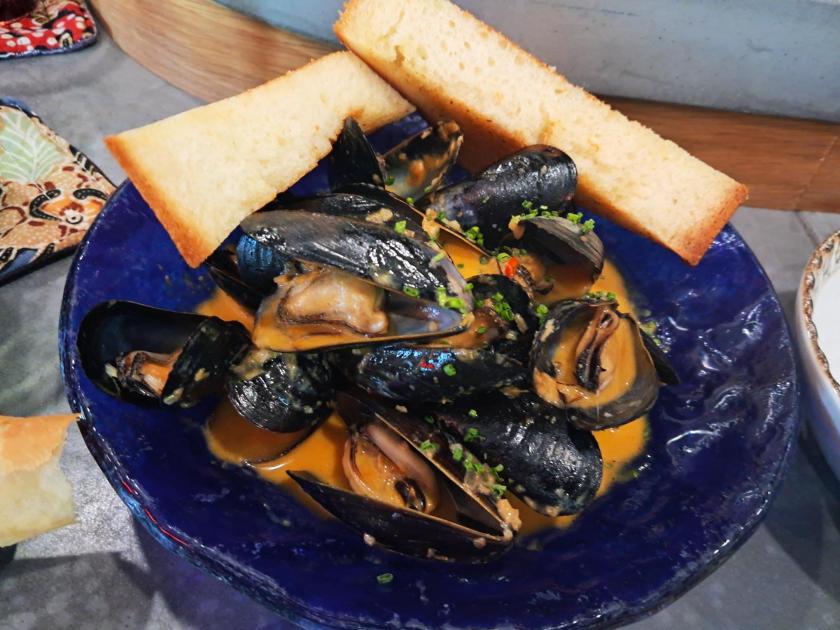
Bagoong, by the way, is a Filipino condiment made of fermented shrimp or krill cured in salt, which makes a  salty, savory, umami flavor.  It sounds intense and funky, but I didn’t notice anything intense or funky standing out to distract from the mussels or their creamy, spicy, coconutty broth.  But I like intense and funky!  (I’ve been told that I AM intense and funky!)

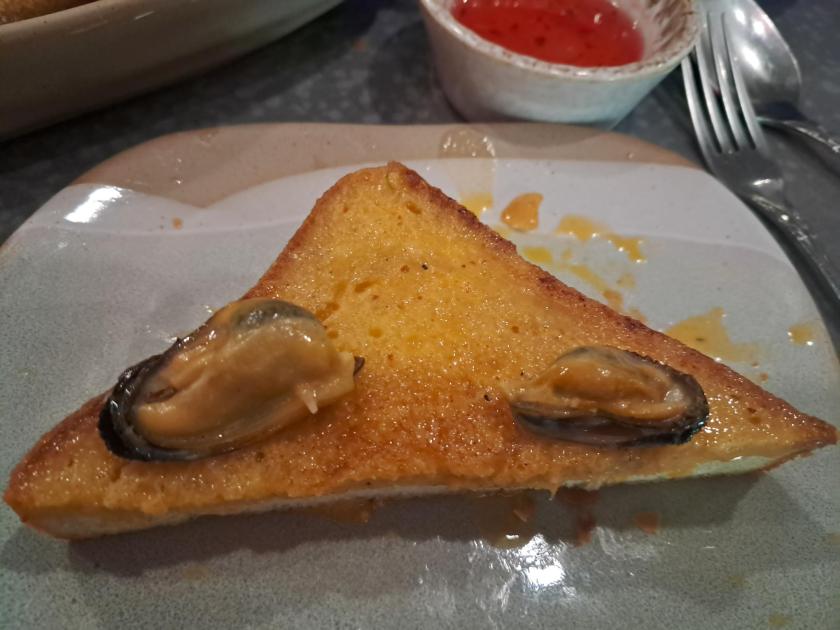
I wrote about pandesal, literally “bread of salt,” when I reviewed the Filipino-American fusion bakery-cafe The Baker’s Son in Kissimmee, this past December.  It is some of the most delicious bread I’ve ever tasted, similar to buttery brioche, Japanese milk bread, and French pain de mie, sharing their subtle sweetness.   As I’ve gotten older, and especially as I’ve cut way back on carbs, sometimes I just really appreciate good toast, and this pandesal toast was no joke, especially when used to sop up the broth and flex a couple of mussels.   
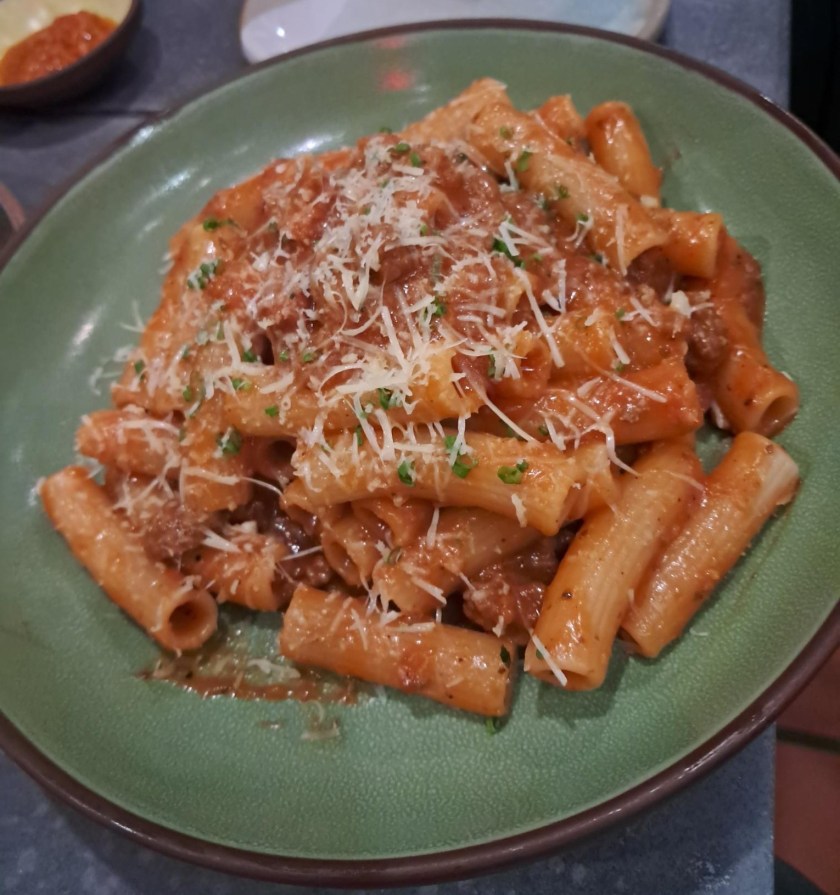
This was Ningang’s rigatoni, a take on the Filipino style of spaghetti, which is traditionally served with cut-up hot dogs and Spam in a sweet tomato sauce.  On my one trip to the Filipino fried chicken chain Jollibee, I was most excited to try a side order of that spaghetti, but I didn’t think it was anything special.  Kaya’s menu describes their version of the dish as “Filipino beef Bolognese, Spam, aged gouda, a touch of sweetness, a lot of love.”  You can taste the love in it, along with in everything else Chef Lo makes.  I love a good pasta dish, especially a meat sauce, and I really loved this rigatoni.  I would have a hard time returning to Kaya and not ordering this every time (among other things, natch).
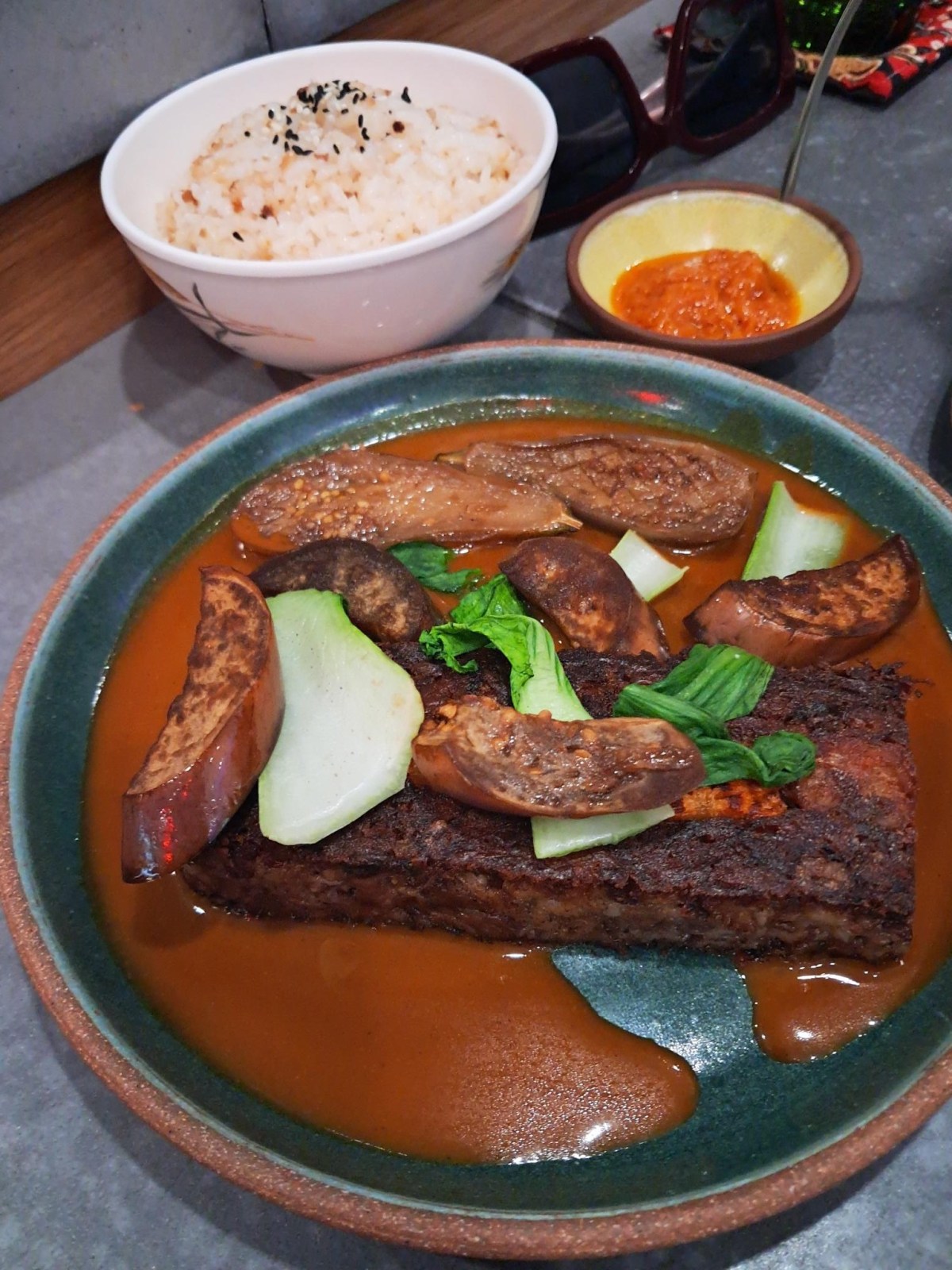
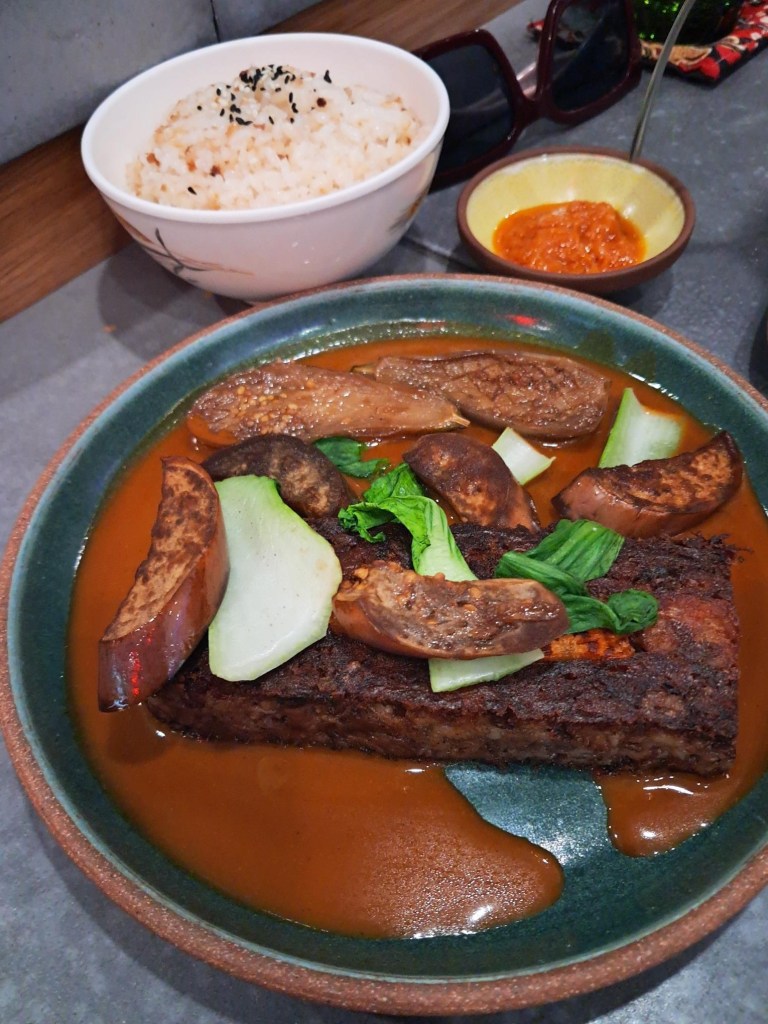
I’ve written often about how one of my favorite meats is oxtail, whether it’s in Jamaican or Trinidadian cuisine, American soul food, or even in a steaming bowl of Vietnamese pho.  I was curious about trying Kaya’s oxtail kare kare, served in a rich peanut sauce with eggplant, bok choy, and a little dipping bowl of bagoong (in the top right, so you can see it by itself), but I’ve never tried or even seen oxtail like this.  Usually eating it is a messy affair, as you’re holding the irregularly shaped bone segments and chewing the tender meat and unctuous fat off them, and the bones are slippery enough that they can slip right out of your hands and go flying.  If my dad ever dared to eat oxtail, he would probably add it to his list of foods to not eat on a date, including most other hand-held meat with bones, and anything you have to “fight with” too much — crab legs that need to be cracked, shrimp that need to be shelled, and so forth.  But Chef Lo deboned all that rich meat and pressed it into a brick, then seared the outside to crispy perfection.  It was not only delicious and not only gorgeous, like everything else we were experiencing at Kaya, but he made it EASY.The oxtail kare kare was served with a side of buttery garlic rice called sinangag, which you must order separately (for $5) if your entree doesn’t come with it.
Because I was dining with a culinary luminary, Jami and Chef Lo sent us out these gambas: huge Cape Canaveral white shrimp, served with the heads on as well as the tails, in rich garlic butter, kalamansi verde, and preserved lemon.  Now these were messy, but what a festival of flavors and textures and colors! 
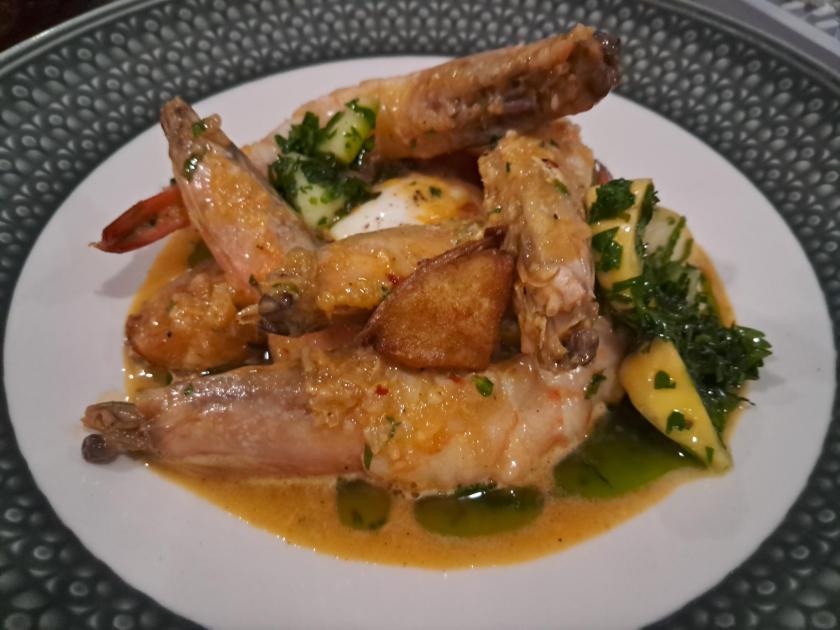
Kalamansi (sometimes called calamansi or calamondin) is a small, round citrus fruit, a hybrid of a kumquat and a Mandarin orange, and their juice is used in a lot of Filipino recipes.  Ripe ones are orange, but because the ones used in this recipe were kalamansi verde (green), they added sour notes because they weren’t ripe yet, perfectly balancing the richness of the garlic butter.  My wife says I love sour and tangy flavors more than anyone she’s ever met, which is one big reason I’m so crazy about Filipino cuisine.  (I also jokingly call myself the “acidic Jew” because of this.)  I have enjoyed kalamansi juice in cool, refreshing beverages before, including from the aforementioned The Baker’s Son (not that different from lemonade or limeade), and after a dear friend with a green thumb hooked me up with kalamansi from her own garden, I squeezed enough juice out of them to make my favorite dessert ever, a variation of Atlantic Beach pie.  (If you’re curious, drop me a line, sweet-toothed Saboscrivnerinos!)

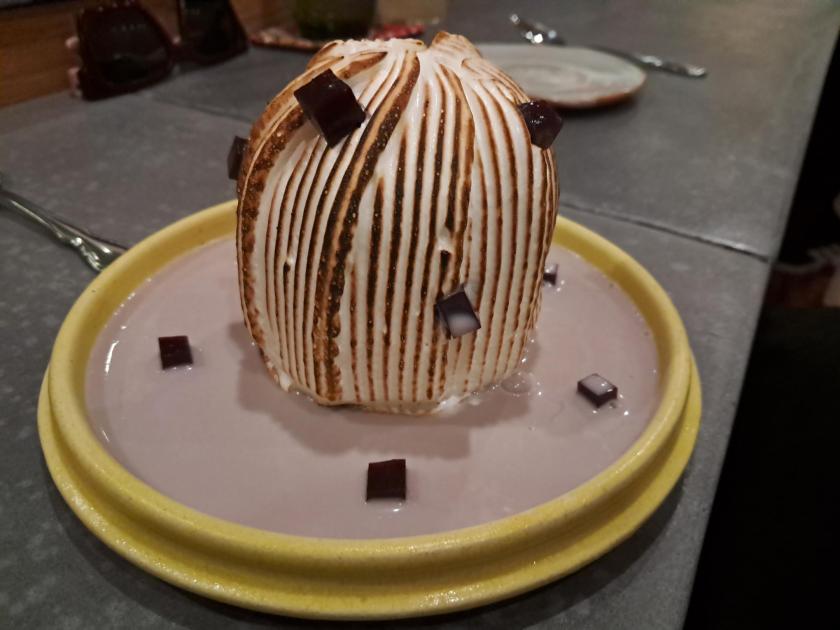
Speaking of dessert, we were about to be blown away by the creativity of Kaya’s talented pastry chef, Chef Clarice Lam.  This was her Silvana Alaska, based on beloved Filipino cookies called Silvanas: two cashew-meringue wafers with a layer of buttercream between them, coated with cookie crumbs.  Chef Lam’s show-stopper was a gluten-free dessert with cashew meringue, ube French buttercream, blueberry compote, a dome-like layer of toasted Swiss meringue (hence the “Alaska” part, like the classic old-timey dessert baked Alaska), tiny cubes of blueberry jellies, and surrounded by a sweet, creamy moat of ube crème anglaise.By the way, ube is a purple yam that is definitely having a moment, being used in all kinds of desserts.  My wife loves the ube soft serve ice cream at Sampaguita Filipino Ice Cream, mere moments away from Kaya, but I’ve never had a dessert of this level of complexity, with or without ube.
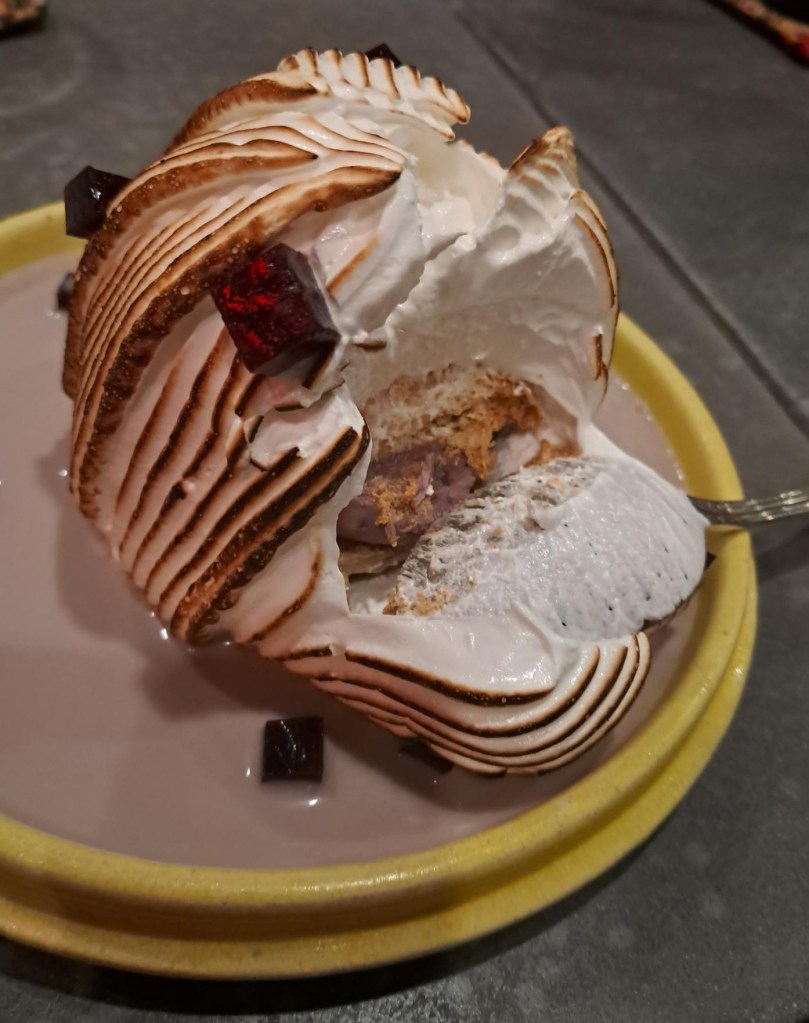
Once we split into the meringue dome, this is what the Silvana Alaska looked like inside.  (I think my photo looks like a big fish opening its mouth, with the blueberry jelly cube as its eye, but that was not my intention.)
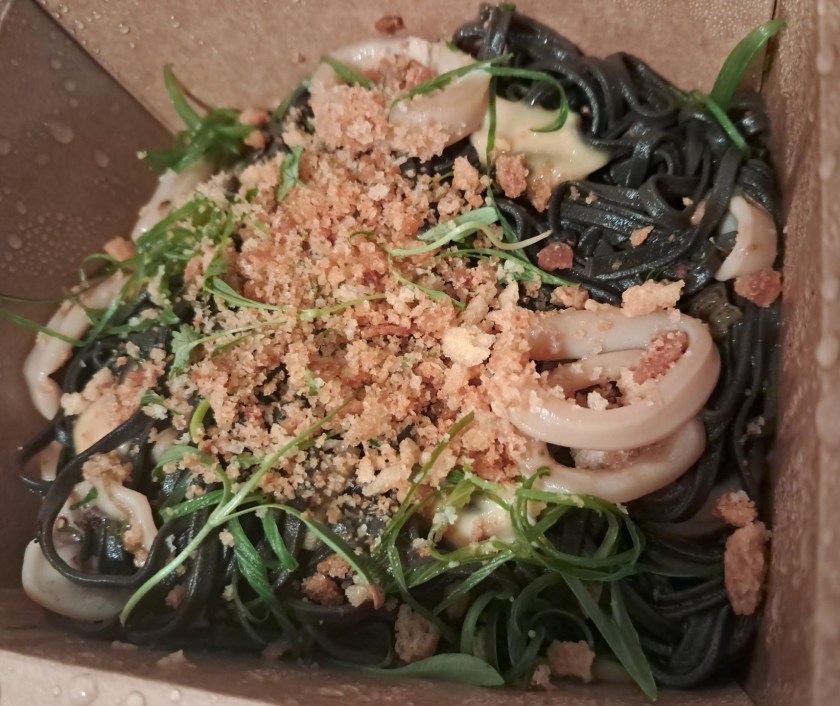
I am so proud of my wife, who has been trying all kinds of new foods lately.  Even though she wasn’t with us at this dinner (arguably having even more fun than we were, seeing her beloved Tori Amos in concert), I selected another tempting dish to bring home for her to enjoy later.  We both love squid ink pasta (I call it “Goth pasta”), and this was Kaya’s squid ink pancit: house-made spaghetti noodles topped with calamari rings, adobo sauce, black garlic aioli, and pandesal bread crumble.  It was magnificent.  We both sampled it later that night, after I picked her up from the concert, and she got two more whole portions out of it the next day.
Folks, I cannot stress how awe-inspiring this meal was.  I rarely go out to dinner because of my odd work schedule, but if Kaya was open for lunch (it isn’t), I’m sure I would have tried it years ago.  Instead, I’m late to the party, but this was, without a doubt, the absolute #1 best meal I’ve ever eaten in my 22 years in Orlando, and in the Top Five meals of my entire life.

I can tell you three of the others right now:

    • Babbo in NYC for our honeymoon in 2009, before we knew what a shit Mario Batali was,
    • Chef Michael Solomonov’s elevated Ashkenazi Jewish restaurant Abe Fisher in Philadelphia in 2023, which closed not long after our visit up there to see Le Tigre, so I never got around to writing about it, and
    • Chef Marcus Samuelsson’s Red Rooster Overtown in Miami, before seeing De La Soul in 2025.

But I was wowed by every part of the Kaya experience: not just the once-in-a-lifetime dishes my friend/mentor and I shared, but the professionalism of our bartender-servers, Jami’s warmth and kindness, the decor, the unbridled creativity of Chef Lo and Chef Lam, and the way the whole place — the whole experience — feels like a labor of love and a way of sharing a cuisine and a culture that too many Americans have yet to experience.  The website lists Kaya’s values with their names in Tagalog, and I really needed to share these, because you don’t see restaurants with a mission statement all that often, and they really exemplify all these beautiful, noble, lofty ideals:

    • Pamilya: We treat our team and guests like family. We practice radical hospitality so that our guests feel a sense of belonging and ease. We create space to be present for our families.
    • Kapwa + Bayanihan: We care deeply about community. We treat one another with love, look out for each other, and lift one another up. We build a model that allows us to be full, whole humans in right relationship with one another.
    • Utang Na Loob: We respect and honor our community, elders, and ancestors, as well as the land and its resources. We take a no/low-waste, sustainable approach, and we celebrate the beauty and richness of our heritage.
    • Mapanlikha: We move from a place of possibility, learning from the past and our experiences while actively creating our vision for the future. We pay close attention to how we can constantly improve while shaping the narrative of what’s possible.

Nothing about this epic experience was “mid” or forgettable, nor was it snooty or snobby or inaccessible.  Nobody was going through the motions.  Even with my own hang-ups about fine dining (that it isn’t meant for people like me), I never felt like an impostor or a sellout or a disappointment to my parents.  It was a close to perfect as a meal could be, and I had a blast!  Kaya has clearly earned its Michelin Green star for sustainability, and deserves to be in that rarified pantheon of top restaurants in Orlando, if not all of Florida, but I feel like it deserves a regular star as well, if not two.  By the way, according to the website, “kaya” means capable in Tagalog, and “kaya natin” means we can.   They are beyond capable, and not only can they, but they do.

And as much as I hoped to return to Kaya sooner rather than later, I surprised myself by returning just a few weeks later — yesterday, in fact!  But it wasn’t for another dinner, not this time.  Instead, Executive Pastry Chef Clarice Lam hosts an event called Kapé Kaya, a daytime bakery concept featuring her awe-inspiring pastries, every Saturday, from 9:30 AM until 12 PM.  I’ve seen pictures of her past creations, but this was a rare treat: the second of three Kapé Kaya events where she teams up with another local restaurant hero: Chef Tyler Brunache of SmokeMade Meats + Eats, my favorite barbecue restaurant in Orlando that won Michelin Bib Gourmand awards for “good quality, good value cooking” in 2025 and 2026.

This was like when Jack White teamed up with Norah Jones… or when Jack White teamed up with Alison Mosshart from The Kills… or when Jack White teamed up with Q-Tip from A Tribe Called Quest!  Or maybe like the too-rare team-ups between Daredevil and Captain America, a pairing that makes all the sense in the world even though you don’t automatically think of them as obvious partners.  I had to be there, so I arrived around 8:45 AM, and there were already about 30 people ahead of me, waiting in line outside Kaya.  The heat and humidity didn’t get too bad until around 9:30, but they moved things along pretty well inside.  In the meantime, we studied the menu:
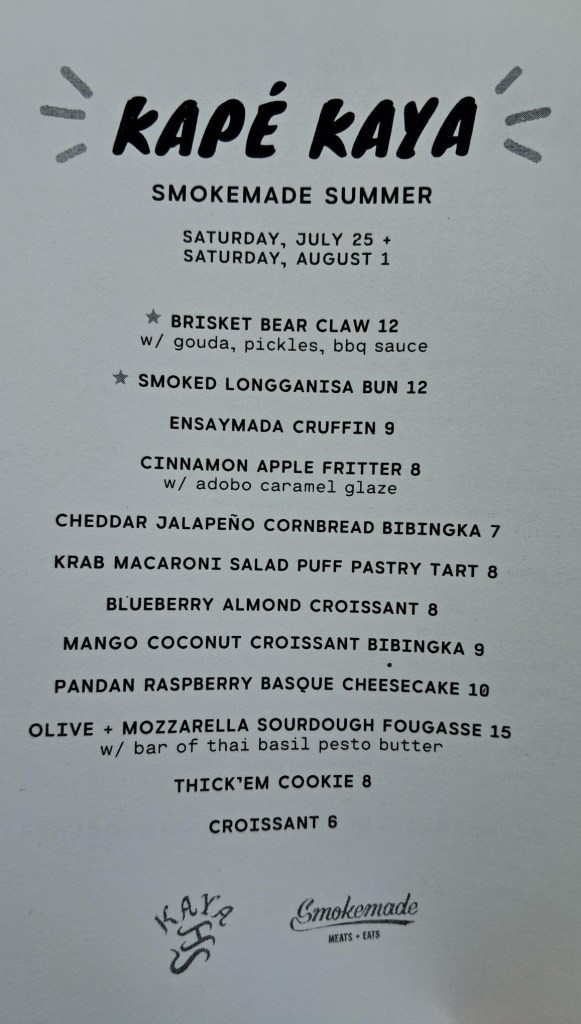
Jami came outside to announce when they were finally opening up, and I couldn’t believe she recognized me after meeting me once, a few weeks ago.  (I was also somewhat incognito, wearing sunglasses and my “I Love Research” bucket hat under the baking morning sun, looking like the nerdiest rapper ever, and she still recognized me and gave me a hug.)  When I finally got in, they had all the gorgeous pastries on display on the bar, with labels and prices.  You order and pay up front, then wait for the staff to assemble your order in large pink bakery boxes. 
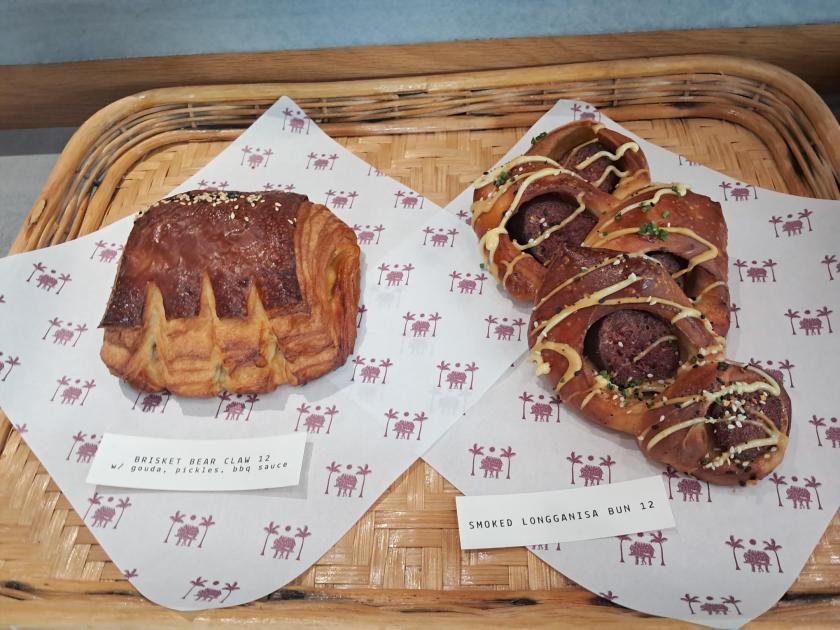
I thanked Chef Lam on the way out the door, and even though I had considered doing it, I refrained from doing my Anthony Hopkins-as-Hannibal Lecter impression, greeting her with “Hello, Clarice.”  She’s probably heard it before, and Mads Mikkelsen was the better Hannibal Lecter anyway, by far.  (I said what I said.)  I was on my way by 10:15, leaving me enough time to make it to donate blood in Altamonte Springs by my 11 AM appointment time.  As usual, I brought a cooler with me to keep my Kapé Kaya treats safe and cool in this awful summer heat.

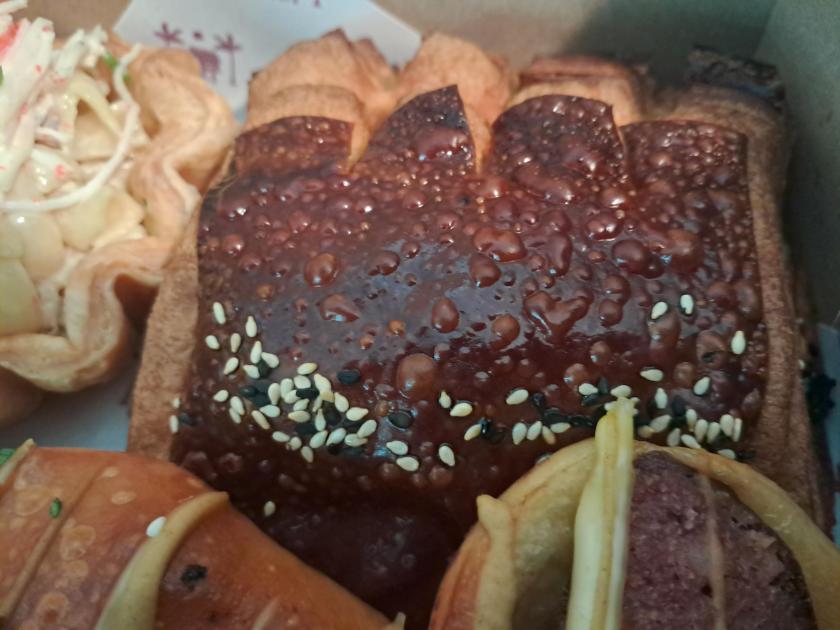
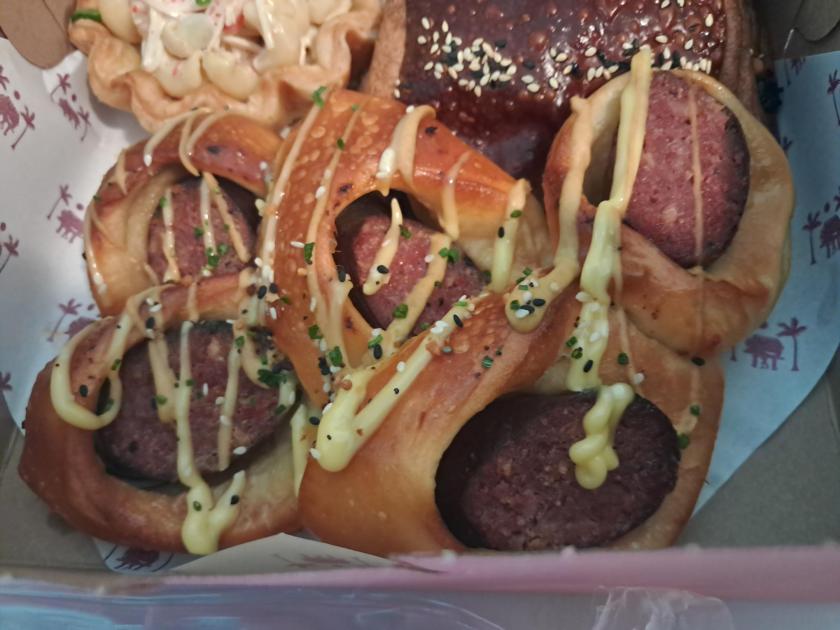
Back at home, this is a close-up of my brisket bear claw, which had buttery, flaky layers like the best croissant you’ve ever had.
This was the longganisa sausage bun, and keep in mind this was all one interconnected thing!  I’ve been lucky enough to catch Chef Tyler’s longganisa sausage as a weekend special at SmokeMade, and I love how sweet and savory it is.  All his house-made sausages have a perfect crispy natural casing, and Chef Lam’s dough was kind of like a savory danish pastry, not flaky and layered like the bear claw.
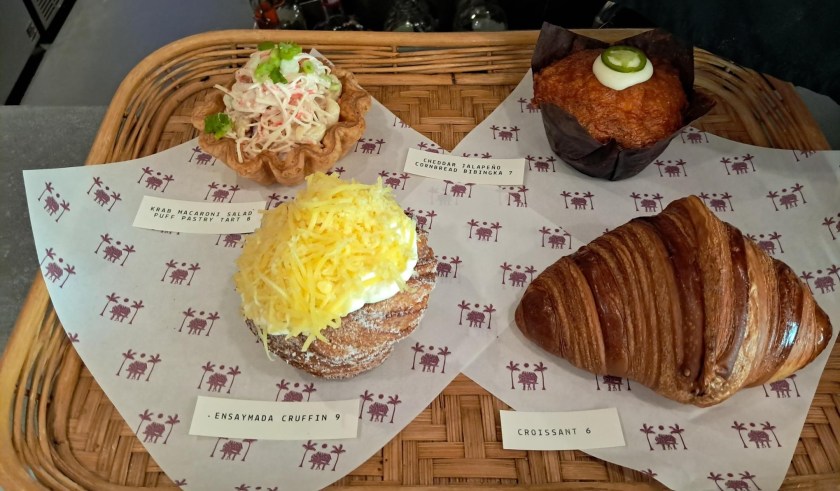
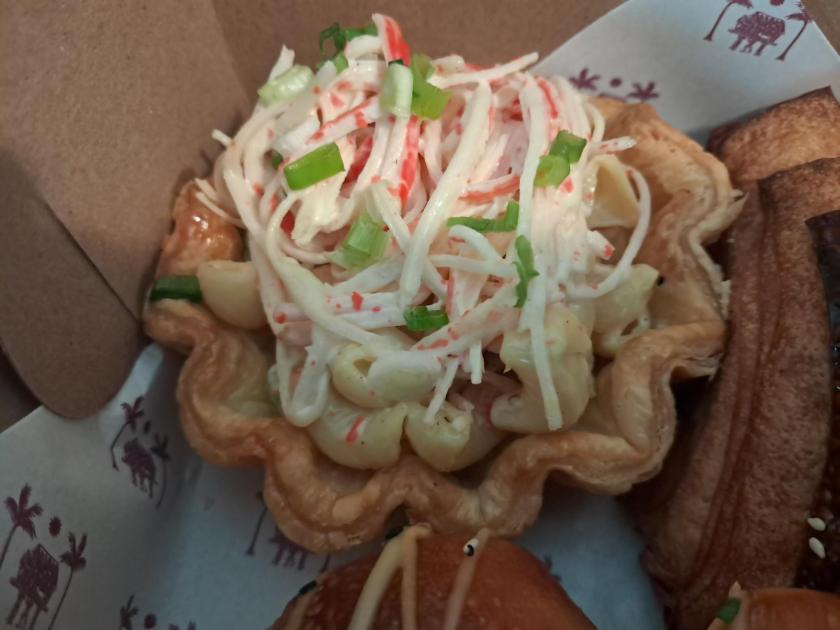
I love macaroni salad and always enjoy the slightly sweet taste of surimi (imitation “krab”) in sushi and poke, so I couldn’t resist the krab macaroni salad puff pastry tart.  It was so refreshing, especially compared to the other two heavier pastries, and the tart shell was flaky and light.
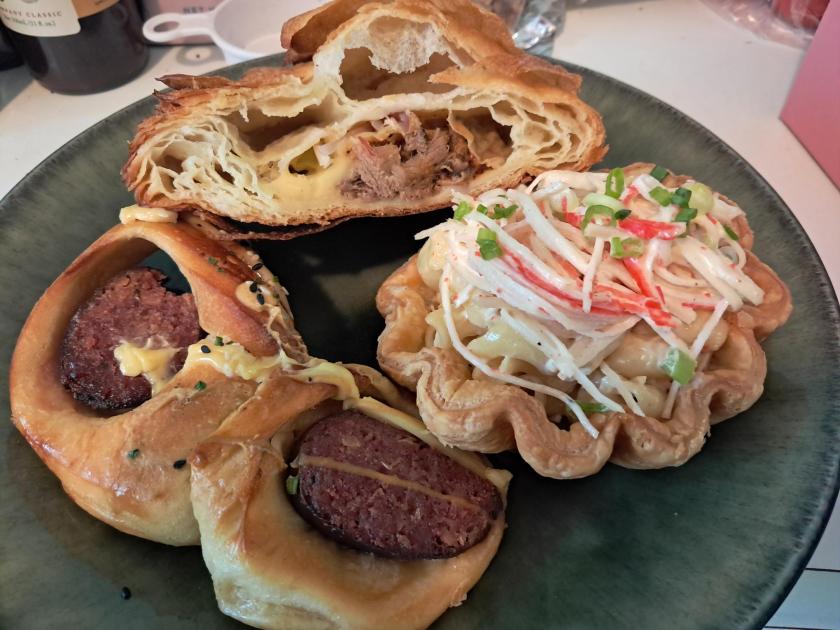
Here they are on a plate, so you can see a cross-section of the brisket bear claw with all those laminated dough layers and smoked brisket, gouda cheese, pickles, and barbecue sauce inside.  Upon tearing into it, it reminded me of a cross between a croissant and the Cuban pastelitos I grew up eating in Miami, sometimes stuffed with seasoned ground beef called picadillo.
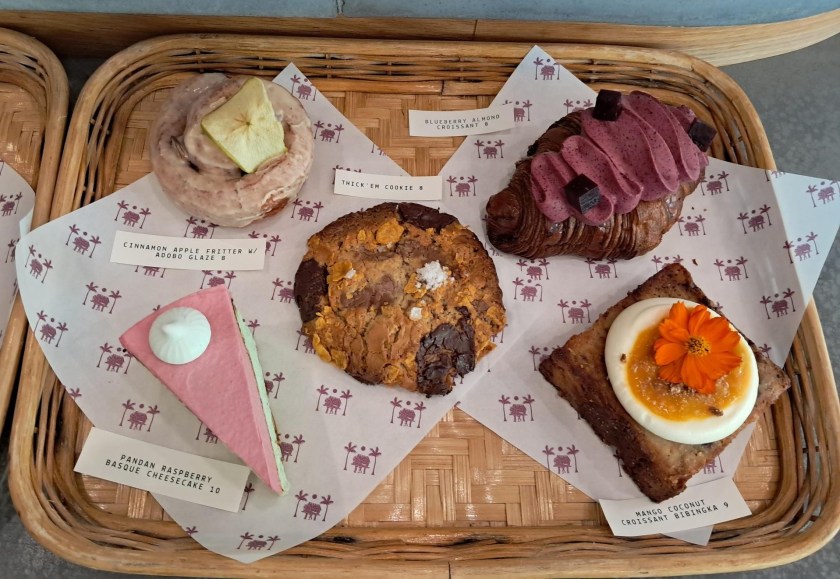
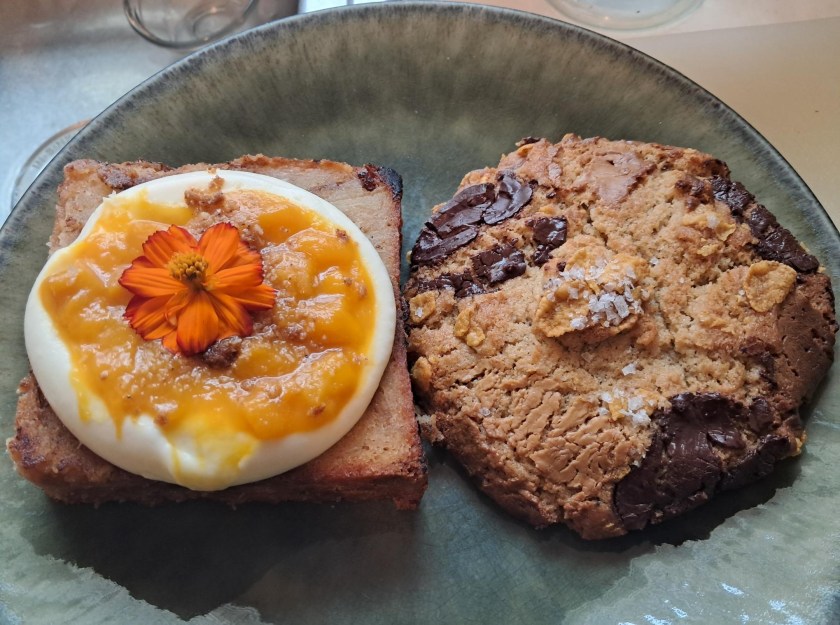
And here are my sweet choices.  One the left, I got the mango coconut croissant bibingka, because I thought it was something my wife and I would both like, whereas I figured the savory pastries above would be all mine.  This thing was so dense and rich, we’re both slowly working our way through it over 36 hours later, a bite or two at a time.  Like so many other Filipino dishes, bibingka is new to me, so I looked it up.  Serious Eats never lets me down: it is a “coconut-flavored, banana-leaf scented rice cake topped with caramelized coconut strips.”  However, not having had prior bibingka experience, I would have guessed it was more like a bread pudding, since that’s what the texture and consistency felt like to me.  I loved the mango puree on top.  It was so good, but a little goes a long way.The same could be said for Chef Lam’s “thick’em cookie,” the one thing my wife actually requested.  This is a huge cookie, even bigger than the ones from Gideon’s Bakehouse.  The edges were crispy, but the rest was soft and yielding, which I always prefer in my cookies.  There were chocolate chunks, corn flakes, and some fancy salt crystals sprinkled on top.  My wife was in heaven, and she has also been nibbling away at the cookie because you can’t just devour it.  This plate was surprisingly heavy with both of these on it.
So that was my amazing Kapé Kaya experience, just weeks after my first dinner at Kaya.  I am posting this NOW because there is one more scheduled Kapé Kaya crossover with SmokeMade Meats and Eats, and that is next Saturday morning, August 1st.  I’ll probably be seeing the next Spider-Man movie before the Internet can spoil it all for me, but all my dozens of readers should do whatever it takes to be at Kaya before the line gets too long and the heat gets too unbearable.  Spider-Man is supposed to team up with the Hulk and the Punisher, but the best team-up in Orlando is going to be happening right at Kaya, and you don’t want to miss it!
Talay

Talay (https://www.talayorlando.com/) is one of the newer and more upscale Thai restaurants in Orlando, located in the “North Quarter” on 861 Orange Avenue, right before you cross East Colonial Drive into downtown Orlando.  I took my wife there for lunch a few weeks ago, and we had a nice meal in the spacious dining room, which was surprisingly empty.  I’m sure it gets crazy crowded later on, though.  Everything is light wood and creamy colors, making the space feel modern and elegant.  There are some booths inside, and there is even more seating outside, on an inviting covered patio.

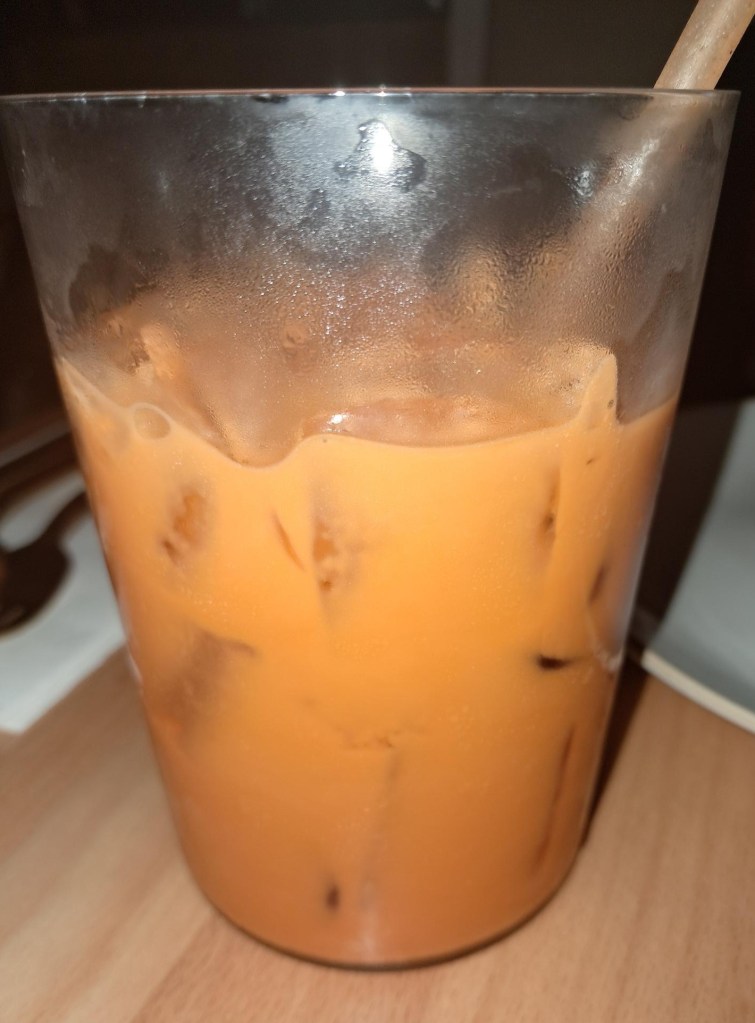
As usual, my wife started her with a creamy and refreshing Thai iced tea:

We ordered four different things, intending to share most of them and end up with leftovers.  A few were relatively small portions, so it all worked out.

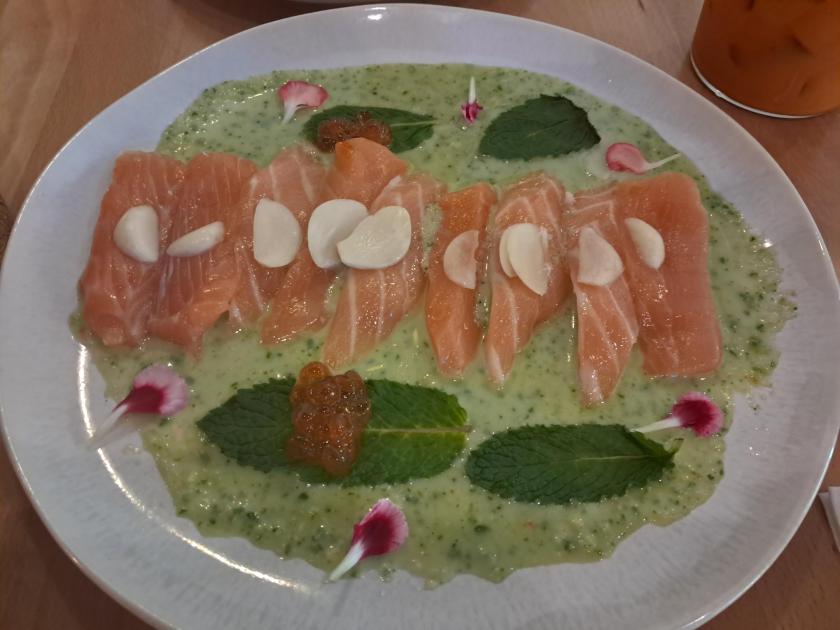
This was salmon chae nam pla, an appetizer with thin slices of raw salmon (each garnished by a paper-thin slice of pickled garlic), two little clusters of salmon roe, and mint leaves, all displayed on a sea of spicy cilantro chili-lime dressing.  The dressing was too spicy for my wife, so I ended up eating most of these.  I must be part bear (I definitely look like a bear), because I never tire of devouring raw salmon.   

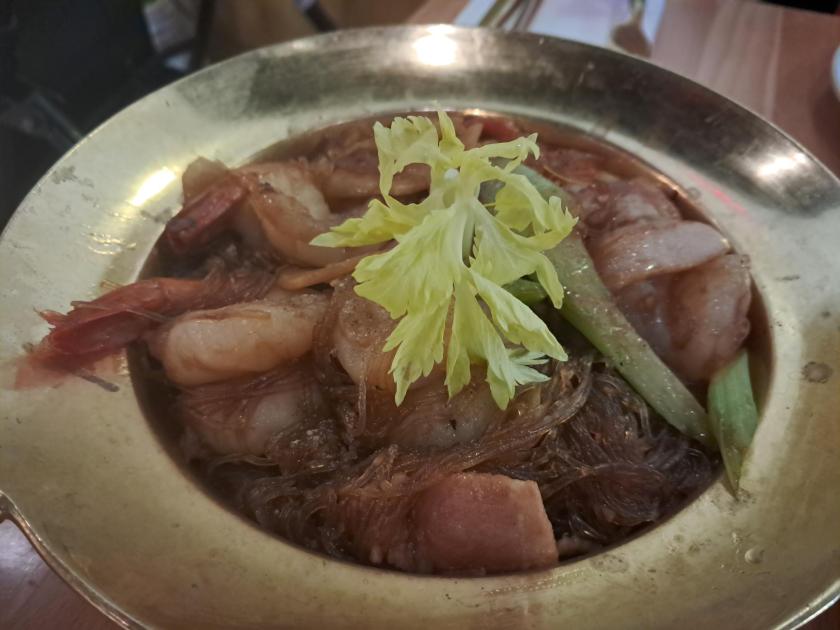
We also shared goong ob woon sen, a dish neither of us had ever tried before, or even noticed on any other Thai menus before.  It included plump shrimp served with their tails on, glass noodles (traditionally made from mung bean or sweet potato starch, which turn translucent), thin slices of bacon, black pepper, sesame oil, celery, ginger, “Talay’s signature wok sauce,” and cilantro chili relish served on the side.  Those leaves in the middle are a tiny celery stick garnish sticking out.   

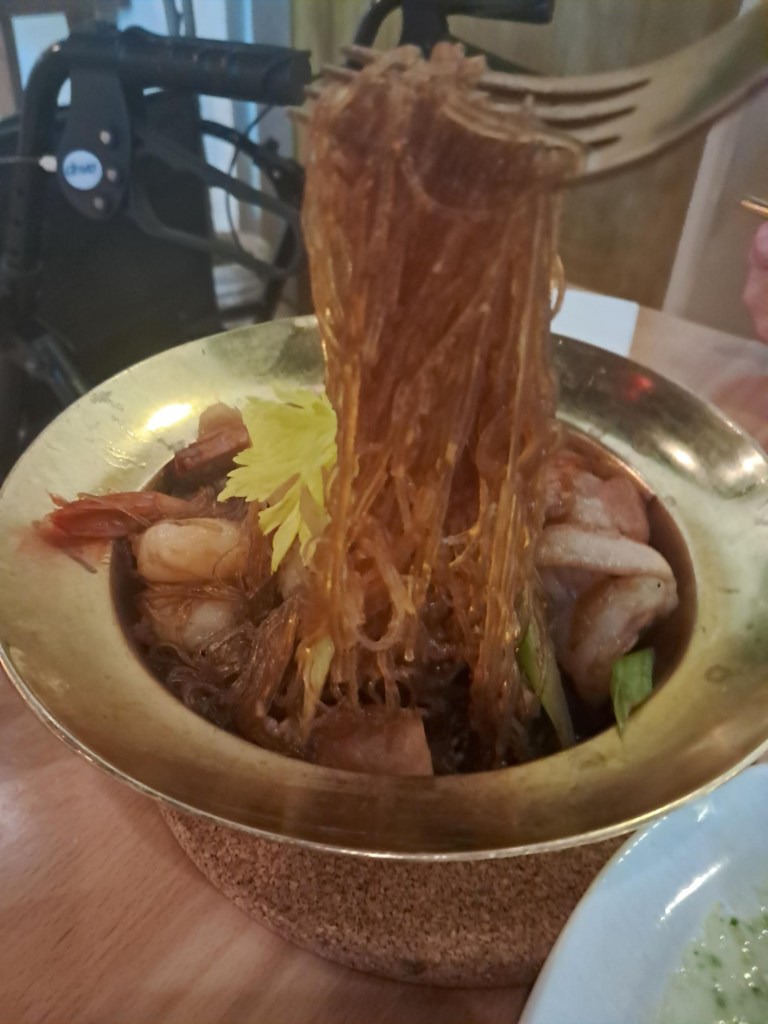
You wanted a noodle pull?  Well here’s a noodle pull! This was a good dish, and the noodles had a nice chew to them.  I didn’t pick this one, and I didn’t know what to expect (other than “bacon is always good”), but it all came together.
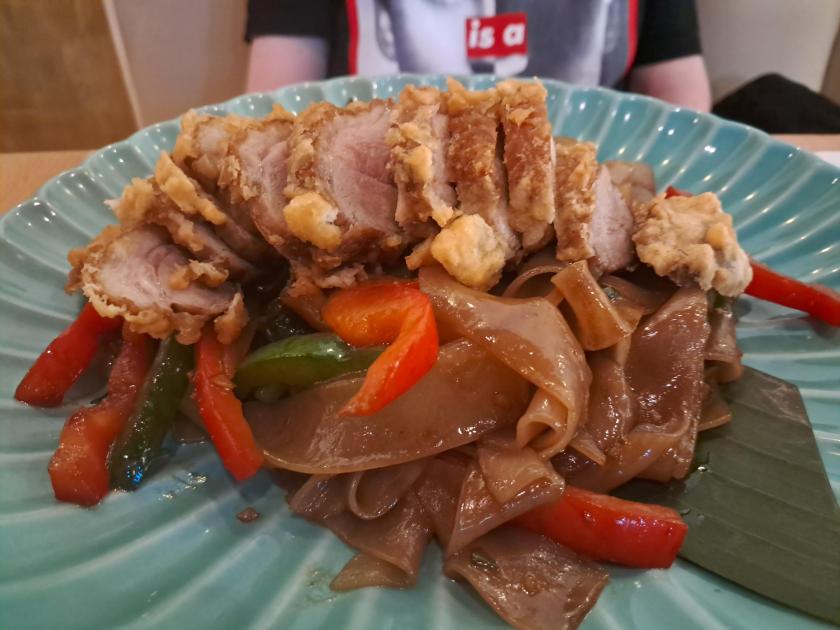
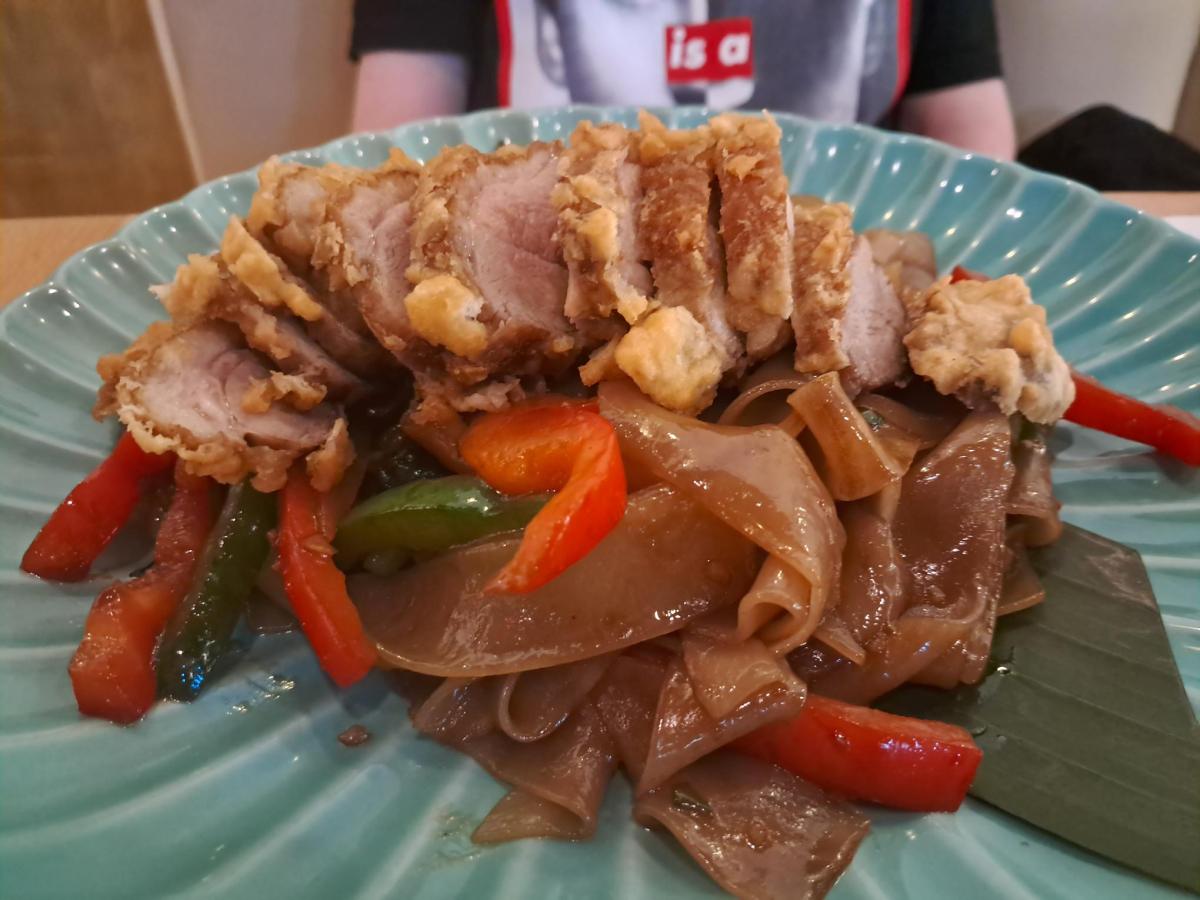
I finally got my wife into my favorite Thai dish that I used to order all the time as a benchmark of any new Thai restaurant, pad kee mao (sometimes spelled pad kee mow, and also known as drunken noodles).  As long as she orders it mild, she loves it as much as she loves her old go-to, pad Thai.  This was Talay’s pad kee mao, a stir-fried sensation with flat rice noodles (always so nice and chewy), green and red bell peppers, Thai basil, chili, and Talay’s spicy wok sauce, which they surely toned down for her.  She chose crispy duck as the protein (for a small upcharge), and the duck was wonderful — tender, juicy, battered and fried to perfection.  We are both big duck fans.   

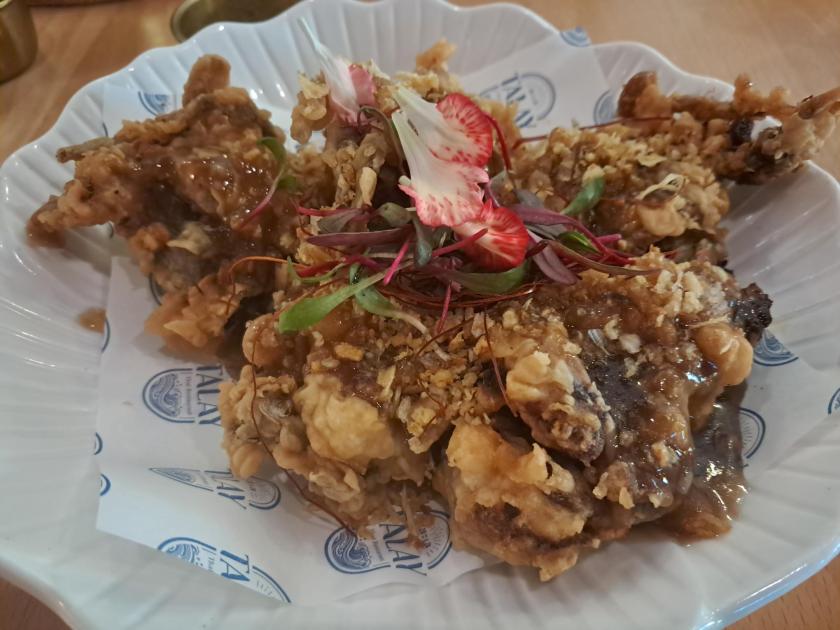
And as for me, I panicked.  So many things sounded good, and I know for a fact I won’t make it back to this spot very often.  Instead of going with a familiar favorite, I wanted to try something more unique off Talay’s Signature menu, since they have so many elevated dishes you can’t find just anywhere.  I decided to go with something I always love on any menu, whether it’s a seafood shack or a Thai restaurant, soft shell crab.  This was pu nim tod kra tiam, crispy soft-shell crab served with garlic, pepper, and a savory brown sauce.  It ended up being a new twist on an old classic, and it was much less heavy than it looks here.   

It came with white rice on the side, which I mixed in to gather all the sauce under the crab, and I asked to try the roasted chili relish, which costs $3 extra.  All I got was the little ramekin on the right, and it was interesting.  It definitely had some sweetness and funky umami, maybe from fish sauce.

Due to the location, I don’t expect we will become regulars at Talay, especially since I bring home takeout much more often than we dine out.  But Talay is definitely one of the nicer Thai restaurants in Orlando, and it would be a fantastic place for a date or a big night out.  It reminded me of Lim Ros Thai Cuisine that way, another Thai restaurant that is a little more elegant and elevated than usual.  Both feature lush, sexy vibes, rather than the “hominess” of the more old-school Thai restaurants we honestly end up at more often (like Thailicious in Longwood).  But I can’t say anything bad about either of them, and if you already know Talay, I’m sure you can’t think of anything negative about it either.  If I ever do make it back, what should I order next time?  I’m always happy to try anything new!

Chayhana

Chayhana (https://chayhanaorlando.com/) is an Uzbek restaurant that serves authentic Uzbek and Central Asian food, all of which is halal.  It is located at 851 State Road 436, #1027, Altamonte Springs, FL 32714, in the long plaza at the intersection of State Roads 436 (Semoran Boulevard) and 434.  I’ve had Uzbek food before, at Caravan Uzbek & Turkish Cuisine, but that’s all the way across town from me, in an area I never go.  I was excited to finally try Chayhana, which is a lot closer.  I’ve brought takeout home twice now, and it was great both times.

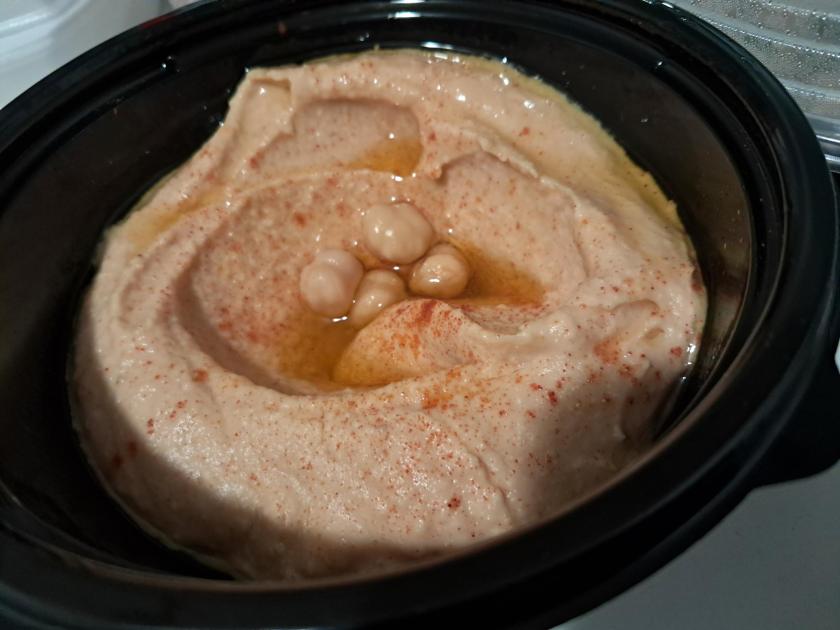
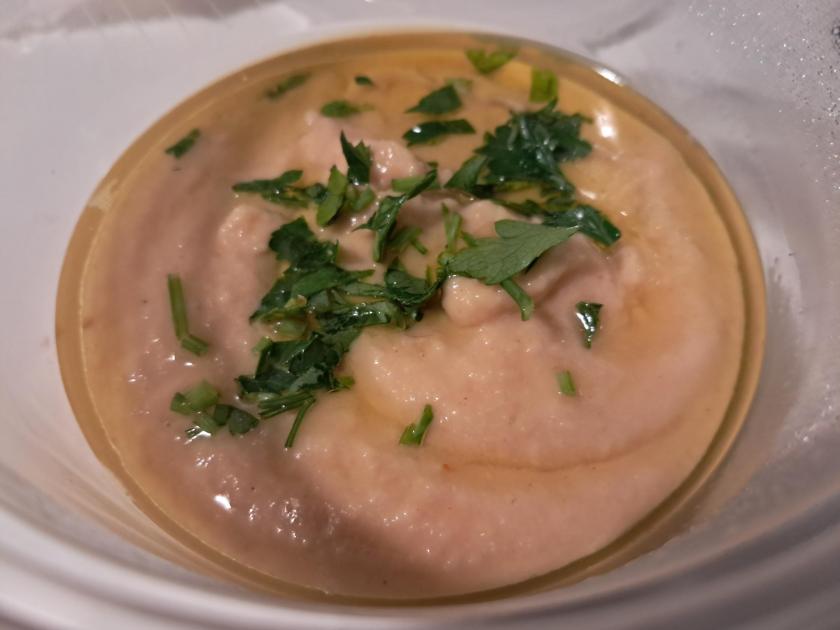
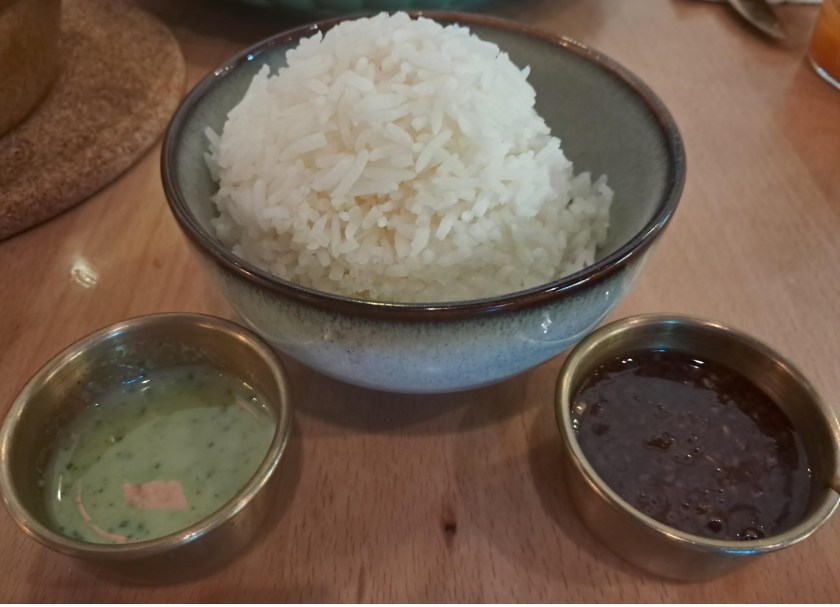
My wife is the biggest hummus aficionado I know.  She loves hummus to the point where I wonder if I should be jealous of hummus.  (With all honesty, I am very secure in our marriage, and I am always glad when she enjoys anything.)  Not long after we both discovered the greatness of The Hummus Guy food truck in Maitland earlier this year, we realized Chayhana’s hummus was very different, but also terrific.  They sprinkle theirs with some light seasoning, drizzle on olive oil, and top it with a few chick peas.  And if I may, what’s the difference between a garbanzo bean and a chick pea?  The president has never paid to watch a Russian garbanzo bean.  Hey-o!
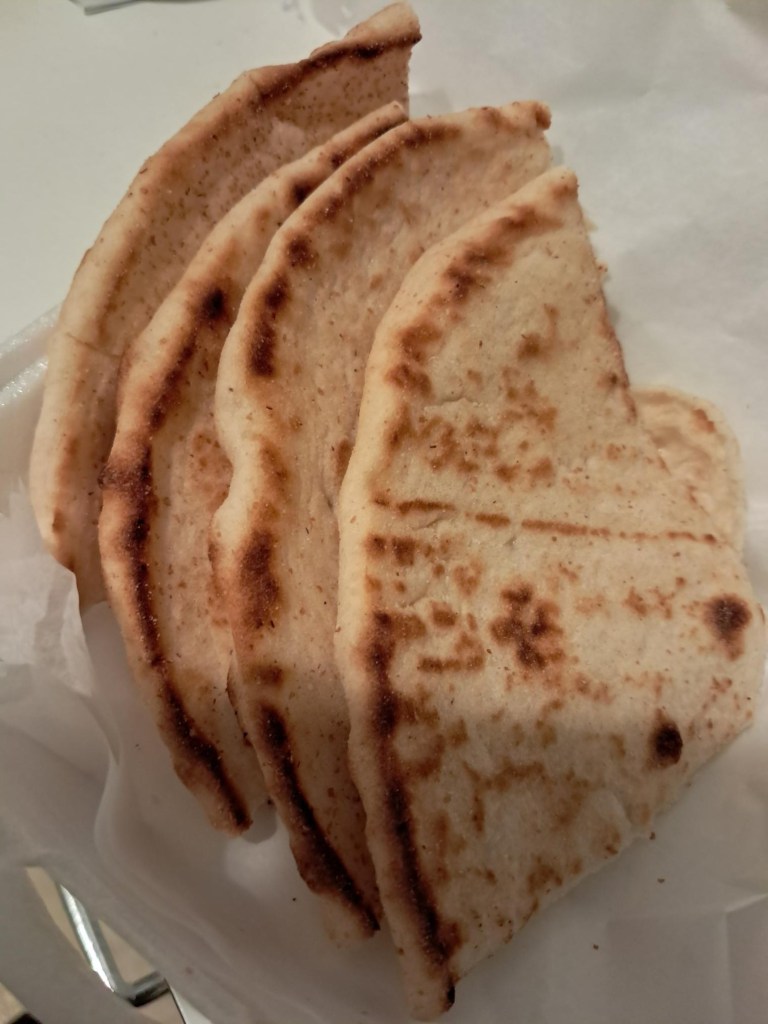
The hummus came with these warm, lightly grilled pita wedges for spreading or dipping.  I consider myself a bit of a pita connoisseur, since there are good and bad kinds, and this is the good kind that gyros are often served on.  You can buy the Kontos brand of this kind of pita at some places, like the halal Indian market Apna Bazaar, with locations on South Orange Blossom Trail and on 434 in Longwood.

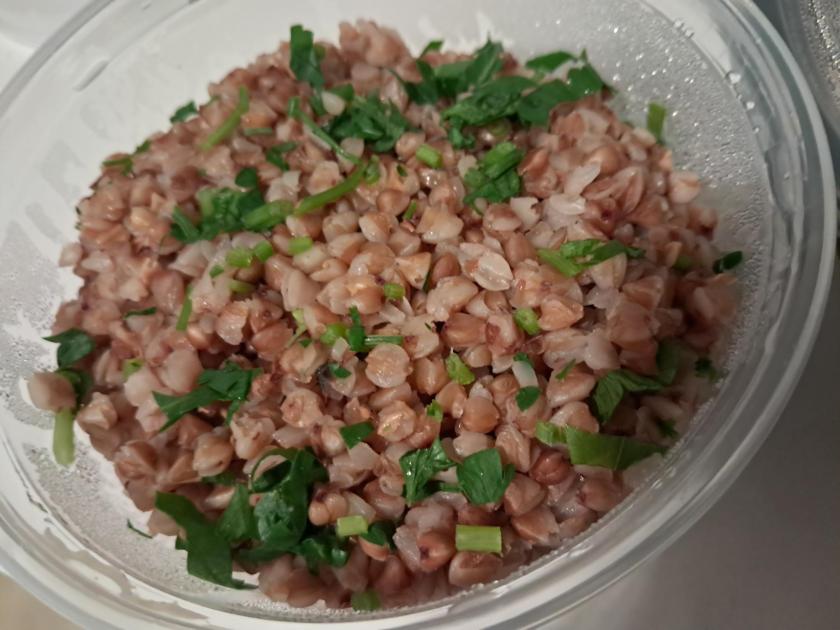
My wife also loves kasha, or buckwheat (o-tay!), a nutty and earthy grain that is toasted and then boiled until tender, kind of like couscous.  I ordered her this grechka, which is warm buckwheat, sprinkled with parsley. 

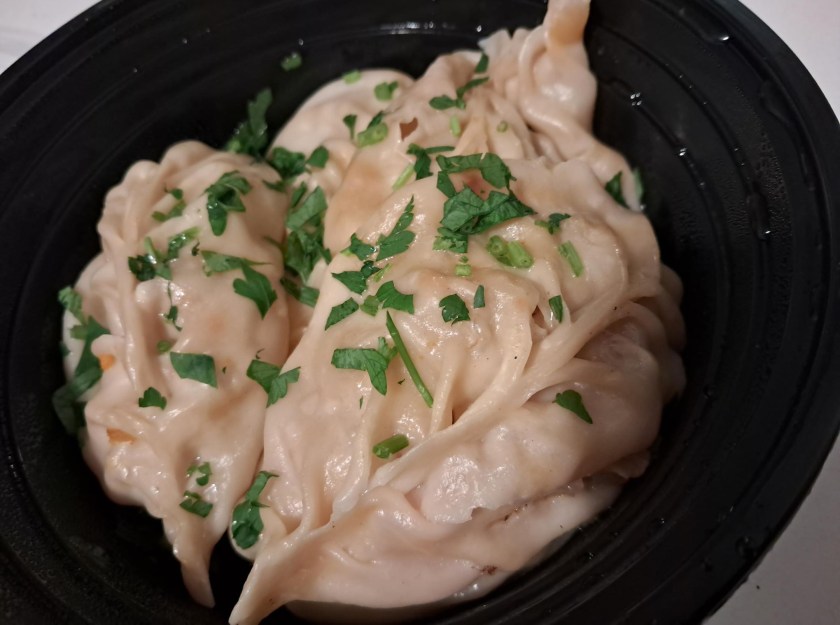
I ordered this pumpkin manty with her in mind.  Manty are filled dumplings with a soft, thin, chewy, handmade dough wrapper, kind of like Chinese wontons, Italian ravioli, or Polish pierogi.  These manty were much larger than any wontons, ravioli, or pierogi I’ve ever seen, though.  And yes, they were stuffed with seasoned pumpkin, onions, and spices for a delicious dish vegetarians would love.  Actually, anyone would love these.  I thought they might be a bit bland, but they were anything but.  And look at the pattern on the outside.  They didn’t have to make them look that beautiful, but someone went to the trouble of doing that to all the manty!   

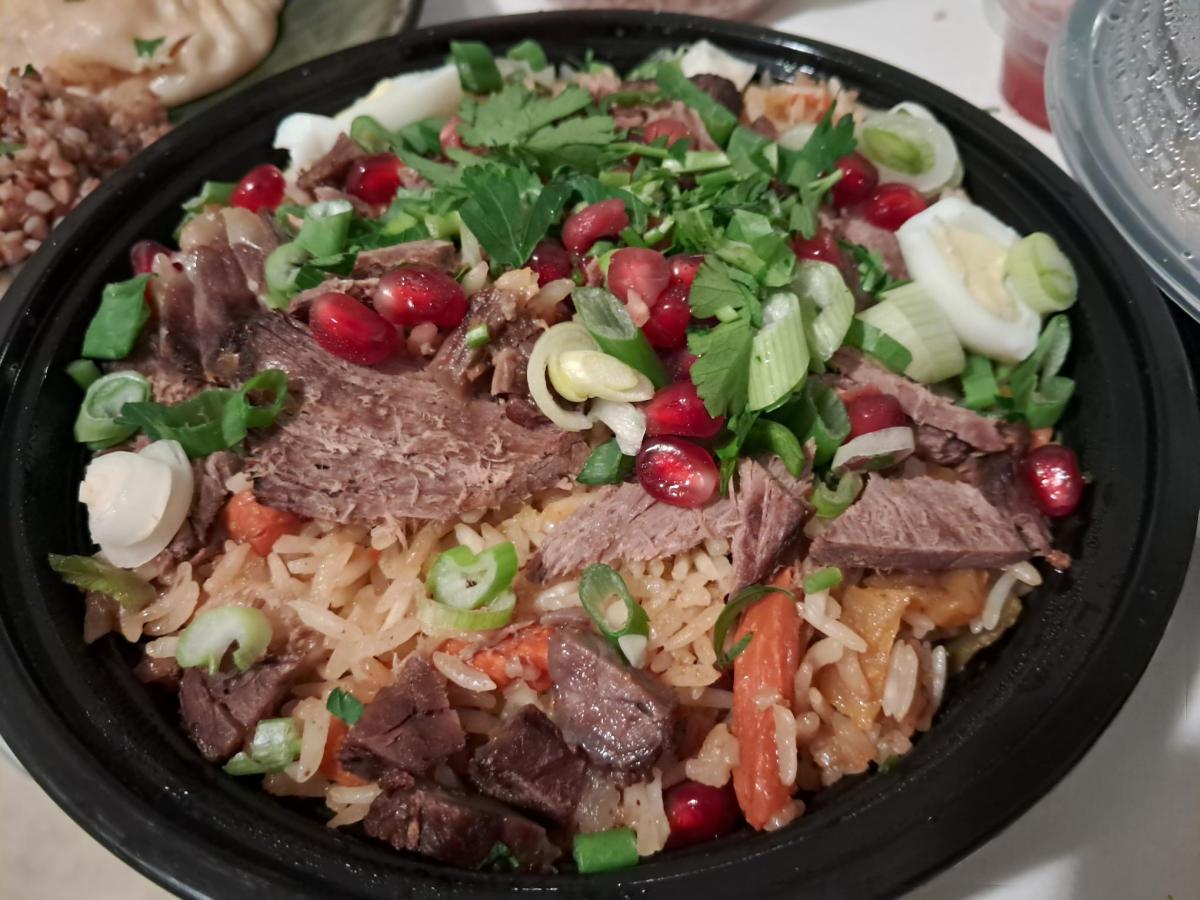
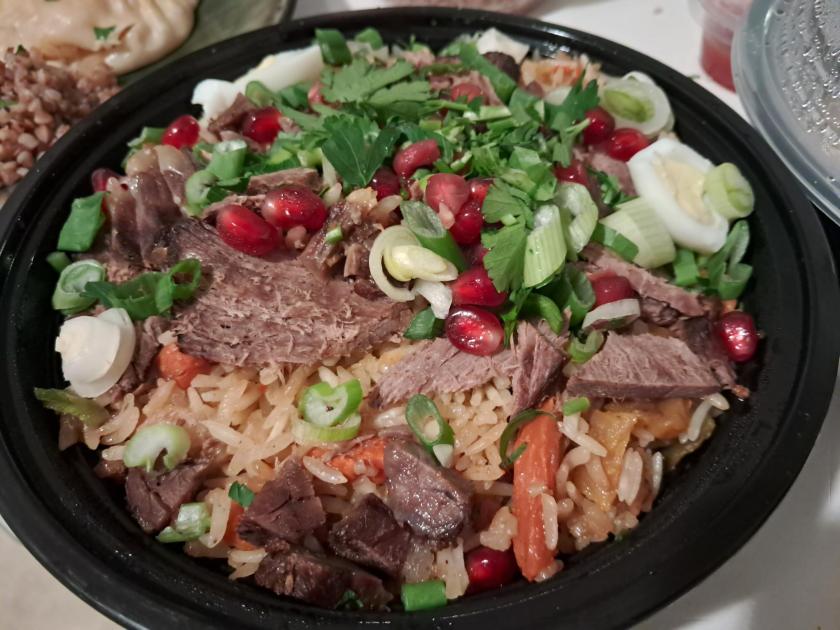
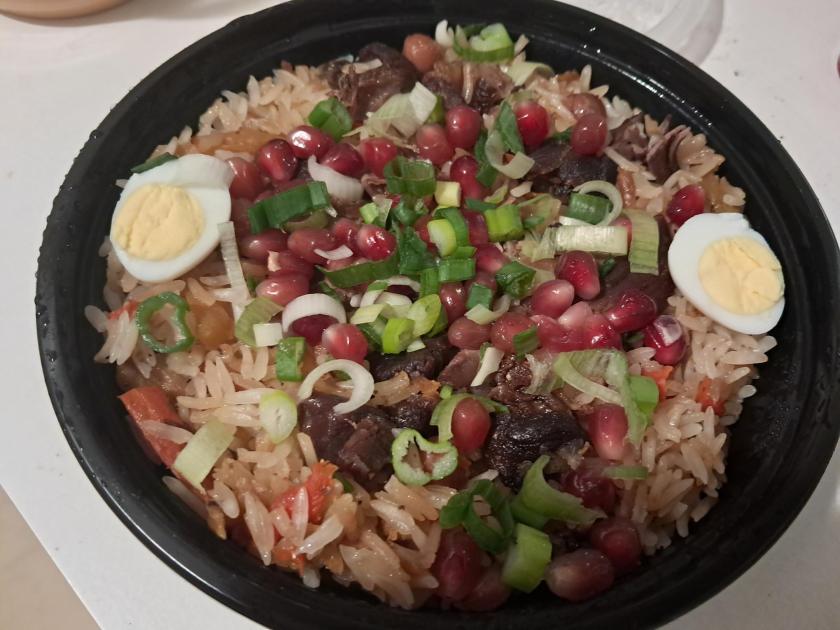
This dish is Chayhana’s best-seller, and you can see why.  It is plov, a dish of fragrant, buttery fried rice cooked with halal-certified beef and lamb, carrots, onions, scallions, a hard-boiled quail egg, and pomegranate arils.  It is gorgeous, isn’t it?  It looks like Christmas, with the parsley, scallions, and shiny red pomegranate arils sparkling on top.  It’s delicious, too.  I preferred it to the similar rice dish at Caravan called to’y osh.I mentioned this in my recent review of Gateway to India, but plov shares its etymology with a more familiar rice dish, pilaf (always so good and buttery from Turkish restaurants like Bosphorous and Istanbul Grill), and they both evolved from Persian pilau, along with Indian biryani, another beloved rice dish.  I love that so much.
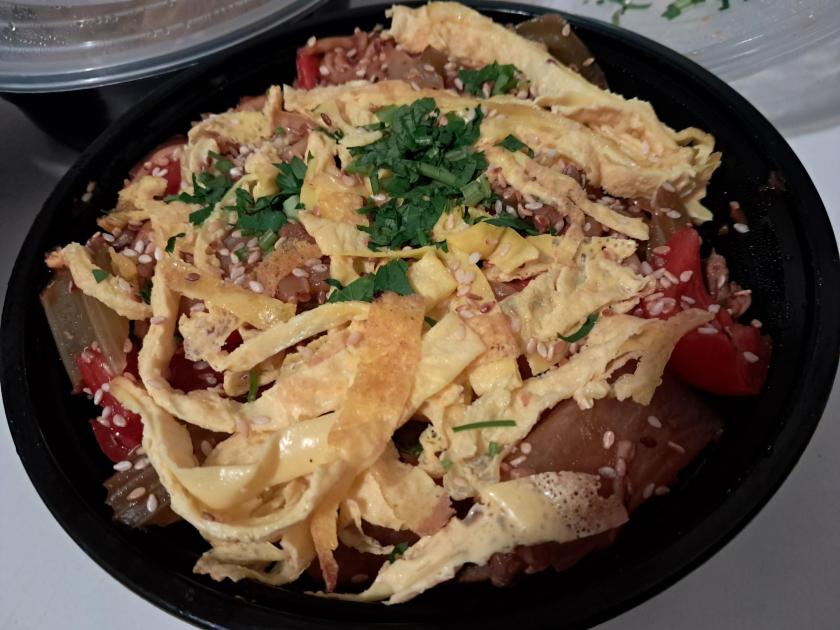
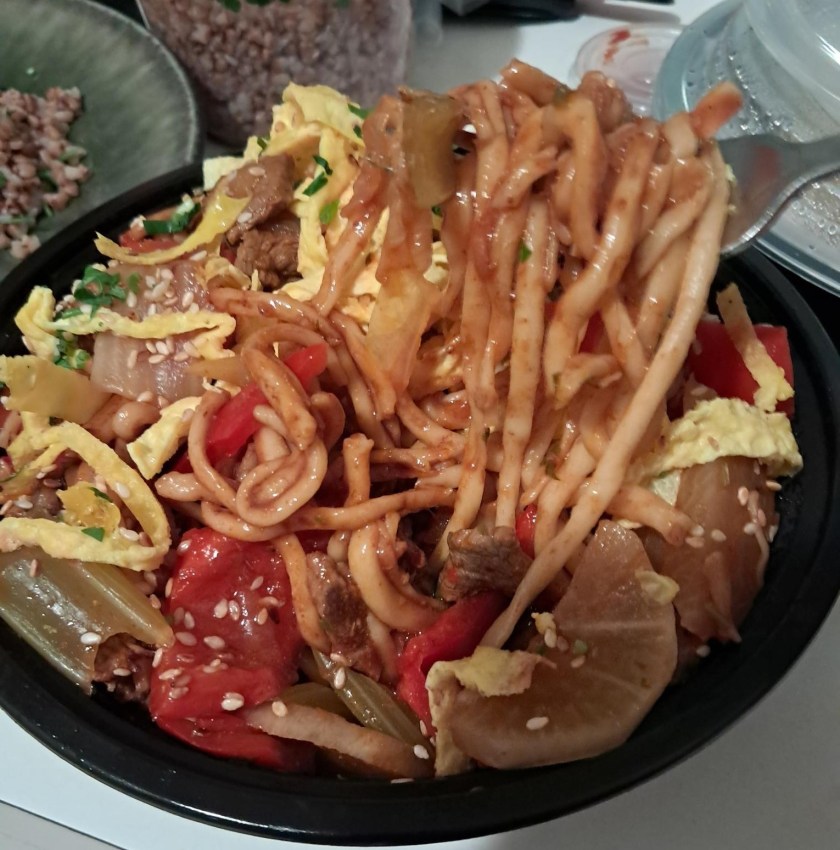
But that’s not all!  I had to try the boso laghman, a dish of hand-pulled wheat noodles, halal beef, thin strips of an egg omelet, sauteed onions and bell peppers, and sprinkled with parsley and sesame seeds, all sauteed together in a savory sauce.  Those are the omelet strips on top, not the noodles.

Here are the noodles, and they were so nice and chewy and al dente.  The sauce gave everything the slightest smoky flavor.  I also ordered laghman at Caravan, and while it was very good, I once again give the edge to Chayhana.  I’ve mentioned in a few different reviews that the term laghman was derived from the Chinese lamian (like the wonderful, chewy noodles I reviewed earlier this year at SLAP! Hand Ripped Noodles), and that’s how we also got the Chinese lo mein and the Japanese ramen.  

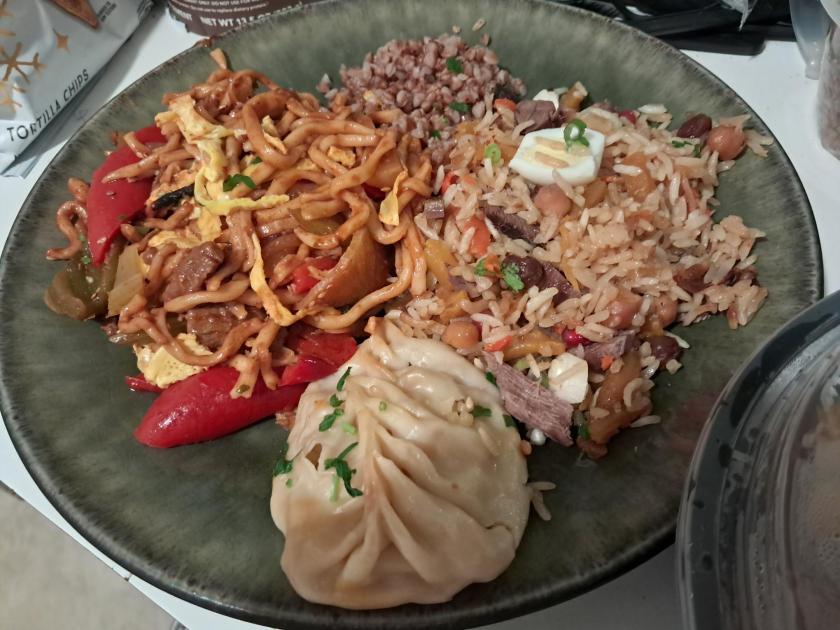
Here is my plate.  What a bounty!  And now you can get a good look at how gorgeous the dough sculpting on that manty was.

After reading the menu, my wife asked me to bring her pistachio cake, which I was happy to do.  But when I got there, they had two different pistachio desserts, and I wasn’t sure which one she wanted, so I brought both home.  That’s the kind of husband I am.

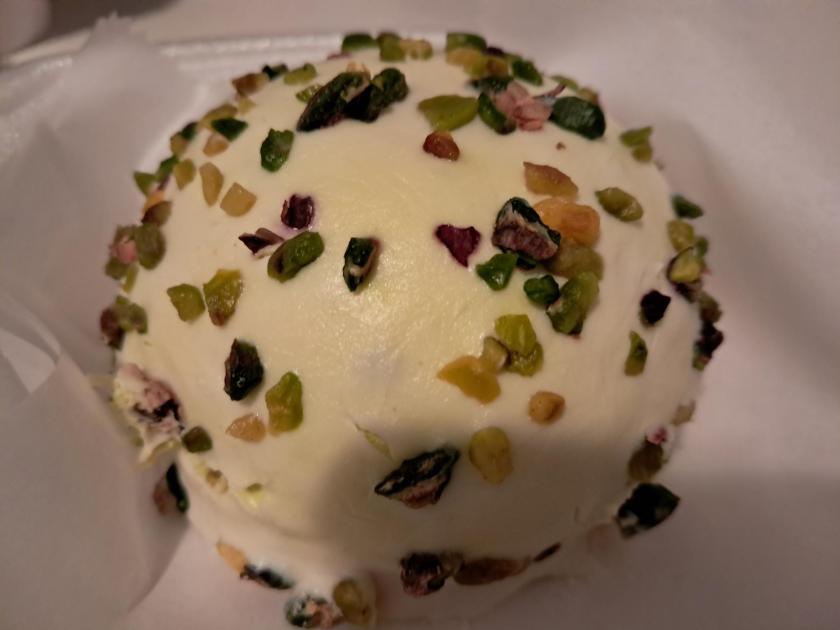
This dome-shaped dessert was the pistachio cupala, which Chayhana imports from a Michelin-starred bakery in Turkey.  I didn’t have any (I’m avoiding sweets, and this didn’t look like my thing anyway), but she seemed to like it.

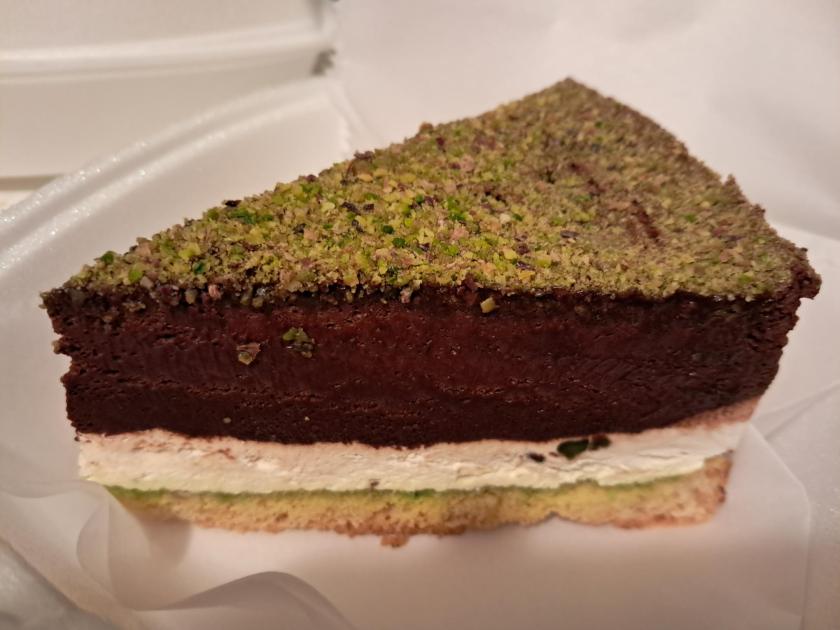
She preferred this Antep dream cake (topped with finely crushed pistachios above that rich, creamy layer of chocolate).  It was not listed on the website, but it was available when I went in.  I think it looks more appetizing, personally:

Everything was such a treat, I returned a few weeks later for another round of takeout.

The hummus wasn’t sprinkled with that seasoning or adorned with extra chick peas the second time, but she still liked it a lot:

The plov was still wonderful:

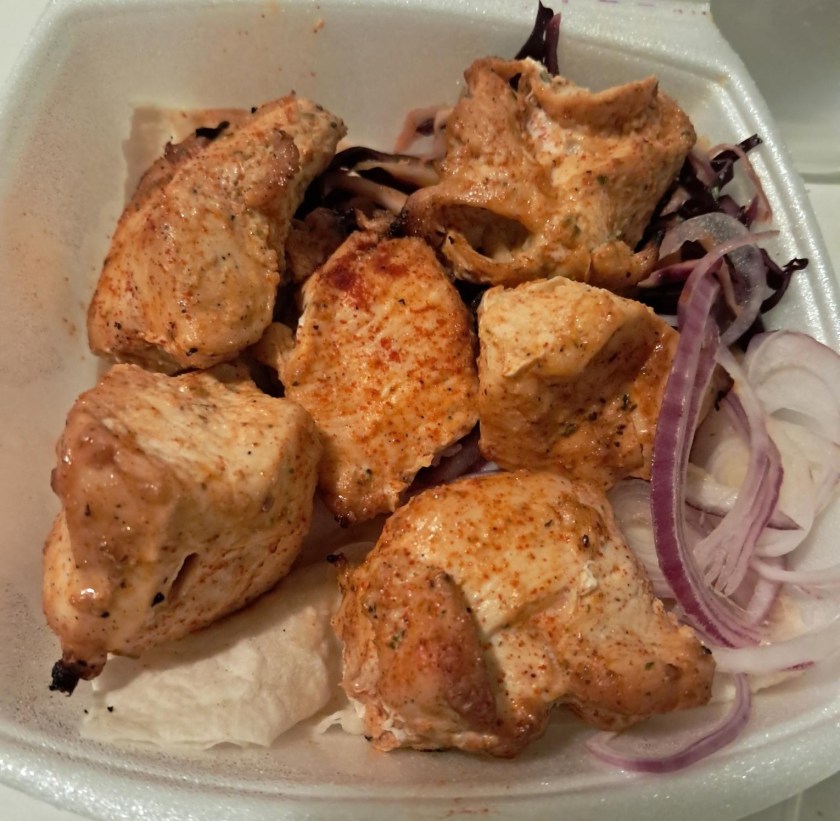
SinceI feel like I ran amok with carbs on our first takeout trip, I resolved to eat a little healthier the second time around.  This was the chicken shish, served in small chunks rather than one long skewer so it could fit in a small takeout box.  I could tell the chicken was marinated in herbs and spices and grilled, but I most admit, the picture on the website made it look better with the nice caramelization from grilling.  I don’t think it lived up to the “golden and smoky” description from the menu.  It was chicken breast meat, which is certainly healthier (and it’s what I cook and eat at home all the time now), but I think thigh meat is always more flavorful and feels like more of a treat. 

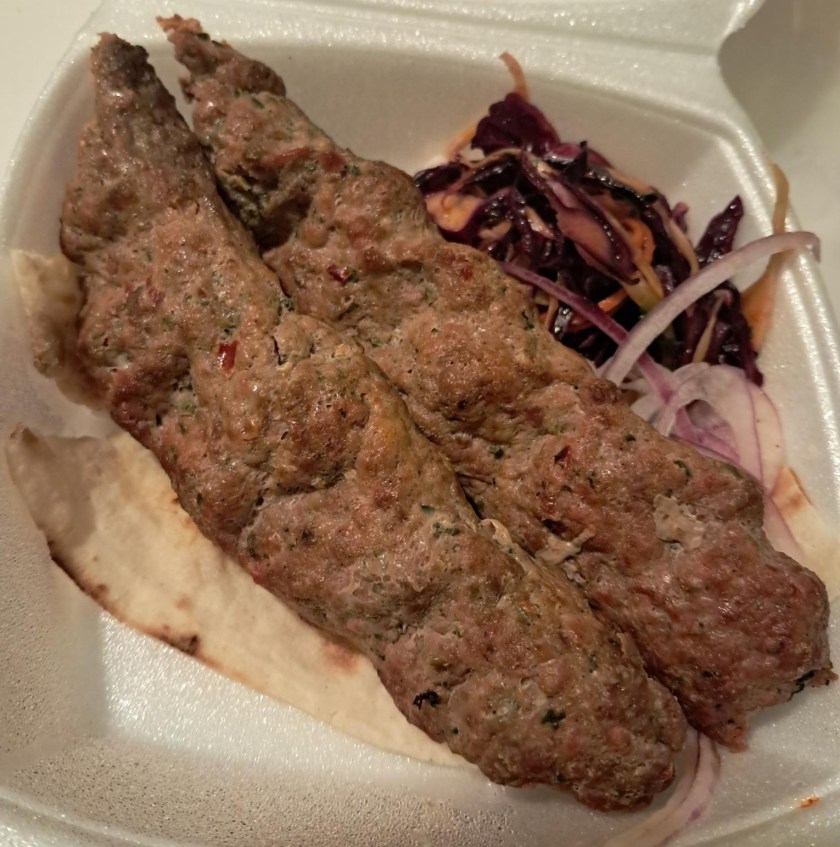
I preferred the lulya kebab, made of seasoned halal ground lamb and beef that was skewered and grilled.  This is the kind of thing I will always order at any Middle Eastern or Central Asian restaurant, kind of along the same lines as the lamb adana kebap I ordered at Istanbul Grill or the Iraqi kebab we tried at Rawsha Mediterranean Cuisine.  Both kebabs were served with red onions (some raw, some grilled) over very thin flatbread.
We have yet to dine in at Chayhana, but there is a nice little dining room that looks comfortable.  When I picked up my takeout orders, it was during the holy month of Ramadan, and smiling Muslim families were just starting to show up for dinners.  Everyone looked so happy to be there, and hopefully I’ve communicated why.  Chayhana is the very definition of a hidden gem, serving food that may be somewhat familiar, but with unique twists.  It makes you think about geography, about how little we (as Americans) know about Uzbekistan and other Central Asian countries, but how their cuisine has so many similarities with Turkish and other Middle Eastern fare, and how they all evolved from shared origins.  That makes our increasingly complicated world seem a little bit smaller, and hopefully gives us all a little hope that we’re not so different, you and I.  And for those of us who live in the Orlando area, we are so lucky to have a diverse culinary scene that allows more than one Uzbek restaurant to survive and thrive, even in super-suburban Altamonte Springs.

Phoresh Noodle & Street Fare

It has been a while since I made this trip to Phoresh Noodle & Street Fare (https://orlandophoresh.com/) with a former co-worker from my previous job, and since then, both of us have moved on to bigger and better things.  It is one of the few Vietnamese restaurants on the east side of Orlando, located at 2751 S Chickasaw Trail #107, Orlando, FL 32829, just south of Curry Ford Road.

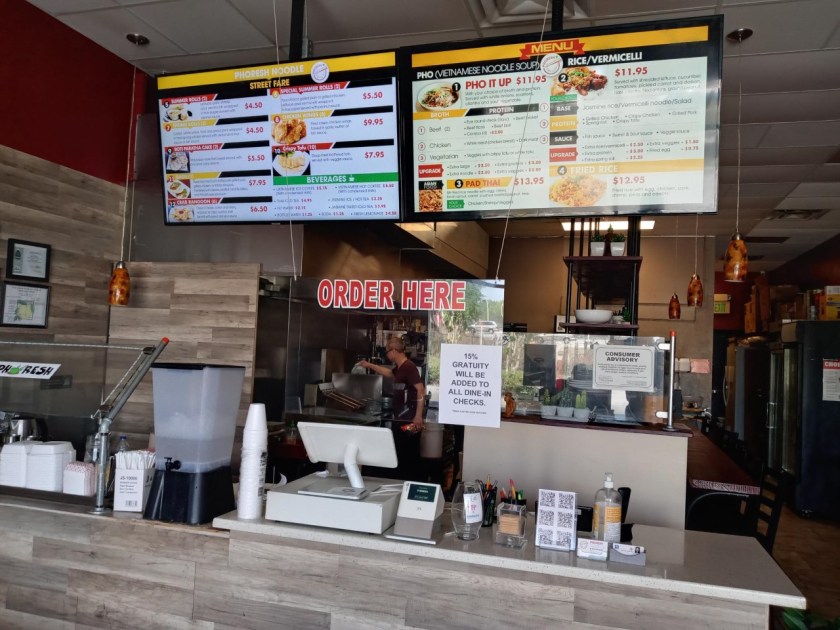
Phoresh is a casual restaurant with counter service:

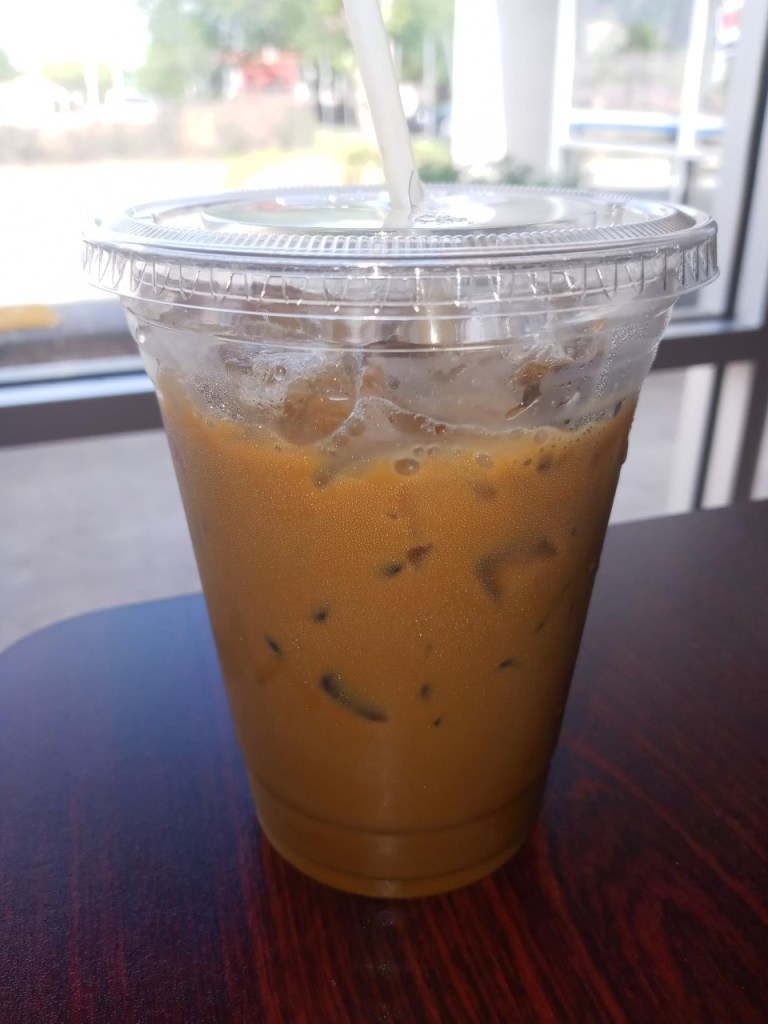
I ordered a Vietnamese iced coffee, which I like the way I like my women: sweet and strong.  But since I so rarely drink coffee, it made my heart race for the rest of the afternoon (women often have that effect on me as well).  Next time, I know I would be better off with just water.

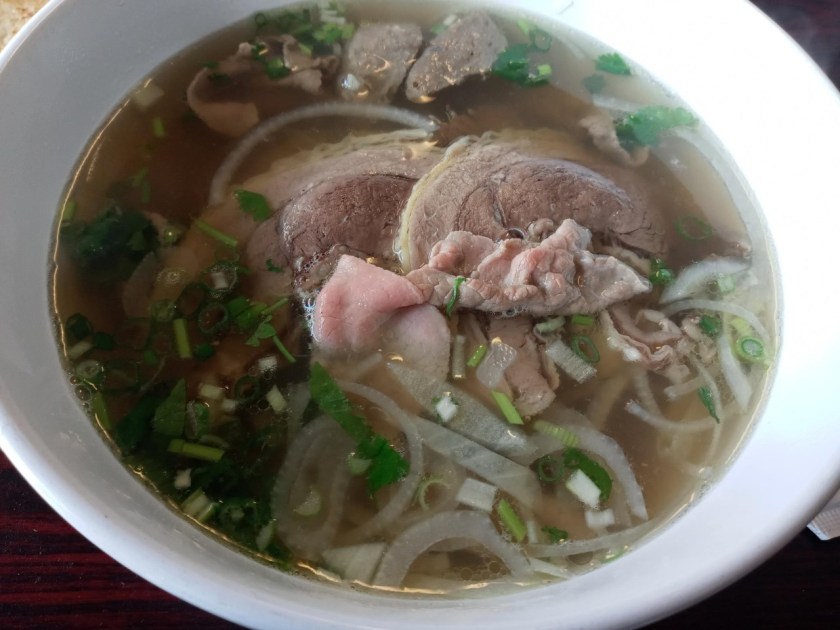
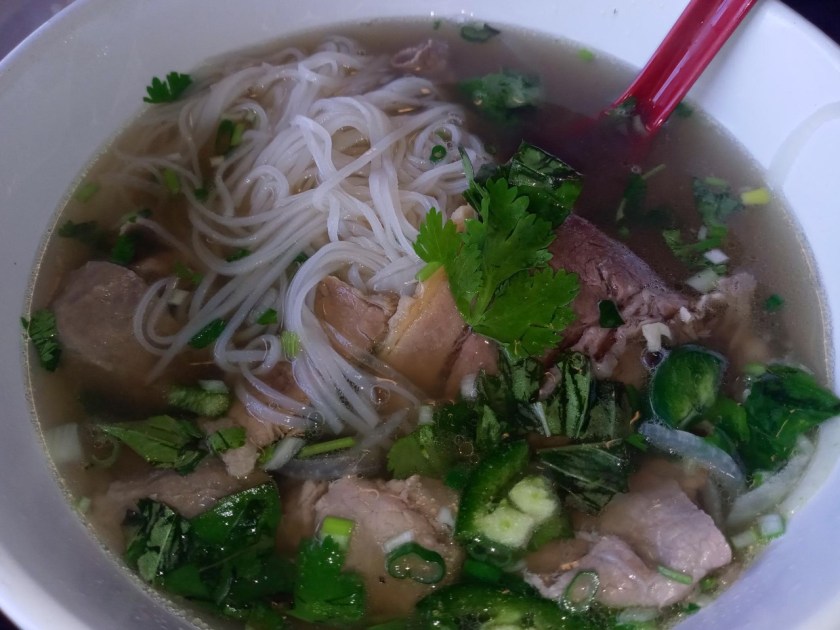
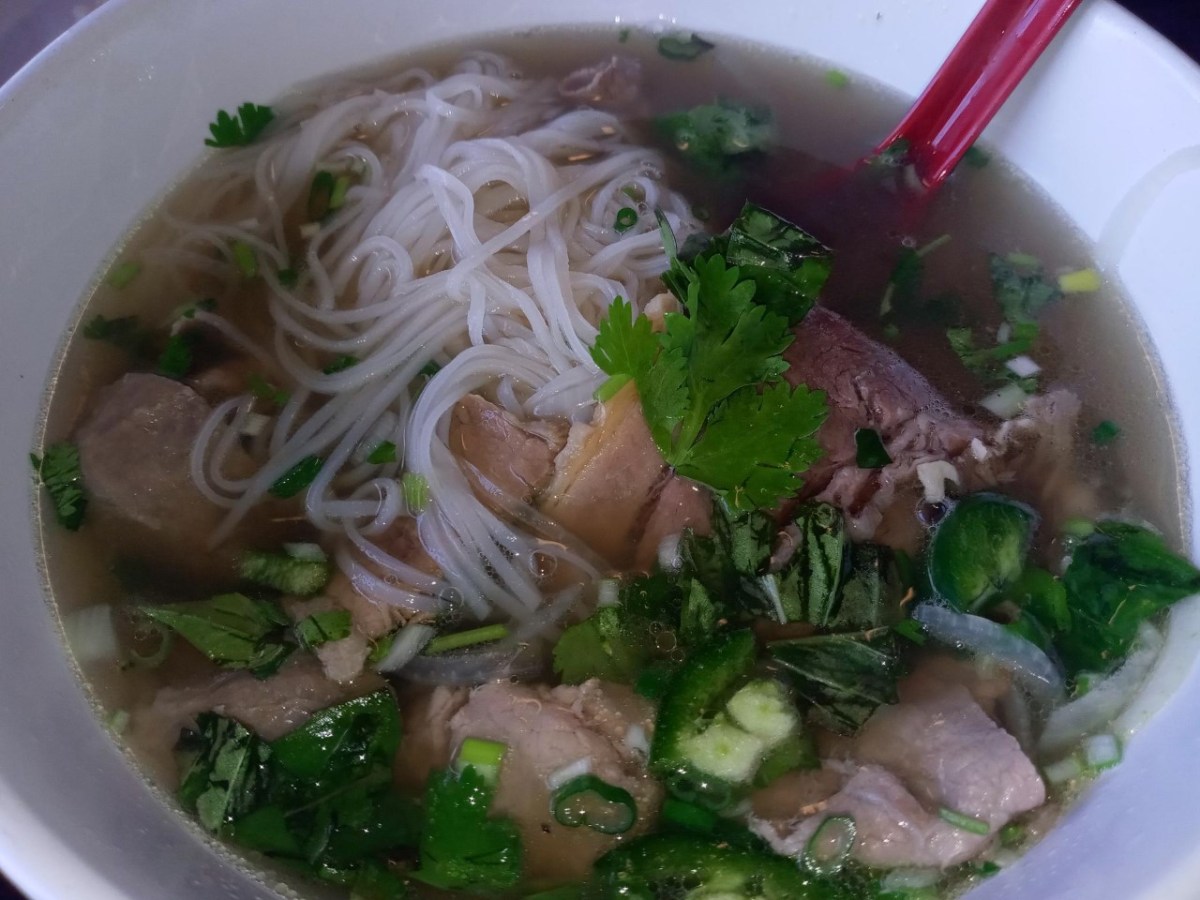
When you order the “pho it up,” you have a choice of beef, chicken, or vegetarian broths, with different proteins available for each.  I ordered the beef broth, and I paid a $4 upcharge for the “combo” with all four possible proteins: paper-thin slices of raw eye round steak (they cook in the hot broth, but I like my steak rare no matter what), beef brisket, beef flank, and dense, chewy meatballs (nothing like Italian-style meatballs).

Here it is after a bit of stirring, to make the rice vermicelli noodles visible:

It was a super-solid bowl of pho, and I can’t say anything bad about it, but I have yet to find anything to dethrone my favorite, Pho Huong Lan.

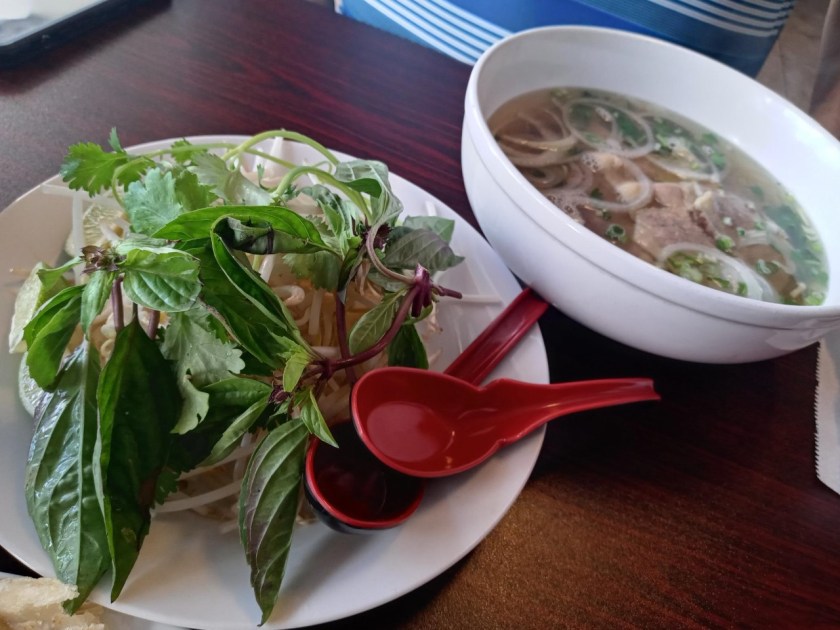
My colleague ordered pho with just brisket.  We shared the plate of herbs, but I don’t like bean sprouts, so he got to have them all.  I love putting basil, lemongrass, and fresh jalapenos into my pho.   

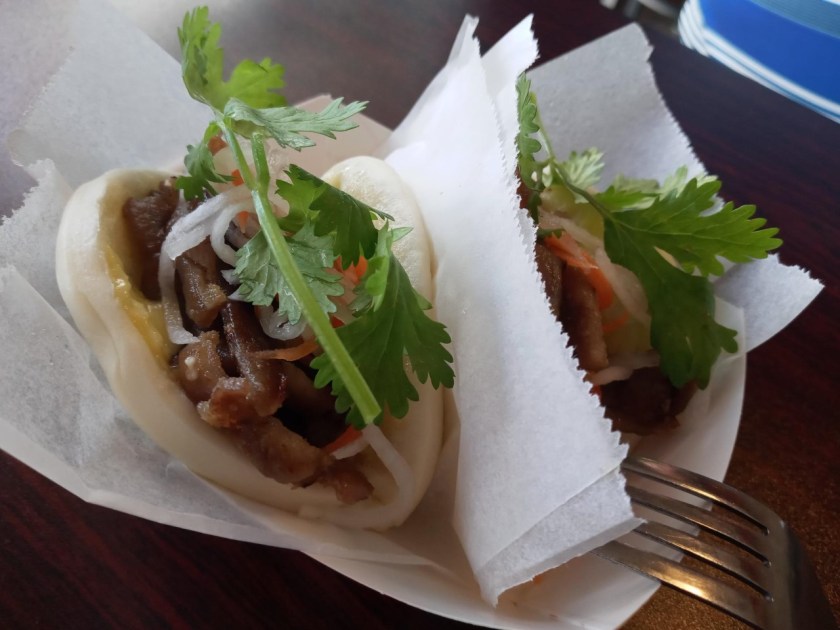
He got an order of pork belly bao, and we each had one.  It was AWESOME.  Looking at the current menu, Phoresh lists grilled pork as the only pork-related option for the bao, and I’m guessing that would be different than the pork belly we ordered, admittedly a while back. 

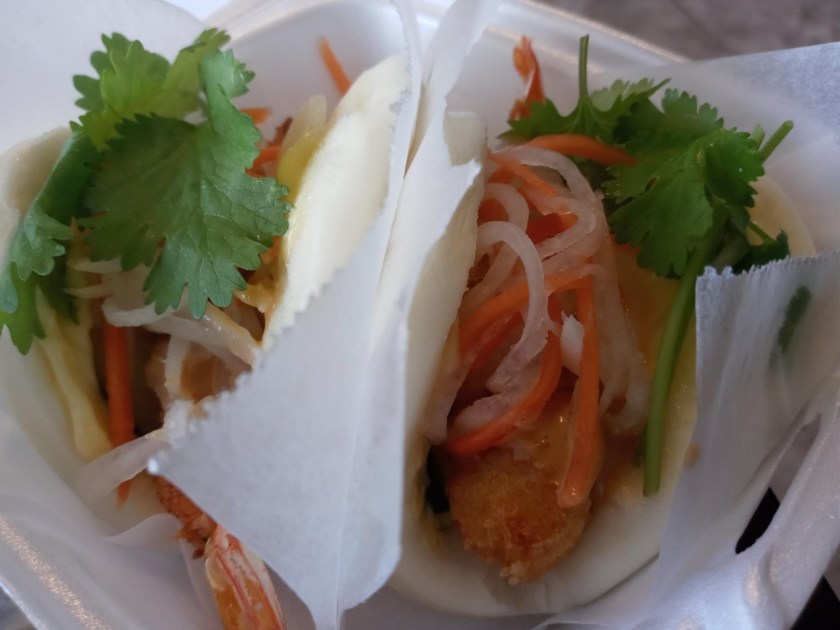
I, in turn, got the tempura shrimp bao, and we each had one of those too.  I loved them as well.  The cool, crispy, slightly sweet pickled vegetables on the top, which would not be out of place on a banh mi sandwich, really made the bao sing.

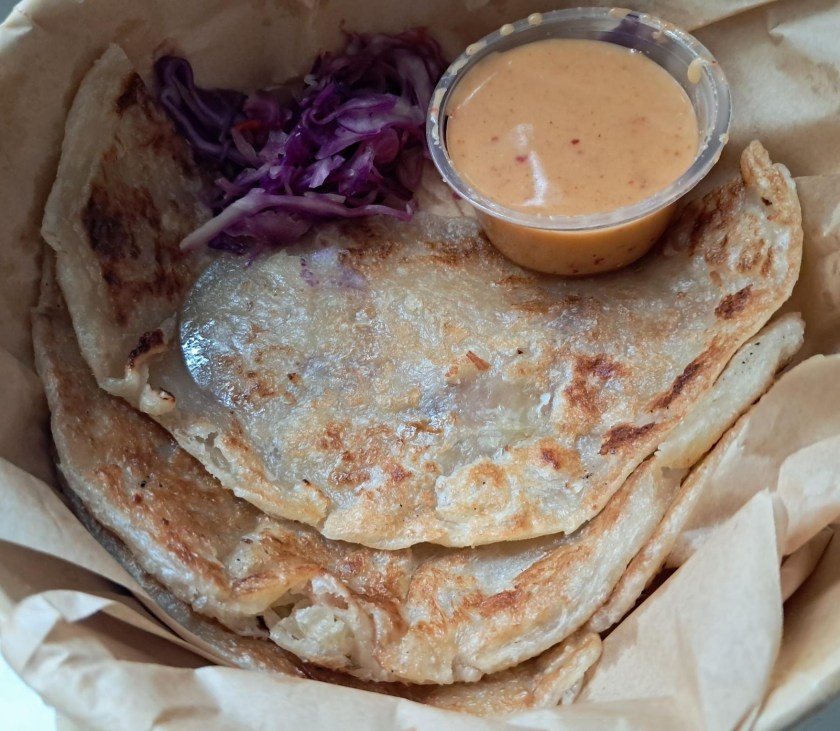
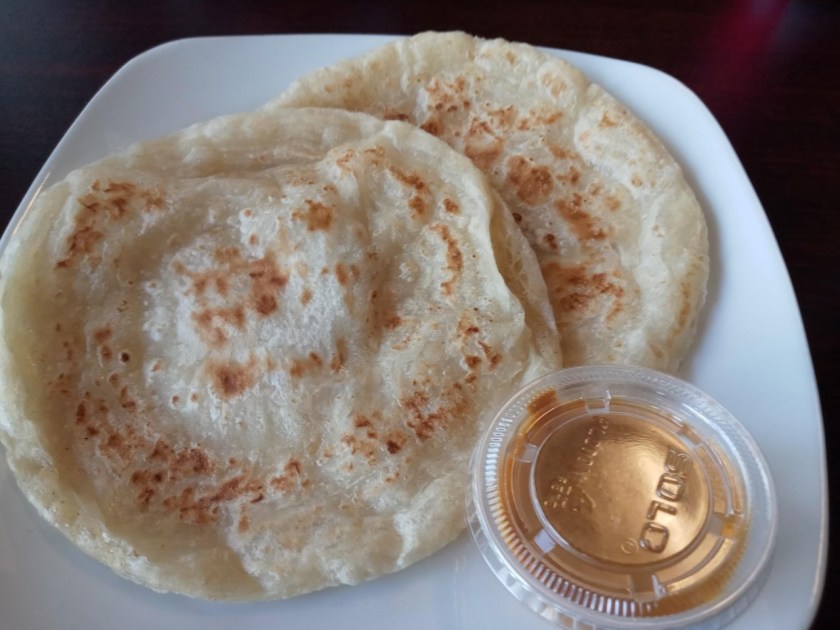
Finally, I got an order of two roti paratha cakes for us to share, but my colleague wasn’t into them, so I had most of them with the spicy curry sauce they came with.  I’m guessing these were pre-made and frozen, then heated up on the grill, not unlike the roti I used to buy at Asian markets to keep in the freezer at home.  But I’m guessing even Hawkers Asian Street Fare doesn’t make their roti from scratch (or could this be me picking a fight with Hawkers?  I’m guessing they won’t notice or care.)  Anyway, these things are are always good, so no complaints.   Like I always say, imagine the love child of a fresh, fluffy flour tortilla and a flaky croissant, and you’ve got roti and/or paratha.

So that was our visit to Phoresh Noodle & Street Fare.  If you live in Orlando, you probably have strong feelings about the best places for pho, and some might offer more pho options, larger menus, and/or table service.  But like I said, there aren’t many Vietnamese restaurants in East Orlando, so if you live out that way, you should definitely give Phoresh a try.

Aloha Hawaiian Kitchen

I love Hawaiian food, and I had been excited to try Aloha Hawaiian Kitchen (https://alohahawaiiankitchen.com/) for a while.  Aloha is down near Orlando International Airport, so I don’t see it becoming part of my regular restaurant rotation, but when I finally made it there in December, it did not disappoint.  Hawaiian cuisine evolved from a combination of Native Hawaiian, Japanese, Chinese, Filipino, Korean, Portuguese, and mainland American ingredients and influences due to the diaspora, but it is very much its own thing.  It is one of my favorite regional American cuisines, up there with Ashkenazi Jewish delis and appetizing stores and the grand tradition of barbecue.  But while I’ve tried amazing delis in New York City, Los Angeles, and South Florida and barbecue in Texas, Memphis, and right here in Orlando, I have yet to visit Hawaii, so I take our local Hawaiian restaurants at their word.

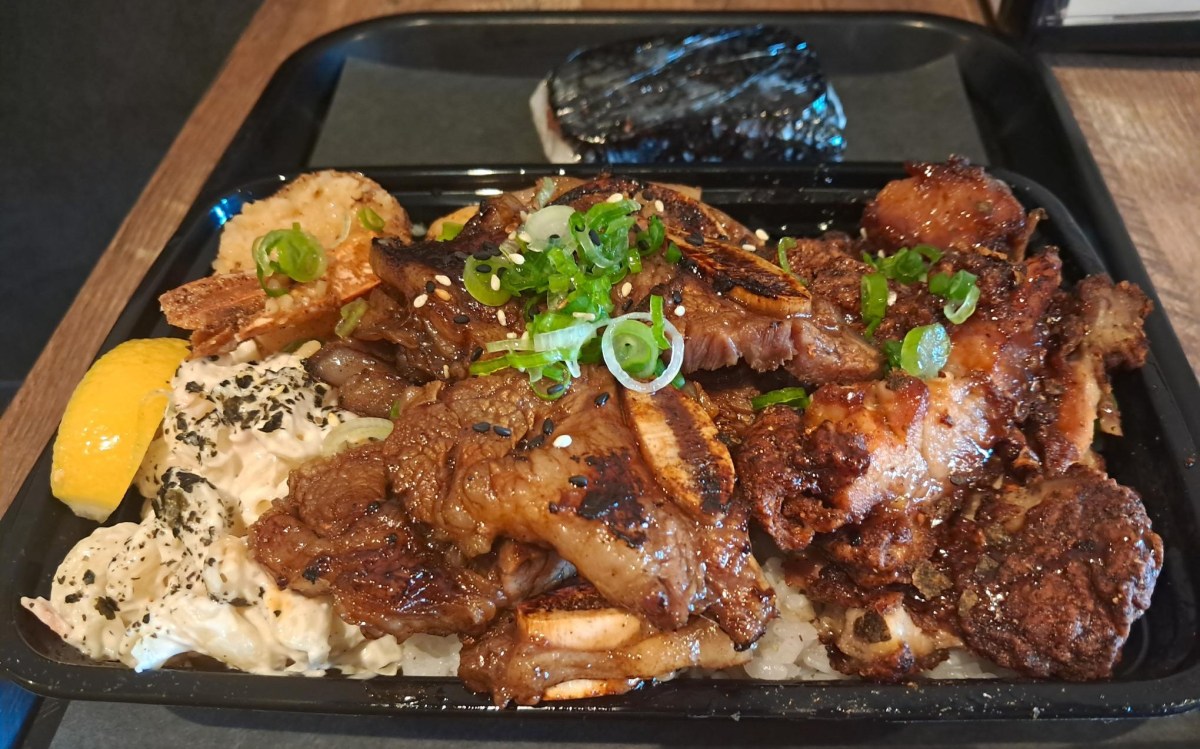
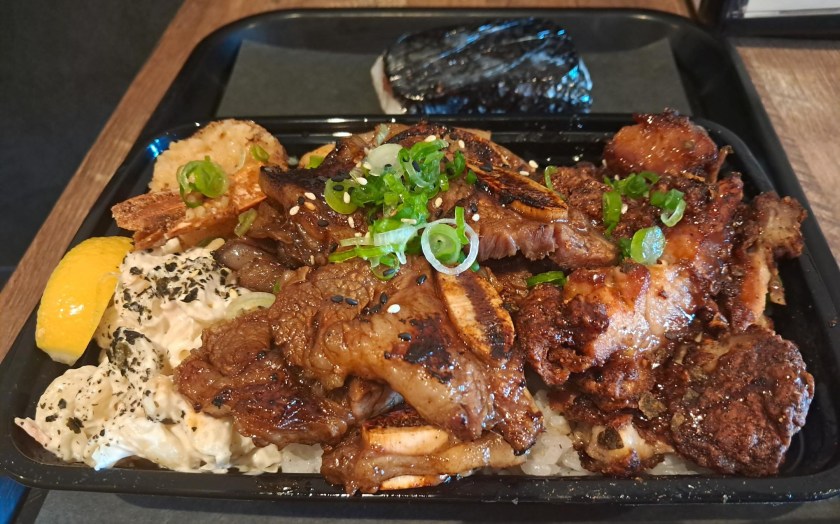
Because I always love sampling multiple things, especially when I know I won’t be able to return to a restaurant often, I ordered the Surfside Sampler, which comes with three meats: marinated and grilled beef short ribs (kalbi), crispy marinated and fried ono shrimp, and marinated and pulled luau pig.  However, I asked if I could substitute the mochiko chicken instead of the luau pork, since it is the same price when they are sold separately.  They were kind enough to allow me to get that substitution.  This heaping tray came with scoops of white rice and Hawaiian macaroni salad, which I am a huge fan of.  It was probably more than enough calories for the full day, with more to spare.  I think the Hawaiians perfected mayonnaise-based macaroni salad, which I have recreated at home.  The secret, which I found in a few different recipes, is to let slightly underdone macaroni noodles absorb a lot of milk, and then stir in your mayo.  (They recommend Best Foods, which I think is the same stuff sold as Hellman’s in the eastern U.S., but I’m a Duke’s man.)
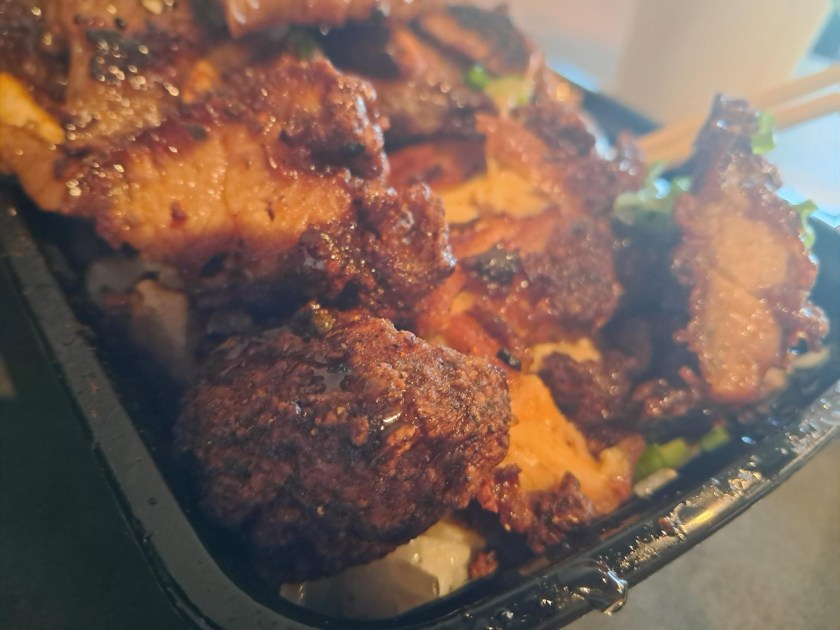
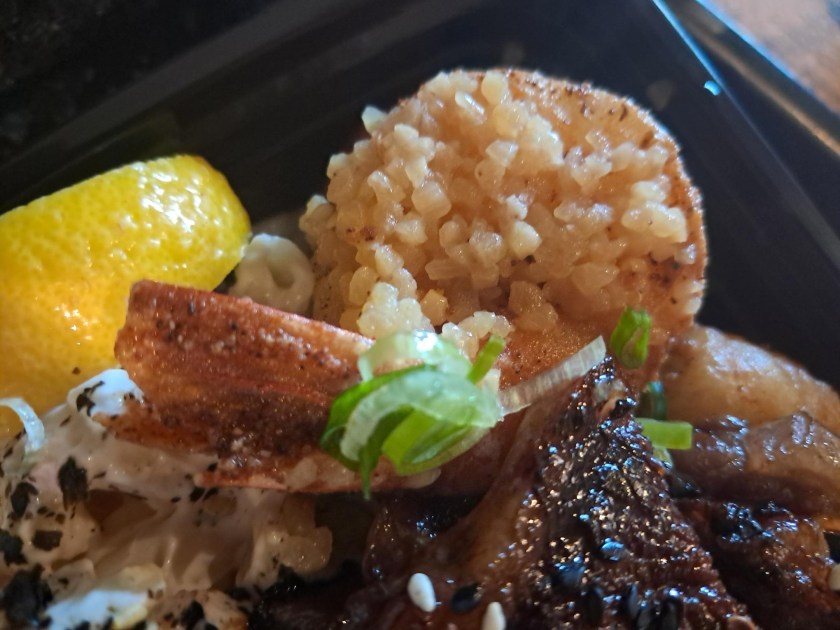
I first tried mochiko chicken at the first Hawaiian restaurant I ever visited, a place called Hawaiian Grindz that used to be on State Road 434 in Oviedo.  It didn’t last very long, perhaps in part because the laid-back owners didn’t always open on time… or at all, despite posted hours.  But I loved the little pieces of fried chicken thighs, which were lightly breaded and then tossed in a sweet sauce.  While these mochiko chicken pieces at Aloha look a bit dark, I can assure you they were fried to crispy perfection.  They weren’t overly sweet, either.  It was a nice blend of sweet and savory — much less sweet than the mochiko chicken at the old place that closed. 

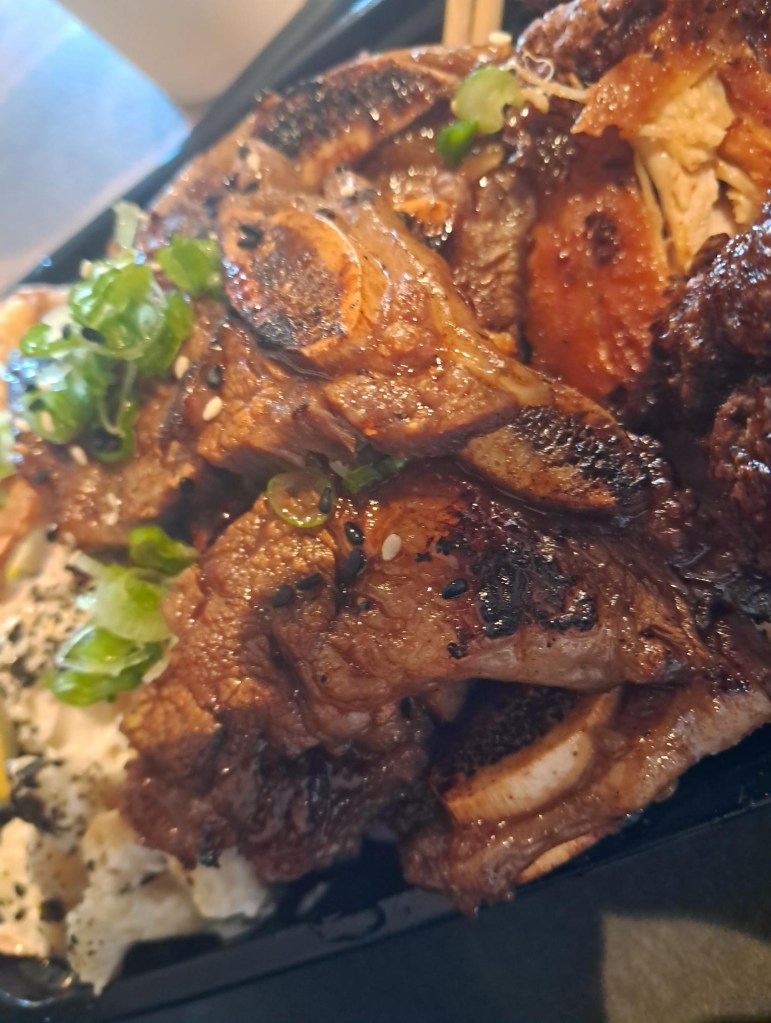
Here’s a close-up of the kalbi, those wonderful marinated and grilled Korean-style beef short ribs, cut against the bone  These also had a savory-sweet marinade,  and the grilling process added some great flavor from caramelizing sugar on the surface.  The meat was tender, but not exactly falling apart or off the bone.  Kalbi (sometimes called galbi on Korean menus) always has a pleasant chew, and you can usually tear or bite the meat near the bone and pull it right out.  That area is even chewier, but the texture is nice. 

Here is an extreme close-up of one of the crispy, garlicky-fried shrimp.  It had such a nice flavor and crunch, and just like at my beloved Poke Hana, it is fried so well that you can eat it crunchy tail and all.  Look at all that garlic! 

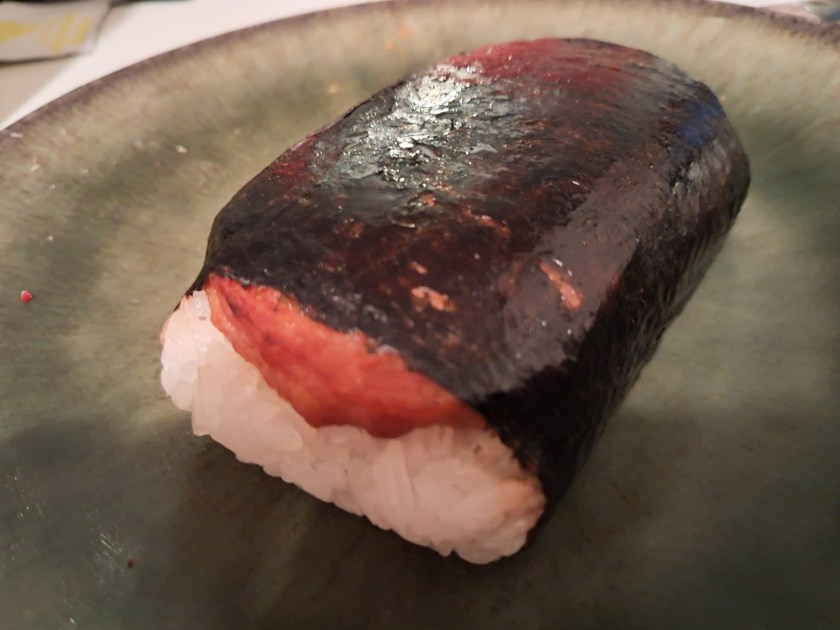
While I wanted to try more, I limited myself to a Spam musubi, which I enjoyed later, back at home.  These are the ultimate in simple comfort food: a slice of fried Spam (which is actually delicious, snobs and skeptics!) on a bed of sushi rice, rolled tightly in a sheet of nori (seaweed, the same stuff in sushi rolls), and often served warm.  I’ve seen these musubi referred to as “Hawaiian protein bars,” and they do have just enough protein and carbs to give you a burst of energy when you need it.

By the way, Spam is a product of Minnesota, but it became closely associated with Hawaiian cuisine when the U.S. military used it to feed troops stationed in Hawaii in the 1940s.  That’s how it found its way into saimin (a Hawaiian take on ramen), Spam fried rice, and of course, the musubi.

We are lucky to have a few wonderful Hawaiian restaurants to choose from in Orlando, including the aforementioned Poke Hana, OverRice, the new Moa Kai Hawaiian Diner, and Hanalei Shave Ice for a cool, refreshing dessert.  Aloha Hawaiian Kitchen is in great company.  Sadly, Aloha is much further away from me, but even though I don’t foresee going back as often, it was very good, and I’m so glad I tried it.  If you find yourself down near the airport, or coming or going from the 528 or the Lake Nona area and you don’t feel like awesome seafood at High Tide Harry’s or Orlando’s best Cuban sandwich at Vicky Bakery, check it out.  Aloha features a large menu, including meat-centric combo meals like I ordered and customizable poke bowls, if you want something lighter than the smorgasbord of meats I enjoyed.  Nowadays, as I continue slowly losing weight from eating less and eating healthier, I would have gotten two or even three meals out of that Surfside Sampler, but I  housed it in one sitting at the time, thinking that dangerous thought of “Well, it won’t be as good heated back up later!”  I’ve come a long way over these past four months.

SLAP! Hand Ripped Noodles

Back in 2019, when I took my wife to New York City for our tenth anniversary, one of the many delicious restaurant meals I had was takeout from Xi’an Famous Foods, a casual restaurant specializing in hand-ripped biang biang noodles and spicy braised meats from the city of Xi’an in northwestern China.  It was like no other style of Chinese food I’ve ever had before, and I’ve been saying for years that even with Orlando’s breadth and depth of various regional Chinese cuisines, we have desperately needed a place like that.  Well, we finally have one!

SLAP! Hand Ripped Noodles (https://www.instagram.com/slap.noodles.usa) opened back in November 2025, at 6532 Carrier Dr Ste B, Orlando, FL 32819, right off International Drive, a little north of Sand Lake Road.  It has been a popular destination ever since, with influencers aplenty sharing videos of chefs slapping and stretching dough to make perfectly long, chewy noodles from scratch and diners slurping them up.  I’ve been wanting to try it ever since it opened, and I finally made it over there yesterday with my best friend, after surviving yet another MegaCon.  (We went to The Whiskey two years ago and Fogo de Chao, which I somehow still haven’t reviewed, last year.)

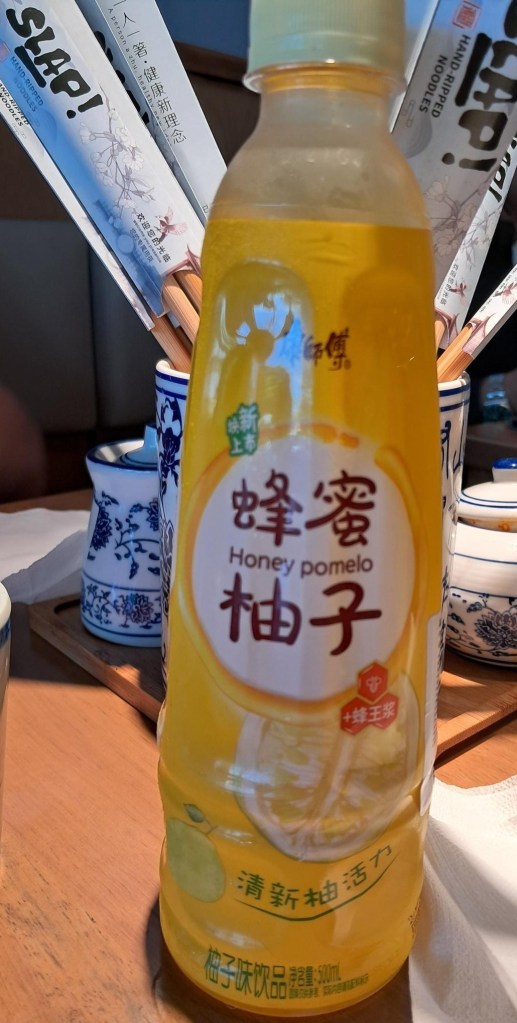
I’ve been so good lately about not drinking my calories, but I figured our food would be spicy, so I treated myself to a sweet drink from SLAP!’s beverage cooler, this interesting-looking honey pomelo drink.  After I chose it, I found a small English language label on the back that described it as honey grapefruit tea.  It was so sweet and refreshing and delicious, and I loved it, especially as a nice treat after a grueling day. 

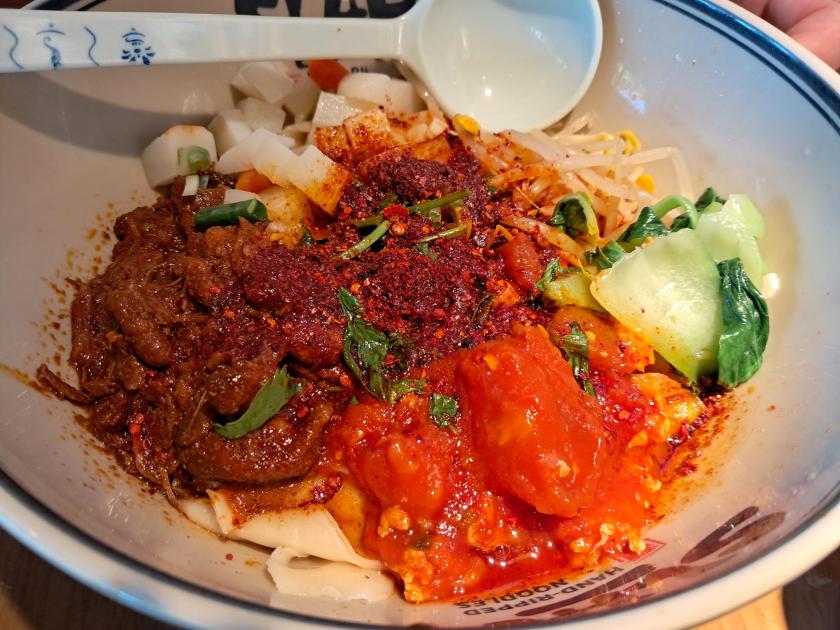
It was way too hot for bowls of soup, so my friend and I both chose chili SLAP! noodle bowls, sans soup.  He got the signature three-way chili SLAP! noodles, which we learned was a combination of three of their other bowls that can be ordered separately: sliced pork, tomato and egg, and vegetable (which included cubed potatoes, celery, and carrots at the bottom.  They also included bok choy, bean sprouts, and lots of chili oil and chili powder.  It looks fiery, but believe it or not, it was a lot milder than it looks.   There were a bunch of those perfectly al dente biang biang noodles under there, don’t worry!

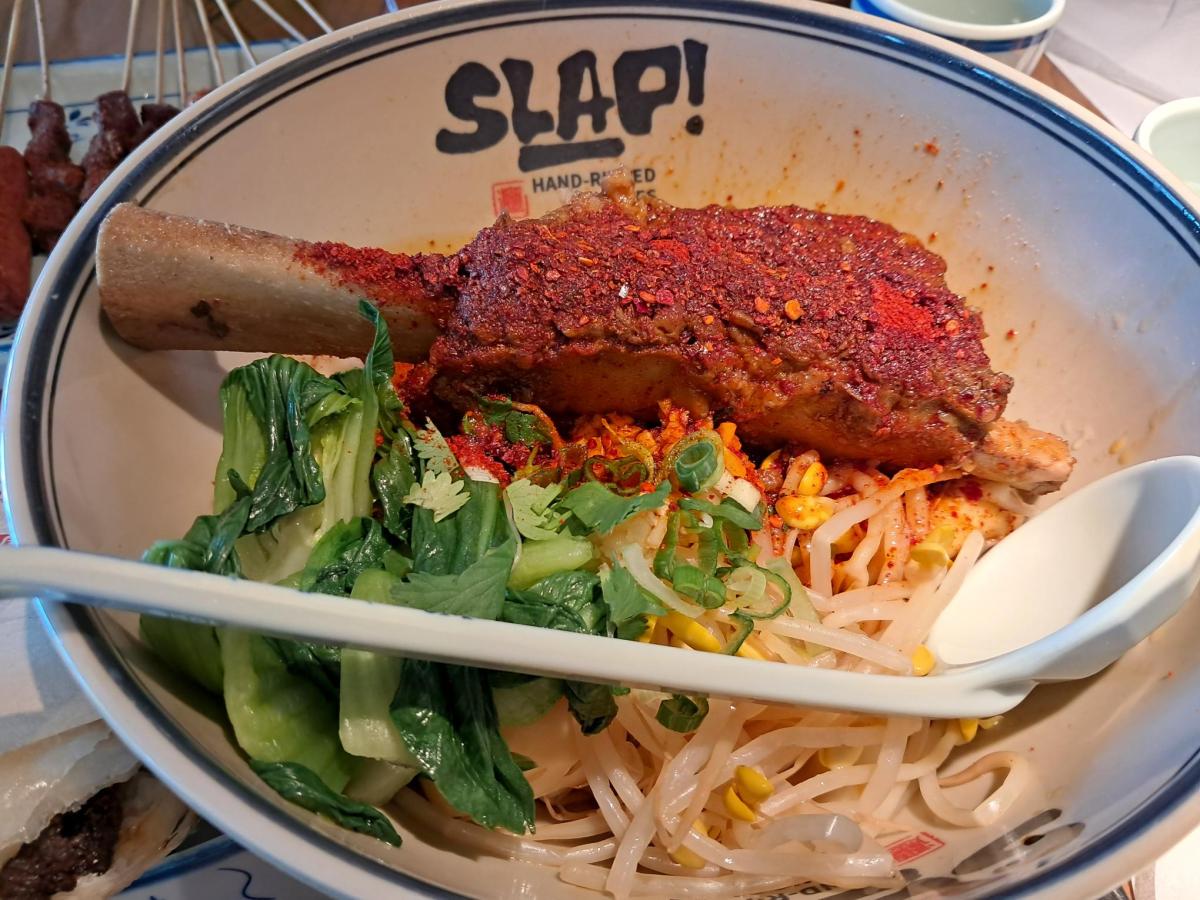
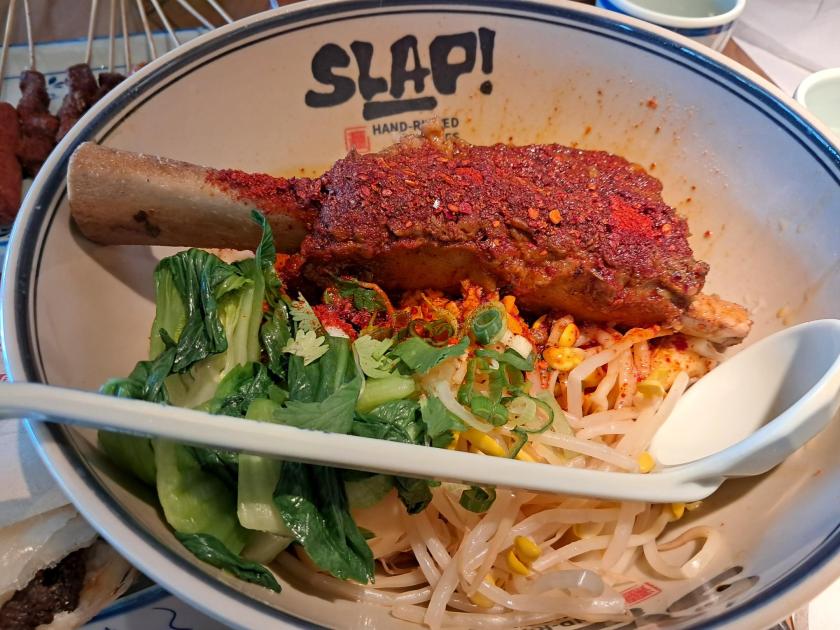
I got the beef short rib chili SLAP! noodles (no soup for me either), because short ribs are up there with oxtails and lamb shanks as rich, flavorful, unctuous cuts of meat I have a hard time turning down.  It has the same kind of seasoning and also included bok choy (which I like) and bean sprouts (which I don’t care for, so I’ll know to ask them to hold the bean sprouts on future visits).  I loved that they included a pair of kitchen shears for cutting the short rib, which I wish more restaurants would give you.  A few well-placed snips separated all the tender meat from the giant bone, and a few more cuts turned it into bite-sized pieces.  I got two meals out of this giant portion, which I’m getting so much better at.   

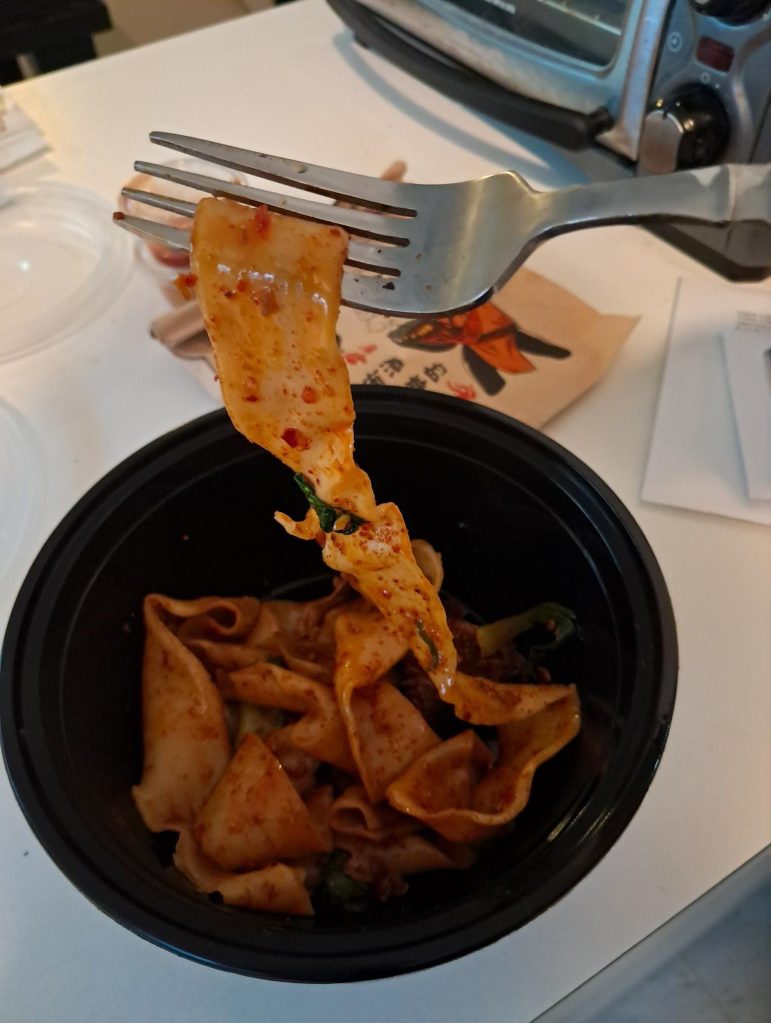
I forgot to get a good picture of the actual hand-ripped biang biang noodles at the restaurant, but here they are in my leftovers, back at home.  At the restaurant, we only ate with chopsticks.  These noodles are awe-inspiring, and the chili seasoning is addictive.  I suspect these dishes would still be too spicy for my wife, parents, brother, and in-laws, who hate anything beyond “mild,” but I think most people will find the taste pleasant and the spicy level nowhere close to overwhelming.   
By the way, watch how you dress at SLAP!, because it is too easy to splatter a good shirt with that chili oil.  I’ve been wearing the same beloved shirt to comic book conventions for 25 years to pose for pictures with comic writers and artists, a running gag that only I appreciate.  Luckily, I had the foresight to pack an expendable T-shirt to change into when we got to the restaurant to protect The Shirt.

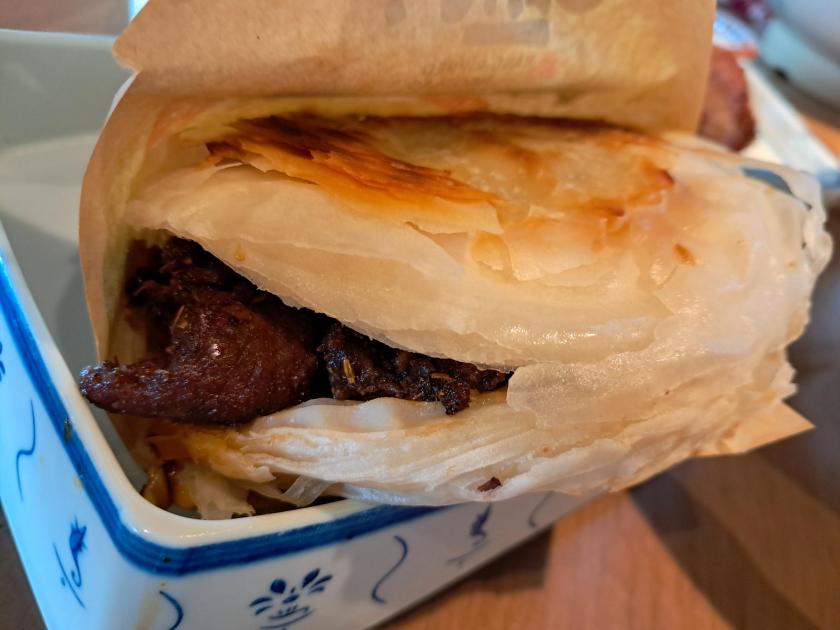
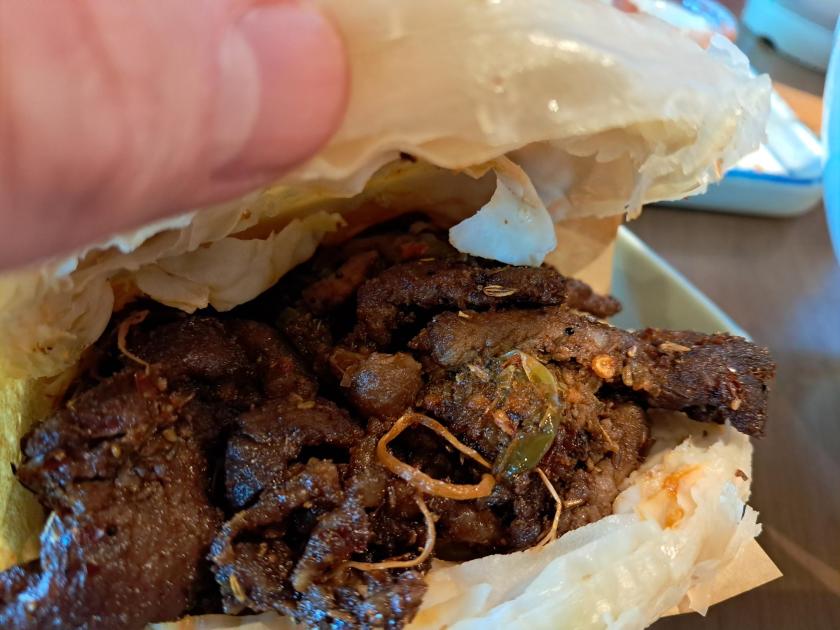
I was also excited to try one of the “crispy pancake” sandwiches at SLAP!, and I went with cumin lamb.  Lamb is probably my favorite protein of all time (not including cured Italian meats), and I still remember the spicy cumin lamb “burger” I got at Xi’an Famous Foods in 2019.  In that earlier review, I described it as being served on “a crispy flatbread bun that was like a cross between a pita and an English muffin, in terms of texture.”  Here at SLAP!, the flavorful lamb was served on roujiamao, which is more like a flaky paratha or roti, a flatbread I’ve described many times as being the love child of a croissant and a flour tortilla.  This roujiamao was much flakier, with more crispy layers, than the typical roti you may have had at Hawkers Asian Street Fare (which you can also buy frozen, as I suspect Hawkers does).  This didn’t have that rich, buttery flavor either, but it complimented the cumin lamb very well, and it was fun to eat it. 

My friend and I each took a few bites, and we still had some left over that I finished for lunch today.  This was a hit, and you can also order the crispy pancakes with braised beef or braised pork.  Next time!  And yes, there will be a next time. 

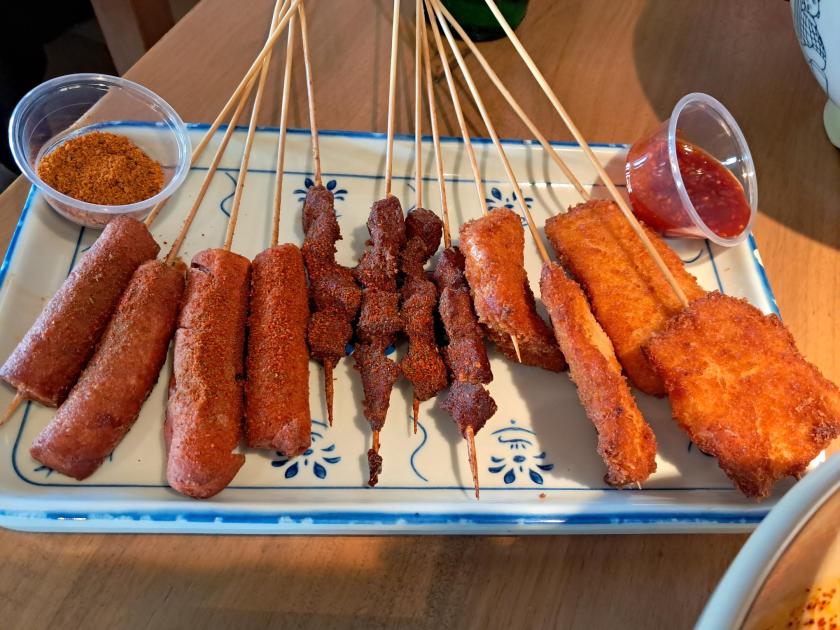
Finally, we also tried some skewers, because we know how to party, and how often will be able to make it back here?  It’s across town from me, and my dude lives in Miami!  Homestead, actually!  All the skewers at SLAP! are served in orders of four for a very reasonable $5.99 each, but you can’t mix and match.  That’s how we ended up with a dozen skewers.  The four on the left are Chinese sausage, which was both of our favorites.  They were grilled and coated with the same chili spice blend, but they weren’t like the chewy and slightly sweet lap cheong I expected, which I love in fried rice.

The four skewers in the middle are beef, which were also grilled and coated with the same chili spicy powder.  They were chewy and not terribly tender, and not juicy at all, but at least they tasted good.  The four crispy chicken skewers on the right were disappointing, though.  My friend was spot-on when he called them “basic.”  I’ve had spicy chicken nuggets from Wendy’s with more flavor, so at least I know to skip them on future visits.  The sauce on the right side that looks like it’s about to spill (we didn’t let that happen) was reminiscent of Thai sweet chili sauce, but not nearly as sticky or sweet.  That sauce and the chili spice on the left helped make the crispy chicken skewers somewhat more interesting, but I’d still order something else next time.  Maybe an order of dumplings, which you can get with lamb, beef and onion, pork and cabbage, or pork, shrimp, and chive.

Vegetarians, there aren’t a ton of options for you at this meat-centric restaurant, but you can safely get the vegetable chili SLAP! noodles, vegetable noodle soup, and a couple of different skewers: enoki mushrooms with tofu skin, cilantro with tofu skin, or “fish tofu,” which I’m assuming is tofu reminiscent of fish, and and not a combination of fish and tofu.  If you are ovo-vegetarians, you could also do the tomato and egg chili SLAP! noodles or tomato and egg noodle soup.

And since I always check (on behalf of my wife), there are a few half-booths along the side wall at SLAP!, in addition to plenty of tables.  Napkin dispensers hang from the ceiling above each table, which you’ll appreciate due to needing a lot of napkins for meals like this, and also for the space they save on the tabletops.  (Short people, your mileage may vary).

SLAP! Hand Ripped Noodles is definitely worth all the hype.  I would have liked to get there sooner, but better late than never.  Now I look forward to returning, but I wanted to publish this review as soon as possible, for the handful of you out there who haven’t already jumped on the bandwagon.  It’s another treasure for Orlando, especially when the options along International Drive are so chain-centric.  As if there was any doubt, SLAP! slaps.

Sushi Island

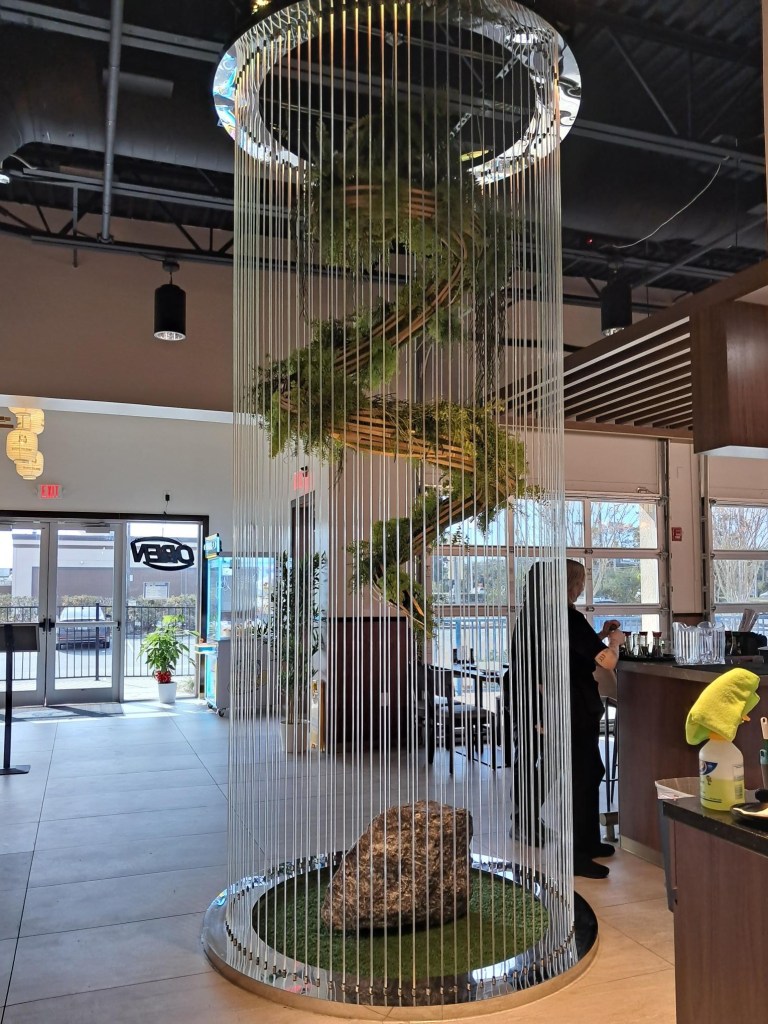
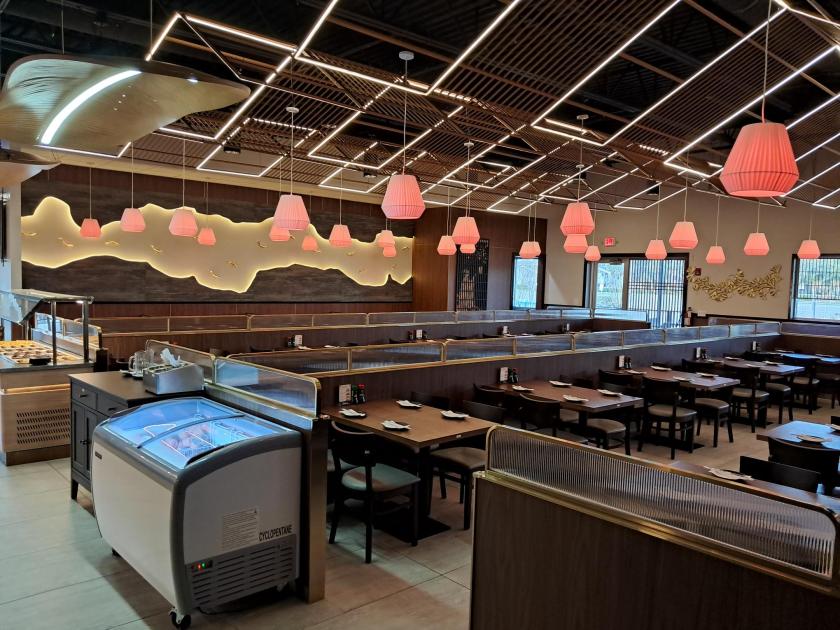
Sushi Island (https://sushiislandwinterpark.com/) is a new all-you-can-eat sushi restaurant in Winter Park, at 227 S Semoran Blvd, just south of University Boulevard near Full Sail University.  The owner completely remodeled what used to be a (bad) sports bar/restaurant called Arooga’s, and the dining room is modern, spacious, and welcoming.

I met a good friend and former work colleague for lunch here on a recent Saturday, and we had a grand time, catching up after far too long.  He has lost a bunch of weight doing the low-carb, high-protein keto diet, and I recently started a weight loss plan myself, trying to eat fewer carbs and smaller portions.  We both figured we would do our best to “be good” here, and neither of us ate ourselves into uncomfortable food comas (which I usually do in all-you-can-eat situations).  I figured that alone is decent progress for me.

That freezer in the front contains single-serving cups of chocolate, vanilla, and strawberry ice cream for dessert, but I can’t imagine saving enough room for ice cream.  My friend and I definitely didn’t.

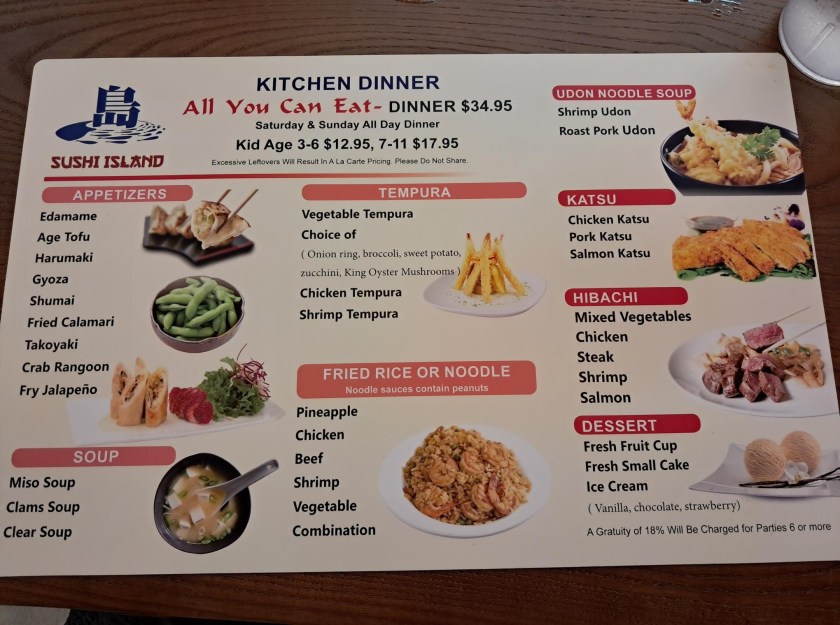
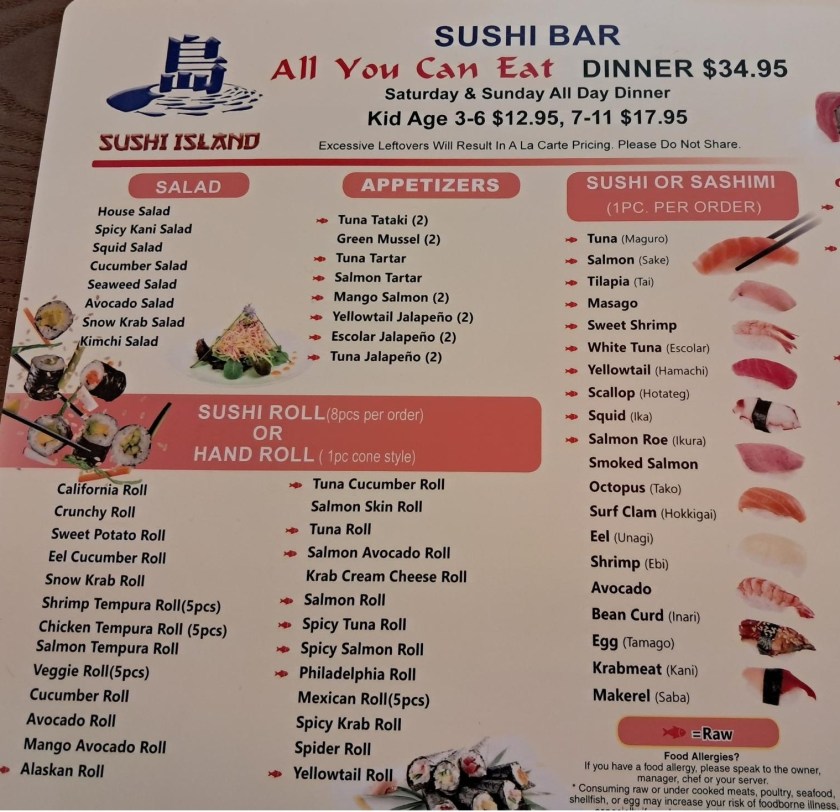
Sushi Island launched its website after our lunch a few weeks back, but I made sure to take clear, legible photos of the menu since they weren’t widely available online yet.  Since we went for lunch on a Saturday, we got the dinner menu and dinner price of $34.95 per person.  In addition to all the sushi on the other side, you can order appetizers, soups (including udon noodle soup), fried rice or noodles, tempura-fried chicken, shrimp, and vegetables, hibachi-grilled meats and vegetables, and breaded, fried chicken, pork, and salmon katsu. 

Here is half of the sushi menu, including salads, appetizers, sushi and sashimi, and simple rolls, which are also available as cone-shaped hand rolls (which I’m never as big a fan of). 

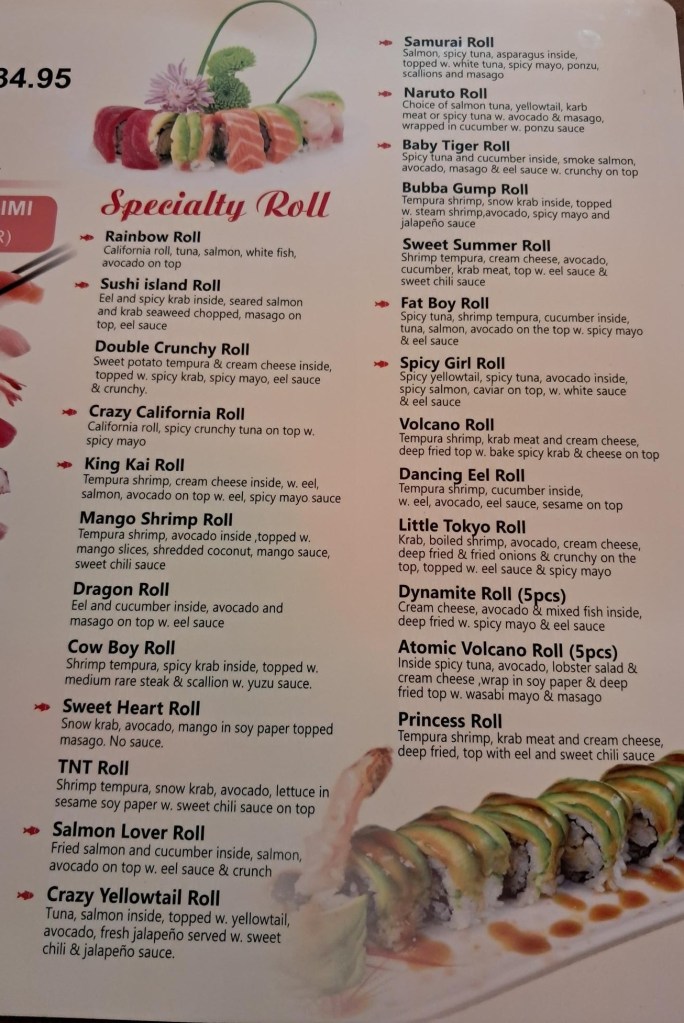
And here are all the sumptuous specialty rolls:
Just as an FYI, there are a few sushi rolls on this dinner menu that aren’t available on the weekday lunch menu, so check the website for the differences.

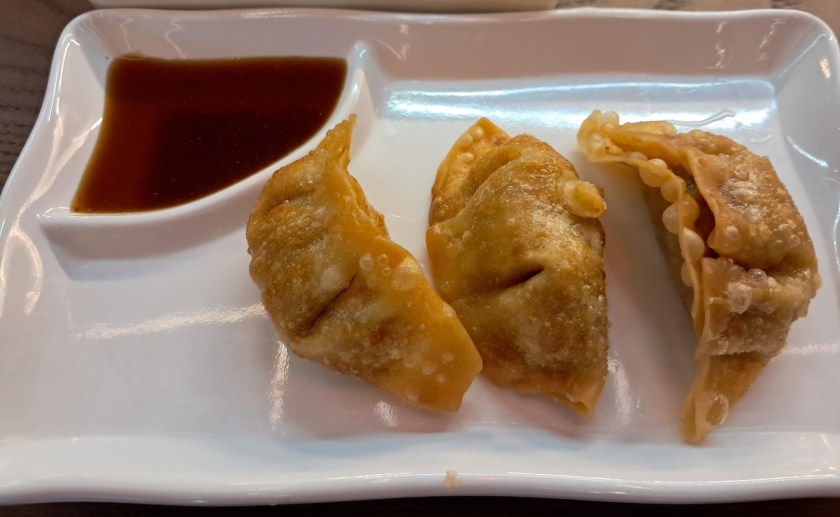
My friend started out with an order of three crispy fried gyoza dumplings.  He offered me one, but I passed.  He liked them!

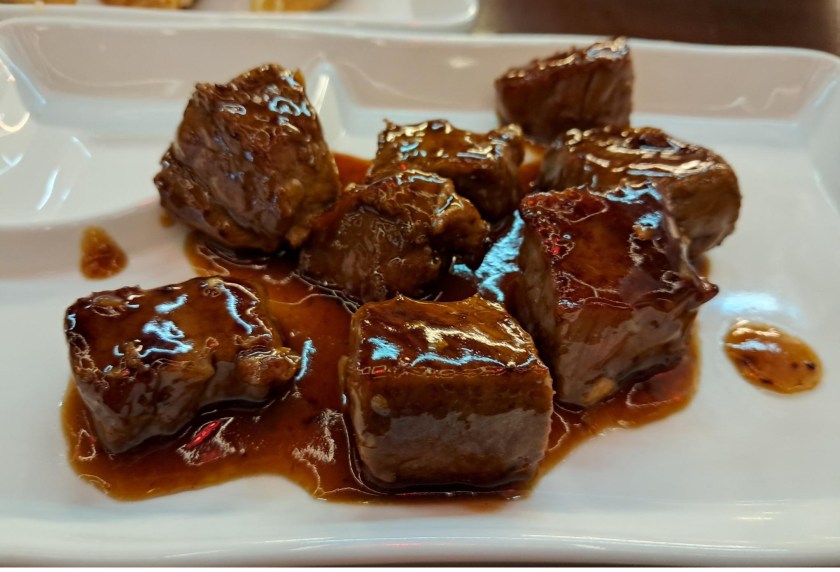
He also got this hibachi steak, a relatively small portion of cubed grilled steak with teriyaki sauce.  I had one piece, which was more done than I prefer, but I didn’t come to Sushi Island for the steak.  

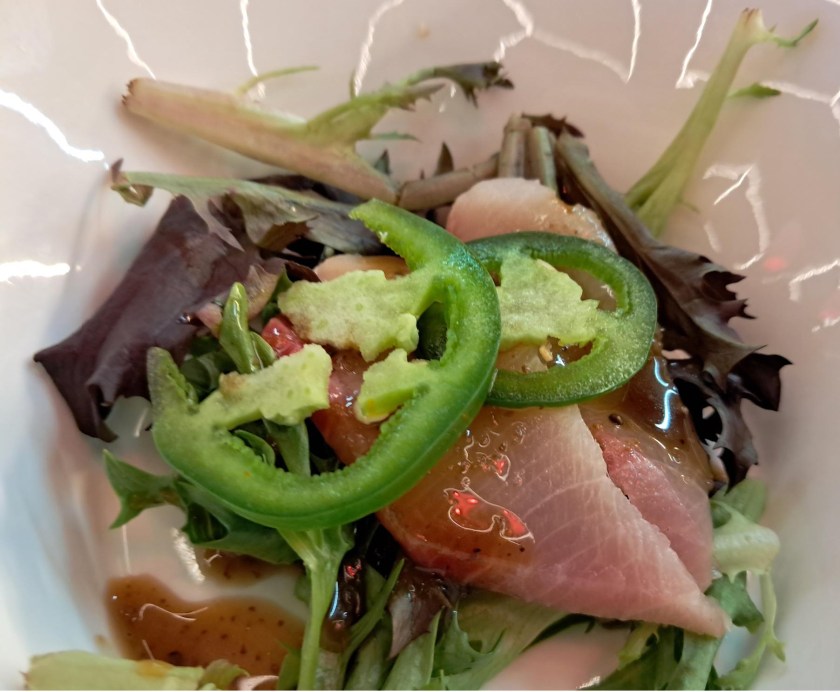
I picked some of the fishy apps for us to share, starting with yellowtail jalapeno.  This was just two thin slices of yellowtail over mixed greens with a dash of dressing and two slices of fresh jalapeno on top.  We each had one piece of yellowtail, and it was a nice start to the feast of fish to come.

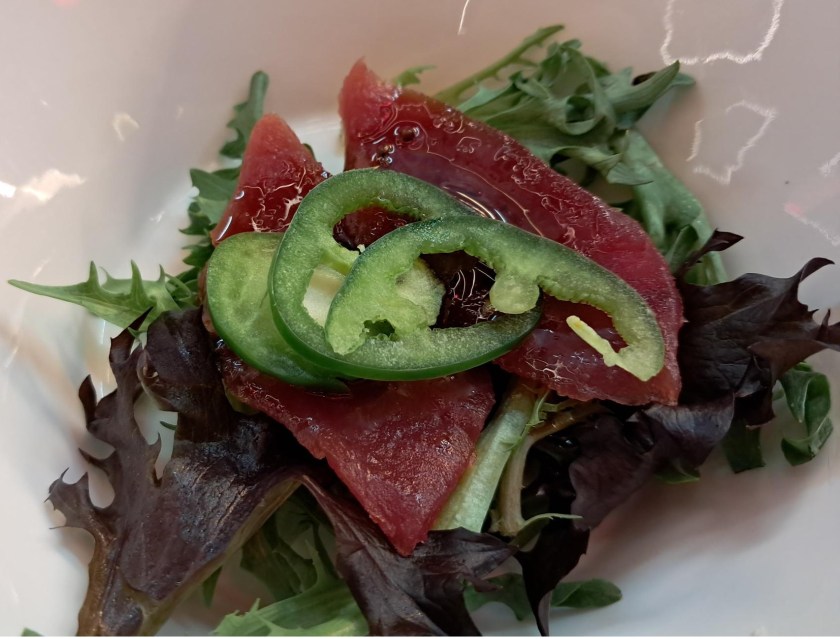
This was the similar tuna jalapeno, which we also liked:

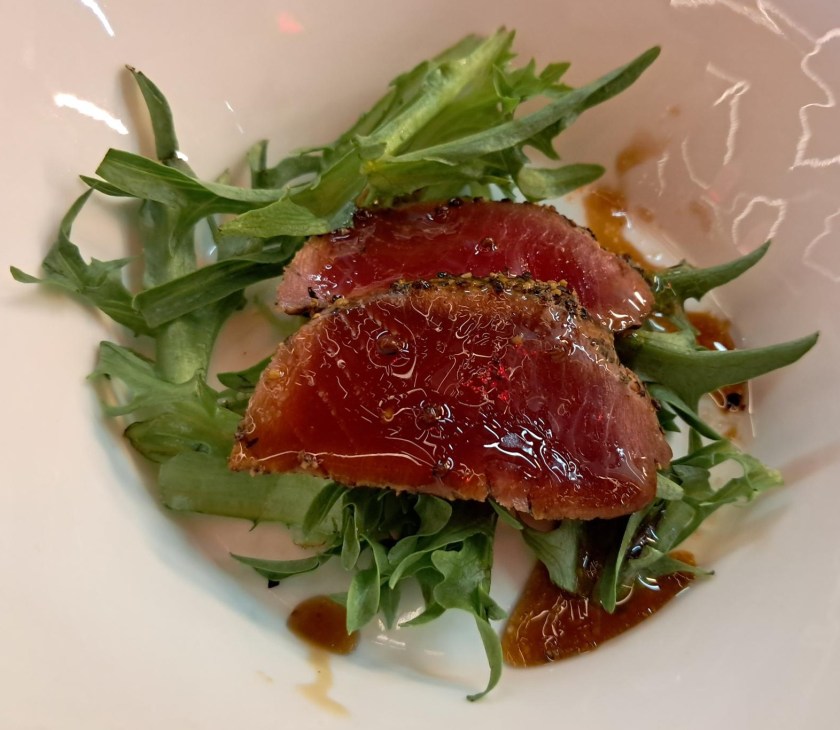
This was tuna tataki, two lightly seared pieces of tuna with a peppery crust:

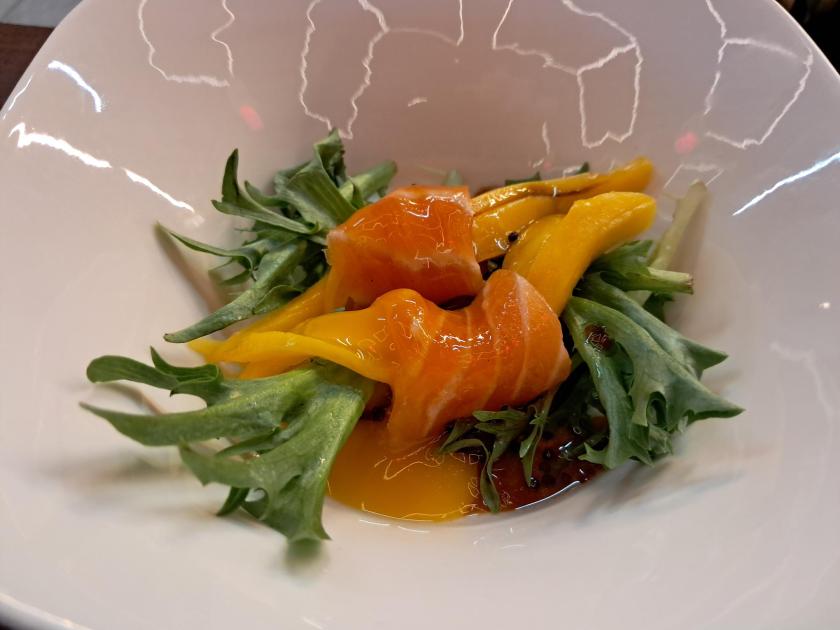
And this was the delicious mango salmon appetizer.  I love raw salmon and I love mango, and I could have ordered a few of these.

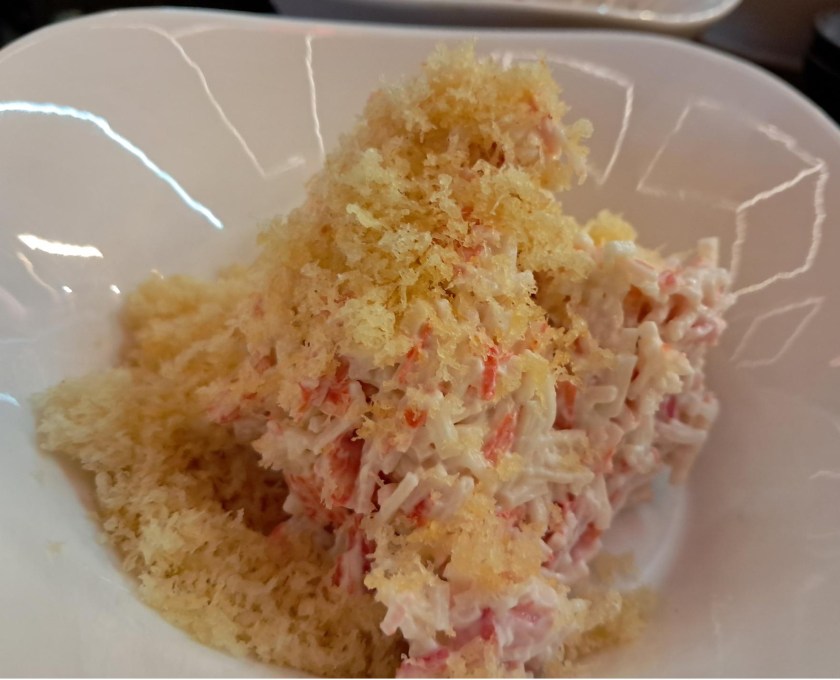
This was the snow krab salad, made with shredded surimi (artificial crabmeat made out of pollock or cod), mixed with some mayonnaise and topped with crispy panko bread crumbs, served chilled.  I really enjoyed this, but I already like the sweet taste of surimi a lot.

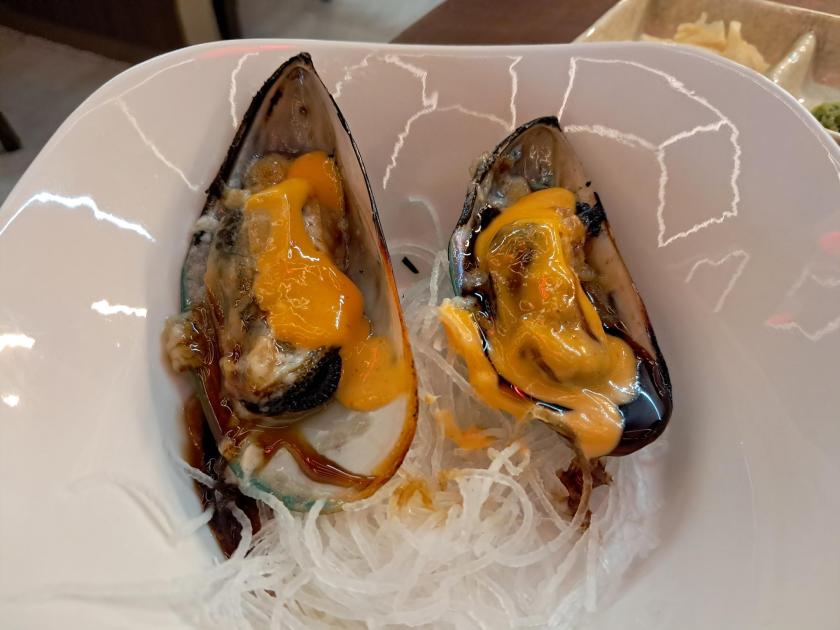
These were two green mussels, topped with spicy mayo.  Mussels are one of my favorite shellfish.  Don’t worry, these were cooked, not raw. 

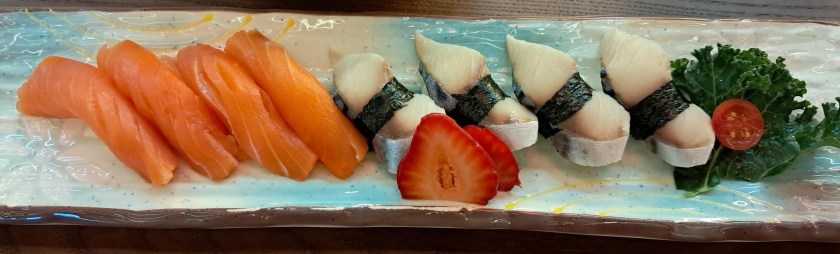
I ordered four pieces of smoked salmon sashimi and four pieces of saba (mackerel) sashimi, which is one of my favorites.  When it comes to sushi or sashimi, mackerel is always lightly pickled, so it has a sweet, vinegary tang like my beloved pickled herring.  I’ve never seen any sushi or sashimi garnished with a strawberry before, but I’ll allow it!I was expecting just the thin slices of fish because that’s what I recognize sashimi to be, but these were served with small balls of sushi rice underneath each one, so they were more like nigiri.  I ate the rice because I ordered them, and I never like wasting food.  Now that I know, I will request sashimi without the rice next time.
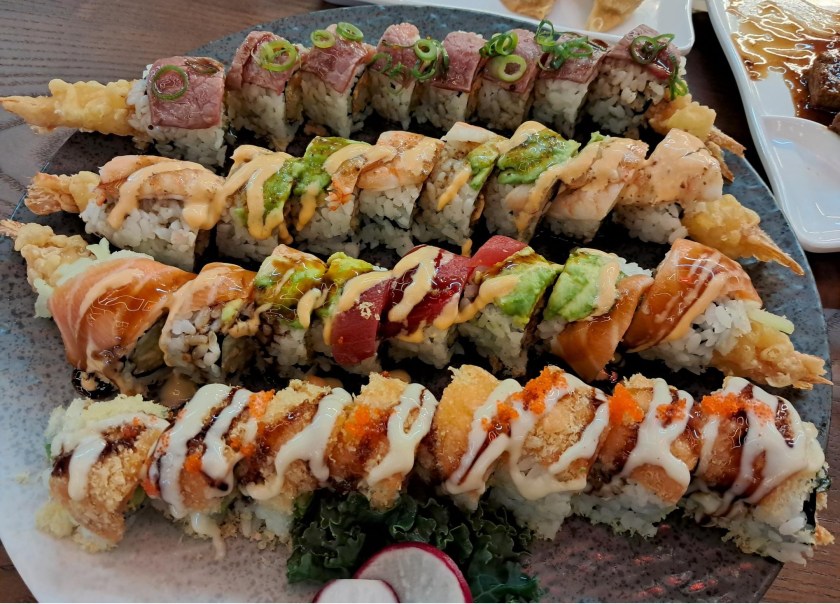
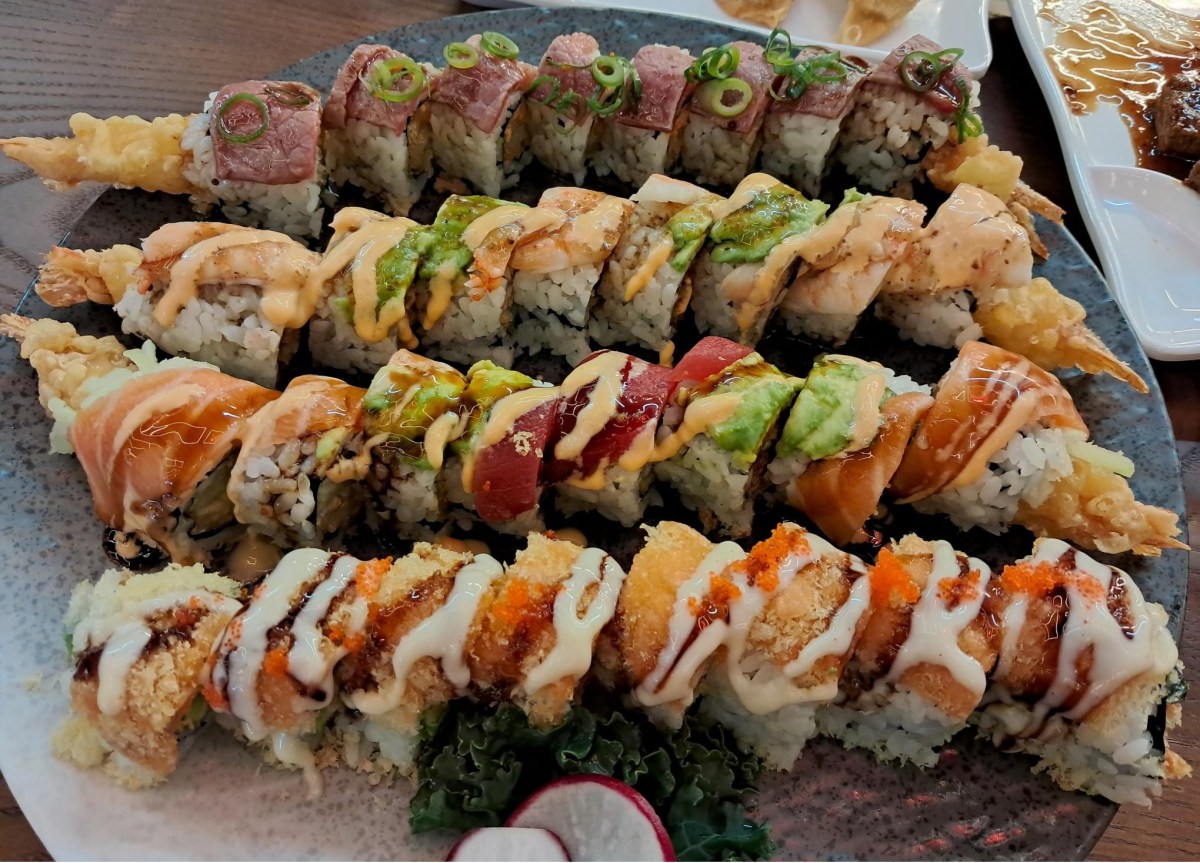
We each ordered two rolls.  My buddy got the top two, and I got the bottom two.  The top one was the Cow Boy roll, with shrimp tempura and spicy krab, topped with paper-thin slices of medium rare steak and scallions.  The second one down is the Bubba Gump roll, with tempura-breaded and fried shrimp and snow krab inside, topped with steamed shrimp, avocado, spicy mayo, and jalapeño sauce.  He was kind enough to share a piece, and it was a good combo with a blend of nice textures.  The bottom two were mine, both recommended by our lovely server Leah: the Fat Boy roll and the Spicy Girl roll, which could be perfect descriptions of me and my wife.  The Fat Boy roll (third one down) contains spicy tuna, shrimp tempura, and cucumber and is topped with tuna, salmon, avocado, spicy mayo. and eel sauce.  The Spicy Girl roll (last but definitely not least) contains spicy yellowtail, spicy tuna, and avocado and is topped with spicy salmon, masago, white sauce, and eel sauce.  I absolutely loved them and could have eaten far more than I did, but I really am trying my best to eat less these days, folks.
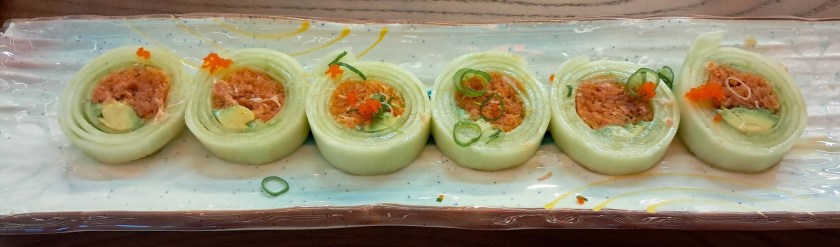
Finally, this was my last hurrah: the Naruto roll, with spicy tuna and avocado served in a beautiful, paper-thin spiral of cool, crispy, peeled cucumber, topped with masago, scallions, and ponzu sauce.  This was such a nice treat, and since I already ate more rice than I hoped to, I was glad to find this good roll without rice.  When I return to Sushi Island (and I WILL return), I will probably order several of these Naruto rolls.  You can get them with different fish, too: regular tuna, salmon, yellowtail, or krab. 

I was so glad to catch up with this friend of mine, who I have watched progress from dedicated law student to esteemed attorney to beloved law professor and head of an important department at my previous institution.  He is one of the best people I know, and I kvell with pride to consider him one of my friends (and to be one of his!) — and that doesn’t even get into his skills as a drummer!  And we could not have chosen a better place than Sushi Island, especially since we’re both eating less and eating healthier these days.  I know I could have eaten a lot more sushi, but we both left satisfied, without being uncomfortably stuffed and bloated.  That means we are making progress in every aspect of our lives!   But Sushi Island was so good, and I am thrilled to have a place like it on my side of town, without schlepping down to International Drive for very similar all-you-can-eat sushi at Sushi Yama.

Pho Bar Vietnamese Kitchen

Pho Bar Vietnamese Kitchen (https://phobar.co/) has two locations in South Florida and one in Boston, but I didn’t label this review of its relatively new Orlando location with my “Chain Reactions” tag because it doesn’t feel like a chain… at least not yet.  I recently went to Pho Bar for the first time, looked at the menu in person, but ordered everything as takeout to bring home to my wife.

She always wants summer rolls from any Vietnamese or Thai restaurant, so I brought her these two HUGE spring rolls (that’s what Pho Bar calls them, even though I think of spring rolls as the crispy deep-fried ones), with shrimp, pork, shredded lettuce, bean sprouts, and basil wrapped in rice paper and served with a peanut-hoisin sauce for dipping.  These were much larger than most restaurants’ versions of summer rolls, and they came individually wrapped in plastic wrap.  I should have waited for her to unwrap them before snapping this picture, but oh well.

I thought we would both enjoy splitting the grilled satay squid, which is always an impressive dish to me.  The presentation is eye-catching for sure, with the grilled squid sliced into perfect rings and separate tentacles.  It was seasoned with a chili soy marinade, and while I liked it, she didn’t love the flavor of this squid.  It was chewier than we are both used to, and I give the edge to the similar-but-superior grilled squid at Z Asian Vietnamese Kitchen, just a few minutes east on Colonial Drive.   The two sauces that came with the squid are ginger fish sauce, which was on the pungent side, and “green chili sauce,” which I really loved.  It had a kick, but also a cool sort of flavor.  I admit I used most of that sauce on some pork loin I marinated, roasted, and sliced very thin.

Like any good Vietnamese restaurant, Pho Bar packed our pho broth separately, so the rice noodles wouldn’t turn to mush while sitting in the hot brother.  Unlike a lot of pho places, Pho Bar makes their rice noodles fresh in-house, and you can see they are wider than the traditional dried “rice sticks.”  But for purists, they also offer traditional rice vermicelli instead.  My wife always orders pho tai, with beef eye round, sliced paper-thin.  It is always served rare, because it cooks in the steaming broth.  

I will usually order pho dac biet, which comes with thin-sliced eye round, sliced brisket, chewy beef meatballs (nothing like Italian meatballs!), beef tendon, and tripe.  But at Pho Bar, I was tempted by a more expensive option, pho suon bo, with brisket, meatballs, and short rib, which is a cut of beef I always love.  Here’s my bowl before I added broth to it, but the short rib was too large to fit:

That was a whole meal in itself, so I ended up with the short rib standing alone at the end!  It was a huge piece of meat, rich and marbled with fat, and the long bone slid right out.  We had so much extra broth left over, I cooked up some noodles (the knife-cut Taiwanese noodles with fluted edges that I always keep in the pantry, not proper rice noodles for pho) and got a whole extra meal with that giant short rib. 

And as we’re about to experience some unseasonably cold days here in the Orlando area, I still have even more of Pho Bar’s pho broth left over, so I have since bought some rice noodles for when I heat up the rest.  This is going to be perfect weather for pho, which is why I’m publishing this review today, of all days.

I still contend the pho at my beloved Pho Huong Lan is the best in Orlando, and I am more likely to return there than to Pho Bar.  But I’m certainly glad I tried the new place.  It wasn’t bad by any means, even if neither of us loved the grilled squid.  If you’re planning to dine in at Pho Bar, the restaurant itself is much nicer than Pho Huong Lan — less cramped, modern decor, comfortable booths.  I expect it will do well in the Mills 50 neighborhood, even with so much competition within the same few blocks.  It feels like more of a “date place,” complete with full bar (hence the name).  The website lists a whole menu of cocktails in addition to beer, wine, and sake, or as hipster foodie influencers prefer to call it, a “cocktail program.”

Thailicious

Thailicious (https://thailiciousfl.com/) is a very casual Thai restaurant in the suburbs of Longwood.  The building looks like a house, complete with outside tables on a covered, screened-in front porch.  My wife and I have gone three times so far, and we really like it, enough to already consider ourselves semi-regulars.  I want to work our way through the entire menu, but their dishes are so good, it is hard to not default back to past favorites.

My best advice for going for dinner is to arrive early, because it always gets super-busy.  The people of Longwood know what’s good, and they also may not want to drive far and wide for newer, trendier Thai restaurants, knowing they have a wonderful, well-kept secret in their own back yard.

On all of our visits, my wife starts out with sweet, cool, creamy, slightly smoky Thai iced tea, her beverage of choice:

She usually orders summer rolls, one of her go-to favorites at any Vietnamese or Thai restaurant.  Thailicious’ version comes with shrimp, rice noodles, carrots, and Thai basil leaves, wrapped in fresh rice paper for a chewy texture and served with a sweet peanut sauce.

On our first visit, we also ordered a crab rangoon appetizer, just for the heck of it.  I hadn’t had crab rangoon in years, probably not since the days of the all-you-can-eat China Jade buffet on East Colonial Drive near Fashion Square Mall, but these were better than I remembered.  They were fried to crispy perfection, not greasy or heavy at all, with sweet cream cheese inside (but nary a hint of crab, as usual).
These were so good, we got them again on our third visit.

The first time in, my wife ordered her go-to noodle dish, pad Thai, since we are now on a quest to discover all the best versions of pad Thai in and around Orlando.  This was one of the best versions either of us have tried around here.  The rice noodles were sauteed with pork (but you can also choose chicken, tofu, or beef or shrimp for a small upcharge), eggs, ground peanuts, bean sprouts, and green onions.  The sauce was actually kind of tangy and citrusy for a change.  A lot of places serve pad Thai that is too sweet, and it never has that tangy funk that I love.

I ordered my own go-to noodle dish, pad kee mao, also known as drunken noodles.  These are wider, flatter noodles, sauteed with onions, bell peppers, carrots, zucchini (a nice touch that nobody else seems to add), fresh basil (so important to the overall flavor of this dish), and scallions, and I asked them to hold the bean sprouts.  I also got pork as my meat of choice, and it was a wise choice.  This was a delicious version of drunken noodles.  The dish is always sweet, but I ordered mine medium-spicy, because I like my Thai noodles like I like my women, sweet and spicy.  Next time I’ll try Thai-spicy, now that I know I can more than handle the medium-spicy baseline.
Well, my wife was brave enough to try the drunken noodles, and she loved them so much that she ordered them (mild, of course) on our second visit, and again on our third!  I tell ya, this dish is a crowd-pleaser.  If you’ve never tried them before, either at Thailicious or your Thai restaurant of choice, give them a chance, and you won’t be sorry.  She wasn’t.

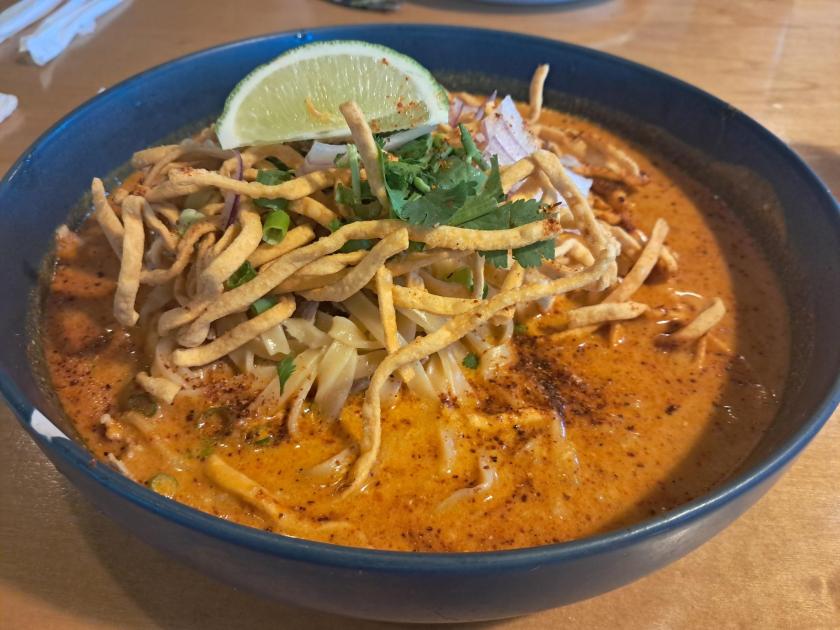
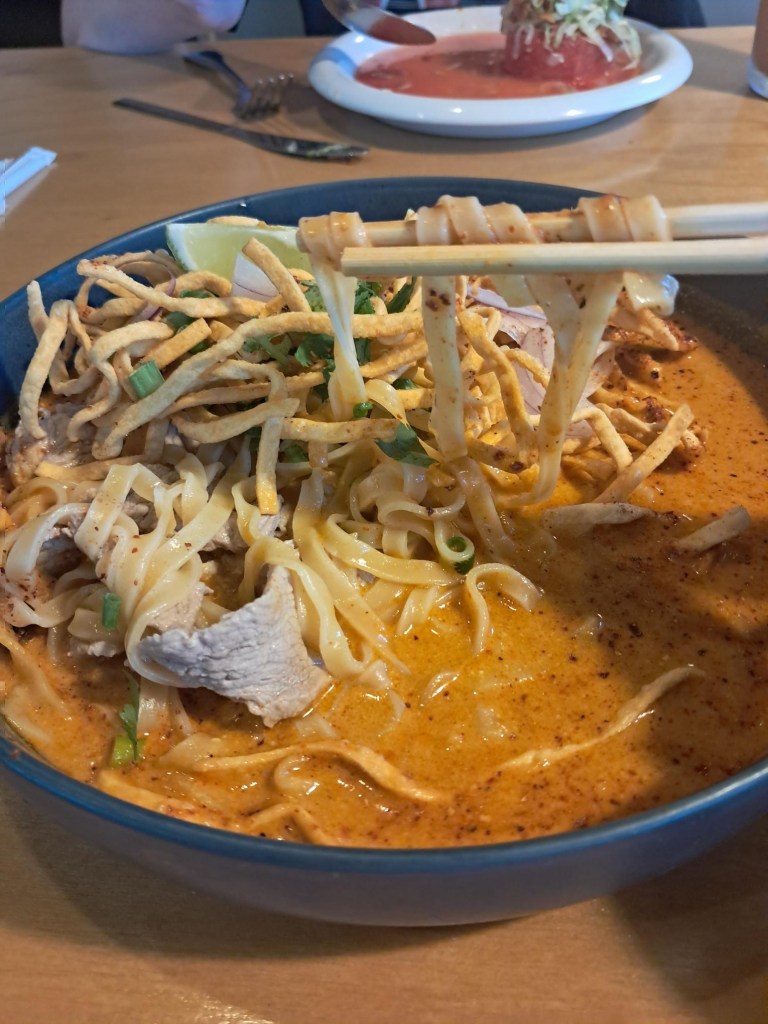
I tried something completely new and different on our second visit: a noodle curry dish from northern Thailand called khao soi, made with egg noodles, napa cabbage, pickled sweet peppers, and pork (instead of chicken or tofu).  The noodles came in the creamy, medium-spicy curry kind of like a thick soup, and our very friendly and patient server gave me chopsticks with it, utensils you don’t usually get at Thai restaurants.  It was nice gambling on a brand new, unfamiliar dish and enjoying it so much.  I’d totally order it again, but that would also defeat my purpose of making my way through the Thailicious menu, as I intend to do in the months and years to come.

Get ready for the noodle pull!

It was so good, it inspired me to start ordering this dish elsewhere, to compare other restaurants’ versions to the first khao soi I’ve ever had here at Thailicious.  You know what they say: You never forget your first time!

Then we got coconut sticky rice for dessert on visit number two, which we never order, but we loved it so much that we wondered why.  What a delicious, sweet treat, especially topped with a huge scoop of creamy coconut ice cream!  We haven’t been living right, avoiding sweet sticky rice, but better late than never.

On our third visit, I ordered the laab gai, a dish of ground chicken seasoned with lime juice, shallots, roasted rice powder, and scallions, served at the hot spice level, on a bed of fresh, crunchy iceberg lettuce.  I am still relatively new to laab (sometimes called larb) after being introduced to an incredible version with ground pork at Isan Zaap Thai Cafe last year and then trying a chicken version at Lim Ros Thai Cuisine earlier this year.  I would rank this one between the two.     

I also got the spicy basil from their traditional spicy Thai dishes menu, with sautéed pork, sweet basil leaves, onions, zucchini, and red and green bell peppers, at a hot spice level.  It came with a bowl of jasmine rice on the side, which I mixed in to soak up the delicious flavors.  They always get the pork so tender here at Thailicious.  In fact, not only are the flavors fresh and strong, but everything is the perfect consistency.

It was delicious, but I always return to noodle dishes, so I’ll give the edge to the fabulous drunken noodles, pad Thai, and that amazing khao soi from  visit #2.  Now that I’ve written a review with a good bit of variety, I will start returning to those old favorites, because I will definitely return to Thailicious.

Orlando has several Thai restaurants, many of which are new, hot, and trendy.  This Longwood mainstay isn’t hot or trendy, but it is so damn good, without any pretension or attempts to be the new influencer-illuminati destination.  That makes me love it even more.  It’s a friendly neighborhood sort of place with next-level food, comfortable booths, and warm and welcoming service.  Just don’t get there too late on Friday or weekend evenings, because the locals know what’s good, and you will have to wait!