Adega Gaucha

Adega Gaucha (https://adegagaucha.com/) is an all-you-can-eat Brazilian steakhouse located at 8204 Crystal Clear Lane, Orlando, FL 32809, right in front of the Florida Mall, just south of the busy intersection of Orange Blossom Trail and Sand Lake Road.  It opened about two years ago, and it is a single, locally owned restaurant, differentiating it from the similar chains Texas de Brazil (which I reviewed back in 2019) and Fogo de Chao (which I have been to twice, but never got around to reviewing).  I grew up going to all-you-can-eat buffets with my family, and then they helped keep me alive through college and grad school.  Because of my buffet background, I have a great appreciation for the variety and abundance of restaurants like this, even though I could never have afforded the typical decadence of a Brazilian steakhouse as a poor student.  Despite the never-ending parade of patient waiters serving roasted meats on giant swords, my favorite part of this meal is always the sumptuous salad bar buffet, where I can gorge on some of my favorite foods, like cured meats, smoked salmon, and various fancy cheeses and roasted and marinated vegetables.

My wife, on the other hand, is not a buffet person, but she does appreciate a well-cooked (but never well done) steak, far more than even I do.  We both like our red meat as rare as possible, and we share a fondness for marbled ribeye steaks, lamb, tender brisket, and gamey meats like bison.  That’s why these Brazilian steakhouses are a rare and luxurious treat for both of us.  We have gone to Texas de Brazil for a handful of special occasions in the past, and she suggested a return visit as a “last hurrah” before an upcoming surgery and a year where we’re both going to try to eat a little less and a little healthier.  I suggested we try Adega Gaucha as an alternative, and I am so glad we did, because we both liked it even more than the vaunted, venerable old standby.  Now I’m suggesting it to you stalwart Saboscrivnerinos, and I will do my best to point out the little differences that set this singular local establishment apart from its chain competitors.

I am happy to report that Adega Gaucha is cheaper than the “big two” chains.  The full churrasco experience for dinner is $55 per person, and lunch on weekdays is $40.  I would much rather eat a big meal like this for lunch than dinner, and ideally on a weekend, because I can’t think of anything sadder than gorging at a nice restaurant like this while worrying about rushing back to work in the afternoon and trying to be productive.  Luckily, Adega Gaucha offers all the same stuff from the dinner menu for their Saturday and Sunday brunch, lasting from 11:30 AM until 3:00 PM, for $45 per person.  To compare to the Orlando Texas de Brazil, weekend lunch from noon until 4:00 PM is $60.  That $15 makes Adega Gaucha seem like a bargain, and I haven’t even gotten into how good the food and service are!

We made a reservation for 11:45 AM on a Sunday, and we were the very first party to be seated and hit the gourmet table (salad bar and buffet), so I was able to pause for some photos.  Here is the charcuterie — pretty standard pepperoni, dry prosciutto and cured ham sliced paper-thin, and genoa salami folded into pretty flowers, atop a mountain of cheeses.  As one would hope, they had glass sneeze-guards in place, to prevent these decadent selections from people’s germs.  I grabbed some of these cured meats, along with the fine smoked gouda in the middle of the cheeses.

I helped myself to some melt-in-your-mouth nova salmon, leaving all the capers behind for diners who like them.  Those white things I cut off are hearts of palm, which I have never developed an appreciation for.

This was beef carpaccio, another decadent delicacy, that I have never noticed at Texas de Brazil or Fogo de Chao. 

My wife liked the sweet potato salad with raisins and dollops of goat cheese in the top left and the quinoa salad in the top right.  I really liked the potato salad in the bottom left and the seafood salad in the bottom center.  We both appreciated the tiny spheres of fresh, soft mozzarella cheese drizzled with balsamic vinegar in the top center.  I am slowly developing a taste for beets, but I was a little too overstimulated to sample what seemed to be beet salad in the bottom right. 

Back at our table, we were greeted by a basket of warm, freshly baked  pao de queijo, Brazilian cheese bread — chewy little buns that my wife always likes a lot.  She said these were better than Texas de Brazil’s version!

Something else Adega Gaucha does that Texas doesn’t is allow the table to select three sides.  My wife chose fried yucca, which I am not into, and I chose caramelized bananas, which I figured we would both enjoy.  They are so delicious.  Go ahead, take those bananas!   

I knew she would dig the sautéed mushrooms, so I let her take those.  She liked them, but she found little marinated mushrooms on the gourmet table that she liked even better than these sautéed ones.   Longtime readers know mushrooms are my Kryptonite, but I never claimed to be a fun guy.

Here is my plate after my first and only venture to the gourmet table, loaded up with some of my favorite foods in the world.  Aside from things I have already discussed, I treated myself to sweet and spicy Peppadew peppers I could eat like candy (and have before), pink pickled onions, roasted red bell pepper, and one of the jewels of the gourmet table, candied bacon, which had a hint of spice and was a huge hit with both of us.

Then we turned our little red cards green to signal the gauchos to arrive with gifts of meat.  (And how about Gaucho?  The last truly excellent album by Steely Dan, if you ask me, but I give Aja a slight edge.)

I lost track of all the different cuts of steak the gauchos brought by our table, but between the two of us, we probably tried them all: filet mignon, top sirloin, the popular Brazilian sirloin cut called picanha, flank steak called bavette or fraldinha, and our beloved ribeye.  Both of us always politely asked for rare, and the gauchos patiently offered us the rarest of the rare.  I was overjoyed that none of the meats were over-salted, which is a major issue for me at both Texas de Brazil and Fogo de Chao, where on top of the encouraged gluttony, everything is ridiculously salty.  I filled little metal ramekins at the gourmet table with fresh chimichurri, that wonderful, pungent condiment of oil, vinegar, garlic, and parsley, and fresh mango salsa that was tasty enough to eat with a spoon by itself.  The mango salsa passed my “Would I eat this over vanilla ice cream?” test.  Yes, it was that good — sweet and spicy and acidic and cool and refreshing and perfect in every way.  I should have gotten a photo of it.  I’m sorry!

But as good as the various cuts of steak were, for me, the highlights were the leg of lamb (also rare), the tender pork sausage called linguica, the roast chicken legs with crispy skin (capturing everything you would hope roasted chicken legs could aspire to be), and our absolute favorite meat at any Brazilian steakhouse, costela, the tender, juicy, marbled beef ribs that the gauchos serve sliced crosswise against the giant bones.  As soon as the first gaucho visited us, we asked for the beef ribs, and you should too.  Before we learned of the greatness of beef ribs at Brazilian steakhouses, we didn’t know to ask for it, and it rarely made appearances when we would dine at Texas de Brazil.  But at Adega Gaucha, ask, and you shall receive.

Below, you can thrill to a later plate with more beef rib slices and two more delicacies that I’ve never had at Texas de Brazil or Fogo de Chao.  You might have noticed the little dark round things at the top of the plate pictured above and the bottom of the plate pictured below.  Those are chicken hearts, and they are wonderful, hearty (heh) fare.  If you think that sounds gross, you are certainly welcome to your opinion, but they are such a delicious protein — dark and rich and slightly chewy, but so flavorful and extremely nutritious.  I have bought chicken hearts before, marinated them in Italian dressing and then sautéed them, but mine always came out a little chewier than I feel they should be.  I’ve had them on skewers, grilled over binchotan charcoal at Susuru and Tori Tori, two local Japanese restaurants that specialize in Izakaya-style pub grub like yakitori.  But I had never had them like this, and I absolutely loved them.  It’s funny that despite having all these different cuts of steak at my disposal, I liked the chicken hearts so much, but I did.

And that beautiful thing on the right is another hallmark of a meal at Adega Gaucha that I have never seen elsewhere: grilled pineapple, rich with butter, sugar, and cinnamon for a crispy, caramelized outer crust, like the best part of a pineapple upside down cake.  This was a huge treat, serving as both a palate cleanser between the rich meats and a dessert.  It was a damn delight, and we could not have been happier to end our meal with a few slices of the grilled pineapple, artfully cut off whole pineapples on the same kinds of swords wielded by the gauchos.

I have heard the cocktails and desserts at Adega Gaucha are as awe-inspiring as the meats and the gourmet table offerings, but we don’t drink, and we were too full for dessert, aside from that grilled pineapple.  But next time (and there will be a next time!), I am ordering a Brazilian limeade, with fresh-squeezed lime juice and sweetened condensed milk.  That has to be the best thing ever, to go with so many other “best things ever” we enjoyed and will absolutely return to enjoy again.  In the song “Hey Nineteen” on Gaucho, Donald Fagen sang “The Cuervo Gold, the fine Colombian, make tonight a wonderful thing.”  For your friendly neighborhood Saboscrivner, hopefully less pathetic than the narrator of that song, the beef ribs, leg of lamb, chicken hearts, chicken leg, linguica sausage, smoked salmon, caramelized bananas, mango salsa, and grilled pineapple made our first visit to Adega Gaucha a wonderful thing.

Chain Reactions: JINYA Ramen Bar

JINYA Ramen Bar (https://www.jinyaramenbar.com/) was first founded in California by second-generation restauranteur Tomo Takahashi, after he had already opened a JINYA restaurant in Tokyo in 2000.  There are multiple JINYA Ramen Bar locations around the United States, including two in the Orlando area — the first in Thornton Park near downtown Orlando, and the second just opened in Oviedo.

I had never been to the Thornton Park JINYA location, but always meant to try it after reading rave reviews and rhapsodic recommendations.  When I heard one was opening closer to me, I was excited, and when co-owner Taff Liao invited me to a “friends and family” preview over Facebook, I was overjoyed.

I just got home from that lunch, where I ran into foodie-about-town and all-around good dude Ricky Ly, founder of the Tasty Chomps! food blog and the really terrific Orlando Foodie Forum Facebook group, arriving at the same time to dine with his family.  It was a great experience, and I am here to tell you that JINYA Ramen Bar will be an asset to Oviedo and East Orlando.  Don’t hesitate to check it out.

***Before continuing with my review, I must note that even though I fully expected to pay for my meal, I did not realize that the “friends and family” preview would be comped by the restaurant, like a dress rehearsal for the staff before its grand opening for the general public.  I don’t get invited to stuff like that often, and I honestly would have felt more comfortable paying.  Still, I was honored to be there, loved my meal, and left what I hope was a generous tip for the friendly staff.  But in the spirit of full disclosure and candor for my constant readers, you stalwart Saboscrivnerinos, I was not charged for this wonderful lunch.***

The restaurant is on the ground floor of the Ellington apartment complex, one of the many new developments in Oviedo.   

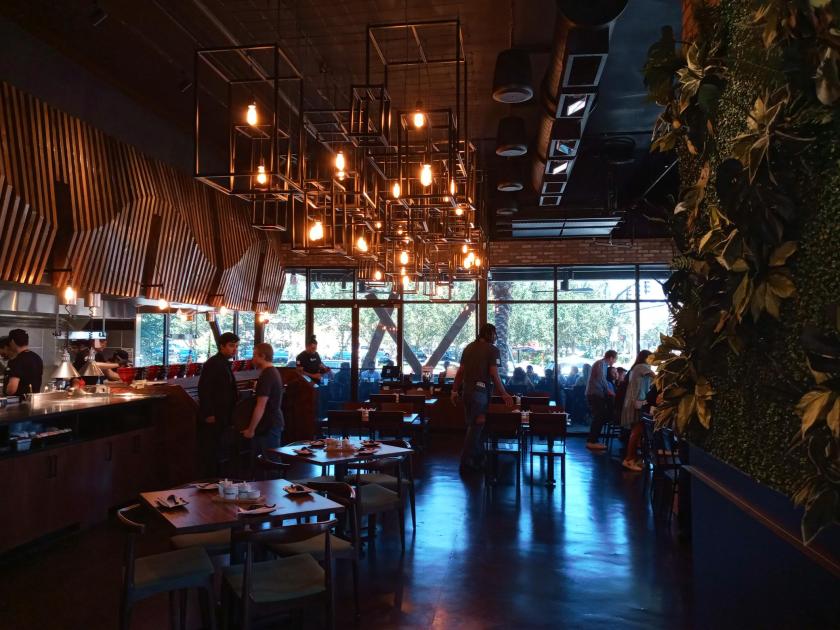
The dining room is a gorgeous, modern, dare I say sexy space with nice light fixtures, brick walls, that trendy and ubiquitous plant wall, and lots of natural light streaming in through floor-to-ceiling windows.  

An open kitchen overlooks the dining room.  There is an outdoor patio, but you will be inhaling exhaust from busy Mitchell Hammock Road if you sit out there, and it was already hot outside when I arrived just before noon, even in late October.

Being a solo diner, I sat at the bar, where two friendly female bartenders hustled, making gorgeous, artful cocktails while keeping my Sprite glass full.  One of them patiently explained the menu in detail, and I did not have the heart to tell her I studied it in advance.  The entire staff is warm and welcoming and well-trained during this soft opening, so expect excellence when you arrive in the days and weeks to come.

I started with an order of crispy rice with spicy tuna, from the Small Plates section of the menu.  I have loved these at other Japanese restaurants, including the late, lamented Kabuto, which closed back in December.  This order came with three small rectangular bricks of rice, coated in panko breadcrumbs and fried to light, crispy perfection.  Each crispy rice brick was topped with a puree of mildly spicy tuna and tiny, cute jalapeno pepper slices.

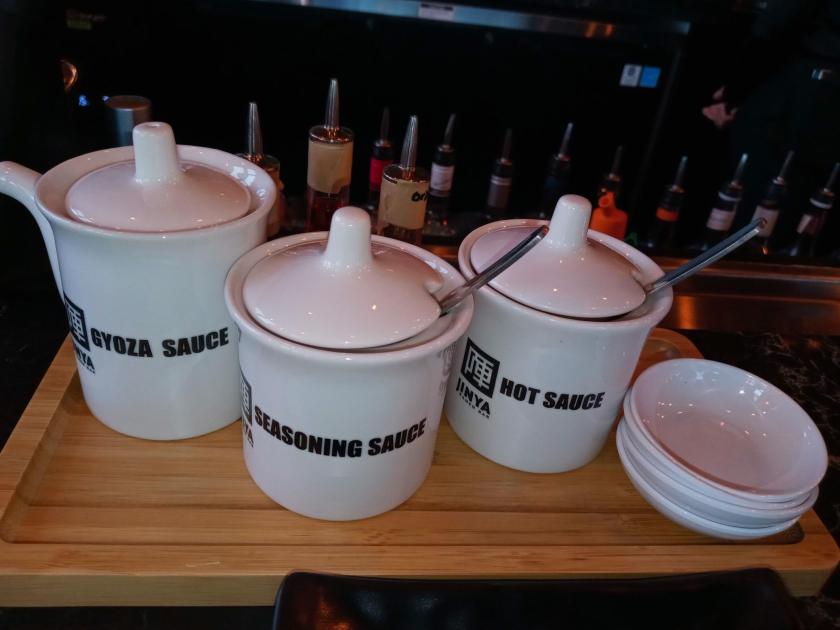
I tried one plain, one dipped in the zingy seasoning sauce, and one dipped in the gyoza sauce (it ain’t just for gyoza anymore!), and no matter what I did, every bite was magnificent.  I could see ordering these every time I return to JINYA Ramen Bar in the future, which will hopefully be often.  In fact, if they ever decide to offer a larger order of ten or twelve, I would probably order that.

I could not go to JINYA Ramen Bar without ordering a bowl of ramen, even if it was unseasonably hot outside.  JINYA makes its own ramen noodles from two different kinds of flour, then ages them in a special noodle-aging machine, which proves that we truly live in an age of technological marvels.  I ordered JINYA’s version of my standard ramen order at any Japanese restaurant, tonkotsu ramen, which features a rich, creamy pork bone broth.  Specifically, I got the JINYA Tonkotsu Black, with a slice of savory, fatty, tender pork chashu, green onion, two sheets of dried seaweed called nori, a seasoned soft-boiled egg with a perfect runny, creamy yolk, garlic chips,  garlic oil, fried onion, and “spicy sauce.”  It was served with thin noodles, but different bowls of ramen come with thicker noodles.  I like ’em thicc, so I will try that next time.

It was masterful.  All the ingredients harmonized so well.  The broth was delicious enough to slurp even without anything else in it.  It wasn’t spicy-hot, but it sure was temperature-hot, enough to make me sweat and blow my nose.  The noodles had an ideal springy chew, and the nori sheets softened as soon as I dunked them into the steaming broth.  It was one of the better versions of tonkotsu ramen I have enjoyed in Orlando, but different enough from mainstays like Oviedo’s underrated Ramen Takagi and Baldwin Park’s trendy Domu that you still must dare to compare.

I could have kept going, and in fact, I thought long and hard about topping off this luscious lunch with two salmon poke mini-tacos on crunchy rice “tortilla” wrappers.  But when I found out I was being comped, I felt guilty taking advantage of the JINYA owners’ generosity and opted against ordering anything else.  I will absolutely return — with my wife and with friends — as soon as I can.  It is a straight shot east from our home, and if this was just a preview while the staff was training, I can’t imagine how much it will improve as everyone gets more experience, because it already felt like a well-oiled machine that had been operating for a while.

Thank you to Taff Liao for inviting me, and I’m sorry I did not get to meet you.  I did get to chat briefly with Eric, another one of the owners, who was very friendly.  Trust me, folks — you are in for a treat.  Having not been to the Thornton Park JINYA Ramen Bar before, the new Oviedo location did not disappoint in any way.  In fact, it is almost too cool for Oviedo and East Orlando, but here’s hoping everyone discovers it and enjoys it as much as I did.

Z Asian Vietnamese Kitchen

Z Asian Vietnamese Kitchen (https://eatzasian.com/) is one of the nicer, more upscale Vietnamese restaurants in Orlando’s Mills 50 district full of Vietnamese and other Asian restaurants, markets, and shops.  That said, as someone who does not love high-end, fancy, luxurious dining, it is still very accessible and welcoming for all.  It is also unique because it received prestigious Michelin Bib Gourmand awards in 2022 and 2023.  To clarify, that does not mean it has a Michelin star, like some of the highest-end eateries, but rather it was recognized for its “good quality, good value cooking.”  Chef and co-owner Huong Nguyen focuses on street foods from Saigon, but her menu offers several dishes that Orlando’s other Vietnamese restaurants do not serve.

I first went to Z Asian with a former co-worker in late July.  She and I both left our workplace for new opportunities this year, so it was a chance to catch up and chat.  She is vegetarian, and Z Asian has so many vegetarian and vegan options on its menu, I thought it would be a perfect choice for dinner.

We started out with an order of two vegan summer rolls (goi cuon chay), with tofu, vermicelli noodles, and shredded lettuce rolled up in transparent, sticky, chewy rice paper and served at room temperature with a side order of peanut sauce.  My wife loves summer rolls with peanut sauce from other Vietnamese restaurants like Little Saigon and Pho 88, but they are usually not my favorites.  I’m not a big tofu guy either, but I’ll try anything once, and this was an excellent summer roll!  The tofu had the consistency of a firm omelet with a slightly crispy exterior, balancing against all the chewy ingredients. 

I also chose an order of pan-fried rice flour (bot chien), something I always see on Vietnamese menus but had never tried before.  It always looks good, and I thought my vegetarian friend would like it too.  It came served on a blanket of lovely fried eggs, although there is a vegan option too, without the eggs.  It was served with a side of crunchy, sweet pickled carrot and daikon radish, with a sweet chili soy dipping sauce.   This was AWESOME.  We both loved it.  This was another dish with a crispy exterior and soft, yielding interior, kind of like fries or tater tots — not in taste, but in “mouth feel.”  They were terrific with the sauce, and I liked the pickled vegetables (necessary ingredients on any banh mi sandwich) a lot.

My friend ordered stir-fried garlic noodles with tofu.  I didn’t try this, but she seemed to like it a lot.  In addition to the fried tofu (similar to the pieces in the summer rolls), it came with bok choy, carrot, and plenty of crunchy bean sprouts.

I ordered special rice noodle soup (hu tieu thap cam), with thinner rice noodles than you usually find in bowls of beefy pho.  Instead of being a beef-based soup like pho, this soup included pork, shrimp, squid, fish cakes, and krab sticks, in addition to aromatic herbs.  It was a nice, light soup and a pleasant change from the pho I’ve ordered so many times elsewhere.   Somehow, I managed not to splash my clothes, which was a minor miracle.My research tells me hu tieu is a Chinese-Cambodian invention that was adapted to Vietnamese tastes in the city of Saigon, and that I could have also ordered a “dry” version with a small bowl of soup on the side to protect my work clothes in the future.
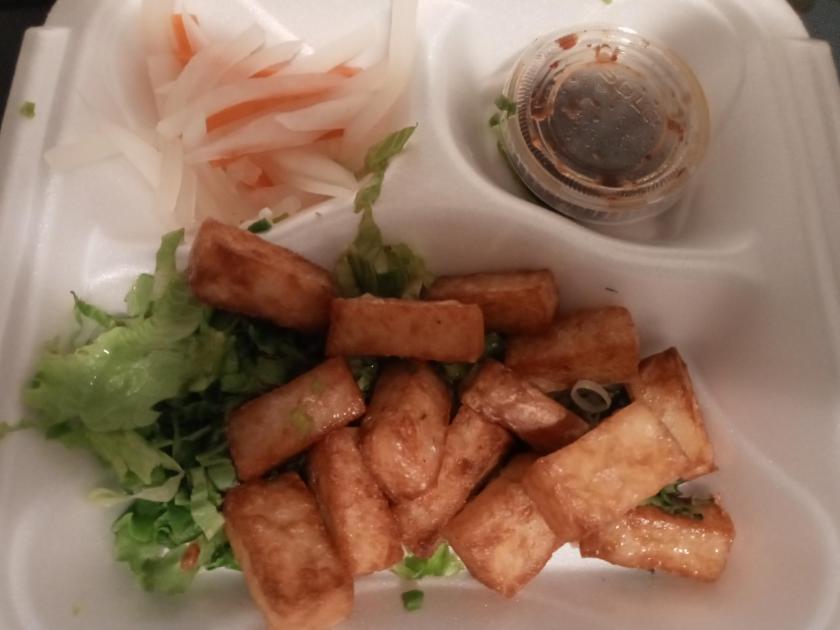
Before leaving, I ordered the pan-fried rice cakes (minus the eggs) to bring home for my wife to try.  She was dazzled with them too, and they did not lose their subtle crispiness on the drive home. 

And I also brought home a dish I had really wanted to try, after seeing so many people post photos of it.  My vegetarian friend would not have been into this at all, but I knew my wife would share my appreciation of Z Asian’s grilled jumbo squid (muc nuong sate).  You can get squid at lots of restaurants (Italian, Greek, Chinese, steakhouses, and so forth) in the form of breaded, fried calamari, but I had never seen such squid served in such a beautiful presentation as this.  If your fellow diners aren’t averse to eating cephalopods (so that counts out my in-laws), this will be a real attention-grabber at your table, and I strongly recommend it.   
The menu says the grilled jumbo squid is marinated in “house sauce,” and it is served with house-made jalapeno green sauce, but it did not need to be dipped in anything.  Squid can sometimes get chewy and rubbery, but this was so tender and flavorful, with slight spicy and sweet flavors balancing out the taste of the ocean (but not a fishy taste).

It wasn’t long before I returned to Z Asian with my wife, who ordered a Thai milk tea (tra Thai) that was rich and cool and creamy and sweet, with a slightly smoky flavor. 

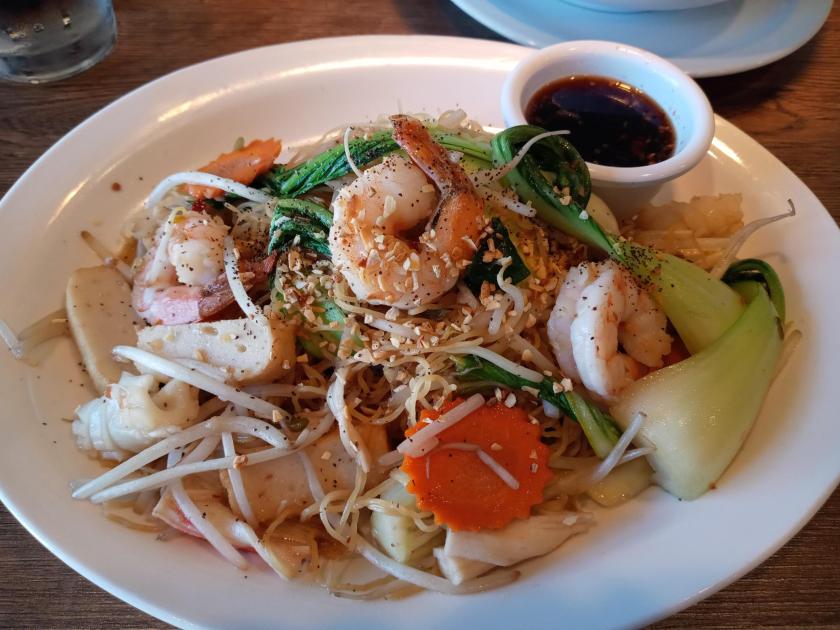
For some reason, I could not decide what to order.  Normally I am not intimidated by a large menu, but for this second visit, I just couldn’t choose.  I eventually picked something pretty random, the seafood stir-fried noodles in garlic sauce, which came with tail-on shrimp, squid, fish cakes, and the usual bok choy, carrots, and bean sprouts.  I chose egg noodles instead of rice noodles, but I had completely forgotten that this was essentially what my friend ordered on our first visit, minus the seafood. To be completely honest, this was okay.  I feel like I did not make the best choice.  I might have been happier with pho or bun bo hue, but I kept thinking about how hot it was for soup (on a scorching August afternoon in Florida), and how it would be hard to beat Pho Huong Lan, maker of the best pho and bun bo hue I’ve ever had anywhere.  Plus, with Z Asian’s huge menu, I wanted to challenge myself and step out of my comfort zone, trying something new instead of something familiar I’ve had dozens, if not hundreds, of times over the years.  But there wasn’t anything wrong with the dish; I blame myself for being uncharacteristically wishy-washy and not choosing wisely.  I was kind of hoping the garlic sauce on the noodles would be more like the awe-inspiring buttery garlic noodles at Kai Asian Street Fare, but not knowing any better, I just set myself up for disappointment.
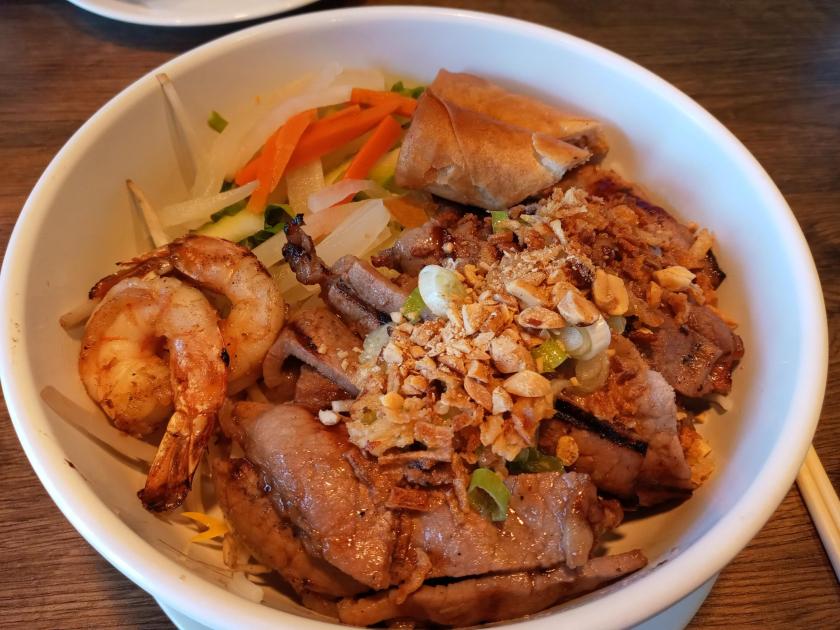
As always, my wife was smarter than I, choosing a favorite from other Vietnamese restaurant menus: slices of tender grilled beef, tail-on shrimp, and a crispy fried spring roll cut in half, served over rice vermicelli noodles, with shredded lettuce, julienned cucumber and carrot, diced scallions, and crushed peanuts.  This was not a noodle soup, but a very refreshing, summery dish with warm and cool ingredients.  Sometimes you can’t go wrong with a classic!   

So that’s Z Asian Vietnamese Kitchen.  I would absolutely return and try something different next time — maybe something with clams or snails, or maybe even sample the bun bo hue or the pho.  But I really don’t think you can go wrong, and if you are a vegetarian or vegan, you have a lot more options here than most other restaurants in and around Orlando.  And if you don’t want to take my word for it, a certain tire company also really recommends the place.

Langer’s Delicatessen-Restaurant (Los Angeles)

Any of my friends, family, and long-time readers know I am a huge fan of delicatessens, whether they are Jewish or Italian.  I am thrilled to say that I recently got to visit the city of Los Angeles for the first time, and on a short, three-day work trip, I still managed to fit in meals at two separate Jewish delis.  I’ll write about the first one I visited a little later, since it was part of a magnificent food hall, but this review is about the second L.A. deli I went to, which happens to be second to none.

Founded in 1947, Langer’s Delicatessen-Restaurant (https://www.langersdeli.com/) is a timeless classic, probably the L.A. equivalent of the legendary Katz’s Delicatessen in New York’s Lower East Side.  I have been to Katz’s a few times and reviewed it after my latest trip there, in 2019.  The atmosphere at Katz’s is chaotic, like so much else in New York City, but the pastrami is so good, it is worth the high prices and less-than-relaxing meal.  However, my admonition to anyone going to Katz’s is to request their pastrami sandwich on a club roll, since the rye bread sucks.  It is essentially an edible napkin, although it doesn’t work much better as a napkin than it does as bread.

I have no such grave advice to offer about Langer’s Deli on the left coast, aside from just making sure you go to Langer’s.  I would rank the pastrami on par with Katz’s — equal, if not better, but that makes it god-tier pastrami that is better than just about anyone else’s from anywhere.  We all got a kick out of the description of the pastrami from Langer’s menu, especially the last part: “Hot pastrami is a select cut of beef, sugar-cured and seasoned as corned beef, then slowly smoked for tenderness and tantalizing taste and flavor, then covered with choice and costly spices.”

I am also thrilled to report that the rye bread at Langer’s is terrific, and it is also a lot more of a chill vibe there, without the bedlam of the Katz’s experience.  I went with two of my new co-workers who are both based in L.A., but none of us had been there before.   Located on the corner of 7th and Alvarado that has seen better days (man, that sounded like a bit of inter-song banter on a ’70s Tom Waits record), Langer’s is near another Los Angeles landmark, MacArthur Park, a once-beautiful park where someone once left a cake out in the rain, but it is kind of sketchy and foreboding today.

Anyway, we all had a very pleasant lunch, and being smart people (librarians all), we stuck to the house specialty, that perfect pastrami.  My new supervisor ordered the French dipped pastrami sandwich, which came on a roll with au jus on the side.  Apparently, L.A. is the place to be if you’re a French dip fan, with the famous Philippe the Original as another destination for sandwich aficionados that I hope to visit in the future.
He seemed to love his sandwich, even if he expressed a bit of cognitive dissonance over our other colleague’s choice.

She ordered the iconic #19, Langer’s most popular sandwich, with pastrami, Swiss cheese, creamy cole slaw, and Russian dressing on rye bread, which was a very smart choice.  I could not get over how soft the rye bread was, yet it had a crispy, crackly crust that you never get with supermarket rye.  

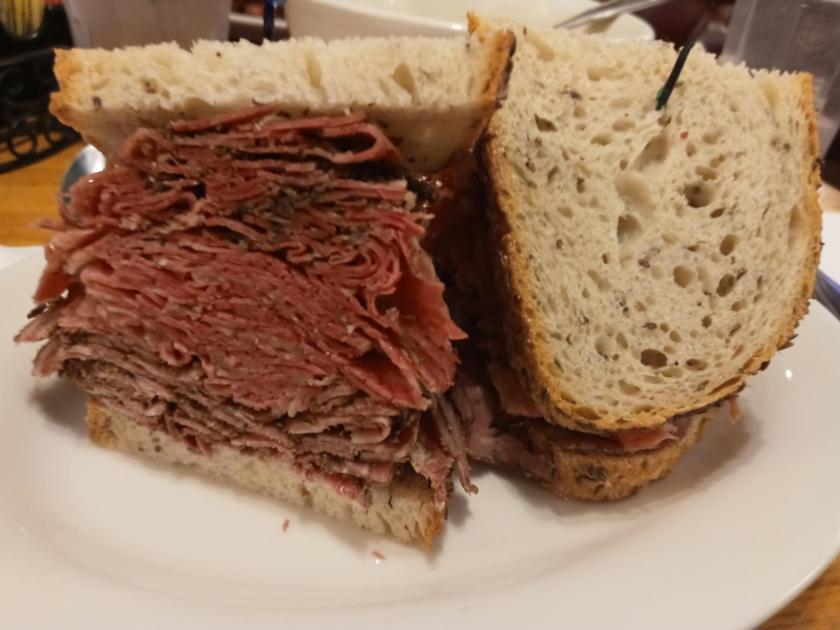
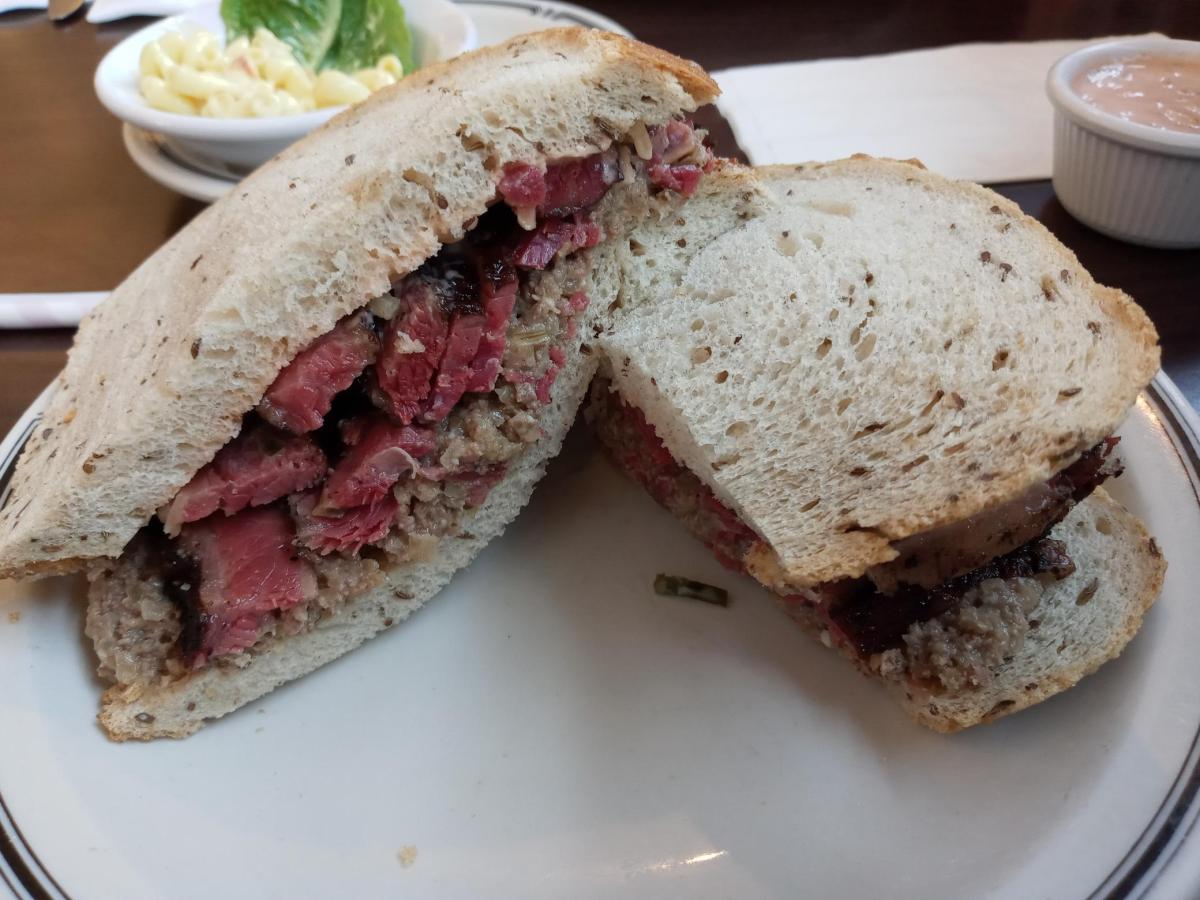
As for me, I could not decide between two sandwiches on Langer’s menu, so in true Saboscrivner style, I ordered both of them, to eat a half of each at the restaurant and enjoy the other halves later.  This was my #6, with hot pastrami, chopped liver, and Russian dressing on that same perfect rye bread.  You can see that the pastrami is hand-carved into thick slices, and it was so juicy and moist and tender and rich and fatty, I cannot rave enough about it.  The chopped liver was savory and creamy and perfect, and a squirt of mustard brought some acidic brightness to this sensational sandwich.  

My other choice was the #44, with hot pastrami (of course), sauerkraut, and Nippy cheese, served on grilled rye.  It was essentially a pastrami Reuben, except the Swiss was replaced with Nippy cheese.  What the heck is Nippy cheese?  I loved the sandwich, and yet I’m still not entirely sure.  I was too distracted to ask our patient server, but my research shows that Kraft used to sell a processed cheese spread called Nippy cheese (before my time), but the stuff at Langer’s is more like a tangy American cheese that had melted into the grilled rye.  It was such a rich and salty sandwich, almost any cheese would have gotten a bit lost in the shuffle, but I like American cheese more than most, and I have zero regrets about my choice.  It was the best Reuben I’ve ever had, especially because I prefer pastrami to the standard Reuben filling of corned beef, and because almost any cheese has more character than Swiss (fit for Reubens, Cubans, and that’s about it).  The pickles were pretty classic deli-style kosher dills, by the way.
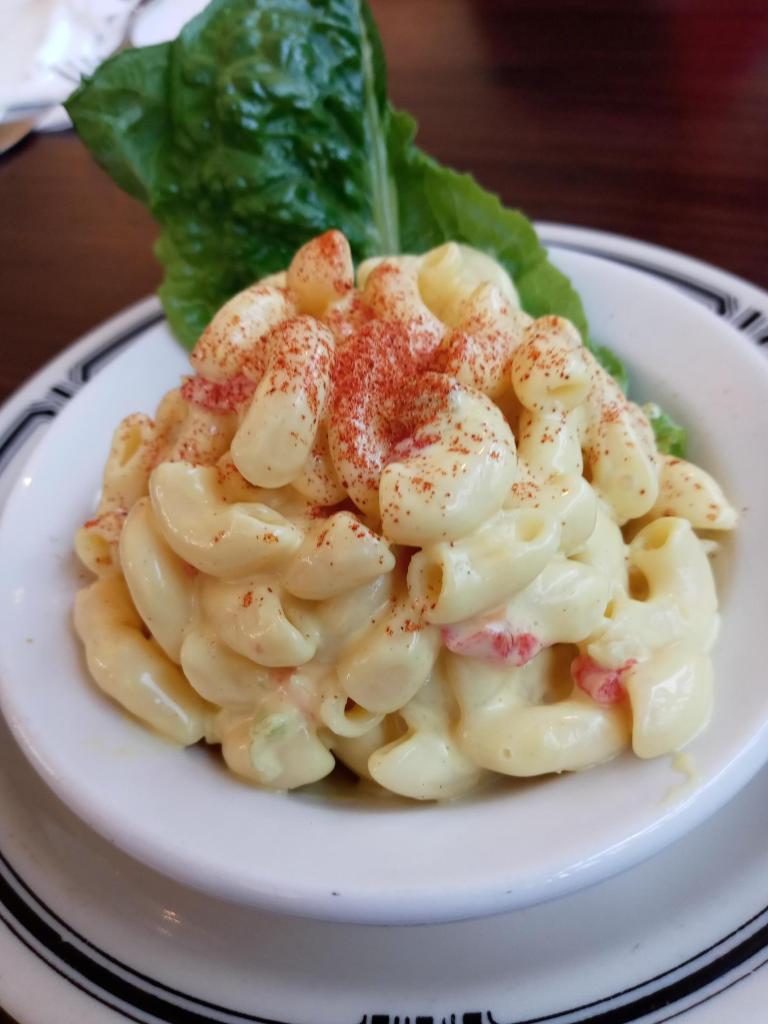
Even though I order macaroni salad almost anywhere that offers it to compare and contrast, I can say that the macaroni salad at Langer’s was nothing special, and I think my co-workers agreed.  The mayonnaise-based dressing was a bit thin and runny, and I think there was yellow mustard in there too.  I had been curious about it, and I’m not sorry I ordered it, but I would not get it again.  If I ever make it back to Langer’s, I think I will try their chili next time, perhaps in the form of chili cheese fries.

As a mustard aficionado (see my past Cutting the Mustard features for more mustard reviews than you ever dreamt of), I was a little surprised to see Langer’s uses good ol’ Gulden’s Spicy Brown, but that’s the mustard my dad always bought, and it’s a classic for good reason.  
My colleagues were good and drank water, but I had heard Langer’s has its own cream soda available as a fountain drink, so I couldn’t resist.  It was much better than that deli staple Dr. Brown’s — sweeter, more vanilla-ey, and more refreshing.  It was a hot August day in L.A., and I definitely took advantage of the free refills.

I had such an amazing time on this trip to L.A., especially getting to meet my co-workers in real life and visit the beautiful school I work for remotely.  Aside from the professional stuff, this magnificent meal at Langer’s Delicatessen-Restaurant was a highlight of this too-short visit (the first of hopefully many).  Not only did the pastrami live up to its legendary status, but I had wanted to eat here for many years — ever since I read journalist David Sax’s 2009 book Save the Deli.  I had planned to go there alone as my first act in Los Angeles, on the way from the airport to work, before even checking into my hotel.  However, sharing that experience on my second day in the city with two new co-workers, getting to know them better over sandwiches, and considering them friends from here on out, made my Langer’s lunch that much more profound and unforgettable.  (And unlike Katz’s, it was a relaxing lunch on top of everything else good about it!)

King Cajun Crawfish

It has been over five years since I’ve eaten at King Cajun Crawfish (https://kingcajuncrawfish.com/), the Vietnamese-Cajun restaurant in Orlando’s Mills 50 district, one of our best and most diverse neighborhoods for dining.  I have always loved it, being a fan of New Orleans and its culture and culinary traditions, so I don’t know what took me so long to return.  At least I’ve been there more recently than I’ve been back to the Big Easy itself (not since 2001, sadly).

You may already be familiar with the Cajun and Creole dishes of Louisiana, but I will be didactic and point out that Cajun food is rustic and rural, a spicy stewpot of French-Acadians who left Nova Scotia and settled in the bayous of Louisiana along with Southern influences, while Creole food is more continental “city food” from New Orleans, influenced by Caribbean and European flavors, especially French.

Vietnamese-Cajun is a unique offshoot — a fusion of a fusion — and we are lucky to have several Viet-Cajun restaurants here in Orlando.  I believe King Cajun was the first, so it has always been my favorite.   Food & Wine offers a nice history of the fusion cuisine, which started with Vietnamese refugees who worked in the seafood industry in Gulf Coast Texas and Louisiana.

I recently invited a beloved professional mentor and friend out to lunch, something we’ve been meaning to do for almost 15 years but never gotten around to.  She is a sophisticated and brilliant woman who hails from New Orleans, so I figured King Cajun would be a good choice.  I see it as pretty authentic, but I was glad she said the same, without any prompting.

King Cajun Crawfish specializes in seafood boils, messy pots of excess featuring crawfish, shrimp, and crab in savory, spicy broths with potatoes, corn, and Andouille sausage.  However, those are so messy, you really have to dress down for a meal like that, or you’ll ruin your clothes.  Just an FYI: a meal like that might not be the best choice for a date, unless you’re planning to disrobe later, in case it could end up being an inspired choice.  My colleague and I played it safer, selecting with other menu items less likely to splatter, splash, and stain, but for future reference, those seafood boils are delicious, especially if you go with the house specialty “ShaBang sauce” (a blend of their traditional, lemon pepper, garlic butter, and “Rajun’ Cajun” seasonings).

My mentor started out with hush puppies, seasoned dough balls fried to crispy, golden perfection, yet savory and soft inside.  These were terrific dipped into some thick, tangy remoulade sauce, and the leftovers heated up perfectly in my toaster oven later that night.

She also ordered a cup of jambalaya, which is a rice dish in a thick, tomatoey sauce with Andouille sausage, chicken, shrimp, onion, and celery.  We both liked the little we tried, and I brought the rest home for my wife, who overcame her skepticism and absolutely loved it.

I got seafood gumbo for us to share, which my wife and I both always enjoyed at King Cajun in the past, and this was no exception.  My mentor and I requested it at medium heat, because there was hot sauce on the table to punch it up if it was too mild.  I could have taken it hotter and been fine, but it was great as is, with plenty of plump shrimp, sausage, chicken, rice, okra, and the “trinity” of Cajun and Creole cooking: onion, celery, and green bell peppers, all cooked in a flavorful roux (stirring flour into butter or some other fat to thicken sauces).  Needless to say, we did not roux this day!  Gumbo is more like a soup or stew than jambalaya, just in case you have confused them in the past.  Both have similar ingredients, but gumbo always has more of a broth, with white rice on the bottom of the cup or bowl.
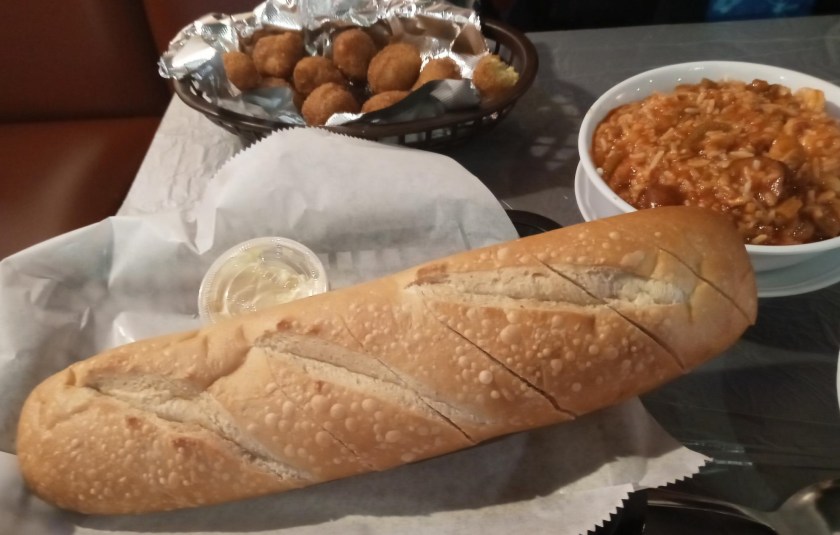
The hot, fresh French bread at King Cajun is awesome — perfectly crusty on the outside and fluffy, soft, and warm inside.  A small loaf, more than enough for two people to share, is only $2.  You must get it, whether you order the seafood boil or something else saucy, like gumbo, jambalaya, or crawfish étouffée (for next time).  The po’boy sandwiches come on the same bread, but when you order the loaf, it is scored to pull apart easily.

This was the fried oyster platter (my choice), which I thought was only supposed to come with six fried oysters, but it came with far more than six.  They were also fried perfectly in a cornmeal batter.  I think I prefer raw or charbroiled oysters most of the time, but these were delightful.  You can also get them in a po’boy sandwich, but we already had French bread, and I felt like getting some sides.All the fried platters come with two sides.  I chose potato salad and onion rings, so long-time Saboscrivner readers know this is also a RING THE ALARM! feature.  The potato salad was cool and refreshing, tangy with a little yellow mustard the way Southern potato salads often are.  The onion rings were breaded rather than battered, but they didn’t have those jagged crags that cut up the inside of your mouth, and the onions inside were at a reasonable temperature, not molten and scalding.  I dipped the oysters and onion rings in the included cocktail sauce, but the remoulade (not pictured) was the best dipping sauce for both.

A side of cole slaw was crispy, cool, creamy, and refreshing, but not too heavy with mayo.  Like the potato salad, it was nice to cut all the richness of the fried stuff we had been eating.

And for dessert, you can’t leave New Orleans or King Cajun Crawfish without an order of beignets (pronounced “bin-YAYS”), puffy triangles of fried dough covered with so much powdered sugar, it looks like they just left a bachelor party in Miami… or let’s face it, any party in Miami.
King Cajun Crawfish serves Café du Monde coffee, a New Orleans classic that is an ideal combination with these beignets (especially with condensed milk added), but we both passed.  I’m not a coffee drinker, and even I’ll tell you that is some damn fine coffee with its flavoring from the chicory root.  Then again, condensed milk makes everything better, and now I’m thinking about requesting some to drizzle over the beignets or dip them in it next time.

This was a long overdue lunch with one of the best people I know, and we could not have picked a better restaurant.  It made me happy she liked it and considered it authentic (better than Tibby’s, she said!), and I wondered how and why it had been so long since my last visit to King Cajun Crawfish.  Next time I return, I will have to go with a group and dress down to enjoy some boiled crawfish and shrimp in ShaBang sauce without ruining my work clothes.  I don’t think that’s too shellfish of a request.

CLOSED: Zorba’s Greek Restaurant

EDITOR’S NOTE: I was saddened to learn that Zorba’s Greek Restaurant permanently closed in August 2024.  Apparently the owners retired, so good for them, after so many years in a hard business.  But Zorba’s really was my favorite Greek restaurant in the Orlando area, and I will miss it terribly.

***

Zorba’s Greek Restaurant (https://zorbasgreekfood.com/) is located at 115 East 1st Street, in the quaint, picturesque, historic section of Sanford, about half an hour north of downtown Orlando.  1st Street is lined with great restaurants (including the beloved Hollerbach’s German Restaurant, Christo’s diner, and the nearby St. Johns River Steak & Seafood), bars, breweries, and cute shops.  There is an excellent ice cream parlor (Wondermade, one of my two favorites in Central Florida) and a very cool new food hall, Henry’s Depot, which I recently visited for the first time and will definitely write about in the future.  There is a German grocery store (Magnolia Square Market, owned by the Hollerbach family), a shop that specializes in hot sauces and everything spicy (Spice is Nice, which I also plan to review), and a farmer’s market every Saturday.  It’s one of the most underrated foodie areas around, so I am thrilled to review another restaurant in the neighborhood that quickly became one of my new favorites.  In fact, after two visits, one for dining in and one for takeout, I might go out on a limb and call Zorba’s my favorite Greek restaurant in the Greater Orlando area.

Funny enough, my wife and I ended up there completely accidentally, after first driving to Sanford intending to go to Hollerbach’s on a day it turned out to be closed.  We had been passing Zorba’s for years, and since it is mere steps away, we went there instead, and were so glad we did.  We were hungry, so we did our usual over-ordering thing, knowing we would have plenty of delicious leftovers to last us for days, which would heat up well at home.

We started out with eggplant garlic spread, which came with warm,  soft, lightly grilled pita bread wedges for dipping and/or spreading.  I am relieved to report the pita bread was really good, because I hate the Toufayan brand of pita they sell at Publix, near the deli section. 

The eggplant garlic spread was savory and creamy, as the menu promised.  It was my wife’s idea to order it, but I think it was so garlicky, I ended up liking it more than she did.  But it was really awesome, and I would definitely recommend it as a nice starter.

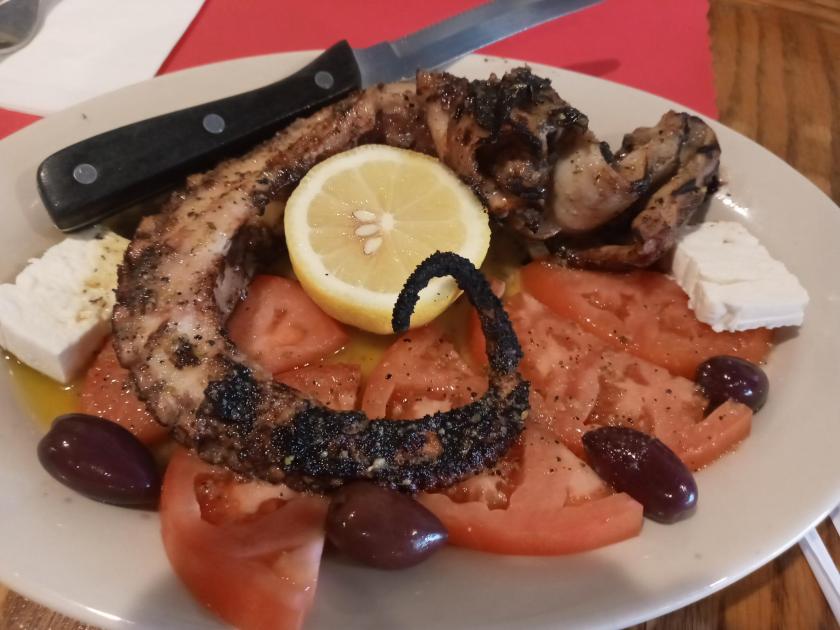
She chose the octopus from the list of mezethakia, or Greek appetizers, to be her main course.  We all have our favorite dishes we can never turn down when we see them on menus, and octopus is one of hers.  You never know quite how restaurants are going to serve it, but Zorba’s served one large, marinated, char-grilled tentacle with tomatoes, kalamata olives, lemon, and some of the best feta cheese either of us have ever had.  I’ve had so much rubbery, chewy octopus that I don’t seek it out anymore the way she does, but she insisted I try it, and it was outstanding — easily some of the best I’ve ever tried anywhere.  Really meaty and flavorful, possibly from being tenderized by an acidic marinade that includes vinegar.  

Since my wife doesn’t cook, I suggested she order something else that she could eat over the next day or two, once I was back at work.  She chose papootsakia, which is really fun to say.  The menu describes it as half an eggplant stuffed with seasoned ground beef topped with creamy Bechamel sauce and baked, but as you can see, it looks like they served her a double portion!  This was another banger.  We both tasted cinnamon in the ground beef, and I suspected they use the same recipe for the moussaka (casserole with ground beef, eggplant, potatoes, and Bechamel) and some other dishes.  My wife named this one of the best things she has ever eaten in her life, and she doesn’t toss around superlatives as freely as your friendly neighborhood Saboscrivner!Needless to say, the papootsakia (hehe) lasted her a few days, and like so many saucy, savory dishes, it kept tasting better and better after every day in the fridge.

Just like octopus and eggplant are two of my wife’s “trigger dishes” that she always feels compelled to try anywhere, slow-braised and stewed meats in sauces are one of mine.  I noticed Zorba’s offered a lamb shank and a pork shank, both braised and baked in a tomato sauce.  I had a hard time deciding between the two, but our patient server suggested I try the lamb shank for my first visit, and so I did.  This really is one of my favorite meals, period.  I loved the braised lamb shanks at Cappadocia Turkish Cuisine (and listed them as one of my Top Five favorite things I ate in 2018 in Orlando Weekly), and now I’m pretty great at making them myself, using this recipe.   Well, I’m happy to say that the lamb shank from Zorba’s is as good as any of the other versions I’ve tried or made, if not better.  The tomato sauce is so rich, it really puts it over the top.  The meat was fork-tender and so savory and flavorful.The rice pilaf was already soft and buttery, but I mixed all the tomato sauce I could into it, making it even better.
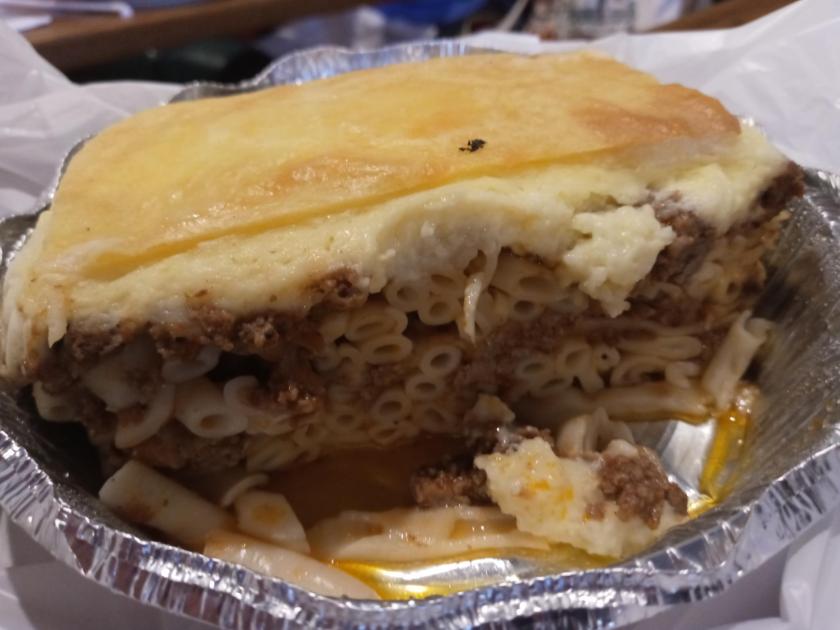
As if that wasn’t enough food, I ordered one of my favorite Greek dishes, pastitsio, which is kind of like Greek baked ziti or lasagna — a baked casserole with layers of seasoned ground beef (with more of that cinnamon) and long, uncut ziti noodles tossed in beaten egg whites and feta cheese after boiling to help the noodles stick together, topped with more creamy Bechamel that browns when baked.  It is a delicious, hearty dish that is different enough from the Italian versions that you absolutely have to try it, if you never have had it before.  And the pastitsio at Zorba’s is absolutely the best version I’ve ever had.  They knocked it out of the park.

It’s so pleasing to the eye too, when the chef gets all the ziti noodles facing the same way, so it creates that honeycomb-like pattern when slices are cut out of it.

All the entrees came with a choice of a lovely Greek salad tossed in a housemade viniagrette dressing with more of that terrific feta (so much better than the kind I’ve been buying at Aldi), or a soup.  The salad turned out to be a much more refreshing choice.

The soup was avgolemono, a hearty Greek chicken soup with orzo pasta and lemon.  We wanted to try both the salad and the soup, but it’s just too blasted hot to enjoy most soups, here in the hottest summer recorded in human history.

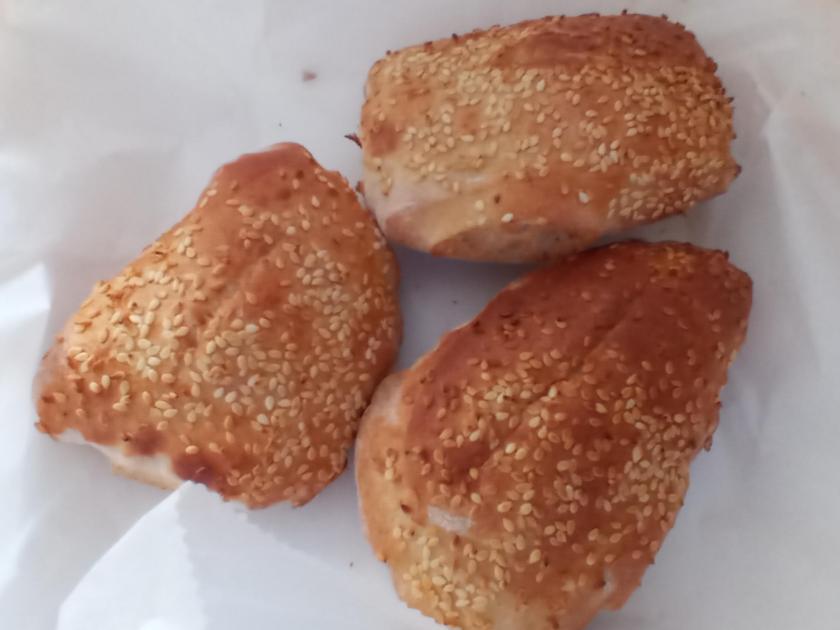
The entrees all come with fresh-baked rolls studded with sesame seeds.  It seems like an unnecessary inclusion, but these are really damn good rolls, especially when you have such delicious sauces and juices to mop up.  Don’t leave them behind!

And my wife said we couldn’t leave without trying the baklava for dessert, so who was I to argue?  It was good baklava, although I have never had bad baklava.

Here’s a look at it with the thin, crispy phyllo dough “roof” removed:

On my second visit to Zorba’s, this past weekend, I brought home the lamb chop lollipops for my wife.  I asked for them rare, but they came out closer to medium.  These are a lot thinner than the thick lamb loin chops I buy at Costco for roasting, so it was probably harder to rescue these while they were still rare.  These were served over more rice pilaf and dressed salad greens.

Since I liked the lamb shank so much last time, this time I ordered the pork shank, which was an even bigger hunk of meat with the bones still in.  Like the lamb shank, it was baked to fork-tender perfection in the same rich tomato sauce, over more rice pilaf.  I didn’t even eat this until the day after I brought everything home, but I suspect it got even tastier in the fridge overnight.   No matter which shank you choose, you can’t go wrong.   Zorba’s prepared both perfectly.   

I could not help ordering a regular gyro for us to share, just to see how Zorba’s stacks up to other gyros around Orlando.  It was really good, with the garlicky, salty lamb slices still tender (some places throw them on the grill after carving them off the spit, drying them out), nice, thick, creamy, garlicky tzatziki sauce, and a properly grilled pita.  If you’re in the mood for a gyro in Sanford, you absolutely can’t go wrong.  BUT — and this is not a complaint about the quality at all — nobody in the Orlando area makes a better gyro than Mediterranean Deli on Fairbanks Avenue.  If they do, I haven’t found it yet.

So that’s Zorba’s Greek Restaurant.  If Sanford wasn’t such a schlep from home, we would become regulars for sure.  As it is, I’ll still make the trek to bring it home when we’re in the mood, because it is that damn good.  You can tell everything is homemade, fresh, and authentic.  The service was great when we dined in, and it’s a nice little spot that would be fine for  casual family dining, but nice enough to bring a date.  There are so many great dining options in Sanford these days, but this is one that may not be as new or exciting or “sexy” as some of the other restaurants along 1st Street.  Don’t sleep on it, though.  It was one of our favorite discoveries of 2023, and it will probably become one of yours too.

Twenty Pho Hour

Twenty Pho Hour (https://www.twenty-pho-hour.com/) is a new “fast casual Asian fusion” restaurant that opened in the shopping center at 11951 International Drive, down by Sea World, in a part of Orlando I rarely venture to.  My wife and I recently went there because a dear friend from college was in town briefly, staying nearby.  I hadn’t seen him in over 20 years, but we lived down the hall from each other in the dorm our freshman year, and had caught up on Facebook, where he is as witty and insightful and as good a dude as ever.  This guy (who shares a name with an infamous TV news reporter and an infamous cartoon character) had even befriended some of my completely unrelated Facebook friends, and my wife really wanted to meet him, so we had a great lunch at the eye-catching Twenty Pho Hour.

Normally you order at the counter, but since my wife and I arrived before my friend, the patient server allowed us to sit down at a table, and she took all of our orders on a tablet when my friend joined us.  Then we wandered around the space, since there is a lot to look at.  Twenty Pho Hour bills itself as “America’s first 2D noodle bar,” and that is due to the striking interior design and theming of the restaurant.  Everything is white surfaces with black outlines, giving it the look of two-dimensional artwork that messes with your eyes and your brain by suggesting three dimensions.  Generation Xers and elder Millennials, you have probably (hopefully!) seen the classic “Take On Me” music video by Norwegian band A-ha, and that is the best way to describe the Twenty-Pho Hour decor.  Plus, the song is a synth-pop bop that can transport you straight back to 1985, for better or for worse.

All the books had funny, punny titles on their spines:

The “pho booth” is a popular picture-taking spot, as one could guess:

So it’s a hip, cool, ‘Grammable place, but what about the food?  Well, it’s perfectly fine, especially on that touristy side of Orlando, far from the super-authentic Asian restaurants clustered around the Mills 50 district.  I’m guessing many who venture here, this could be their first taste of pho, the iconic Vietnamese beef noodle soup that lends the restaurant its name, so I decided to try a classic: pho dac biet ($13).  This is the combination pho that comes with thin slices of rare eye round steak, beef brisket, chewy beef meatballs, tender tendon, and tripe (which has an odd texture that isn’t always my favorite), in addition to soft rice noodles, onions, and green onions in a complex, fragrant, slow-simmered beef broth.  I’ve slurped, scarfed, sipped, and supped on pho dac biet all over Orlando, so I wanted to try this as pure and unadulterated as possible.  I didn’t add any sambal oelek, sriracha, or hoisin sauce to my pho, just the fresh basil, fresh jalapeño slices, and a healthy squirt of lime.  And it was perfectly fine.  It didn’t capture the majestic magnificence of my other 2023 discovery, Pho Huong Lan, which I would still consider the best pho in Orlando by far.  But it was refreshing, the way only pho can be, compared to having other hot soups during most of the hot, humid year in Florida.  Later, I would describe it to my wife as “baby’s first pho,” but you know what?  There’s nothing wrong with that.

My friend ordered the Trifecta ($13), a soup of beef brisket, chicken, shrimp, and udon, a thick and chewy Japanese style of noodle, in beef broth.  He seemed to really enjoy his, but I did not get a picture of it.  Sorry!

My wife ordered pad Thai ($13), a dish of stir-fried rice noodles with egg, peanuts, carrots, scallions, cilantro, and lime in a sweet and tangy sauce.  She chose tofu as her protein, but you could also choose steak tips, brisket, chicken, shrimp, or vegetables.  Note that even the plates and bowls stick to the visual theming of white with black borders, to continue the illusion and make the food pop visually even more.   I’ve always felt that pad Thai is a great dish for judging a new and/or unfamiliar Thai restaurant, along with my personal go-to Thai dish, pad kee mao, sometimes known as drunken noodles.  I think my wife chose wisely, because she really loved Twenty Pho Hour’s version of pad Thai.  She let me try a taste, and I liked it too.

My wife also adores summer rolls at most of our favorite Vietnamese restaurants like Little Saigon and Pho 88, so she wanted to try the Twenty Pho Hour version.  These were tofu summer rolls ($5) — transparent, chewy rice paper stuffed with fried tofu, mixed greens, rice vermicelli (the same noodles that were in my pho), carrots, zucchini chips, fried onion, and fried garlic.   She seemed to like them a lot, but she didn’t dig on the sweet chili sauce they came with.  She greatly prefers the sweet peanut sauce that most other Vietnamese restaurants serve their summer rolls with.  Little did we realize, Twenty Pho Hour also serves more traditional summer rolls with that peanut sauce, but oh well, lesson learned.

My wife ordered a taro milk tea ($5) with some strawberry-flavored popping boba added (a $1 upcharge), and she really liked that.  Taro bubble tea is her standard drink at any Asian tea shop or Vietnamese restaurant, but they had a few flavors to choose from.   Taro always tastes like vanilla to me, but with a slightly earthy undertone that is pleasant.   

And my old pal ordered an adult beverage that came with an adorable Twenty Pho Hour-branded rubber duckie, complete with the restaurant’s logo and matching color scheme.  This was the spicy Tokyo mule ($12), with jalapeño-infused sake, ginger beer, simple syrup, lime juice, and fresh basil.  It sounded really interesting and refreshing, and he seemed to really like it.  Unfortunately, he forgot to bring the duck with him, but you can keep them.  

So that’s Twenty Pho Hour.  Despite the name, the restaurant is not open twenty-four hours, so that is misleading, but I understand the need for some logical leaps in service of a pun.  At least it remains open until 2:00 AM Thursday through Saturday.  If you find yourself down near Sea World and don’t want to schlep toward downtown Orlando for pho or other Asian food, it would be a pretty safe bet.  It’s already quite popular, and I expect its popularity with increase exponentially in the weeks and months to come, so plan your visit accordingly.

Apparently it is up for some kind of Michelin dining award in 2023, to be announced later this summer.  I’m assuming a Bib Gourmand award, which “recognizes great food at a great value,” or a “Recommended Restaurant.”  But I’m not expecting a restaurant that has you fetch your own chopsticks and plastic utensils will get a Michelin star.  Personally, I am skeptical about the entire Michelin process, and about getting restaurant recommendations from a tire company with delusions of grandeur, but here you are, getting restaurant recommendations for the past five years from an ex-librarian writing from a home office filled with action figure displays.

CLOSED: Mr. J Hand-Pulled Noodle

EDIT: On August 11, 2025, Mr. J Hand-Pulled Noodle announced it has permanently closed.

***

A month or two back, I found myself in Ocoee, an area of West Orlando I never end up in, so I invited a work colleague who lives out there to meet me for lunch at Mr. J Hand-Pulled Noodle (https://www.mrjhandpullednoodle.com/).  I had heard lots of praise about the new Chinese restaurant, one of the only ones in Florida to offer Lanzhou-style hand-pulled noodles called lamien, served in halal Chinese Muslim beef noodle soup.  I was excited to try it, and so was my foodie friend.

Mr. J (which I can only hear in Arleen Sorkin’s New Jersey-inflected Harley Quinn voice) opened next to a Publix in a little shopping plaza at 1688 East Silver Star Road in Ocoee.  The sign for the previous restaurant, Crab & Wings, was still up when we visited.  It is a relatively small dining room, with are four tables for parties of four, three tables for parties of two, and a counter in the back with four additional seats (stools), where we sat.  You order at the counter, and they bring your food to you when it is ready.

There are eight different noodle shapes to choose from, all made by the chef-owner, Jiqing “James” Meng: flat, thin, small flat, normal, triangle, leek leaf, thick, and thicker.  I half-expected him to be putting on a show for the diners, pulling and twisting and whipping and winding noodles, like a scene out of Kung Fu Hustle, but all the action was taking place in the kitchen, out of sight.  You should definitely come to Mr. J for an awesome lunch or dinner, but don’t expect a show.  That was fine with us — it should end up getting hype and praise for the awesomeness and authenticity of the food, not for any kind of performative aspect.   

The Mr. J’s Hand-Pulled Noodle Soup ($15.95) was a clear, consomme-style beef bone broth that reminded me more of Vietnamese pho than the familiar wonton soup I have ordered countless times at countless Chinese restaurants in Orlando, Miami, and Gainesville.  I could not begin to identify all the herbs and spices that gave it its complex yet subtle flavors, but I know coriander and garlic leaves are involved.  It was not as spicy as I was expecting or hoping, despite knowing a bit of chili oil was in there, but that allowed me to focus more on the thin slices of tender beef and the perfectly soft and chewy “small flat” noodles I ordered.   

Here’s one of those noodle-pull action shots all food bloggers try to do.  I always try to be a cool man of the world and eat my noodle soups with chopsticks, but that just means I splash my shirts, no matter how cool I try to look.  The noodles were much softer than Italian “al dente” pasta, and because they are made with wheat flour, they were also softer than the rice vermicelli in bowls of pho.  But even when I couldn’t finish all of mine and took some home, they kept their shape and firm, springy chewiness.  Note the thin slice of crunchy white daikon radish in the bowl with all the diced leeks, a nice addition.

I figured the noodle soup would not travel well, so I also ordered stir-fried hand-pulled noodles to go ($16.95), to share with my wife at home.  This dish included more of the sliced beef, stir-fried with either “thick” or “thicker” noodles.  I chose “thicker,” because I love ’em thick, and the only thing better could be thicker.  Onions, green and red bell peppers, tomato, and even pumpkin (according to the menu) are stir-fried in the mix too, although I admit I couldn’t identify the pumpkin in with all that other goodness.  The red sauce was tangy and mildly spicy, and it was topped with fresh cilantro.This was another tasty dish, but I would definitely advise first-time diners to go with the soup if they are dining in, if they have to choose between the soup and the stir-fried noodles.  The soup is definitely the house specialty, and it is the most unique dish.  You also have more noodle shape choices if you go with the soup.

I neglected to take a close-up, but in the background, you can see the tea eggs I ordered for my colleague and I to try ($1.50 each), since I had never had a tea egg before.  They were delectable hard-boiled eggs dyed a rich brown hue from tea once we shelled them, and they took on some of that unique flavor.  I eat hard-boiled eggs a lot at home and in my boring work lunches, and the tea eggs inspired me to do more exciting things with them in the future, like this.  There were also “thousand-year-old eggs” on the menu, another kind of egg I’ve never tried before, but I figured I would not push my luck.

Like I said, I am never this far west in Orlando, so I have no idea when I will return to Mr. J, so I’m glad I tried everything I did when I did.  If you make it to Ocoee more than I, you owe it to yourself to try it for yourself.  Chef Meng is a master of his craft, elevating noodles to an art form.  I can safely say you have never tried noodles like these or soup like this in Orlando.  Even though it feels like 2023 has skipped spring and gone straight to summer, get some of his beef noodle soup with these fresh, hand-pulled lamian noodles before it gets even hotter out there, and don’t let the heat and humidity stop you even in the epicenter of August’s armpit.

Pho Huong Lan

Well, we’ve had another chilly few days, and when the weather gets cool, my thoughts turn to hot, hearty soups.  Pho Huong Lan (https://www.phohuonglan.com/) is my new favorite restaurant in Orlando for the two Vietnamese noodle soups I love so much: pho and bun bo hue.  For the uninitiated, pho is a hearty beef noodle soup featuring rare beef that cooks in the hot broth, as well as meaty add-ons like sliced brisket, chewy beef meatballs (nothing like Italian or Swedish meatballs), tender and unctuous beef tendon, and tripe.  Bowls of pho are infinitely customizable, as they come with basil leaves, bean sprouts, sliced fresh jalapeño peppers (much hotter than the standard pickled variety you get in jars), lime wedges to squeeze into the broth, and condiments like hoisin sauce and spicy sriracha.

Bun bo hue is a spicy red broth that usually contains thicker noodles and different cuts of beef and pork, and it also comes with fresh herbs, vegetables, and lime wedges to make every bowl unique.  I’ve tried them all over town, and Orlando is blessed with many Vietnamese restaurants that serve excellent bowls.  I can’t think of many disappointing experiences I’ve had with either kind of soup.  They warm your body and soul — perfect for chilly weeks like this one — but pho is one of the only soups I seek out to enjoy in the summertime, because it is so light and surprisingly refreshing.  But that said, of all the restaurants I’ve tried these two soups at, Pho Huong Lan makes the souperior versions of both.

Here are photos of the menu.  Pardon the contrast — yellow text on a white background is not the greatest combination.  You may want to right-click on the menu images and open them in new tabs for larger images.   

This really cool mural livens up the dining room, where hot pots simmer off to the side.  

Lucky maneki neko cats decorate the front counter, greeting customers.

For our first takeout order, I ordered pho for both my wife and myself.  Like any good Vietnamese restaurant, they package the fragrant broth separately in takeout orders, so the tender rice noodles don’t turn to mush before you get to enjoy it.  Mine is on the left, and it doesn’t look as clear as my wife’s broth on the right because it has oxtails (one of my favorite meats!) swimming in it.  

My wife ordered pho tai dap, with rare flank steak.  That’s her usual, but most local Vietnamese restaurants serve it with small, paper-thin slices of rare beef.  Pho Huong Lan surprised us both by serving it with a large piece of tender rare flank steak, served like chopped steak — not exactly in the form of loose ground beef, but close.  It cooked perfectly well in the hot broth at home, so don’t worry about that one bit. The rice noodles were thicker and more tender than the rice vermicelli most local restaurants served.  We both liked them a lot.

Here’s a close-up of the rare flank steak we both got.  I preferred this a lot to the slices of rare beef we are used to.  It was a lot more tender than those slices once it hit the broth.

I got a smaller portion of the rare flank steak because I chose the pho dac biet, my usual at most restaurants, with rare flank steak, brisket, beef tripe, tender beef tendon, and beef meatballs (which were also floating in the broth with the oxtails I added on for an upcharge).

Here is my beautiful bowl of pho, fully assembled at home, as perfect as such a thing can be:

On my second visit, I tried the bun bo hue, which came with thicker, chewier rice noodles and a different assortment of meats than the pho: “rough” flank steak, beef shank, the chewy and unctuous tendon I love, congealed beef blood, and a round slice of pork bologna.   I also paid the upcharge for beef short rib, another fatty and tender meat I love.  I am so happy that Pho Huong Lan offers oxtail and short rib options, which I don’t mind paying extra for.   
(In addition to the short rib and oxtail add-ons for the pho and bun bo hue, you can also add ox pennis [sp] to your noodle soup for an upcharge, something I’ve never noticed on any other local Vietnamese menus.  But as many times as people have told me to “Eat a dick,” I’m just not there yet in my development as an adventurous eater.)

Here is the assembled bun bo hue, which was so warm and comforting and refreshing on a chilly day.  It was spicy, but not nearly as spicy as other dishes I’ve had from other cuisines, and not even quite as spicy as other versions of bun bo hue I’ve had in Orlando.  Here, the heat complimented all the fresh flavors without overwhelming any of them.

Pho Huong Lan only serves pho and bun bo hue, with multiple options in multiple sizes.  If you’re looking for rice dishes, grilled meats, summer rolls, banh mi sandwiches, or any other Vietnamese specialties, the good news is you have many other great options in Orlando, especially in the same Mills 50 district.  I have reviewed plenty of them, and I remain a fan.  But if you’re in the mood for these two iconic noodle soups, I argue that Pho Huong Lan makes the absolute best versions in Orlando.  I’ve tried most of them, and this restaurant is streets ahead of its competitors.  Your mileage may vary, and I would love to hear what my dozens of readers think, but I feel pretty confident recommending Pho Huong Lan as the best I’ve ever had.

Wa Sushi

Wa Sushi (https://www.facebook.com/WaSushiCasselberry/) is a real treasure in the Seminole County suburb of Casselberry, 20 minutes north of downtown Orlando.  The small, serene location is located in a nondescript shopping plaza between an Ollie’s Bargain Outlet and a store called Sports & Pokemon (the two genders?), but it boasts some of the finest sushi and Japanese food in the Orlando area.

Wa Sushi used to be in another, even less auspicious location elsewhere in Casselberry, pretty far out of the way and hard to find, and our very cool next-door neighbors invited us there once.  It was good, but for whatever reason, we didn’t return until recently — our first visit in years, and the first to this new location.

You can find Wa Sushi’s menu on the Facebook page above, but they had a menu of specials when I took my wife there recently, for our first real date night in a while:

This was one of the last evenings of 2022, and we saw Wa was offering another special of toshikoshi soba, or “year-crossing noodles,” traditionally meant to be eaten on New Year’s Eve to let go of the hardships of the past year (since soba noodles are so soft and easily cut).  Well, we figured we could both use some of that.

Rather than try the version in broth, we ordered the toshikoshi ten zaru soba ($16), cold soba noodles served with a dashi soy dipping sauce and a side order of tempura-battered and fried shrimp and vegetables.  It was beautifully plated, and really good too, although I probably would not have ordered it if the dish wasn’t associated with the tradition of letting go of the hard times of the past year.

Close-up of the tempura shrimp and vegetables.  My wife ate the tempura sweet potato, and I had the onion and shishito peppers.

Here are the cold soba noodles, made from buckwheat and topped with some fine shreds of nori (seaweed).  They didn’t have much flavor at all, kind of like eating plain, cold spaghetti, but earthier.  The dashi dipping sauce helped immensely, as did the finely-diced scallions that also came on the side.   

Something we ordered came with the obligatory wee house salad with sesame dressing and miso soup, which I enjoyed:

This was ika geso ($11), a small plate of deep-fried squid legs from the Hot Tasting section of the menu.  After how tender and fried to perfection the shrimp were, we thought we would double down on the tempura shellfish.  These were chewier than a lot of fried calamari we have ordered around town, but I have a feeling this squid was a lot fresher, as opposed to some restaurants that may use frozen calamari.  They definitely tasted fresh.

My wife always loves a good selection of sashimi, or in this case, a beautiful portion of chirashi ($33) — select cuts of raw fish, selected by the chef.  There was salmon in here, ebi (shrimp), tako (octopus, one of her favorites, whether raw or cooked), ikura (orange globes of salmon roe), tamago (perfectly cooked and sliced egg), and unagi (eel).  I always love eel in sushi, but this was her first time trying it, and she liked it.  I’m always impressed by her willingness to try almost anything.

And we ordered three beautiful rolls to share:

In the foreground, you can see the ultimate tuna roll ($16): spicy tuna and cucumber inside the rice, topped with  tuna, wasabi-infused tobiko (fish eggs), and sweet chili sauce.  This one was awesome, but I’m always a fan of spicy tuna in any form. 

Here you can see the inferno roll ($14) in the front, and the mango tango roll ($13) in the back.  In the very front are slices of escolar sashimi ($2.50), just for her — a big fan of the butterfish.  The inferno roll features spicy salmon and cucumber topped with yellowtail, spicy mayo, and paper-thin slices of fresh jalapeño pepper.  Awesome combination.   
The mango tango roll in the back features tempura-battered and fried shrimp, mango, and cucumber, topped with crab salad.  I believe this was real crabmeat and not surimi (processed fish sometimes called “krab,” even though I like that stuff too).

I was really impressed by Wa Sushi, once again, all these years later, in a much more convenient location.  Last summer I wrote a review of Kabuto Sushi & Grill, another friendly neighborhood sushi spot close to our home, just on the Winter Springs side rather than the Casselberry side.  I even listed one of Kabuto’s dishes in my Top Ten Tastes of 2022, which came out in the last Orlando Weekly issue of the year.  Sadly, that very week, the last week of 2022, Kabuto announced it was closing permanently.  That’s when I resolved to get us back to Wa, to support them as much as we could moving forward, to help spare it a similar fate.  I know lots of local foodies already know how fine Wa Sushi is, and common consensus is that it is one of the best sushi establishments in the greater Orlando area.  It absolutely is, and to have it so close to home, a true treasure in Casselberry, of all places, means we have to protect it, support it, and shout our praise from the rooftops, both real and virtual.  So here’s my praise and my protection.  Let’s support all of our favorite restaurants as much as we can this year, especially those friendly neighborhood favorites we are lucky to have so near and dear to us.