Selam Ethiopian and Eritrean Cuisine

A while back, I went to a Transformers convention here in Orlando with one of my closest friends.  We went to high school together in Miami, and he was in town for the show, visiting from Tampa.  He is a vegetarian, so afterwards, I suggested lunch at Selam Ethiopian and Eritrean Cuisine (https://www.ethiopianrestaurantorlando.com/), located at 5494 Central Florida Parkway in Orlando, just off International Drive and close to the Sea World theme park.  I’ve only ever had Ethiopian food once before, a long time ago, at Orlando’s only other Ethiopian restaurant, Nile, which I need to get back to.  But I had been hearing great things about Selam for years (including a Michelin recommendation), and it lived up to every bit of hype.

We started our epic lunch by sharing this order of two lentil samosas, fried to perfection in their thin, crispy shells.  These were flatter triangles than the pyramid-like Indian samosas most of us are probably used to, with lighter, thinner shells that were more like spring roll wrappers than the empanada-like exteriors of Indian samosas.  They were stuffed with a blend of lentils (a legume I love), onions, jalapenos, and herbs.  Selam also offers samosas with minced beef or chicken, as an alternative to these vegetarian ones.  The chunky hot sauce was absolutely delicious.  I’d say it had a medium-hot spice level, so too much for my wife, parents, and in-laws, but not hot enough to make people run to the bathroom or beg for a glass of milk.

We each ordered lunch combination platters that are served on injera, which is a thin, sourdough-based bread that you rip apart with your hand and use it to scoop up or dip into various stewed meats and vegetables.  It’s a similar concept to Turkish lavas bread and Indian naan, but the injera is much thinner, more like a crepe or a very thin pancake, and almost spongey in consistency.  I’m always a little surprised Ethiopian food hasn’t caught on more as a mainstream cuisine, because Americans do love dipping things into other things.  Be prepared to scoop and dip, because there are no utensils!  The cuisine offers some of the most delicious vegetarian dishes I’ve ever tasted, and I say that as a committed omnivore.

This was my meat combination platter, which included four different meats.  The green vegetables on the left are gomen besiga, a dish of sautéed collard greens with beef, ginger, garlic, onions, and jalapenos.  I am a huge fan of collard greens, even though I didn’t grow up eating them, but now I am delighted to try every version I can, usually on barbecue and soul food menus.  But these were like nothing else.  To the right of the greens is ye beg wot, chunks of lamb stewed with onion, garlic, ginger, and turmeric.  I love lamb and stewed meats in general, and that had so much flavor.   The redder chunks of meat in the middle are beef wot, a similar stew made with beef that was a little spicier.  (If I mixed up the lamb wot and beef wot, I apologize to everyone!)  The dark red dish on the right with the hard-boiled egg (a pleasant surprise) is doro wot, a spicy chicken stew flavored by seasoned butter called niter kibbeh and a pretty spicy spice blend called berbere.  After this meal, I bought a little thing of berbere at Penzey’s Spices, and I need to experiment with it more.  That is homemade cottage cheese in the top right.  I loved everything.  I’m always excited to explore a new cuisine, and whenever a restaurant offers some kind of combo to let me sample multiple dishes and flavors, I will take that opportunity.

My friend did the same thing by ordering the vegetarian combination platter.  That’s a little side salad on the left, followed by ye timatim fitfit, which is the injera bread chopped up and sauteed with fresh tomatoes, green chilies, onions, garlic, and herbs.  It was cool to see how versatile the injera is, and kind of a meta thing to use the flat injera to scoop it up with, like dunking Oreos into cookies and cream ice cream.  The next one over, the yellow-orange dish, is ye kik alicha wot, which is mild split peas stewed with onion, garlic, ginger, and turmeric. After that, the dark red is ye misir wot, with pureed split red lentils simmered in chopped onions, garlic, ginger, vegetable oil, and berbere sauce, so it was spicier than the split peas next to it.  Next up is atakilt (vegetable) wot with the most delicious potatoes, carrots, green beans, onions, cabbage, and ginger, all stewed together.  Finally, the vegetarian combo platter had ye gomen (collard green) wot on the right side, which was probably similar to my gomen besiga, only with no beef in this one.
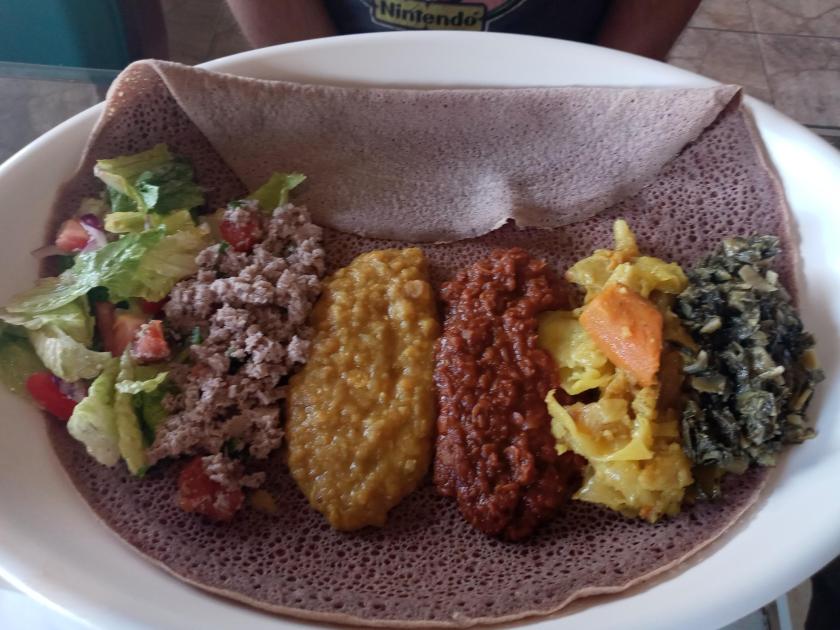
My friend, who is always a generous guy, let me sample all of those, and I have to say that as tasty as my meats were, and how exciting it was to try all those unfamiliar flavors, the vegetarian combo blew them away with depths of flavor.  If I was skilled enough to cook Ethiopian and Indian recipes well, I could probably go vegetarian, or at least eat vegetarian more often than I do, which is not as often as I should.  But I recommend this highly to everyone, whether you eat meat or not, to demonstrate the absolute wonders and miracles you can achieve with vegetables and spices.

In fact, two years before I published this review, I listed Selam’s vegetarian combination platter in Top Tastes, where I listed my favorite local restaurant dishes of 2023 in Orlando Weekly, back when I was writing those every year.  (Somehow we skipped 2024, and who knows what’s going to happen this year.)

I hardly ever drink coffee, but if you go to an Ethiopian restaurant, it almost feels like a necessity to do the traditional coffee ceremony, so we did.  While I don’t pretend to be a coffee connoisseur, this was really delicious and strong coffee, with a depth of flavor I never notice in plain black American-style coffee.  That said, I’ve never been into plain black coffee, and here at Selam, I needed some sugar in mine to mellow it out.

While this meal goes back a while, I remember it like it was yesterday.  I kept holding off on publishing this review because I was hoping to return, ideally with other friends to try other dishes.  Unfortunately, it is far from home, and Ethiopian food is a hard sell for most people I know (including my wife, who was brave enough to try it with me that one other time, 16 years ago, but it wasn’t her thing).  But I give Selam my highest possible recommendation, whether you are familiar with the cuisine or completely uninitiated and a little intimidated.  Don’t be intimidated!  Everything was a hit, and it’s FUN.  It would actually be a fun place to take a date, because you eat with one hand, which is kind of sensuous, and you share everything.  But if any of my friends ever want to go to there on a weekend, I’m your huckleberry!

Istanbul Grill

I love Turkish food.  It might be my second-favorite cuisine of all time, after Italian, and the insidious social media algorithms are always sending me reels of the most amazing-looking Turkish street foods that always make me hungry.  Unfortunately, Turkish restaurants don’t always last here in Orlando.  I was a big fan of Beyti and Cappadocia, but they didn’t survive.  Luckily, I have a new favorite, Istanbul Grill (https://istanbulgrillorlando.com/), but unfortunately, it isn’t close to home like Beyti was or close to work like Cappadocia was (especially because my work and home are now one in the same).  It is way far south on Orange Blossom Trail, south of the Florida Mall, south of the 528.  It’s a haul — about 45 minutes each way in good traffic on a weekend during the day.  But I’ve brought home takeout twice from Istanbul Grill, and it was so worth it both times.

It is a big attention-getter to order lavas bread in a Turkish restaurant.  They walk it out to your table, this big, beautiful bread puffed up with hot air like a football, and then you stab it with utensils to deflate it (and watch out for the hot steam escaping).  It is very soft, and you rip off pieces and use it for dipping and scooping.  Of course, if you get lavas bread to go, it deflates on the long drive home, but if you’re lucky, it stays warm and may stay soft overnight if you have any left.

And why do you need soft bread for dipping and scooping?  For this mixed appetizer platter!  Almost every Turkish restaurant offers a variety of cool, fresh, refreshing dips, and you can usually order some kind of assortment.  My favorite is spicy ezme in the top left, almost like Turkish salsa — a combination of fresh tomatoes, onions, parsley, green and red bell peppers, hot peppers, garlic, tomato paste, and lemon juice.  My wife wants nothing to do with ezme, so I get it all.  In the top right, the tabouli salad is all hers — crushed bulgur wheat, parsley, scallions. and tomatoes with olive oil and  fresh mint.  She told me this is her favorite tabouli from any restaurant, Turkish or otherwise.In the bottom left, we have baba ganoush — fresh smoked eggplant puree with tahini (sesame paste), olive oil, labneh (strained yogurt thickened into a cheese-like form), mayonnaise, garlic, and lemon juice.  We both love this one, but it is her absolute favorite.  In the cup in the middle, we have cacik — a dip of creamy yogurt, shredded cucumber, mint, dill,  and garlic, perfect for cutting spice and mellowing out rich meats.  And in the bottom right, we have the old classic hummus — chick peas, tahini, olive oil, garlic and cumin.
As great as this mixed appetizer bounty is, I do wish Istanbul Grill served two more dips that I rank even above ezme: soslu patlican (eggplant sauteed with tomatoes, onions, and peppers, like a spicy ratatouille) and taramasalata (a creamy dip made with salted, cured fish roe).

For my first visit, I made sure to order lahmacun, one of my Turkish favorites.  These thin, round flatbreads look like pizza without cheese, but they are much thinner than even tavern-style pizza and not as crispy, and aren’t sliced.  They are topped with a delicious mixture of ground lamb, tomatoes, onions, and peppers, and then baked.  Here you get three in an order.
I’ve made lahmacun from scratch before, and I think I’m going to have to do it again soon, since I have ground lamb in the freezer and want to use it up before hurricane season gets hot and heavy.  Mine are pretty awesome, but not quite as perfect as Istanbul Grill’s.

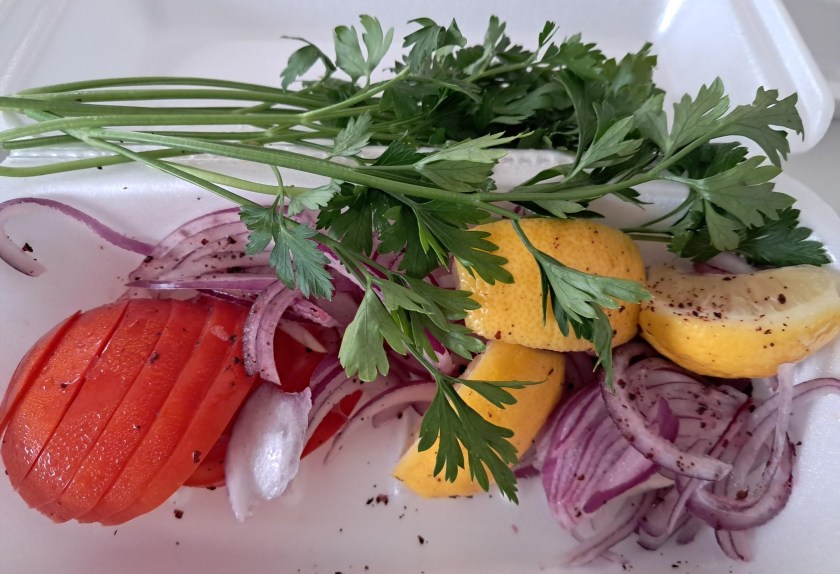
Instead of eating lahmacun like pizza, you are supposed to roll it up and fill it with sliced tomatoes, red onions, fresh cilantro, and a squeeze of lemon juice.  It is so refreshing and light, much moreso than you would think a pizza-looking thing would be.

My wife ordered “mosakka” (often called moussaka on other restaurants’ menus), an oven-baked dish of eggplant with ground beef and tomato sauce, topped with mozzarella cheese.  If you’ve made it this far, you might be more familiar with the Greek version of moussaka, which is often assembled in layers and topped with a bechamel sauce, but both of us really love the tomatoey Turkish variant.  I tried a bite, and folks, you have to try this some time!  This is actually my preferred moussaka/mosakka.

It was hard for me to choose, but I made the game-time decision (standing at the counter placing my order) to go with lamb adana, grilled kebaps of ground lamb seasoned with red bell peppers.  Think of it as a grilled meatloaf with a firmer texture.  These were fine, especially when I added some of the house-made hot sauce, but I was hoping they would be a little more exciting, flavor-wise.  I almost always gravitate toward lamb dishes at Turkish, Middle Eastern, and Greek restaurants, but I probably would have been happier with the special beef adana, grilled ground beef shoulder kebabs tender seasoned with mint, red bell pepper, onions, chili flakes, and cumin.  There seems to be more going on in that one.  Leave it to me to choose the lesser adana!  Or maybe I should have tried a different lamb dish.  Luckily, there would be a next time.   They came on a bed of rich rice pilaf (which gets so much better with all the meat drippings soaking in) with a small salad and crunchy pickled red cabbage.

My wife had asked me to pick her a dessert, so instead of baklava, I brought home this kunefe, because she is in her pistachio-loving era.  This Middle Eastern dessert is a large “patty” of very fine shreds of dough that almost look like vermicelli strands, often with a sweet cheese filling, soaked in a sugary syrup and topped with crushed pistachios.  It looks a bit dry in this photo because the sugar syrup came in a separate little ramekin (not pictured) for us to pour over the kunefe when we got it home.  That definitely improved its looks, texture, and most importantly, its taste.  I didn’t try it, so I don’t know if this one had cheese inside or not, but she liked it, so that made us both happy.   

For our second visit, we got Istanbul bread instead of the fluffy, puffy lavas (that is actually quite thin once you rip it apart).  This was very similar to a thicker pita bread or a good pizza crust, minus toppings, and much thicker than the lahmacun.  It held up well dipping and scooping the mixed appetizer platter I brought home again.

My wife asked for an order of falafel, which came with four decent-sized discs and a little cup of tahini, which really surprised me when I took a big dip, expecting it to be hummus.  I like hummus (who doesn’t?), but straight-up tahini, not so much.    These looked darker than your average falafel, so she thought they were burned and ended up not having any after all.  I ate them a few days later, so I can vouch for them not being burned and actually being delicious.  I made them into two separate sandwiches (two falafels in each) on onion naan bread with homemade pickled cabbage, homemade pickled red onions, tomatoes, Istanbul Grill’s own hot sauce, and Flavortown Secret Sauce from my giant collection of condiments.  I should have taken a picture of one of those, because they turned out pretty.

One thing my wife ate with gusto was this order of four beautiful grilled lamb chops, seasoned to perfection.  I asked them to grill them as rare as possible.  Despite being very thin (much thinner than the thick lamb loin chops I buy at Costco), they were delicious, and seasoned so well.  The rice pilaf underneath them got better and better as it soaked up all those savory drippings.  She actually got four separate meals out of this, with one lamb chop and a little rice in each portion!

She surprised me by taking a big bite of the grilled pepper on the left, before I could warn her it would be too spicy for her.  It was.  She won’t do that again!  And I ate all the crunchy red pickled cabbage, of course.

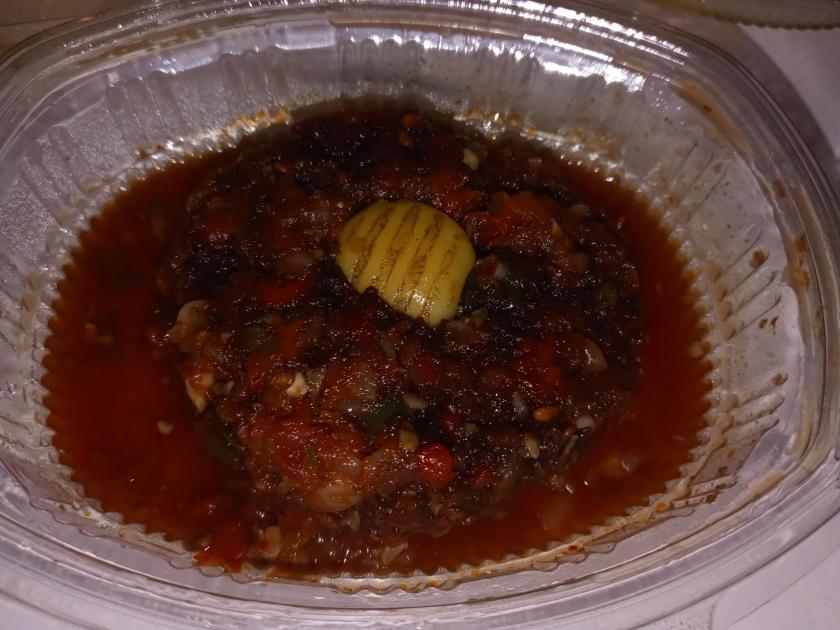
This was my lamb shank, a tender, braised chunk of meat barely clinging to a large bone, which was stewed in a tomatoey gravy.  This is one of my favorite dishes to order at Turkish or Greek restaurants, but because I love it so much, I learned how to make braised lamb shanks myself at home, and my sauce is a lot thicker, spicier, and more robust overall, especially since I braise mine in the oven for five to six hours.  This was perfectly good, but just like I’m exceptionally picky about restaurant lasagna because I love my homemade version so much, I also like my lamb shanks a lot more than this one.  Sorry, Istanbul Grill.  It’s not you, it’s me. 

It came with a big styrofoam container of rice pilaf, which I dumped into the lamb shank’s somewhat thin gravy to soak it up. 

And this was the iskender style kebab, a dish I was introduced to a long time ago at Bosphorous, the first Turkish restaurant I fell in love with, and then Cappadocia (RIP) raised the bar even higher.  I didn’t eat this until the following day, but it consists of “signature house prepared meat” sliced  thin over “garlic bread” (I’m thinking fried Istanbul bread) topped with  a tangy, tomatoey “special sauce” and served with yogurt.  It is mildly spicy, acidic, and also creamy, and you get the crispiness of the fried bread underneath catching all those meat and sauce drippings.  The other Turkish restaurants used their doner kebap meat (think sliced gyro meat, all salty and garlicky usually grilled to make it a little firmer), but this was definitely different from those. 

Like I say at the end of too many of these reviews, we both really liked Istanbul Grill, but it is too far from home to return with any regularity, and too far to even drag my wife down there to dine in the restaurant.  But I recommend it, and I will challenge myself to keep ordering different things off the expansive menu whenever I return.  And FYI, there is a second location in Kissimmee, which is even further from me, but might be more convenient for some.

Baar Baar (Los Angeles)

Baar Baar (https://www.baarbaarla.com/) in downtown Los Angeles (the locals call it DTLA) is the most upscale Indian restaurant I’ve ever been to, with a gorgeous dining room and a large, eclectic menu of gourmet dishes that definitely seemed “elevated” above the standard Indian cuisine I’m used to. This memorable meal goes back to late summer, 2023, when I was invited on my very first trip to L.A., joining our dean, an associate dean, and my director, only about a month after starting my current job.  I definitely felt like the odd man out, hanging with these big shots, but their warm welcomes and lack of pretension convinced me I belonged there.  Our dean, a very classy lady who knows how to throw a dinner party, ordered several dishes, mostly small plates meant to be shared.

These puffs were dahi puri, topped with tamarind, mango, yogurt mousse, and raspberry chaat masala.  These were very light and crispy (similar to pani puri I’ve had elsewhere), but the toppings added sweet flavor to go with the savory, lightly fried puffs.

These beauties were Kashmiri duck tacos, served birria-style, shredded with cheddar cheese, cilantro, and red onion — true fusion cuisine!   Instead of Mexican tortillas, the crispy taco shells were more like roti or parathas.  The four of us each got half a taco and savored every morsel.

These six gorgeous oysters came with guava and chili granita (almost like a sorbet), pickled cucumber, and shallots.  I love oysters, and these were so fresh and refreshing.  I would have been happy just having this platter to myself and nothing else, but of course we all shared these and everything else.

This fun and frizzy dish was sweet potato chat, an appetizer served with tangy-sweet tamarind chutney, sweet and sour yogurt (or “yoghurt,” according to the menu), and kale.

These were two lamb chop burrah kebabs (the second one is underneath, and you can see the bone), served with fresh mint, hemp seed chutney, and lachcha pyaz, a bright and pungent salad comprised of thin rings of red onion rings, ground spices, lemon, and fresh herbs.  I love onions, but raw red onions are intense, and so is the onion breath they create.  I was desperate to make a good impression on these three powerful, professional women, so I didn’t mess with the lachcha salad the way I normally would, dining on my own.  The lamb was wonderful, and the fresh mint really worked well with it.

This dish doesn’t seem to be on the menu anymore, but it was tandoori butternut squash, served with asparagus, millet khichdi (instead of rice as the base of this dish, it was a combination of millet and yellow moong dal, or mung beans), and rice papad, which are like very thin, airy, crispy crackers or wafers. 

While these look vaguely desserty, they were savory paneer pinwheels (notice how they look like three slices of something longer, rolled into a spiral), with makhani (a creamy, buttery, tomato-based sauce), topped with dollops of red pepper chutney, and pistachios.  I loved them. 

These were beef short ribs, always one of my favorite meats from any cuisine, served in Madras curry (a spicy British-Indian creation with a base of tomatoes and onions), with bone marrow Khurchan and baby  vegetables.  Between the tender short ribs and rich, unctuous bone marrow, which is like “meat butter,” I was in heaven with this decadent dish.

At Baar Baar, even a simple side of saffron rice was still cooked as perfectly as any rice could be.

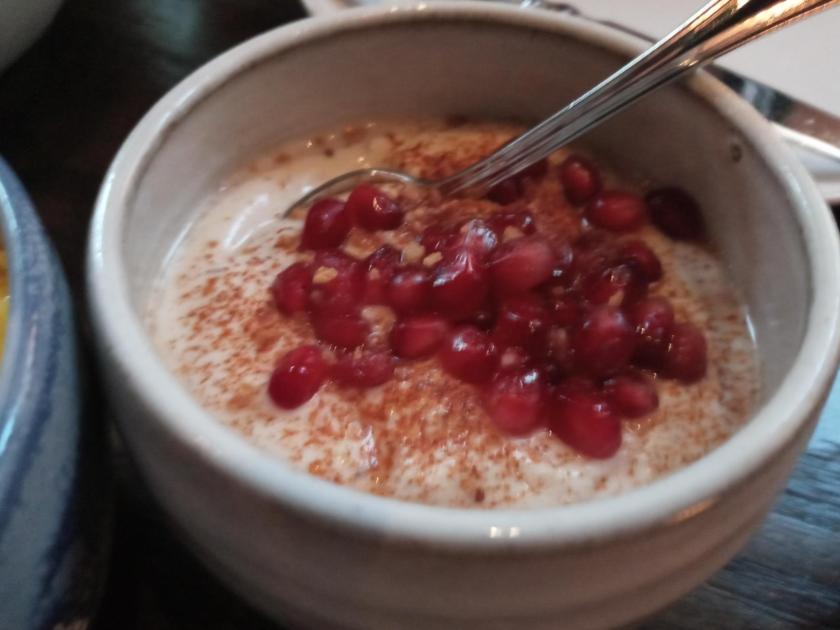
And this was a side of pomegranate raita: cool, refreshing, creamy, tangy yogurt topped with pomegranate seeds. 

This gorgeous dessert doesn’t seem to be on the Baar Baar menu anymore, but it was called mango ghewar, and it consisted of malai kulfi (Indian ice cream flavored with cardamom, saffron, and rose water), mascarpone cheese mousse, mango jelly, and crushed pistachios.

Needless to say, this was a sumptuous feast, even shared by four people.  Like I said, our dean is a class act who knows how to party!  Few things bring me as much joy as sharing a bunch of different dishes with people over good conversation, and that’s what our dinner at Baar Baar turned out to be.  Not only was it the finest Indian meal of my life, but it was a reminder that all the decisions I had made in my life to get to this moment in time — this job, working remotely, getting to visit our gorgeous school in L.A. once in a while, collaborating with these amazing people, even being part of this grand gustatory gathering — turned out to be right.  This dinner was almost two years ago, and ever since then, I have been grateful every day for the new direction my life has taken.  I’ve also been falling more and more in love with Los Angeles and its culinary culture.  Even though Orlando is my home, I’ve had so many great meals in L.A. (sometimes solo and sometimes with colleagues and friends, like this one), and I have so many more L.A. restaurant reviews yet to come!

The Prince (Los Angeles)

The Prince (https://www.instagram.com/theprincela) is a classy, old-school Los Angeles Korean restaurant and lounge that is most famous for appearing in multiple movies and TV shows over the decades, including Chinatown (one of the greatest L.A. movies, neo-noirs, and movies in general of all time), Mad Men (one of my favorite shows of all time), and New Girl (where it was the characters’ regular hangout).  I’ve never actually watched New Girl, but now I am imagining Zooey Deschanel with bangs and glasses, singing a silly old song (maybe “Dream a Little Dream of Me”?) and strumming a ukulele in this dusky, dark red hipster hangout.

Back in November, I was on a work trip to L.A. and had a chance to join some of my amazing co-workers for dinner.  I always stay in Koreatown, where my employer is located, and where there seem to be hundreds of Korean restaurants to choose from, at all different styles and price points.  I am still very new to Korean food, but the more things I try, the more I feel inspired to branch out and try more.  The Prince was walkable from our campus, so since I was already aware of its cinematic résumé and timeless cool décor, I convinced this small group to trust and follow me.

I must apologize in advance for the photos that follow in this review.  It’s a gorgeous room, dark and anachronistic, but as soon as I took my first photo to set the scene, a server yelled at me to not use flash photography inside.  So I did my best, such as it is, to share the red vinyl booths, the dark wood, the dim lighting, and even these hale and hearty knights standing guard.

Also, I swear I saw Spike Jonze, director of super-creative movies and iconic music videos, dining there, but I wasn’t 100% sure it was him.  As much as I wanted to thank him for “Sabotage,” Adaptation, and Jackass, I didn’t want to be That Guy who disturbed his dinner… especially if it wasn’t Spike.

Anyway, our group was a mix of adventurous and unadventurous eaters, so we picked five things that looked good to everyone, and we all shared them.   That is my favorite way to dine with friends.

These are the onion rings (RING THE ALARM!) and cheese balls, because you know if I go anywhere and see onion rings on the menu, I have to order them.  They were crowd-pleasers, and it was not the first time I had really good onion rings at a Korean restaurant.   The cheese balls were even better — perfect, golden-fried, golf ball-sized orbs with melty cheese in the middle, under the breading.  I should have tried to get a shot of a bisected cheese ball to show you their molten, sticky, creamy centers, but they went fast!

When you’re introducing Korean food to unfamiliar diners, beef bulgogi is one of those perfect gateway dishes.  Bulgogi is a dish of thin-sliced beef (often sirloin steak), marinated in a savory-sweet sauce, and then grilled or stir-fried with onions and green bell peppers.  The bulgogi marinade contains soy sauce, sugar, sesame oil, garlic, ginger, and pear juice, which tenderizes the meat.  There is nothing spicy or “weird” to scare off the unadventurous diner, so it was another hit at our table. Just FYI: “bul” is Korean for fire, and “gogi” means meat.

We also ordered galbi (sometimes called kalbi), a very similar dish but with beef short ribs sliced cross-wise against the bones, rather than thin-sliced steak.  It has a similar flavor due to the marinade, but I already love short ribs in any form — not just the flavor, but the wonderful texture.  I especially like the chewy part of the meat right around the bones, which you can just pull off with your fingers if you don’t want to gnaw it off.  This was served over onions and scallions, and there wasn’t a morsel left.

I didn’t have any input in choosing this garlic shrimp dish, served with fresh, raw, shredded cabbage, but I was happy to try a couple of the shrimp, which came in their shells and had to be peeled.  It was delicious — different from scampi or any other garlic shrimp dish you might be envisioning, but still very satisfying.

I did choose this dish, though: thick, perfectly al dente udon noodles served with mixed seafood: shrimp, mussels, squid, and tiny crab legs (more trouble than they were worth to crack open).  The menu describes it as coming in a spicy broth, but it could be served mild upon request.  I honestly don’t remember what we decided as a group, but I think we went with spicy and almost everyone still loved it.

Real Korean food aficionados might be rolling their eyes, disappointed that we made relatively staid and familiar choices, but that’s often what happens in a “family-style” group dining situation.  I would have loved to try the soondae, since I always love blood sausage in all its other forms, from Argentinian morcilla to British black pudding, but nobody else was on board with this one.  It’s all good!

I have no regrets or complaints about The Prince, especially because it is such a part of Los Angeles and Hollywood history.  I would not be surprised if there are better Korean restaurants in L.A.’s Koreatown, but the vibes at The Prince are unmatched.  Every time I make it out there for work, I try to visit at least one historic, iconic L.A. landmark, whether it’s a tourist attraction, a restaurant, or both.  So far, I’m making quite a list.  I love my job, and I love L.A.!

Caravan Uzbek & Turkish Cuisine

Night and stars above that shine so brightThe mystery of their fading lightThat shines upon our Caravan
–“Caravan,” lyrics by Irving Mills, music by Duke Ellington and Juan Tizol

It took me 45 minutes to drive to Caravan Uzbek & Turkish Cuisine (https://caravanhalal.com/) on a late Saturday afternoon, arriving right at 5 PM to pick up takeout that I ordered online at 4:15.  The restaurant looked nice inside, but it was too early for dinner, so it wasn’t busy.  For this first visit, my wife didn’t feel like driving all the way to South Orlando with me, but I was more than happy to race back home with dinner in my heating bag.  I had been wanting to try Caravan ever since I first heard about it some time last year, since we both love Turkish food, and a lot of our old favorites had either closed or let us down.  And I’m obsessed with trying new cuisines, so I was even more excited to try Uzbek food for the first time.

Interestingly, the Central Asian nation of Uzbekistan isn’t even next door to Turkey.  While Turkey straddles Europe and Asia and borders the Black Sea to the north and the Mediterranean Sea to the south, Uzbekistan is further east and completely landlocked by five different countries: Kazakhstan, Kyrgyzstan, Tajikistan, Turkmenistan, and Afghanistan.  Since you were dying to know, Uzbek and Russian are the main languages spoken, and like Turkey, Islam is the majority religion, even though both countries are considered secular states.  Still, with majority Muslim populations in both Turkey and Uzbekistan, that explains why all the food at Caravan is halal.

We started out getting a mezze platter, the combination of cold dips that is so refreshing and rewarding at almost every other Turkish restaurant we have enjoyed in the past.  We got five different dips, all packaged conveniently in separate plastic containers with lids that snapped on tightly, leading to no spills or leaks on the way home, which is always nice.  Each dip was topped with a grilled olive, which was a nice touch.

Hummus, which you’ve surely had before, in one form or another:

Babaganush, the smoky eggplant dip that is my wife’s favorite:

Ezme, my personal favorite, which is like a spicy Turkish pico de gallo with  finely processed tomatoes, onions, bell peppers, hot red pepper paste, parsley, and lemon juice.  This was a terrific version of ezme, like some of the nicest, freshest salsa or pico ever.

Haydari, a creamy, yogurt-based dip with dill, mint, and chunks of walnut:

The website said we would also get spinach sautéed with onions as part of the mezze platter, but instead of that, we got cacik, another cool and creamy yogurt-based dip that is thinner, with cucumber, garlic, and mint.  I was curious about the spinach and onions, but the cacik was good, so no complaints from me.

Instead of puffy, fluffy lavas bread like we’ve had countless times from Bosphorous, Zeytin, and the late and lamented Beyti, we ordered a Turkish bread called ekmek.  We got two round pieces, dusted with light and black sesame seeds.  They were more like standard loaves of bread that hadn’t risen very much, as opposed to true flatbreads like lavas or pita.  I ripped off pieces of ekmek to dip with gusto, but my wife wasn’t super-into it.     

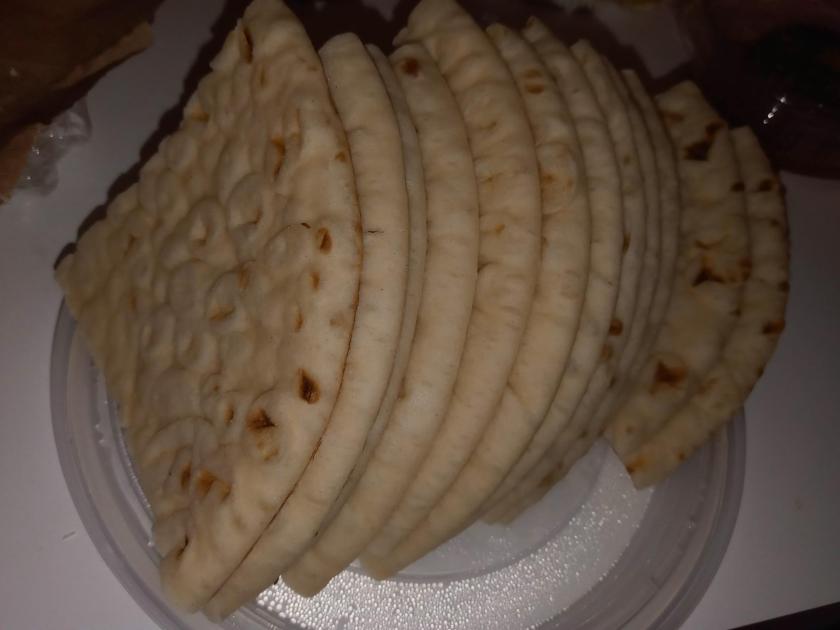
I also ordered Uzbek bread, but was a little disappointed that Caravan just gave us wedges of store-bought pita, like I have bought countless times at various grocery stores:

The entrees we ordered were all really good, starting with an order of semechki, or lamb ribs, from the shish kebob section of the menu.  I love lamb in all its forms, especially braised lamb shanks, but I realized I have never tried lamb ribs, despite being a gigantic fan of beef and pork ribs.  The grilled lamb ribs were pretty tiny, without a whole lot of meat on the small bones, but the meat that was there was very tender, with intense flavor from the grill.  There were six pieces in the order, and they were served on a soft flour tortilla that absorbed the delicious meat juices.

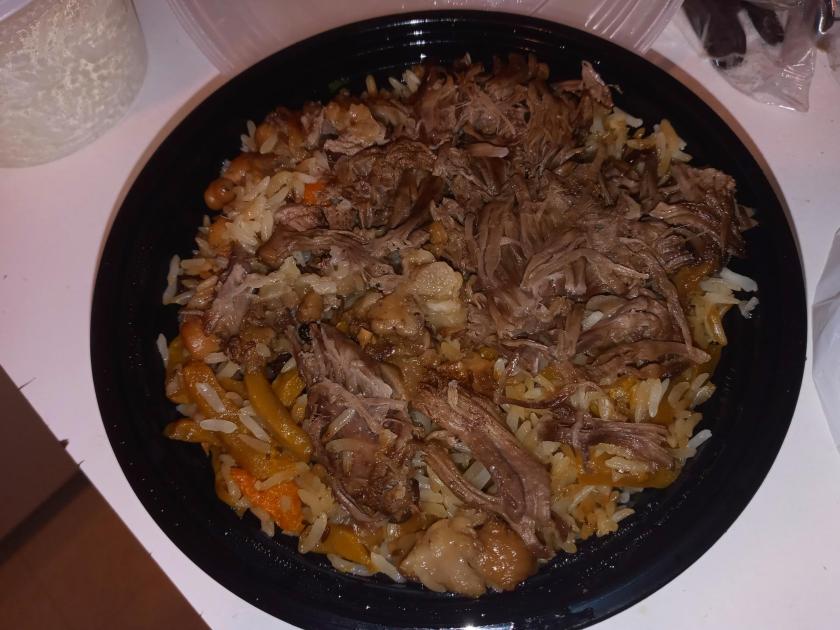
My wife chose the to’y osh, an Uzbek dish of Lazer rice seasoned with cumin, coriander, raisins, sautéed onions, and yellow carrots cooked until they were soft, tender, and sweet.  It was topped with shredded beef that must have been braised, because it was really tender too.  Like I said, this was our first time trying any Uzbek dishes, but it reminded me strongly of biryani, a popular Indian dish of rice mixed with meat and vegetables that may have Persian origins.  The to’y osh was very subtly seasoned, lacking the strong flavors of biryani rice, but it was a heart, savory dish with a nice combination of textures.

Even though we liked everything except the store-bought pita (which I’m still going to salvage by baking it in the oven on the convection setting to crisp it up), the biggest hit for both of us was the fried laghman, the dish I’ve seen almost everyone order in the handful of Caravan reviews I’ve read so far.  This was a dish of hand-pulled wheat noodles, and since I am a noodle nerd, the name laghman comes from the Chinese lamian (for hand-pulled noodles, like you would get at Mr. J Hand-Pulled Noodle in Ocoee), which also led to both lo mein and Japanese ramen.  These long, chewy, thick noodles were stir-fried in a wok with fresh vegetables and tender strips of beef with a soy-based sauce — almost like lo mein.  When I looked it up, I wasn’t far off — laghman comes from the Uyghur people, an ethnic, primarily Muslim minority who live in China (where they are horribly persecuted) and have other communities in Uzbekistan and the other Central Asian countries that surround it.  This was also our first experience trying any Uyghur cuisine.

The laghman noodles looked like they would be spicy, and I was hoping they would be spicy, but much to my wife’s relief, they weren’t.  The only spicy things we ended up with were the ezme and a chunky hot sauce that came with the lamb ribs.  And I was all ready to use the cool, creamy, refreshing haydari and cacik to put out fires in my mouth, too!

This was an interesting first visit to Caravan, one that inspired me to do some geographic research before writing this review.  I had been wanting to go there with a group for quite some time, so we could order a bunch of dishes and share everything, but that hardly ever happens anymore.  Bringing home takeout to share with my ever-patient wife worked just as well, and we ended up with plenty of leftovers.  I have no idea how often I’ll make it back to Caravan, just because it is so far from home, but I feel like we made some great choices for our first trip.

Sherry’s Trini Flavors

Sherry’s Trini Flavors (https://www.facebook.com/profile.php?id=100090751170325) is a wonderful Trinidadian restaurant set up inside a gas station convenience store at 1200 West State Road 436, Altamonte Springs, FL 32714, shortly before Altamonte Springs blends into Apopka to the west.  It is closed Sundays and Mondays, but open every other day from 11 AM until 7 PM.  As you can guess, Sherry’s Trini Flavors is primarily a takeout operation.  The menu is simple, you order at the counter, and they prepare your food to enjoy somewhere else — somewhere you can sit down to fully appreciate its savory flavors.

I appreciate that Sherry’s is a lot closer to home for me than the venerable Singh’s Roti Shop and Caribbean Shack (formerly known as Vindi’s), all the way out in Pine Hills in West Orlando.  I have been there twice now, and I think the food is just as good as those two popular restaurants, and probably even better, despite the smaller menu at Sherry’s.  Singh’s has all those Trinidadian Chinese specialties, and both Singh’s and Caribbean Shack serve oxtails, which I am sad to say Sherry’s does not.  I thought I might have missed oxtails on my first visit last year, but they are not on the menu, and I confirmed on my latest visit this past weekend that they don’t serve them at all.  But as much as I love those tender, unctuous cuts, Sherry’s Trini Flavors offers plenty of other delicacies, including other rich, savory, bone-in stewed meats.

On my first visit, I ordered the stew chicken dinner that came with fried rice (not rice and peas) and delicious, savory, occasionally stewed chickpeas called channa (a name that reminds me of a really cute girl I had a crush on until she went to Birthright and came home obsessed with the IDF soldier she hooked up with over there).  The stew chicken isn’t as sweet and tangy as Jamaican-style “brown stew” chicken, which usually seems to involve ketchup.  Still, the mostly dark meat is seasoned and stewed to perfection, literally falling off the bones.  If you like chicken but have never tried Trinidadian stew chicken, your life won’t be complete until you do, and this would be a perfect place to start.

On my more recent visit, I couldn’t help ordering stew chicken again!  This time I got the roti option that comes with potatoes, channa, and one of two types of roti, which I will talk about soon, rather than the “dinner” that comes with rice.  The chicken was even better than I remembered.  No regrets here.

On my first visit, this was curry duck, which was much spicier than the stew chicken, but not as spicy as you might be worried about.  Apologies for not scooping out a few chunks of tender, rich, bone-in duck meat, but the containers all leaked a bit, and it was a mess at the time.  The meat was easily falling off the bones.

And this was my favorite meat I’ve tried at Sherry’s so far, which I got on my most recent visit: curry lamb.  Goat is much more popular in Caribbean cooking, but my wife really, really adores baby goats, so the least I could do is not bring that meat home to eat in front of her.  Since we have both frolicked with super-cute baby goats in the pasture at Orlando’s Wildflower Farm, I don’t eat goat meat anymore.  But I’ve never met a lamb, so I have no such compunction about eating those guys, possibly my favorite protein of all.  This was tender, braised meat, very easy to separate from the bones, and seasoned to perfection.  It was served with more potatoes and channa. This savory stewed curry lamb was so incredible, I didn’t even miss oxtails.

When you order these proteins as roti, they come with stewed potatoes instead of rice, channa, and your choice of two warm flatbreads that are served folded up like a hot towel, but can be unfolded to be about the size of a large, round towel.  These are the roti, and if you love tortillas, pita bread, Turkish lavas bread, Indian naan, or Malaysian parathas, you absolutely have to try the roti here.  They are very different from other roti I’ve had, which are flakier like parathas (the love child of a flour tortilla and a buttery croissant).  These are big, billowy blankets meant to tear off pieces and dip or scoop them in the rich sauces or create little wraps with the meats and channa.

The yellow-tinted roti is called the dhal puri or daal puri, which is stuffed with tiny granules of ground yellow split peas.  If you’re anything like me, you might create a dust storm of split pea bits all over the table when you tear off a hunk of the dhal puri, even if you’ve had it before.  It is really good, but believe it or not, there’s another roti I like even more.

This roti edges out the dhal puri for me, and it is the only one my wife likes.  Sorry, loves.  And she doesn’t even share my obsession with Trinidadian food!  It has the delightful name of the “bussup” or or sometimes “buss up shut,” Caribbean slang for a tattered, torn, or “busted up” shirt.  It is thicker than a flour tortilla and chewier than most pita bread.  Greasier, too.  But it is soooo good whether you choose to dip, scoop, or wrap with it.   

This was one of the doubles I got on my first visit, served on a plate so I could enjoy it fresh on the premises.  Doubles are a beloved street food from the islands of Trinidad and Tobago, and one of the most delicious vegetarian foods I can think of.  It is made of two small, chewy, fried flatbreads with channa in between them.  The green stuff you see is a spicy condiment that I just loved, giving these doubles the edge over the ones I’ve tried from Singh’s and Caribbean Shack.  I ordered even more doubles to bring home on both of my visits.  They are somewhat messy to eat (both drippy and greasy), but awesome. 
On my most recent visit, I brought home four doubles and wolfed down two of them while they were still warm.  The others heated up just fine in the mick-row-wah-vey.  You can add any of the proteins to your doubles as an upcharge, but I kinda like them as their own thing.

On my first visit, I also tried the macaroni pie, which is essentially a baked macaroni and cheese casserole with long ziti-like noodles, served in slices.   I’ve had somewhat dry, slightly overcooked macaroni pie elsewhere, but this one had the meltiest, cheesiest texture, and I loved it. 

So after trying this kind of food at three different local restaurants, I absolutely love it and recommend it to all.  Even if it is completely unfamiliar to you, the closest comparison I can make is Jamaican food, followed by Indian food, but Trinidadian is very much its own thing.  I am so glad Sherry’s Trini Flavors exists, and it is a heck of a lot closer to me than the other restaurants in Pine Hills.  I will be returning much more often to treat myself and slowly work my way through the menu.  While Sherry’s menu does not offer as many different dishes as Singh’s or Caribbean Shack, the standards I’ve tried are all top-notch, clearly made with love and care in a tiny operation, hidden away from most, that deserves to be discovered and loved.

Isan Zaap Thai Cafe

For years, I had been hearing my friends rave about Isan Zaap Thai Cafe (https://isanzaaporlando.com/), unfortunately a little far from home for me, but moments away from another Thai restaurant my wife and I love very much, Naradeva Thai.  You could seriously eat a big meal at one, then still comfortably walk to the other for another meal, they are that close.  But I don’t recommend doing that.

I do, however, recommend Isan Zaap, and I’m not the only one.  Michelin, that tire company that doubles as a restaurant critic organization, awarded Isan Zaap Thai Cafe one of its coveted Bib Gourmand awards, for “good quality, good value cooking,” joining some of Orlando’s finest establishments.  So if you don’t trust your friendly neighborhood Saboscrivner’s recommendations by now, you can rely on the Michelin Guide, known for its completely unbiased judging.

While Naradeva’s dining room has a serene wilderness vibe, Isan Zaap is more of a modern dining space.  Their menus are very different as well.  I do not pretend to be an expert on Thai food, but I know they represent different regions of Thailand, with Isan Zaap covering Isan, the Northeastern region of Thailand (similar to another local Thai restaurant, Mee Thai).  According to Isan Zaap’s website, Isan cuisine includes fresh herbs and spices, multiple proteins, and fermented ingredients, which makes sense, because I enjoyed a lot of funky, pungent flavors in the dishes I tried.

On my first visit in late January, I brought a friend with me who I always run into whenever I do anything cool and fun around town.  Whether it’s a concert, a stand-up comedy show, or a comic book convention, this dude is always there with his finger on the pulse of all things cool and good.  We were both riding high after attending a comic art show where I met my all-time favorite artist, so I chose Isan Zaap as a way to prolong the good feelings and rare chance to hang out.

I started my meal with a refreshing, sweet, slightly smoky Thai iced tea.  It was so good, I wanted to gulp it all down, but I knew I would want to save it to cut the heat of whatever food I ordered.

I decided to order larb for the first time ever, after remembering young Peter Parker and his smokin’ hot Aunt May (played by Marisa Tomei) riffing about larb in Spider-Man: Homecoming.  I don’t think they ever explained what larb was in that scene, but it sounded right up my alley, with minced pork, pork skin, pork liver, and “seasoning” with lime juice, herbs, and roasted rice powder.  I asked for it with medium heat, but boy, was it spicy.  I have gotten used to ordering Indian dishes hot, but I eat Thai food so infrequently, medium felt just hot enough.  Man, was this some luscious larb!  Listed under the “Salads” on the menu, it was so bright and tangy, sour and spicy, crunchy and funky, and surprisingly cool and refreshing, while spicy enough to make my lips tingle.  It was served chilled, with thin slices of onion, finely shredded carrot, cucumbers, and lots of mint, and it exceeded all my expectations with its blend of flavors and textures.  I was a little surprised the larb did not come with rice, but what do I know?  Anyway, it made me a larb lover for life.

Because I’m me and I just can’t help myself, I ordered a second dish, figuring I would try it there and finish the rest at home: my go-to favorite that I like to try at every Thai restaurant, stir-fried drunken noodles, also known as pad kee mao (or sometimes pad kee mow).  These are wide, flat, chewy rice noodles sautéed with onions, red and green bell peppers, basil leaves, and a protein (I chose squid, which was a little rubbery, but still tasty), in a sweet and spicy sauce.  I asked for this dish medium as well, and it also brought a pleasant amount of heat. 

My friend chose excellent-looking pad Thai with tofu, another dish you can never go wrong with.  He let me try a bite, which had the nice sweet-and-sour tanginess I always enjoy in pad Thai.  I made a mental note of it, because my wife loves this dish, and I definitely wanted to return with her. 

It was a great lunch and a great hang.  I went home and talked about this meal for damn near three weeks before my wife and I finally made it back to Isan Zaap together, again for lunch on a weekend.  We both ordered Thai iced coffees this time, which I liked even more than the Thai iced tea.  (I almost never drink tea or coffee, but this just goes to show you that if you put sweetened condensed milk in anything, I will consume it.)    

My wife ordered pad Thai, as I figured she would.  She got it mild and chose mixed seafood for her protein.  It came with shrimp, squid, and mussels in the half shell, which she was kind enough to share with me, because I notoriously love mussels and she is ambivalent about those bivalves.  She liked it, and as usual with her, she got two meals out of the dish.

I chose two things again on this trip, figuring we would share them both.  This is a picture of half our order of grilled pork neck, which looked and smelled so good that I uncharacteristically devoured half of it before remembering to take a picture.  It was a very pretty plate of thin slices of perfectly grilled, marinated, tender pork, accompanied by pretty shredded carrots and cabbage on the side and a very spicy Isan dipping sauce that I loved and she wanted nothing to do with.  The grilled pork neck did not come with rice or anything else, so it might not be the most filling dish for a single hungry person.  I would definitely recommend it to share with a group, though — or if someone is avoiding carbs and just wants delicious lean protein.

I also thought we would both enjoy the chef’s special dish of crab fried rice, after noticing so many crab dishes on the menu.  Again, I ate the vast majority of this, even though it was not spicy or intimidating in any way.  It was solid fried rice, but there wasn’t a lot in it aside from eggs, garlic, a little basil, and the lump crabmeat on top.  I certainly enjoyed it, but next time I will order something more unique and unfamiliar, that’s for sure! 

Unlike our first visit, this time our server brought us a container of four tins of seasonings to spoon onto our food: chilli, sugar, vinegar, and fish sauce.  I used a little bit of the chilli (just a red powder) and a splash of vinegar to jazz up the fried rice, but I did not want to overwhelm any of the flavors.  I know the sugar is meant to cut the heat, but the spiciest thing I had at this second meal was the Isan dipping sauce with the sliced pork neck.   

Last, but certainly not least, I ordered another dish to bring home and enjoy later: the pork liver larb, served chilled and tossed in the same spicy, sour dressing with toasted rice powder, shredded carrot and cabbage, sliced cucumbers, and more herbs on top.  This time I made jasmine rice in my Aroma rice cooker to go with the larb, which may be completely inauthentic, but it worked for me.  I love liver in all its forms, and the pork liver was rich and intense in that offal (but not awful) way, and tender enough to almost melt in my mouth.  It might have been my favorite component of that original larb dish I tried, but I found myself missing the additional textures and flavors of the ground pork and pork skin in the “O.G.” larb.  Again, you live and you learn, or at least I do! As always, I appreciated that Isan Zaap packed my takeout larb in one of those great plastic containers with a clear, locking lid.  These are microwave-safe AND dishwasher-safe, and if you think I keep a collection of them, you’d be right as rain.

So Isan Zaap Thai Cafe was really wonderful after both of my visits, and it ignited my newfound interest in Thai food.  I’ve been to a few other Thai restaurants in Orlando, and a longtime favorite closed in 2023, but I am excited that there is so much more to learn about and experiment with.  I’m no tire company, but I can tell you that Isan Zaap is definitely worth all the hype and praise, whether you eat Thai food all the time or just dabble occasionally, as I do.  I don’t know how often I will make it back to this restaurant, but Isan Zaap serves some of the best Thai food I’ve ever had, and not just in Orlando either.  If you know, you know, and if you don’t, then what are you waiting for?

Summer House on the Lake

My latest review is of one of the newest restaurants to open at Disney Springs, the part of Walt Disney World devoted to shopping and dining, where you don’t have to pay a hefty admission fee or even pay for parking.  We end up out there a couple times a year, often to meet visiting friends, but this trip was just a daytime date with Dr. Professor Ma’am, my beautiful and brilliant better half.

I had told her about the mid-December opening of Summer House on the Lake (https://www.summerhouserestaurants.com/disney-springs/), part of a restaurant chain that boasts “California-style cuisine and breezy beach vibes.”  It also sounds like the title of a horror movie, if you ask me — at one point I referred to it as Last House on the Left.  My wife’s graduate school was based in Santa Barbara, and she relished her occasional trips out there, just as I’m slowly falling in love with Los Angeles, after two visits to my new employer out there.  She loves the emphasis on fresh ingredients and lighter dishes in Southern California dining, so it sounded like a restaurant made just for her.  It is owned by a corporate restaurant group called “Lettuce Entertain You,” so even though I was skeptical, I always appreciate a pun.

I believe we arrived for lunch on the third day Summer House on the Lake was open.  It was a huge space (I believe in the old Bongo’s location, and yes, right on a manmade lake at Disney Springs), and the dining room was full of light wood and natural light.  It looked like any number of hotel lobby restaurants to me, but I can definitely see the California influence, sure!

The menu features small plates, sandwiches, tacos, and salads, as well as pastas, pizzas, and a burger, but it didn’t strike me as the kind of place to order pasta, pizza, or burgers.  It also highlights an in-house bakery with plenty of cookies to choose from, lots of cocktails, and a “signature Rosé Cart.”  This confirmed my suspicion that Summer House on the Lake is the kind of restaurant my beloved Uncle Jerry once referred to as a “chick place,” meaning the kind of restaurant women are the most likely to love.  (He was referring to the chain restaurant Mimi’s Cafe at the time.  If you know, you know.)  Seated at our booth, I improvised a bit of comedy about a bunch of bros wanting to hit up Summer House on the Lake to watch the game, pound some beers, demolish some nachos and wings, and hit on moms who are “being so bad” by quaffing rosé and nibbling cookies, and my wife continued to put up with me.

Anyway, we started with ahi tuna and watermelon tostadas, which came with Hass avocado and Thai chili on crisp corn tortillas.  We got a plate of five, and while they were beautiful and delicious, with the slightest bit of heat, I did not detect any watermelon anywhere.

I am a sucker for raw tuna in sushi and poke, and they were pretty generous with the tuna on these tiny tostadas.  i could have eaten about twenty of these myself, easily and happily.  They were my favorite thing we had at Summer House on the Lake, and I would definitely recommend them to fellow raw fish fans.

For her main course, my wife ordered a Costa Mesa salad, with queso fresco, corn, pico de gallo, avocado, quinoa, and crispy tortilla strips.  She asked for dressing on the side, and while they brought her chipotle crema in a little ramekin, we were confused if the other ramekin of dressing was the lime vinaigrette from her salad or the herb vinaigrette that was supposed to come with my salad.  (More on this in a bit.)
She opted to add seared ahi tuna to her salad as a protein, I guess to stick with the tuna theme of our lunch.  You can see they served her a beautifully seared slab of ahi, with a gorgeous pinkish-purple center.  Other protein options, all available for an upcharge, are grilled or crispy chicken, salmon (unfortunately cooked, rather than sushi-grade raw), and steak.

I figured that as long as I was at a “chick place,” I might as well get a salad too, which is a rarity for me at a restaurant.  I do make and eat salads quite often at home, believe it or not!  But after chuckling at the house salad called “a nice house salad” on the menu, I chose the Buena Vista Cobb salad for myself, with avocado, egg, corn, cucumber, tomato, bacon, blue cheese,  and herb vinaigrette (that might have been in that ramekin on the side, or might have been completely absent).  I always forget that Cobb salads are full of delicious things I like.  I would make them at home, except I never have bacon or blue cheese on hand.   
This was actually quite good, and the eggs were a lovely soft-boiled consistency I have tried to duplicate at home over the past two weeks.  I think boiling for eight minutes produces creamy, glistening yolks like this.

After we were so good with our salads, it was time to be so bad with dessert.  My wife ordered this seven-layer chocolate cake with vanilla chantilly cream.  I wasn’t terribly interested in it, so I didn’t even try a bit.  She said it was just okay.

After we paid our check and left, we discovered the cookie bar in the front of the restaurant, with huge cookies on display behind a glass counter.  If you have tried the cookies from Gideon’s Bakehouse in Orlando’s East End Market or at Disney Springs, these are along the same lines — huge, decadent, chewy (a little under-baked, which I prefer to over-baked), and ridiculously rich.  We got three cookies to go, which we enjoyed at home later.  According to her, they were better than the chocolate cake, but so rich and heavy that they were almost too much.

My wife chose a chocolate chip cookie topped with chunks of their brown butter crispy rice treat, which are essentially posh Rice Krispies treats.  They also sell the treats separately, but didn’t have any when we were there.  It was good, because how could this not be good?

She also chose this fudge bomb cookie, a moist and chewy sugar cookie topped with thick, rich, fudgy frosting.  I ended up eating most of this later, because she didn’t like it as much as she expected to.  It reminded me a bit of a classic New York black and white cookie, only the cookie was more buttery and less “cakey,” without that slight lemony flavor, and the frosting was softer and lacking that glossy shine.  If we return, we would try different cookies next time.

But on a rare occasion when I chose a dessert for myself, the lemon cookie did not disappoint.  My wife lacks my obsession with citrusy desserts, but this had a nice, bright flavor and a slightly tart tang to balance the buttery richness and the sticky sweetness of the glaze.  Like the other cookies, it came close to being too much, but I liked it much more than the other two.  It tasted like a perfect summery confection, perfect for a summer house on a lake. But at the end of the day, I would sooner choose cookies from Heartsong Cookies, baked by the delightful Kathy Paiva, than any of these.

I also don’t know when and if we will return to Summer House on the Lake.  Over my 19 years in Orlando, I’ve eaten at most of the restaurants at Disney Springs and certainly had good meals, but nothing ever bowls me over, knocks me out, leaves me raving and craving more there.  I’m glad we tried a new restaurant, and I absolutely recommend Summer House at the Lake, especially to my female readers in search of a “chick place.”   That said, whenever my wife and I end up at Disney Springs again for a concert at the House of Blues or meeting out-of-town friends, we would probably try something new next time.

Z Asian Vietnamese Kitchen

Z Asian Vietnamese Kitchen (https://eatzasian.com/) is one of the nicer, more upscale Vietnamese restaurants in Orlando’s Mills 50 district full of Vietnamese and other Asian restaurants, markets, and shops.  That said, as someone who does not love high-end, fancy, luxurious dining, it is still very accessible and welcoming for all.  It is also unique because it received prestigious Michelin Bib Gourmand awards in 2022 and 2023.  To clarify, that does not mean it has a Michelin star, like some of the highest-end eateries, but rather it was recognized for its “good quality, good value cooking.”  Chef and co-owner Huong Nguyen focuses on street foods from Saigon, but her menu offers several dishes that Orlando’s other Vietnamese restaurants do not serve.

I first went to Z Asian with a former co-worker in late July.  She and I both left our workplace for new opportunities this year, so it was a chance to catch up and chat.  She is vegetarian, and Z Asian has so many vegetarian and vegan options on its menu, I thought it would be a perfect choice for dinner.

We started out with an order of two vegan summer rolls (goi cuon chay), with tofu, vermicelli noodles, and shredded lettuce rolled up in transparent, sticky, chewy rice paper and served at room temperature with a side order of peanut sauce.  My wife loves summer rolls with peanut sauce from other Vietnamese restaurants like Little Saigon and Pho 88, but they are usually not my favorites.  I’m not a big tofu guy either, but I’ll try anything once, and this was an excellent summer roll!  The tofu had the consistency of a firm omelet with a slightly crispy exterior, balancing against all the chewy ingredients. 

I also chose an order of pan-fried rice flour (bot chien), something I always see on Vietnamese menus but had never tried before.  It always looks good, and I thought my vegetarian friend would like it too.  It came served on a blanket of lovely fried eggs, although there is a vegan option too, without the eggs.  It was served with a side of crunchy, sweet pickled carrot and daikon radish, with a sweet chili soy dipping sauce.   This was AWESOME.  We both loved it.  This was another dish with a crispy exterior and soft, yielding interior, kind of like fries or tater tots — not in taste, but in “mouth feel.”  They were terrific with the sauce, and I liked the pickled vegetables (necessary ingredients on any banh mi sandwich) a lot.

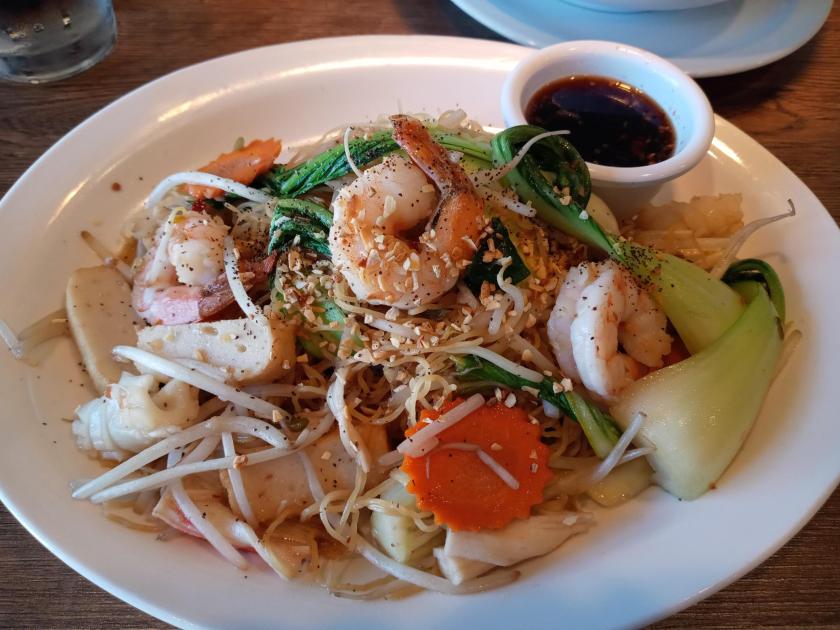
My friend ordered stir-fried garlic noodles with tofu.  I didn’t try this, but she seemed to like it a lot.  In addition to the fried tofu (similar to the pieces in the summer rolls), it came with bok choy, carrot, and plenty of crunchy bean sprouts.

I ordered special rice noodle soup (hu tieu thap cam), with thinner rice noodles than you usually find in bowls of beefy pho.  Instead of being a beef-based soup like pho, this soup included pork, shrimp, squid, fish cakes, and krab sticks, in addition to aromatic herbs.  It was a nice, light soup and a pleasant change from the pho I’ve ordered so many times elsewhere.   Somehow, I managed not to splash my clothes, which was a minor miracle.My research tells me hu tieu is a Chinese-Cambodian invention that was adapted to Vietnamese tastes in the city of Saigon, and that I could have also ordered a “dry” version with a small bowl of soup on the side to protect my work clothes in the future.
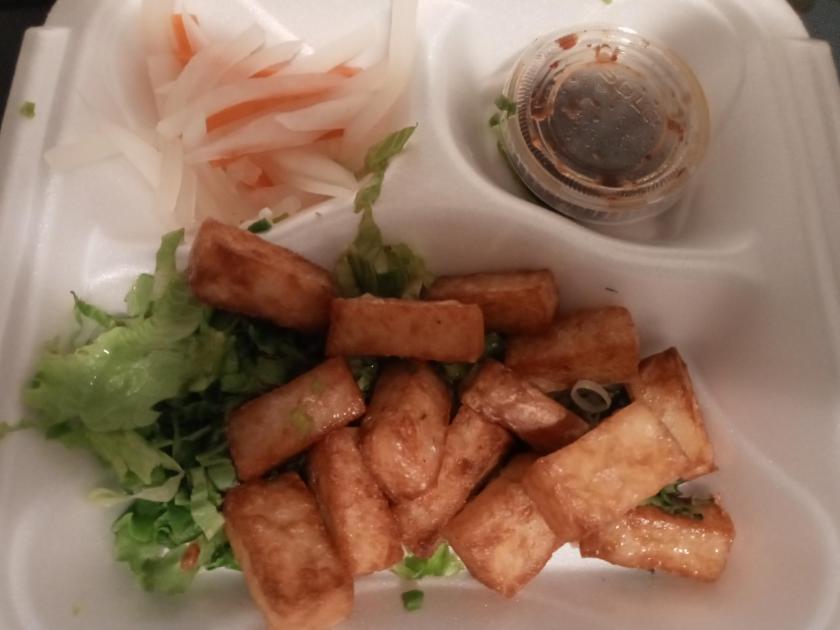
Before leaving, I ordered the pan-fried rice cakes (minus the eggs) to bring home for my wife to try.  She was dazzled with them too, and they did not lose their subtle crispiness on the drive home. 

And I also brought home a dish I had really wanted to try, after seeing so many people post photos of it.  My vegetarian friend would not have been into this at all, but I knew my wife would share my appreciation of Z Asian’s grilled jumbo squid (muc nuong sate).  You can get squid at lots of restaurants (Italian, Greek, Chinese, steakhouses, and so forth) in the form of breaded, fried calamari, but I had never seen such squid served in such a beautiful presentation as this.  If your fellow diners aren’t averse to eating cephalopods (so that counts out my in-laws), this will be a real attention-grabber at your table, and I strongly recommend it.   
The menu says the grilled jumbo squid is marinated in “house sauce,” and it is served with house-made jalapeno green sauce, but it did not need to be dipped in anything.  Squid can sometimes get chewy and rubbery, but this was so tender and flavorful, with slight spicy and sweet flavors balancing out the taste of the ocean (but not a fishy taste).

It wasn’t long before I returned to Z Asian with my wife, who ordered a Thai milk tea (tra Thai) that was rich and cool and creamy and sweet, with a slightly smoky flavor. 

For some reason, I could not decide what to order.  Normally I am not intimidated by a large menu, but for this second visit, I just couldn’t choose.  I eventually picked something pretty random, the seafood stir-fried noodles in garlic sauce, which came with tail-on shrimp, squid, fish cakes, and the usual bok choy, carrots, and bean sprouts.  I chose egg noodles instead of rice noodles, but I had completely forgotten that this was essentially what my friend ordered on our first visit, minus the seafood. To be completely honest, this was okay.  I feel like I did not make the best choice.  I might have been happier with pho or bun bo hue, but I kept thinking about how hot it was for soup (on a scorching August afternoon in Florida), and how it would be hard to beat Pho Huong Lan, maker of the best pho and bun bo hue I’ve ever had anywhere.  Plus, with Z Asian’s huge menu, I wanted to challenge myself and step out of my comfort zone, trying something new instead of something familiar I’ve had dozens, if not hundreds, of times over the years.  But there wasn’t anything wrong with the dish; I blame myself for being uncharacteristically wishy-washy and not choosing wisely.  I was kind of hoping the garlic sauce on the noodles would be more like the awe-inspiring buttery garlic noodles at Kai Asian Street Fare, but not knowing any better, I just set myself up for disappointment.
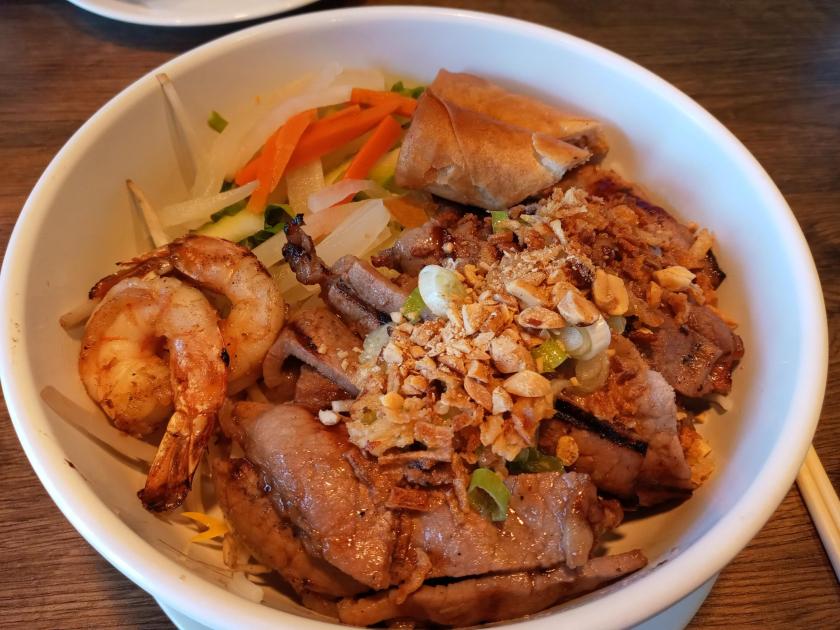
As always, my wife was smarter than I, choosing a favorite from other Vietnamese restaurant menus: slices of tender grilled beef, tail-on shrimp, and a crispy fried spring roll cut in half, served over rice vermicelli noodles, with shredded lettuce, julienned cucumber and carrot, diced scallions, and crushed peanuts.  This was not a noodle soup, but a very refreshing, summery dish with warm and cool ingredients.  Sometimes you can’t go wrong with a classic!   

So that’s Z Asian Vietnamese Kitchen.  I would absolutely return and try something different next time — maybe something with clams or snails, or maybe even sample the bun bo hue or the pho.  But I really don’t think you can go wrong, and if you are a vegetarian or vegan, you have a lot more options here than most other restaurants in and around Orlando.  And if you don’t want to take my word for it, a certain tire company also really recommends the place.

Sanaa

This is a review of a wonderful meal I ate back in May, with five wonderful former co-workers.  (I started a new job six weeks ago, so I’m still getting used to referring to the job I held for 15 years as my old job, and my co-workers as former co-workers.)  After attending the lovely graduation ceremony for our students every May, we had a nice unofficial tradition of going out to lunch somewhere afterwards, usually a fun place somewhere on Disney property, where we would never have the time to go on a normal workday.

Last year we had an awe-inspiring lunch at Jose Andres’ huge Jaleo restaurant at Disney Springs, and this year we went to Sanaa (https://disneyworld.disney.go.com/dining/animal-kingdom-villas-kidani/sanaa/) at Kidani Village, part of the beautiful Animal Kingdom Lodge resort hotel.  You do not need to purchase admission to the Animal Kingdom theme park to eat here, or I probably would have skipped out on this one.  Sanaa serves African food with Indian influences,

Like everything at Walt Disney World, the theming of the restaurant is beautiful.  It is a popular place, and my Disney-experienced colleague booked a reservation for our party weeks in advance, which was a wise move.   You can actually see zebras, giraffes, and other wild animals out those windows… just not in my photo.  (Sorry.)

If you ask me, the highlight of dining at Sanaa is the Indian-style bread service.  This is a dream for vegetarians and people who are at peace with consuming carbs.  It costs $21, and you get five different breads and a whopping nine different accompaniments.  The six of us shared everything and were very polite about it, but in the future, I would totally order this just for myself, possibly even as my main meal.  If you come to Sanaa and don’t order the bread service, you are missing out on something spectacular.

The five breads are supposed to be traditional naan, garlic-ginger naan, spiced naan, onion kulcha, and paneer paratha.  I only see four in the photo below, and I could not possibly begin to guess which one was which, but trust me when I tell you that they were all fluffy, soft, buttery heaven.  If you haven’t had naan or roti or paratha or kulcha before, I encourage you to find the closest Indian restaurant on your way home from wherever you are and pick some up to go, even if you don’t order anything else!   Imagine the softest, fluffiest pita bread, and you’re still not even close to how good these clay oven-baked flatbreads can be.

Of course I got a lousy photo of the beautiful dips, sauces, and chutneys, trying to capture them before my colleagues dove in, but they were a real treat for a fan of condiments, sauces, and dips like me.  I wasn’t always sure what I was dipping into what or spooning onto what, but there wasn’t a bummer in the bunch.  They included cucumber raita (cool and creamy yogurt in the top right), roasted red pepper hummus (top left), mango chutney (second from top right; similar to a chunky mango salsa), tomato-date jam (I loved this one, whichever it was), tamarind chutney, coriander chutney, garlic pickle, red chile sambal, and spicy jalapeño-lime pickle. This was such a crowd-pleaser, and it was definitely the highlight of the meal for me.  Like I said, whenever I get around to returning, I’m gonna get this just for myself, and then suggest anyone else I am with share one.

One co-worker ordered samosas, which were plated beautifully.  These were potato and pea samosas in what looked like perfect pastry shells, served over mango and tamarind chutney.  I didn’t ask to try hers because that is all she ordered for herself, but have you ever had a bad samosa?  I don’t think that is possible, kind of like the nonexistence of bad empanadas.

I ordered the potjie (referring to food slow-cooked in small cast-iron pots), which I was drawn to because the menu presents several options to choose from.  You may choose one from the “journey” (meat-based dishes): Goan seafood curry, butter chicken, braised beef, or pork vindaloo, and then one from the “harvest” (plant-based dishes): rajma masala, chickpea wat, sukuma wiki, or lentil daal.  Our server was very patient, answering our questions and making suggestions.

I can try butter chicken at any number of wonderful local Indian restaurants, since that is my wife’s favorite Indian dish, and even though I love a good vindaloo, I knew our group was headed to Epcot next, so I did not want to ruin a rare, fun afternoon out by sabotaging my stomach with something really spicy.  I thought the most interesting and offbeat choice was the Goan seafood curry, so that’s what I got.      

It came with shrimp, fish, and scallops in a rich curry that was mildly spicy, probably much more mild than the vindaloo.  Luckily, it came with plenty of fragrant basmati rice, and I mixed them together liberally.

My plant-based choice was sukuma wiki, an East African dish of collard greens stewed with tomatoes and spices.  I love good collards, and even though these were purely vegetarian (rather than being cooked with any smoked pork, smoked turkey, or ham), they were so full of flavor.  No regrets here!  Even though this dish is from Kenya and Tanzania, it made me realize it has been more than a decade since I’ve had Ethiopian food (another cuisine that handles collard greens very well).  It is also really damn good, and I need to get some again soon.

My one male colleague at the lunch also ordered the potjie, but with completely different options.

He opted for the braised beef, which looked and smelled really fine:

And he also chose rajma masala, a curry dish of kidney beans cooked with onions, tomatoes, herbs, and spices.  It looked and smelled great as well, but he was not joining us for Epcot, so the rest of us dodged a big bullet that afternoon.
At this point, I was already pleasantly full, but people in my party insisted on ordering three separate desserts to share.  Let it never be said that librarians don’t know how to party!

This was serradura, which was butterscotch pudding, almond coffee  streusel, fresh pineapple and mango, and Breton shortbread (which I didn’t try because it looked like a biscotti, God’s joke on people who like cookies).  The little spoonful I had was very nice.  It was cool, creamy, not too sweet or rich.  

This was kheer, a plant-based dessert of coconut-rice pudding with cashew streusel and saffron-poached fruit.  I tried a tiny taste because sometimes coconut and nuts betray me, but I liked it more than I expected to.  I would never have even considered ordering this dessert, but it was delicious.  

And this was a dessert special that was like a fancy version of a chocolate candy bar with nuts.  I left that for the other five people to devour, because I was very content at this point. 

As my friends and regular readers (the stalwart Saboscrivnerinos) know, I am not what you would consider a “Disney adult.”  I have nothing against Disney, but my wife and I just aren’t theme park people.  That said, I had a blast at Epcot after lunch with my former co-workers, awesome people I am proud to call friends, as well as professional colleagues.  (Frolleagues?)  I especially want to thank one frolleague who also left that same institution over the summer, one of the dozens of stalwart Saboscrivnerinos, a wonderful woman who used a guest pass to get me into Epcot.  Next time I see you, I’m treating you to something — and you know who you are!

My wife and I end up at Disney Springs every so often, usually visiting people who are staying at or near the parks, since you don’t have to pay admission to go there.  There are good restaurants at Disney Springs, but it was a blast to go somewhere new on the sprawling resort property, somewhere I had never been before, and to enjoy new dishes and flavors I had never even tried before.  I would strongly recommend Sanaa to any adventurous tourists and locals alike.

While I have favorite Indian restaurants in Orlando (Bombay Street Kitchen chief among them), not a lot of places serve African-Indian fusion dishes, aside from occasional specials at the casual Oh My Gyro in Longwood.  There is nothing quite like Sanaa, and especially nothing like that breathtaking bread service.  You don’t have to pay park admission to eat here or even pay for parking, so consider adding it to your list of Disney dining destinations.