The ‘Dines List 4: Sketches of Spain

This is my fourth installment of The ‘Dines List, a series of rambling reviews that extol the virtues of sardines and other tinned seafood, which I eat quite often. The goal is to review new and interesting tinned fish and shellfish I discover in my travels (or friends send me as gifts), and also to win over the sardine-skeptical.  Sardines in particular are very healthy due to being pure protein and full of omega-3 fatty acids.  They are mostly environmentally friendly since they are tiny little fellers who are low on the food chain.  And they are surprisingly delicious — far tastier and less “fishy” than the uninitiated might think.

A few years back, sardines started going viral for being “hot girl food” (check that Vogue article if you don’t believe me!), which really raised their profile and made these humble little fish both trendy and sexy.  Well, I am neither hot, nor a girl, nor sexy, and rarely am I trendy, but I’ve been flying my fish flag since I was a poor college student decades ago.  Now I eat them because I like them, not because I have to.  I guess I’m just ahead of my time, like with the whole loving superheroes thing, ever since I was a little kid in the early ’80s, long before they were cultural icons.  Awww, I’ll never be a cultural icon.

(But good grief, there is already some backlash against the whole tinned fish trend, and I blame the criticism on the fact that women have embraced it.  Let people — and especially women — enjoy things!  Be curious, not judgmental!)

Anyway, back in 2021, I wrote my first riveting installment of The ‘Dines List, which I titled Canned Sardines 101, listing and reviewing some of my favorites and providing advice and recommendations for the ‘dine-curious.  Then I started getting geographical with The ‘Dines List 2: Mission to Morocco!, where I only reviewed Moroccan sardines, and The ‘Dines List 3: Postcards from Portugal, where I only covered Portuguese tinned seafood.  As you might guess, these countries along the Mediterranean Sea have huge fishing and canning industries, as well as a culture and tradition of dining on ‘dines.  I wrote about Portuguese sardines way back in March 2023, so it was only fitting that I’d get around to Spanish sardines and other tinned seafood eventually.  Spain and Portugal produce the most serious gourmet tins, and I’ve been trying as many different varieties as I could in the meantime.  So with all due respect to the legendary Miles Davis, welcome to The ‘Dines List 4: Sketches of Spain.

I found Vigo hot spiced sardines in sunflower oil at Mazzaro’s Italian Market in St. Petersburg, a place I always recommend and rave about.  As sardines and other tinned seafood have become more popular and trendy, Mazzaro’s has dramatically increased its tinned seafood selection with a lot of higher-end Spanish and Portuguese brands that you won’t find at everyday supermarkets.  These Vigo sardines are some of the cheaper ones at Mazzaro’s, for $2.99.  I’ve also seen them at Walmart, but just the big Supercenter near me, not the smaller Neighborhood Markets.  Does anyone else think of Vigo the Carpathian coming alive inside the painting in Ghostbusters 2, whenever they see this Spanish food brand?  No?  Just me?  It can’t just be me!

Once I drained most of the oil, these definitely weren’t as pretty, so maybe you get what you pay for.  I either ate these bad boys straight out of the tin or dumped them on top of a salad.  I recall them being perfectly okay, but I’ve had better — read on to see some of them!

I bought these La Española sardines in “oil – spiced & piquant” at Bay Cities Italian Deli & Bakery, an awe-inspiring Italian market and deli in Los Angeles’ beautiful Santa Monica neighborhood.  Bay Cities is a West L.A. icon that has been open since 1925.  I bought several sandwiches and a bunch of snacks there on a work trip in April 2025, including a few different La Española tins, since I’ve never seen this brand for sale anywhere in Florida.  That way I had food for my hotel room and for work lunches, since I never rent a car in Los Angeles.  At some point, I’ll get around to writing a Bay Cities Italian Deli & Bakery review, because it deserves one.

These were larger sardines — firm and meaty, not super-spicy, but just fine for eating out of the tin in a hotel room like the most depressing film noir antihero ever.  I don’t remember finding the pickle and carrot slices pictured on the outer box, but they may have been under the ‘dines.

These Jadran sardines with hot pepper are interesting, because they seem to be harvested from the Adriatic Sea (between the boot of Italy and Croatia), but the box specified they are a product of Spain — perhaps processed there.  I think I bought them at either the huge International Food Club out on L.B. McLeod Road off John Young Parkway (a super-fun place to browse and discover treasures) or at Tima’s House, the small Euro-Balkan market in Longwood.

They weren’t the prettiest sardines ever, but I have plenty of silvery beauties coming up:
I added them to a nice salad, so isn’t this a work of art?  Dig the jammy hard-boiled eggs and beautiful pickled onions I made myself.

I’m pretty sure I picked up these Serrats small sardines in olive oil when they were on sale at our friendly neighborhood Fresh Market, because I don’t like paying full price for the fancy Spanish and Portuguese sardine brands. 

These were attractive, silvery fish, packed tightly and beautifully in their tin.  (I had already drained the oil here.)  I think more people would like sardines if they all looked this nice and orderly, since people eat with their eyes.  But did they taste good?

I served them on some lightly toasted Cuban bread with more of my homemade pickled onions from a different batch and some sliced tomatoes.  As you can see, they fell apart a bit as I removed them from their tight tin, but these were very good.

Fresh Market is where I’ve bought the vast majority of my Matiz sardines as well.  I am nuts for lemon desserts, but not as big on lemon in savory dishes.  Still, I had to try these Matiz wild sardines with natural lemon essence.

Trust me, they looked a lot less blurry in real life.  I don’t recall them tasting super-lemony, which was fine with me, but they didn’t make a strong impact on my memory, which means they weren’t mind-blowingly amazing or mind-blowingly awful.  I probably wouldn’t buy this variety again as a result, but I never regret trying anything.

My next Matiz product was their wild spicy sardines with piri piri pepper in olive oil, also from Fresh Market:

My only experience with piri piri peppers so far had been in hot sauce from Nando’s, the South African grilled chicken chain I tried in Chicago and still need to write about.  If Nando’s opened locations in Orlando, it would be a license to print money, but you can buy Nando’s piri piri-based hot sauce  (they call it peri peri there) and “Perinaise” at Publix and Fresh Market.  Just one look at these ‘dines made me think they would have a nice, vinegary, tangy bite to them.   

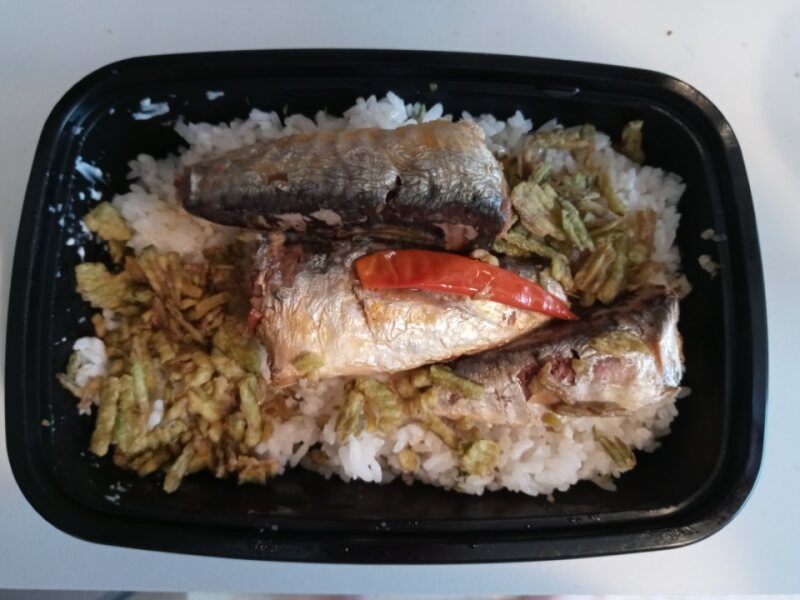
I had these with some rice after draining most of the oil, and sprinkled them with some crispy fried jalapeños.  They were a great little lunch, and barely spicy at all on their own.  The little included pepper is usually like an empty sack of seeds and never terribly pleasant to eat, but do I try every time?  YUP!
I had an even better feeling about these Matiz wild small sardines with sweet piquillo peppers, because I always think smaller sardines taste better and have better textures than the larger ones, and piquillo peppers make everything better.

They looked nice and silvery in the tin after I drained most of the oil.

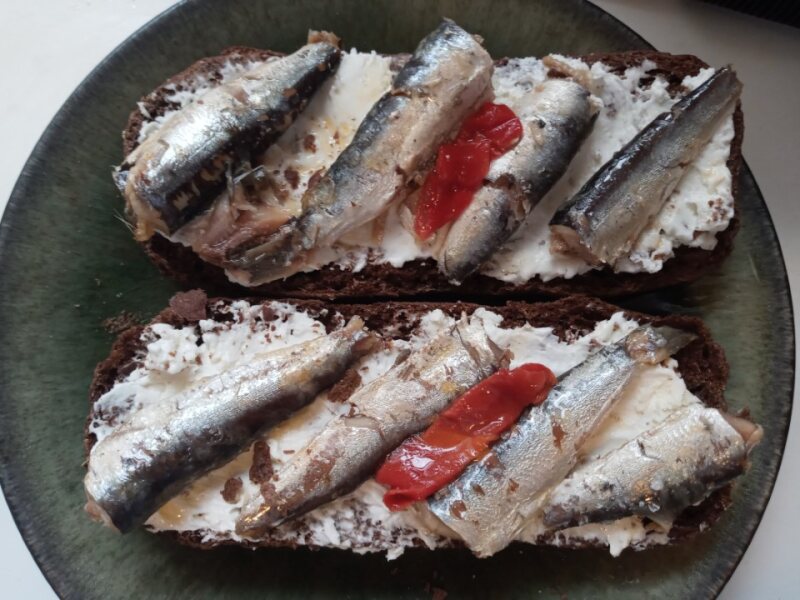
I don’t even remember what kind of dark, crusty bread I ate with these little ‘dines, but I spread some cream cheese underneath them.  They were excellent, and for a change, the little peppers were pleasant to eat.  I always appreciate a piquillo pepper, though.
I liked these so much that I tried another tin on a different nice salad:

A while back, an old friend mailed me these Donostia Foods sardines in spiced sauce, and I knew they would be awesome.  She runs The Back Yard restaurant and bar in Baltimore and started their imported gourmet tinned seafood program, which sounds like a big hit.

I knew that despite a nondescript box, these would be special sardines because they included olive oil, tomato, carrot, cucumber, red pepper, onion, “spices,” and salt.  They were some of the most delicious ‘dines I’ve ever had. 

Here they are on a cracker with a wee cornichon from the tin.  This was a well-balanced bite of food!

I am lucky to have true and dear friends in my life, and sometimes they even hook me up with tinned seafood.  I hope you all have people like this in your own lives.  My best foodie friend and his wonderful girlfriend surprised me with these Los Peperetes sardinillas (small sardines), which he had read raving reviews about.  She was already in Spain, and he sent her on a special mission to track these down for me.  Can you imagine going to that trouble for someone you haven’t even met yet?  They are awesome, and so were these Los Peperetes.

Look at how beautifully packed these tiny sardinillas are!  Los Peperetes did an artful job.
Even the tiny tails were lightly crispy.  Yes, you can eat the tails, and you won’t choke or anything.  I like them.

I had to include this photo to show that there was a whole second layer of tightly packed fish below the top layer.  It was the gift that keeps on giving!  These were really something special.  I ate them plain at first, to get the full effect without any other distracting flavors, but I still have one more tin that I’m saving for a special occasion (or maybe a nice treat if we lose power during hurricane season).  You can’t ask for better quality sardines than these, or better quality friends than mine!   

The same dude surprised me a different time with this assortment of imported Spanish tinned seafood from Conservas de Cambados, which blew my mind.  This freakin’ guy!  What a mensch!  I had never heard of this brand before or seen them for sale locally, but I recently saw them for the first time “in the wild” at the aforementioned Mazzaro’s Italian Market in St. Petersburg.  I was absolutely blown away by his generosity and excited to dig into each of these.

There was only one tin of sardines in the box, but I knew they would be great because they were small.  Luckily for us, the label tells us the tin contains fish (sardines, in fact)!

This was up there with the Serrats and the Los Peperetes for gorgeous presentation.  I definitely think more people would eat sardines if more tins looked like this:

Here they are on some toasted Cuban bread… or maybe this was a Cusano’s hoagie roll, which I make a special trip to Gordon Food Service to buy.  There were a bunch of these little guys!  I might have added some lettuce, tomato, onion, and a splash of vinaigrette after the photo op, but I wanted to photograph them in an unadulterated manner first.

Wait a minute, ye scurvy scalawag!  This next thing isn’t a sardine!  I know, I know — it is line-caught Spanish white tuna belly, also from the Conservas de Cambados assortment.  I love tuna in all its forms: raw in sushi or poke, seared as a posh appetizer or entree, or even the cheap canned stuff in a tuna salad sandwich or tuna melt.  I hardly ever eat canned tuna because of the mercury, and because the smell of regular canned tuna makes my wife gag in a way that sardines (luckily for both of us) do not.  But this was a rare and decadent treat, and this was the best place to include it. 

I don’t know what I was expecting, but it looked a hell of a lot more appetizing than the cheap “chunk light” tuna in natural spring water that I grew up eating, and packing the fish in oil rather than water makes it smell a lot less offensively fishy.   

After draining the oil, I enjoyed it on some toasted Cuban bread with a light slathering of Duke’s mayo underneath.  I make really good tuna salad (and chicken salad, and egg salad), but this was such a luxurious product, I didn’t want to dilute the flavor with any other distractions.  As you might guess, it was a cut above any canned tuna I’ve ever had in my life.  It just tasted rich — not necessarily fatty, but not “fishy” and definitely not dry.

The Conservas de Cambados gift box also included a tin of line-caught Spanish white tuna in olive oil, which I forgot to photograph, but it was also really good, I assure you.  And the other tins in the photo above were scallops and two different types of octopus, which I will tell you about later.

As long as we’re talking about delicious Spanish tuna, this is my most recent discovery from Bravo Supermarket, the Latin grocery store chain with multiple locations here in the Orlando area: Conchita Fritada de Atun, or Zesty Tuna Fish Dip.  It was essentially a tuna paté blended smoothly with tomatoes, pimento, onions, pickles, “spices,” rice flour, and sunflower oil.  It might look like cat food, but it tasted luxurious and was absolute heaven to eat, meow meow.  I dipped some toasted pita bread wedges in it, and I loved every moment.  It was cheap, too — had to be $2.99 or at most, $3.99.  It would be easy enough to make something similar, but this was better than it had any right to be.

Finally, these aren’t sardines either, but huevas de merluza, or hake roe (hake being a whole different kind of fish).  I had never heard of this Spanish company Agromar, or even hake, but it turns out they are medium-to-large fish related to cod and haddock, so nothing like the little dudes I’ve been specializing in writing about so far.  But I do love fish eggs, whether they are masago (orange capelin roe), tobiko (orangey-red flying fish roe), or ikura (that much larger salmon roe that pops in your mouth like popping boba) in sushi, or caviar, that ultra-decadent delight.  And these were spicy too, so how could I not try it? By the way, I bought this at the best place to buy fancy tinned seafood in Orlando, Hinckley’s Fancy Meats in the East End Market food hall.  I reviewed Matt Hinckley’s wonderful sandwiches a few years back, and he is definitely a master of smoking and curing meats, making patés and rillettes, and so much more.  But since then, he has branched out into curating and selling some very high-end, fancy tinned fish and shellfish from Spain and Portugal, so check out his staggering selection and order some.  Yes, he ships!

These definitely didn’t look anything like what I would have expected, though.  Not tiny round eggs, and not anything like bottarga, that intensely flavored, decadent, Italian salt-cured roe sac from a grey mullet, either.  The box refers to them as “medallones” (medallions), and I guess they look like that… or sliced Vienna sausages.  At first, I didn’t know what to think, but I will try anything once!

These hake roe medallions are some serious gourmet shit, and what do I do?  Serve them (just to myself, because my wife would have wanted nothing to do with this) on Ritz crackers, which are the best and most versatile crackers.  I’ll dip Ritz crackers into smoked whitefish salad or chopped liver, spread them with cream cheese and guava paste, or crush them and bake them into the best buttery-salty-sweet pie crust ever.  Or I’ll put hake roe on ’em! Were they tasty?  Sure.  They weren’t spicy at all, not salty, or even “fishy,” but they were pleasant.  Can I describe the texture?  No, not really.  It really wasn’t like anything else I’ve ever eaten.  Am I glad I tried them?  You better believe it!  Would I get them again?  Probably not, only because there is a wide world of seafood out there, and I’d love to try some different impulse buys from the vast selection at Hinckley’s Fancy Meats before doubling back.  But if you’re buying the next round, stalwart Saboscrivnerinos, I will happily enjoy some future huevas de merluza tapas with you!

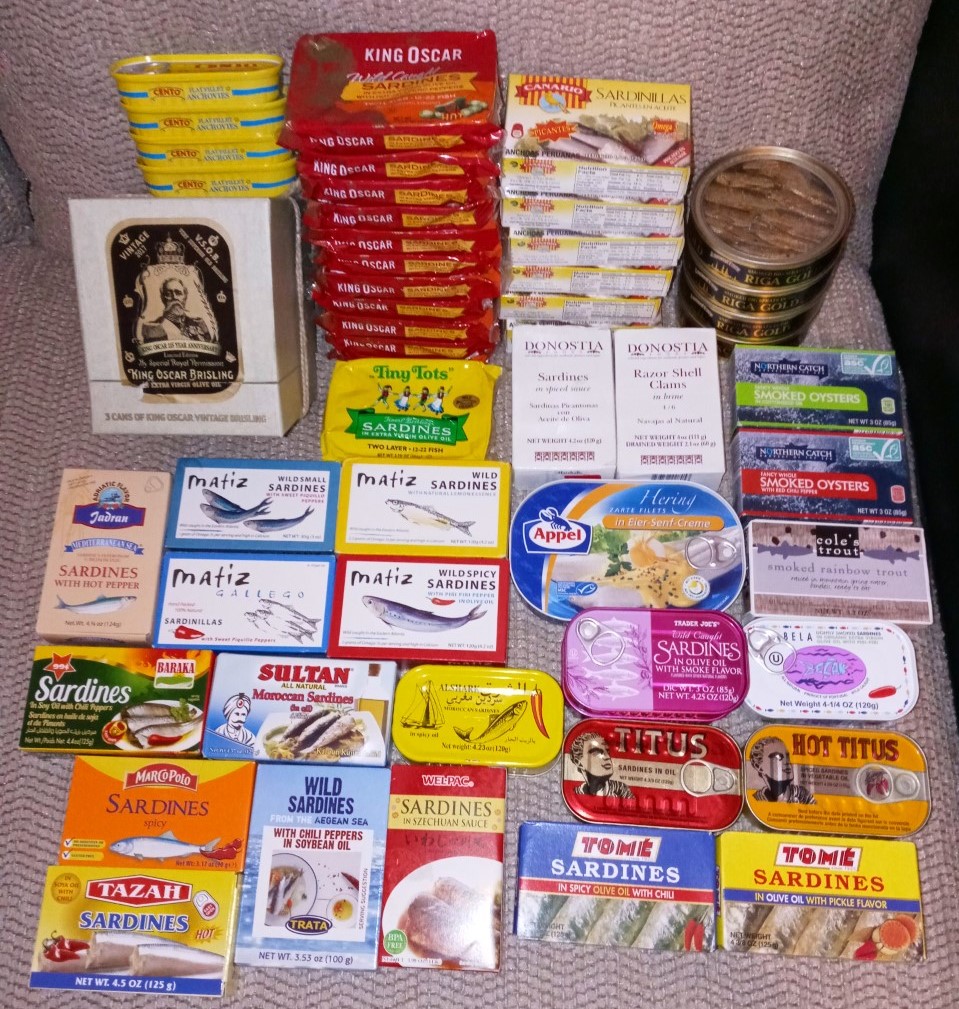
That’s all for now, but I have a huge stash of more sardines and other tinned seafood to review, from Spain and other seas and ports around the world.  In the meantime, whether you read this piece while sardines are still in style or discover it long after the tinned trend has come and gone, you can always rely on The ‘Dines List for detailed descriptions and unbiased reviews of humble (and occasionally not so humble) tinned fish.  And coming soon, we’ll venture into the wild waters and delicious depths of tinned shellfish, so get ready to see me flexing my mussels.

The ‘Dines List 3: Postcards from Portugal

It has been a long time since my last installment of The ‘Dines List, the recurring Saboscrivner feature where I review different tinned sardines and other tinned seafood.  Before you recoil in disgust or make that “Flehmen Response” face that is so funny when cats do it, I want to once again extol the virtues of the humble sardine.  These tiny fish are near the bottom of the food chain.  They are extraordinarily healthy, full of omega-3 fatty acids, no mercury like so much canned tuna, pure protein, and mostly environmentally sustainable, although I have been reading articles recently about sardines being the victim of overfishing, both in the Pacific Ocean and near the setting of this latest ‘Dines List.

Plus, now sardines are trendy “hot girl food,” so even though I am the furthest thing from a hot girl (not a girl, not hot unless you have a thing for bear types, and then the jury is probably still out), I am pleased that a thing I like is finally being appreciated and enjoying a moment in the cultural zeitgeist, just like how the last 20+ years of superhero movie mania has validated another one of my lifelong loves.  So now, on to the ‘dines!

Beautiful Portugal, the westernmost country in Europe, lies on the western coast of the Iberian peninsula, next door to Spain.  Historically, Portugal was responsible for a lot of seafaring, trading, and fishing, and to this day, fish and seafood are a major part of the typical Portuguese diet.  Only Japan and Iceland consume more fish per capita than Portugal!  Many of the locally caught sardines, tuna, and other fish are processed (tinned) and exported all around the world.

After my last ‘Dines List feature, where I reviewed sardines from Morocco, Portugal’s neighbor across the sea, I decided to do a round-up of all the Portuguese sardines I could find, to review them all and point out the good, the bad, and the stinky.

I discovered these Nuri spiced Portuguese sardines at Lotte Plaza Market, the fantastic and huge pan-Asian supermarket in West Orlando, a super-fun place for local foodies to shop and eat.  You can have a delicious meal at one of the many Asian restaurants in the food court and then stock up on groceries and snacks, but don’t forget the Nuri ‘dines!

These had a really nice heat from piri-piri peppers, and they also included carrot, cucumber, laurel(!), and clove in the seasoning.

Since I had never tried the Nuri sardines before, I ate them plain, but for some reason I plated them instead of devouring them straight out of the tin.  Note the single carrot slice, single pepper, and single cucumber slice, which was more like a thin pickle slice at this point.  I really liked these and would get them again.  They were surprisingly, pleasantly spicy!

I must have bought these Bela sardines a long time ago, maybe at Fresh Market.  This brand tends to cost more than other sardines, so I must have gotten the can on sale.  Unlike the Nuris above, these were lightly smoked, and the label makes clear they were packed in organic extra virgin olive oil.  Like the Nuris, they were also seasoned with piri-piri peppers, which is a delicious, piquant pepper that adds a nice kick to foods without being overwhelmingly hot. 

These Belas were much nicer-looking than most other tinned sardines, still retaining their iridescent silvery skin (which is perfectly tasty, don’t worry).  I typically avoid boneless, skinless ‘dines, because the bones give a nice, light crunch and are packed with calcium, and ‘dines with skin are more attractive and taste better, at least to me.

I made a Bela sandwich on a toasted bialy, with some sliced onion, fresh cilantro, Trader Joe’s piri-piri hot sauce (the orange sauce on the left), and crispy French-fried onions over the ‘dines themselves, with cream cheese beneath them.  Thankfully I’m still wearing a mask in public three years into the pandemic, which allowed me to eat a stanky sandwich like this with a clearer conscience.  It was delicious, though.  All the flavors went well with these beautiful Belas.

I believe I found these Bon Appetit Portuguese sardines at Green Hills Supermarket, a wonderful Eastern European grocery store in Altamonte Springs, Florida, which is heaven for tinned fish aficionados.  They stock all kinds of pickled herring, smoked Latvian sprats, and countless brands of tinned and bottled ‘dines from around the world, particularly European brands.  

After draining the “hot olive oil,” these weren’t that much to look at either, and to be completely frank, I barely remember them.  I think they had kind of a dry taste, like you could chew them forever and not much would happen (like too many people’s mamas’ pot roast).

I served the Bon Appetit sardines on homemade potato blinis, fancy little savory pancakes I learned how to make after first trying them at Bern’s Steak House in Tampa.  The blinis were definitely better than the ‘dinis.

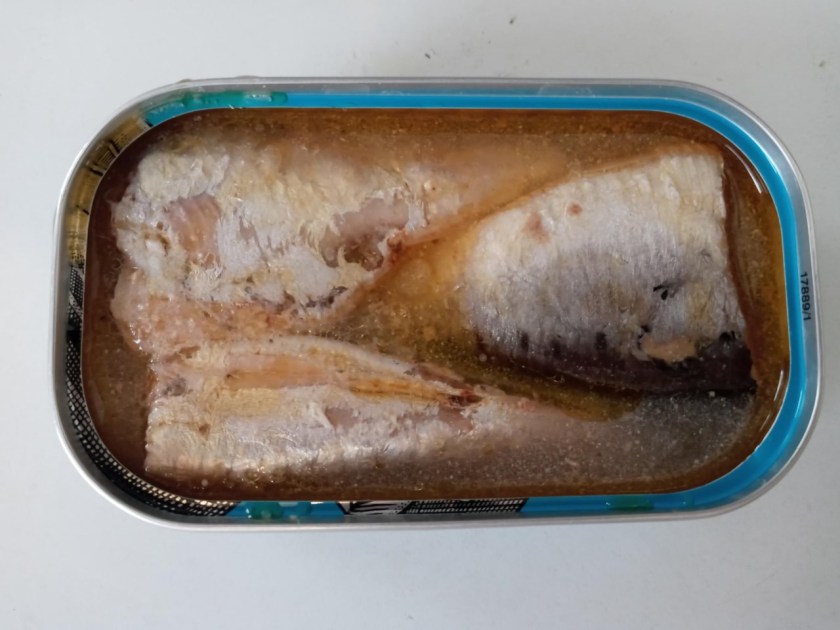
I always see this Porthos brand at Fresh Market, usually priced higher than most supermarket ‘dines — maybe even $6 or $7 per can?  I know myself, and I know I would not have bought this unless it was on sale for $5 or under.  What I didn’t catch was that the ‘dines were packed in brine rather than some kind of oil, so caveat emptor.

Not very pretty, are they?  I would have expected more from the fancy-pants Porthos brand.  They were smellier than most canned ‘dines just because they were packed in brine rather than oil.  I grew up in a house where we ate canned tuna packed in water as a regular staple food, and I ate it throughout college and grad school, pretty much until I met my wife and the smell emanating from a can I opened made her throw up immediately, with no warning whatsoever.  I never bought canned tuna in water again, and while she might not share my love of canned sardines, the smell never nauseates her either.  But these were fishy and funky, and I wouldn’t buy this bougie brand again.  I probably mixed them with Duke’s mayonnaise and one of the many mustards in my collection to make sardine salad, a tribute to the tuna salad that sustained me through far too many bachelor pads and degrees.   

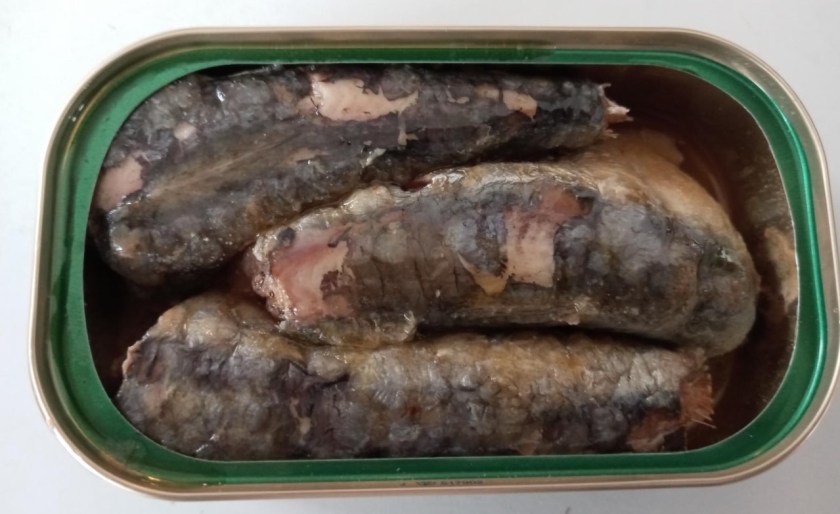
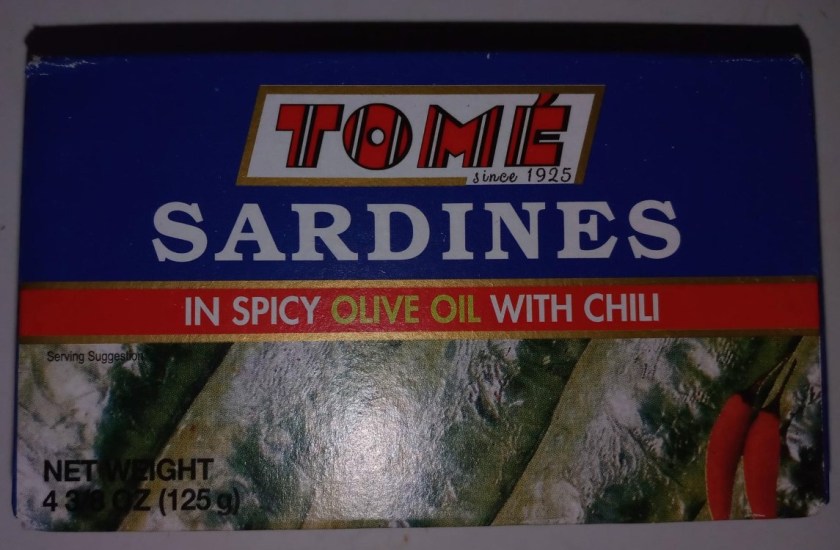
I think I found these Tome sardines at Enson Market, another Asian supermarket at 5132 W Colonial Dr, Orlando, FL 32808, maybe five minutes west of the aforementioned Lotte Plaza Market.

The picture on the box shows little sliced vegetables, including what looks like a pickle slice and maybe a red pepper.  I think these ‘dines had a bit of a sour, pickley note, but I must admit, I don’t recall the vegetables coming in the can.  I would have mashed these up into sardine salad with a dollop of mayo, and I chopped some Grillo’s Pickles into it (my favorite brand, from my Plethora of Pickles review).

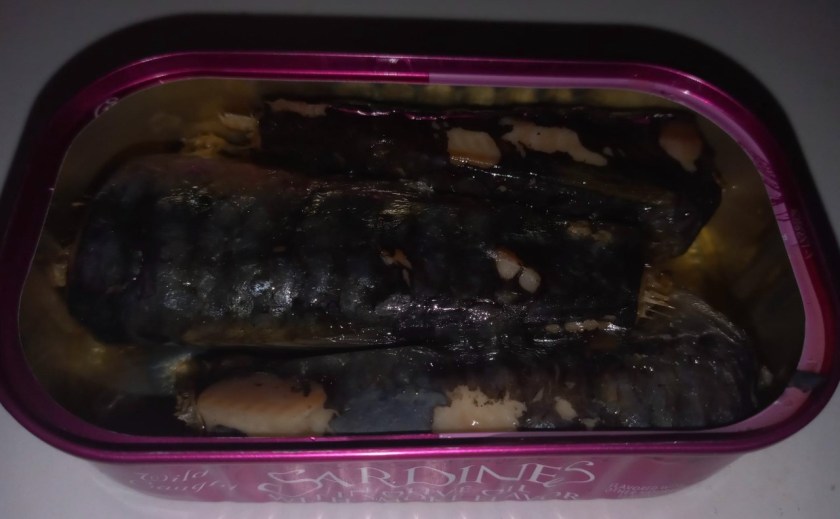
The Tome sardines in spicy olive oil with chili were better, but still pretty standard.

They looked more appealing in the can with their shimmering silvery skin attached.

I recall these being good enough to eat straight up, after draining the oil (never down the drain, folks!).  

Trader Joe’s Wild Caught Sardines in Olive Oil with Smoke Flavor are a terrific value for Portuguese sardines, and surprisingly tasty on their own or in anything.  That little bit of smokiness helps immensely.

Like so many of the others, I ate these plain, straight out of the can after draining most of the oil, probably standing over the sink at home.  They definitely aren’t the prettiest ‘dines, but I would get them again. 

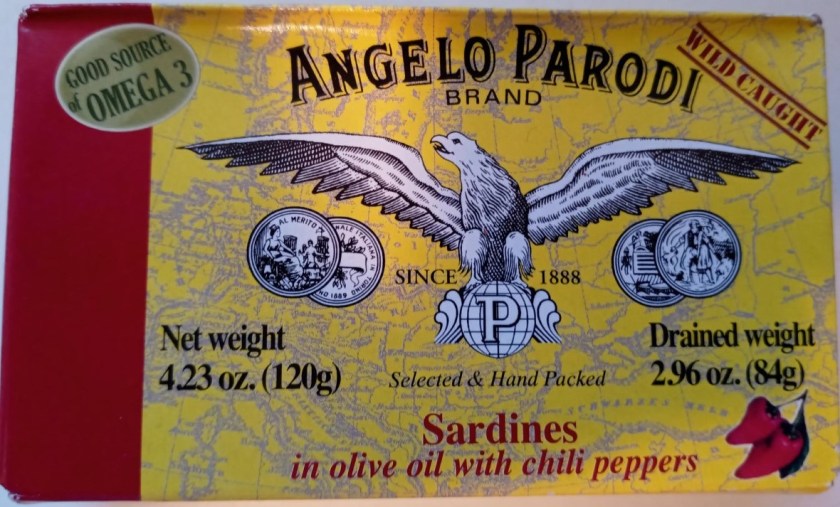
This is my most recent ‘dine discovery: the Angelo Parodi brand, which I found for the first time visiting Filippi’s Pizza Grotto in San Diego’s Italian Village, a wonderful old-school Italian-American restaurant attached to an equally old-school Italian grocery store.  You have to walk through the tiny market to get to the restaurant in the back, with red and white checkered tablecloths, candles melted into chianti bottles, the whole deal.  I had great pizza and a good Italian sub (which I should really get around to reviewing), but I couldn’t walk through an Italian market without bringing home some edible souvenirs, so I grabbed two tins of the Angelo Parodi ‘dines in olive oil with chili peppers.  Despite the brand name and the source, they are also products of Portugal, not Italy. 

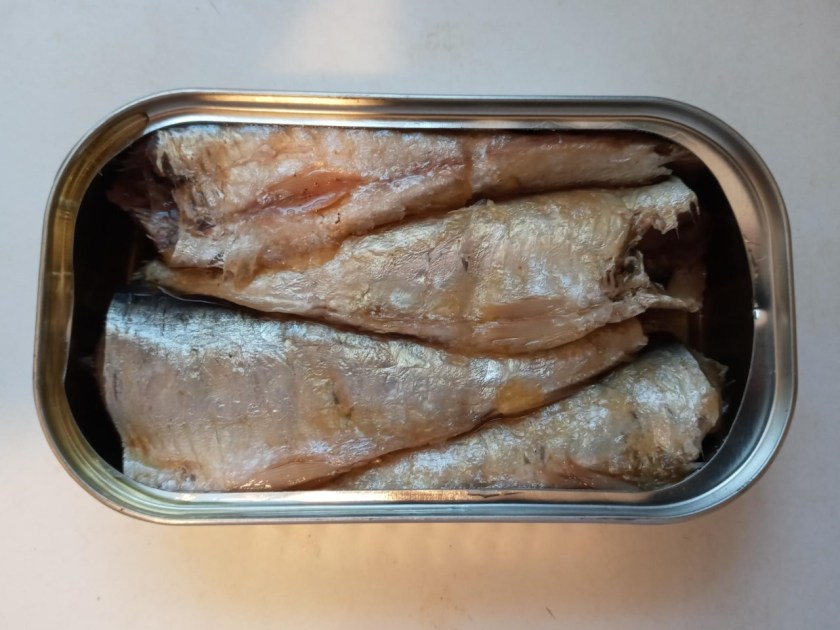
I already drained the orange oil in this photo, but they looked beautiful — nice and meaty, silvery skin intact, packed tightly, definitely pleasing to the eye.

And here they are.  Thrill to my half-assed plating with some fresh, house-made Ceili chips (potato chips) from Fiddler’s Green, our favorite Irish pub in Winter Park, Florida.  Tonight I brought my wife home her favorite chicken tenders and the chips, but I knew I was having the Angelo Parodi ‘dines so I could finally finish this mega-review of Portuguese sardines.  They were surprisingly spicy, even drained of the oil, but very firm, meaty, and on the salty side, especially paired with the potato chips.  That was not the best choice — some crusty Italian bread would have been better, but crusty Italian bread would make almost anything better. As usual, the included chili peppers were sad sacks of seeds, not really worth trying to eat.   But even though I’ve never seen Angelo Parodi products for sale in Florida (not even at Mazzaro’s Italian Market in St. Petersburg or Doris Italian Market in South Florida, two wonderful places I desperately need to revisit and review), I would definitely get these sardines again.

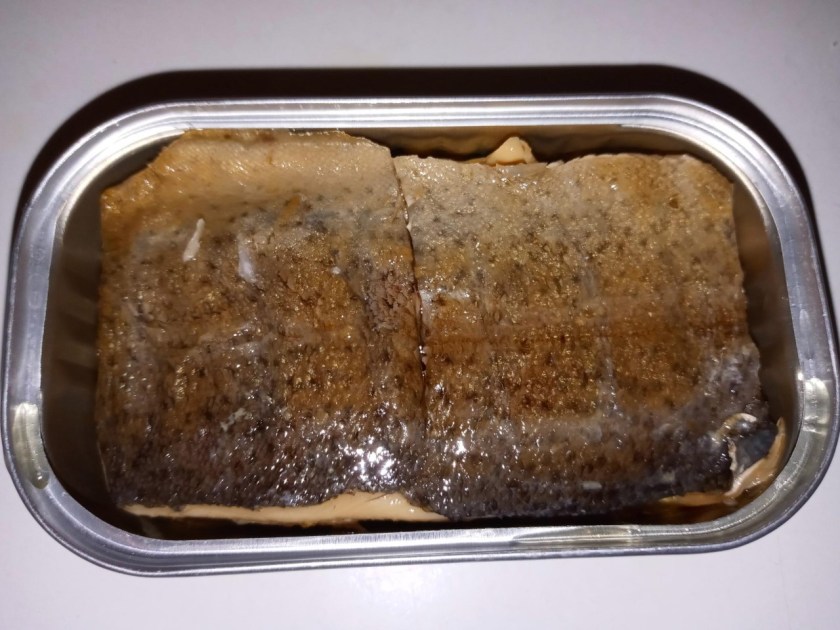
Finally, this isn’t a can of sardines at all, but rather Cole’s smoked rainbow trout that happens to be from Portugal, so I’m including it.  My wife loves trout, and I often pan-fry pecan-crusted (fresh) trout filets for her.  She does not share my love of sardines, but this is one of the very few canned fish she will actually eat.  It is absolutely freakin’ delicious, and I include it here to go along with the Portuguese theme, and to for the sardine skeptics who might be open to other tinned treats.  If any canned fish is going to win over the masses, this is the one. 

While the canned rainbow trout filet doesn’t look like much, it flakes apart beautifully, and it is tender and moist and lightly smoky, and not “fishy” at all.  Here is the before pic:

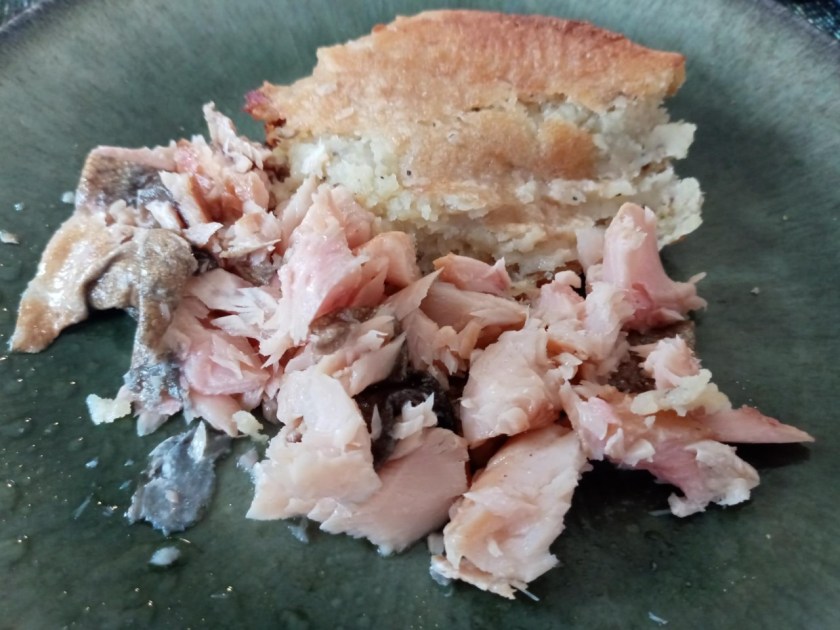
And the after pic is below.  I enjoyed this tin with a Gabila’s frozen potato  knish, thawed in the microwave and then heated until crispy in the toaster oven.  I usually use these frozen Gabila’s knishes as mustard delivery devices, as in my last Cutting the Mustard mega-review, where I went into more detail on the brand and its storied history.  But the knish went so well with the smoky, flaky, oily, rich trout, I refrained from adding mustard or any other condiments.  It didn’t need them.  Trout, trout, let it all out, this is the fish I can’t do without!

I worry now about the reports of the entire Portuguese sardine fishing industry being in danger, because they are such a major part of the Portuguese diet, as well as the national economy.  I always thought eating sardines was morally superior to consuming larger fish that are higher up in the food chain, but now it sounds like we all need to get used to cutting back.  The Monterey Bay Aquarium’s SeafoodWatch website even says Moroccan-caught sardines are a good alternative, but it is better to avoid Portuguese-caught sardines.  Of course, I started writing this ‘Dines List column well almost two years ago, and I fully admit I had no idea when I started.  I strive to sustain a sundry sardine stash at the Sabo-Shelter, but once I eat my way through those, I want to be part of the solution, not part of the problem.

The ‘Dines List 2: Mission to Morocco!

Believe it or not, even though we’re finally into October, it’s still hurricane season, so this lifelong Florida Man isn’t relaxing just yet.  I usually don’t let my guard down until we get to Thanksgiving, so I still have a huge stash of shelf-stable food on hand, including plenty of my favorite quick, easy, healthy, delicious household staple, tinned sardines.

I don’t know if my first installment of The ‘Dines List, the new ongoing Saboscrivner feature where I review canned sardines and other tinned seafood, was a rousing hit among my dozens of readers back in July.  Most people come here for restaurant reviews, but because I don’t go out to eat as often as everyone thinks I do, I bolster those with reviews of other foods I enjoy and want to spread the word about in recurring features like Grocery Grails, Tight Chips, Cutting the Mustard, and now The ‘Dines List.  But the truth is, I eat a lot of sardines.  I got into them when I was a poor student, but now that I make the medium bucks in the high-stakes, high-pressure world of academia, I continue to dine on ‘dines because they’re so healthy, they’re environmentally sustainable (especially compared to most other fish), they’re cheap, they’re versatile, and I just like them.  Plus, as a lifelong collector of things like comic books, action figures, and music, I appreciate that there are seemingly infinite varieties of sardines, so I love discovering and collecting new brands and flavors and sharing information about them.

My first ‘Dines List feature, “Canned Sardines 101,” was a rundown of some of my all-time favorite sardines, meant as a guide for the unfamiliar and the skeptical, to ease new ‘dine eaters into those briny waters and introduce them to the tastiest and least-intimidating tinned ‘dines I know of.  But since there are so many more sardines out there, future ‘Dines List installments are going to have themes to them, and this one is going to be about sardines from Morocco.

Why Morocco?  Perhaps the better question is why not Morocco?  Located in the northwestern point of the African continent, Morocco borders the Atlantic Ocean and the Alboran Sea, which is the westernmost edge of the warm Mediterranean Sea.  This geographical area, where ocean meets sea, has a long history of fishing and trading, and there are commercial fisheries all through the region.  Morocco is right across from Spain and Portugal, and plenty of tinned sardines are products of those three countries.  I’ll cover Spanish and Portuguese sardines in future installments, but it is worth noting that due to European Union agreements regarding fishing rights, many Spanish vessels fish for sardines in Moroccan waters.

The first Moroccan sardines I found were from the Titus brand, which most Asian markets around Orlando seem to carry.  These had a very cool-looking can.  I love how sardine can graphic design tends to be “old-timey,” like they’ve had the same artwork, fonts, and colors for decades, or even longer.  You’ll never see tins emblazoned with a cartoon fish shredding on an electric guitar while riding a skateboard and wearing sunglasses and a backwards cap, because there are no focus groups warning the sardine companies they need to be more “extreme” and “totally in your face.”  And that’s just fine, really.

But the ‘dines inside weren’t the prettiest.  This was after I drained the oil, but don’t worry, you didn’t miss much.   

I just threw these over some pasta and didn’t bother to take a picture.  They were okay.  I don’t think I would get them again, but of course I bought two cans of the regular Titus and two cans of…

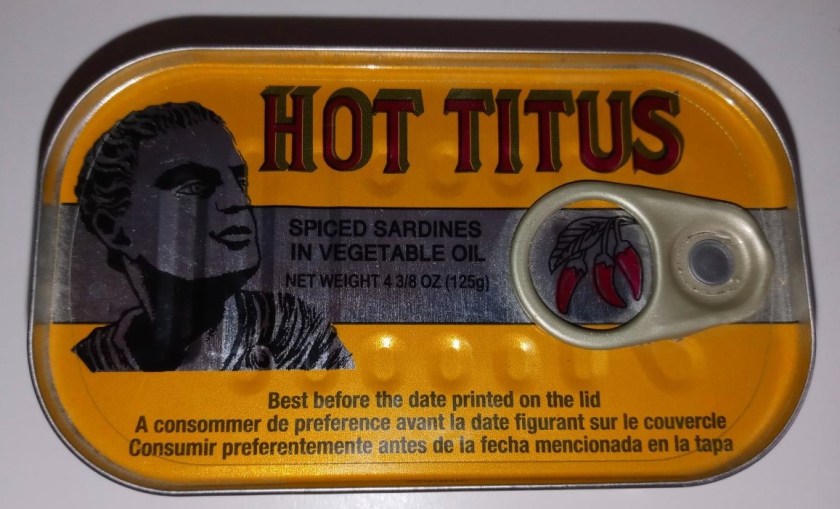
HOT TITUS!  I almost always gravitate toward spicy sardines, which are either packed in spicy oil or with some kind of hot peppers, or both.  They usually taste better than plain ones, at least to me.   

This can only included three large ‘dines, and in my experience, the bigger ones rarely taste as good as the smaller ones.  They tend to be drier and flakier in texture than smaller brisling sardines.   These Hot Titus ‘dines came packed with some very hot peppers (dry and full of spicy seeds) in addition to the bright orange spicy vegetable oil.

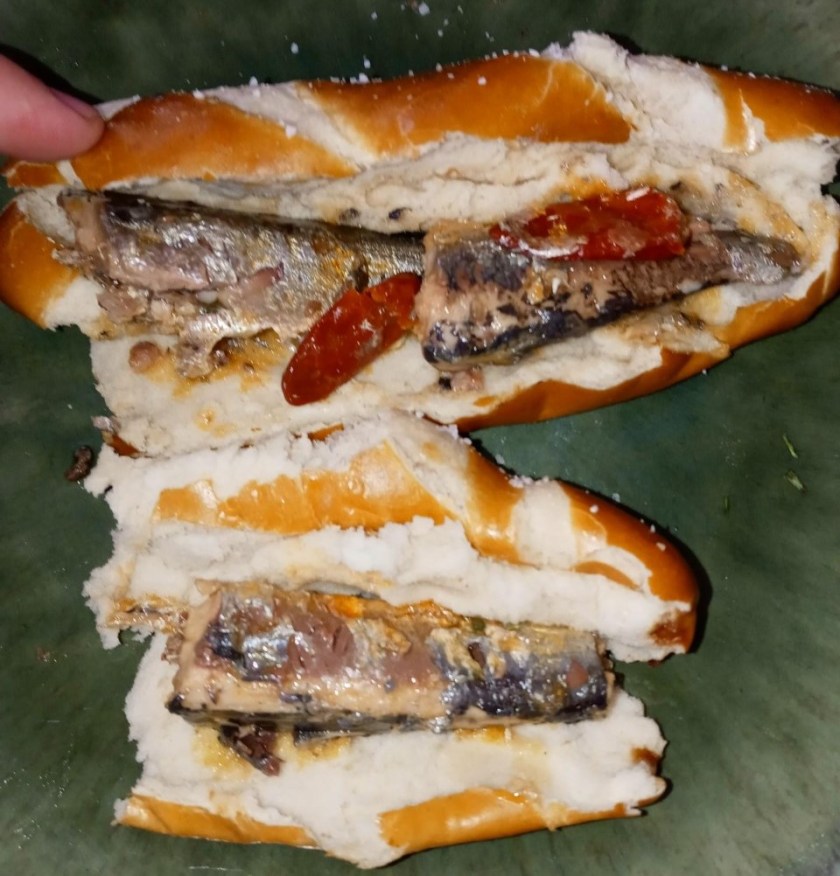
I made the Hot Titus ‘dines into one and a half sandwiches on delicious Deutsche Kuche soft pretzel sticks from my favorite grocery store, Aldi.  I pronounce the brand name “Douche Cooch,” because I am easily amused.  The pretzel sticks are imported from Germany, and I just bake them in the toaster oven at 350 for nine minutes.  They come out with perfect crispy, crackly exteriors and soft, fluffy interiors, ideal for salvaging sardines (or sampling mustards, as in my Cutting the Mustard feature from earlier this summer).I left off the condiments to get their full flavor… which wasn’t much to speak of, even with the two peppers they had been canned with.  I drained the oil, as I always do, but it didn’t impart much flavor either.  That could have been because it was vegetable oil instead of the superior olive oil.  A schmear of mustard and some fresh and pickled vegetables would have helped turn these into superior sandwiches, even with mediocre ‘dines, but I wanted the full, unadulterated Hot Titus experience.
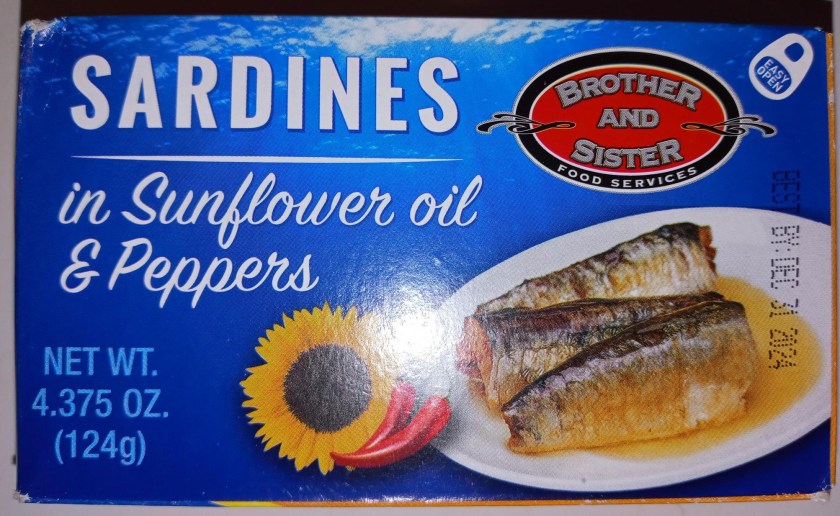
Earlier this year, I found these Brother and Sister sardines at Tima’s House, a Euro-Balkan grocery store in Longwood, which has some neat stuff.  I don’t think they would have cost more than $3, or I would not have bought them.  You don’t usually see sardines in sunflower oil, but I’m a mark for spicy ‘dines with peppers, so I had to try them.  Plus, they were from Morocco!

They were pretty typical-looking large sardines with dark skin, packed in a deep orange spicy oil that didn’t actually impart much flavor. 

I had these four Brother and Sister ‘dines over a simple salad, since I pack a salad in my lunches for work almost every day.  This salad looks like it was more simple than usual, since I just see lettuce and cucumber on it, but I probably splashed on a bit of a vinaigrette dressing.  They were okay.  I’ve made better salads and eaten better sardines, that’s for sure.  The little peppers aren’t very tasty, and they are full of seeds, so I tossed them after taking this picture. 

I don’t remember if I got these Baraka sardines at Tima’s House or at one of Orlando’s many Middle Eastern grocery stores.  Once again, they are products of Morocco, and they are packed in soy oil with chili peppers, so I was on board.  The price was definitely right on these, but sometimes you don’t want the absolute cheapest canned seafood out there. 

I instinctively drained the orange oil before taking this photo, so they weren’t just sitting in a completely dry can:

And I enjoyed them on some marble rye toast with a schmear of neufchatel cheese (like cream cheese, but low-fat, so the cheese and your life are both less enjoyable) and everything bagel seasoning.  The tin ended up having just three large sardines plus the long chili pepper that didn’t taste very good on its own.

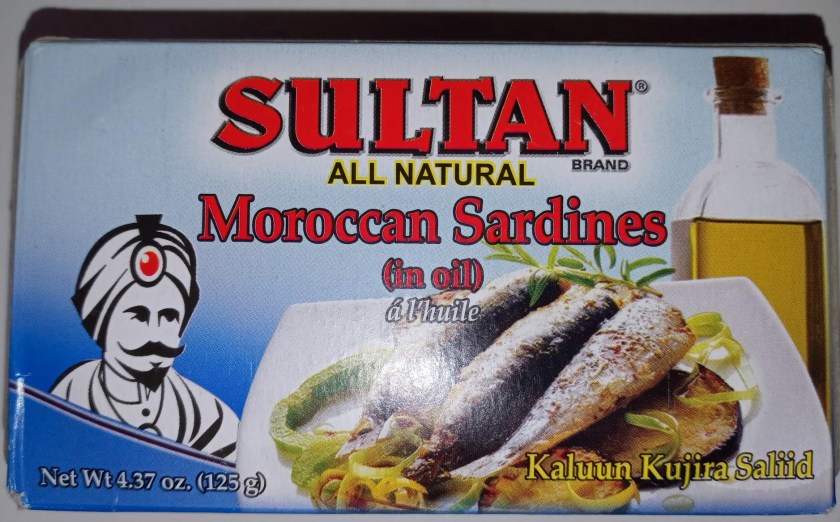
The next Moroccan ‘dines I tried were from the Sultan brand.  First I tried spicy Sultan sardines, in oil with chili peppers.  I believe I found these at the Walmart Supercenter, of all places, in the small Middle Eastern food section.  They were cheap, so I figured “Why not?  I’m already in Walmart.  How much worse can things get?”

They were pretty large ‘dines, as all the Moroccan ‘dines tend to be.

I had these on Ritz crackers (the BEST crackers for any purpose), with dabs of my homemade tzatziki sauce underneath each one — Greek yogurt, cucumbers, garlic, salt, and a dash of dill.  These spicy Sultans weren’t bad at all.  They were very meaty ‘dines, with decent flavor from the spicy oil and some subtle heat.  The chili peppers, as usual, were barely edible.  

I also bought a can of plain Sultan sardines at the same time, and my hopes for these weren’t as high, especially after the relative disappointment of the plain, non-hot Titus ‘dines compared to the Hot Titus.

These were even larger fish:

But I worked some magic, following a Sicilian recipe for pasta con le sarde, a dish that includes onions, garlic, fennel bulb, golden raisins soaked in wine, seasoned bread crumbs, the plain Sultan sardines, and pasta — in this case, some perciatelli, which is essentially the same as bucatini (long, hollow tubes).  Of course I didn’t have any wine to soak the golden raisins in since neither my wife nor I drink, so I just threw them in there unaltered, thinking the sweetness and chewiness would bring something nice to the experience.  It was a tasty pasta dish, especially with that fragrant fennel, which is a truly underrated ingredient.  But I felt like it could be better.

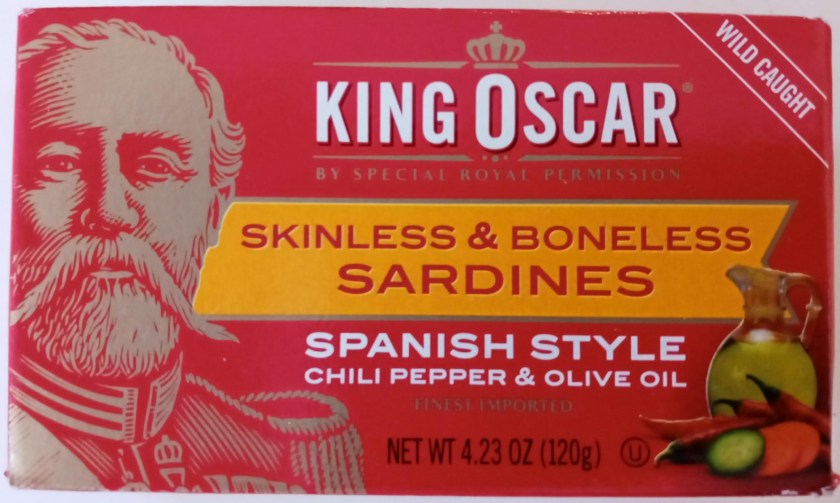
In my first ‘Dines List write-up, I sang the praises of Norway’s King Oscar brand, some of the best sardines you can buy in terms of quality, variety, and value.  King Oscars are readily available at most major supermarkets, and I mentioned last time that they are terrific “gateway sardines” for the uninitiated.  Most King Oscar sardines are products of Poland despite being caught in Norwegian waters.  However, these skinless and boneless Spanish Style ‘dines, packed in olive oil and seasoned with chili peppers and tiny slices of carrot and pickle, are products of Morocco, hence their inclusion here.

In that previous installment, I warned about avoiding boneless and skinless sardines.  That’s just a personal preference, but I felt obligated to try these for a more complete feature on the different varieties of Moroccan sardines.  These King Oscars are perfectly good sardines, but they never look right to me without the silvery skin.  And I think the bones add some interesting texture (plus calcium).

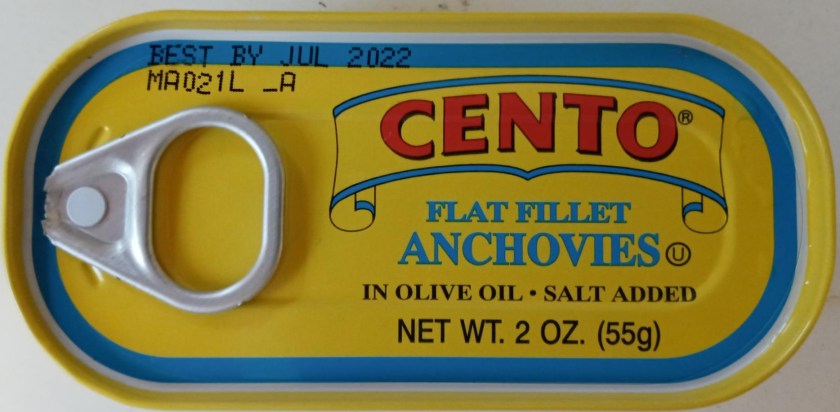
I decided to attempt pasta con le sarde again, to do something more exciting with these boneless, skinless ‘dines.  I started sautéing diced onions, garlic, and more of that awesome fennel bulb in extra virgin olive oil, then added a can of Cento anchovies, which I always stock up on at Trader Joe’s, because they are so good in recipes.  (They are also products of Morocco!)  I mashed up the salty anchovies and their oil in the aromatics and kept sautéing until the anchovies completely dissolved.  That added some saltiness and savory umami flavor, which is good because all boneless, skinless sardines are very mild.  (Although these Spanish Style King Oscars are the best boneless, skinless sardines I’ve ever tried, both flavor- and texture-wise.)

Once the aromatics were translucent and soft, I added sultanas (golden raisins) that I had been soaking in white wine vinegar as a substitute for wine, since I learn from my mistakes.  Then I stirred in the King Oscar ‘dines, their oil, and the tiny sliced vegetables straight out of the can, then some seasoned Italian bread crumbs and red pepper flakes, and let everything continue to sauté.  I tossed it all together with some al dente fettuccine pasta, threw some diced tomatoes on top, and boom: new and improved pasta con le sarde!  This was by far the better attempt, between the higher-quality King Oscar sardines that brought their own flavors, plus the can of anchovies, the red pepper flakes for some necessary heat, and the white wine vinegar-soaked golden raisins for sweetness and tartness.  I’ve never seen this pasta dish on a restaurant menu anywhere, but I am  obsessed with it now.

A long time ago, I bought a can of Alshark sardines from a Middle Eastern grocery store and thought they were pretty good, so I tracked down another can for the purposes of this review, since they are also Moroccan.  

This was the only sardine can I had trouble fully opening, but I was still able to get the four large ‘dines out.  

I ate them plain to really experience the flavor.  These were meaty and pleasantly spicy, moreso than any of the other so-called spicy ‘dines in this review.  I’d definitely get these Alshark ‘dines again.

Last but not least, I decided to try Wild Planet’s “Wild” white anchovies, another product of Morocco.  These are totally different from the salt-cured anchovies most people are familiar with, like the Cento anchovies shown above, which are one of my secret weapons when cooking.  These are more like typical tinned sardines than super-salty brown anchovy filets.  

White anchovies like this are popular in tapas dishes in Spain, where they are called boquerones.  I ate these straight out of the can after draining the oil because I had never had boquerones before, and they were okay.  Pretty plain and bland, like Wild Planet sardines I’ve tried before.  Despite the name of the company, there wasn’t much “wild” about their flavor.  Unfortunately I bought these at Costco, so I have four more cans to get through.  I will definitely jazz them up with more exciting recipes and serving methods to make them more interesting in the future.

So here ends our Mission to Morocco, the second of hopefully many ‘Dines List features right here on The Saboscrivner.  Expect to learn all about sardines from Spain, Portugal, and other parts unknown in the months (and years) to come, but at least I got this one out before hurricane season is over, just in case it inspires anyone to stock up on some sardines.

As always, stalwart Saboscrivnerinos, let me know what you try and if you like them or not, and if there are other sardines or tinned seafood you recommend.  I’m always happy to take requests and accept freebies, especially if any of you jet-setters travel to Europe, where grocery stores have mythical aisles of nothing but fancy tinned seafood.  But in the meantime, I’ll be on the hunt (or more accurately, gone fishin’) in Orlando’s many supermarkets and international grocery stores as a connoisseur of the canned, a professor of the preserved, the dean of sardines.

The ‘Dines List: Canned Sardines 101

“Born sinner, the opposite of a winner
Remember when I used to eat sardines for dinner”
–The Notorious B.I.G., “Juicy” (1994)

I’ve been putting this off for a long time, but we’re into July now, so for Floridians, hurricane season is starting to feel like a real, existential threat.  As I put the finishing touches on this piece, a tropical storm named Elsa is currently days away from our big, stupid peninsula, and I wish we could all just let it go, am I right?  But we don’t have that luxury.  We need to stock up on serious supplies and shelf-stable snacks in the days to come, so this is the right moment for my latest review.  Trust me.  If nothing else, it will be a deep dive into uncharted waters.  But it could just save your life!

Most of this food blog is dedicated to reviewing and recommending restaurants in and around Orlando, Florida, and my occasional travels out of town, which I look forward to resuming.  But how do most of us eat most of the time?  We buy groceries and prepare simple meals at home, right?  (I know, I know, your meals are not simple, how dare I?)  As much as I like getting takeout, and as much as I’m loving eating at restaurants again, I still do meal prep, pack lunches for work, and cook food in large batches so I can eat leftovers for a few days before the cycle repeats.  I enjoy the process of grocery shopping, even when every trip out of the house felt like putting on the ol’ hazmat suit and wandering out into the wild wastelands.  So last year I created a new recurring feature on The Saboscrivner called Grocery Grails, where I review some of my favorite supermarket and grocery store finds.  So far, Grocery Grails have covered potato chips (the recurring Tight Chips features), pickles, mustards, and ramen noodles.

And now Grocery Grails has a second spinoff (after the aforementioned Tight Chips), a fabulous, fantastic feature devoted to one of my staple foods, sardines — delicious and healthy, but also unglamorous and relatively intimidating for the uninitiated.  It’s a little feature I like to call The ‘Dines List, and it is a crash course in appreciating canned sardines and other canned seafood, which I collect and eat all the time.  I will use The ‘Dines List to demystify, review, and recommend sardines, since I consider myself a connoisseur of the canned, a professor of the preserved, a dean of sardines, if you will.  This isn’t the first sardine review blog out there — Mouth Full of Sardines and Society for the Appreciation of the Lowly Tinned Sardine are out there, fully dedicated to reviewing sardines, whereas this is just going to be a recurring feature here on The Saboscrivner, as a palate cleanser between my restaurant reviews, just like Tight Chips and Grocery Grails.

So here’s The ‘Dines List 101: my freshman feature on the best canned sardines out there.  Don’t get me wrong, there are some gross sardines on supermarket shelves, and those may have turned people off to the entire concept of tinned seafood.  Here are a few helpful hints to get you started with this sardine syllabus, just based on my own personal preferences:

  • Smaller sardines taste better to me than larger ones.  If you can find a can that advertises itself as “two layer,” “dual layer,” “double layer,” or “cross pack,” you have tinier fish, literally packed in like sardines.  Bigger fish that are packed two to four in a can usually don’t taste as good to me, although there are always exceptions.
  • Stick to sardines packed in oil.  Feel free to drain the oil (not down the sink!), but I guarantee they will smell and taste better than sardines packed in water, which even I don’t like.  The same goes for canned tuna, which I ate my entire life until I met my wife, because she hated the smell so much when I opened a can of tuna.  She doesn’t share my love of sardines, but at least the smell of an open sardine can never seems to bother her the same way.
  • I never like skinless and/or boneless sardines.  Don’t be afraid of the shimmering silvery skin or the bones.  Those ‘dines always taste better than skinless and boneless varieties, which are always blander, and their textures aren’t as pleasant.  The bones are usually removed anyway, but they are a good source of calcium.  And yes, sardine tails are so teeny-tiny, you can eat them with no problem.  Don’t worry — nothing is going to crunch in your mouth or get caught in your throat.
  • Really large, oval-shaped cans of sardines never taste that great to me.  You will often see these in the “ethnic foods” aisle in the supermarket, rather than with the rest of the canned meat and seafood.
  • I love spicy sardines, and there are a lot of terrific spicy varieties out there.  But as much as I love tomato sauce and mustard as ingredients in so many foods, I almost never like sardines packed in tomato sauce or mustard.  They are always watery and low-quality, imparting a funky flavor to everything (or more likely, attempting to cover up the funky flavor of the fish).  Add your own condiments and accompaniments!  Sardines are very much a blank canvas that allow you to get creative.
  • On that note, sardines are versatile, and you can do almost anything you want to them.  Personally, I like them best on some kind of bread or crackers or in a sandwich, but I definitely eat them straight out of the can sometimes, usually standing over a sink (dad-style) to avoid dripping the oil everywhere.  But you can put them on a salad, serve them over pasta or rice, and even mash them up and make “sardine salad” the way you might make tuna salad with canned tuna.  If you elect to preserve the oil, you might consider sautéing vegetables in it and mashing up some ‘dines for an umami punch (I do this with canned anchovies much more frequently), or even using it for a quick vinaigrette dressing.
  • Sardines are practically health food!  They are full of omega-3 fatty acids to help prevent heart disease, and they are pure protein, fantastic for a meal or a snack if you are trying to cut carbs.  Legend has it that my favorite actor, the great thespian Nicolas Cage, bulked up for the 1997 action movie Con Air while working with a trainer and eating nothing but sardines.  (Con Air is a fun ride, but doesn’t even make my Top Ten Nicolas Cage films.  Cage is at his best when he’s full Method and completely unhinged, but I digress.)
  • Being so low on the food chain and plentiful in wild waters, sardines are extremely ecologically sustainable and low in mercury, much moreso than larger fish like tuna, or farmed fish.  The Monterey Bay Aquarium has a lot of interesting and important information about choosing sustainable seafood.
  • Finally, while sardines have been dismissed as food for broke people and dads, apparently they are the “new hotness.”  I don’t know where you’ve been, but these days, hip bars and gastropubs like my friend’s Baltimore bar The Back Yard are serving up fancy tinned seafood, inspired by bars in Spain offering canned conservas on tapas menus.  They’re elegant!  They’re continental!  And if that don’t beat all, the fashionable website Nylon just named tinned fish “the hot girl snack of the summer.”  Well, I had no idea I’d be up on some hot girl shit, but I’ve always been ahead of my time (and mostly unappreciated as a trendsetter).

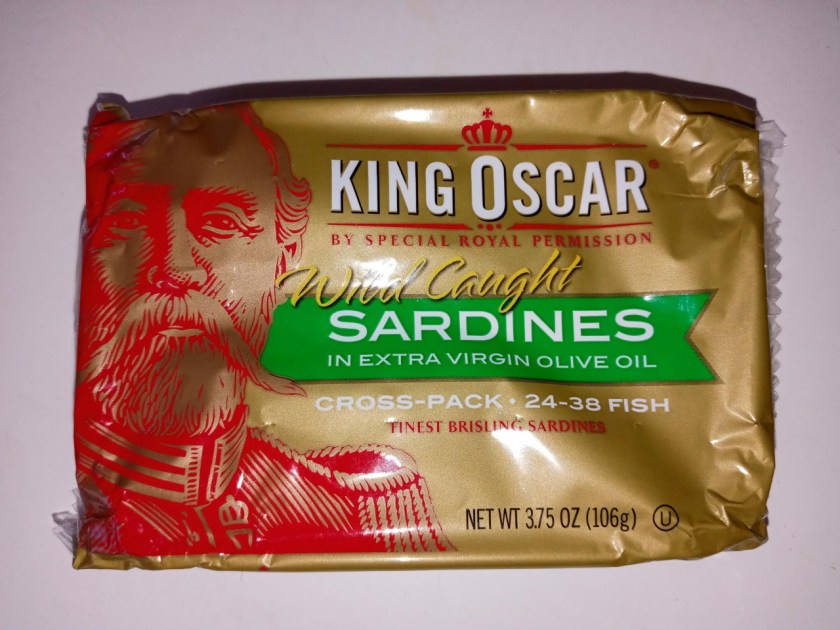
So since I’m highlighting personal favorites, I figured I’d start you out with the ‘dines that earn consistently high marks on my ‘Dines List: wild-caught brisling sardines from King Oscar.  The Norwegian company was founded in 1873, but has been using King Oscar II’s name and likeness “by special royal permission” since 1902, and exporting its delicious ‘dines to the U.S. since 1903.  King Oscar is known for its high-quality, sustainable sardines from Norway’s icy waters.  They market several varieties and flavors, and cans typically run between $2 and $4 at most major supermarkets, including Publix, Winn-Dixie, and Walmart.  You can find cheaper sardines from other brands, and some of them are also good, but many are not.

My favorite King Oscars are the two layer jalapeño sardines, which are actually packed in Poland since 2008.  They are easy to find, cheap, and delicious in anything, or alone.  I always have a huge stash of these at home:

They actually pack sliced jalapeños inside the can to impart their spicy flavor into the extra virgin olive oil and the ‘dines:

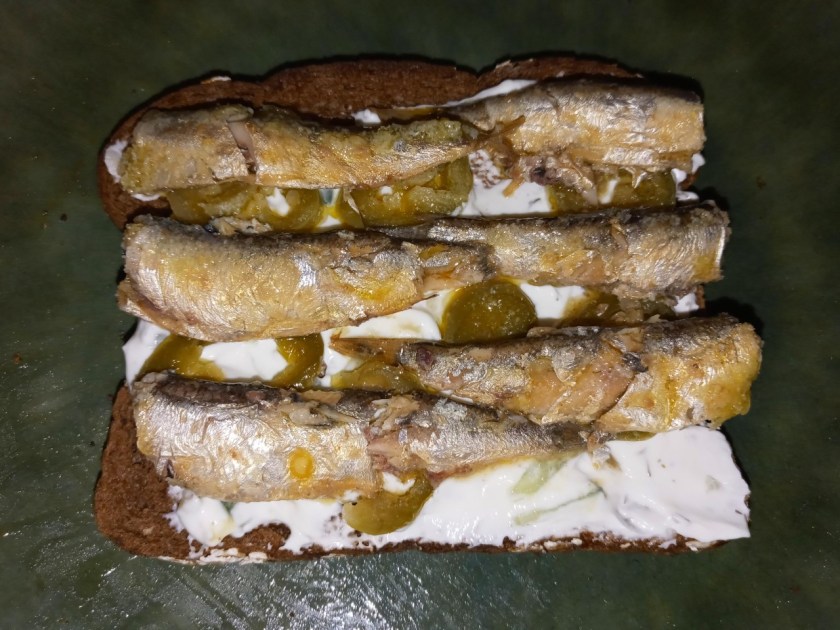
I enjoyed this particular can on some toasted Cheesecake Factory brown bread.  Did you know you can buy that bread as a sandwich loaf or a pair of mini-baguettes at Publix and Winn-Dixie?  I also spread on some homemade tzatziki sauce made with Greek yogurt, cucumbers, garlic, dill, and coarse sea salt.

Since I had more sardines left in this can but no more jalapeños, I made a second slice of toast with thin-sliced cucumbers.  Now I’m just waiting for some Boomer to complain about my sardine toast, but maybe they won’t find it as inexplicably offensive as avocado toast.

If you don’t like spicy, you can buy regular, plain two layer sardines, also packed in EVOO:

From a different day, here are King Oscar’s single layer Mediterranean style  sardines, also packed in EVOO and seasoned with herbs de Provence, red bell pepper, black olives, and garlic.

They weren’t kidding:

Here are some of these slightly larger Mediterranean ‘dines on toasted pita points:
I’m not a big fan of black olives, so I bought this can specifically to review here on The ‘Dines List.  You’re welcome!  I ate the whole can, though — olives and all, to get the full Mediterranean experience.

Next up, we have the King Oscar cross-pack, their smallest sardines of all.

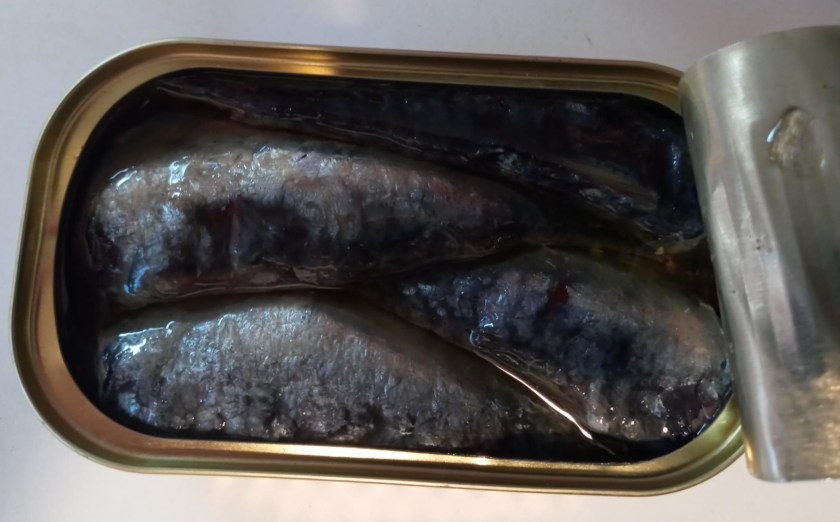
The can says it holds 24-38 ‘dines, and I counted 24 exactly.  Yes, there is an entire layer underneath the ones you can see here.
The cross-pack is usually about a dollar more expensive than the other varieties, but I don’t like them quite as much.  Don’t get me wrong, they are fine, and might even be a good “gateway” sardine for the uninitiated, but I just prefer the taste of the jalapeño two layer variety.  The cross-pack ‘dines are definitely blander, but you can include them in some really creative recipes and jazz them up that way.
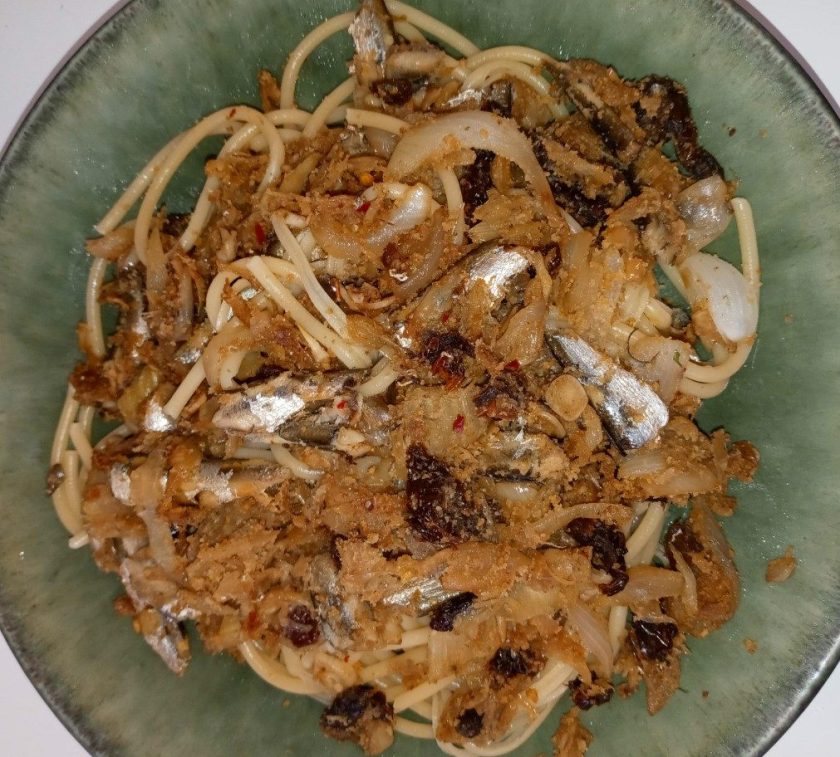
This was a dish I concocted recently — my own take on pasta con le sarde, with shaved fennel bulb, onions, garlic, smoked sun-dried tomatoes, raisins, chili flakes, Italian-seasoned bread crumbs, and King Oscar cross-pack sardines, all sautéed together in extra virgin olive oil and served over bucatini pasta.  It was damn delightful, and I will make it again for sure, maybe when I have golden raisins on hand in the future.

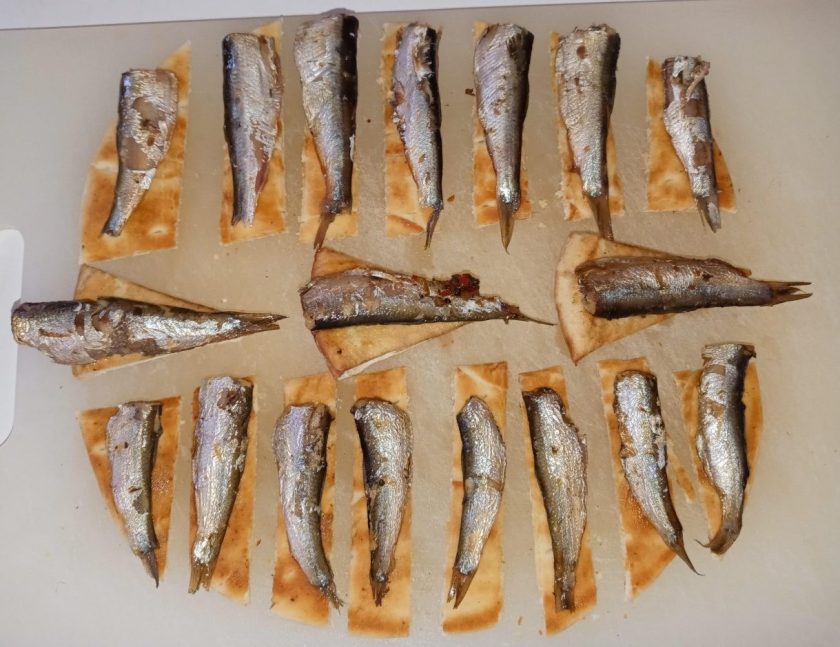
In the interest of really comparing and contrasting, dear readers, I opened three cans from my stash at once to take these comparison photos on pita strips I toasted until they were crunchy and firm.  The top row is plain two layer King Oscar sardines (exactly the same as the jalapeño variety, just minus the jalapeños), the three in the middle are the slightly larger one layer Mediterranean ‘dines, and the bottom row is the cross-pack ‘dines.  Funny, looking at them laid out on a cutting board like this, they really don’t look that different from each other!

Moving past King Oscars, I want to introduce you to some other good brands of canned ‘dines.  These are the only other kind I stockpile in our pantry, in addition to the King Oscar  jalapeño ‘dines.  They are from the Canario brand, and there is almost no information about this company on the Internet.  But I absolutely love their sardinillas picantes en aceite (“small sardines in oil spiced piquant”).

These Peruvian-caught fish have a rich, meaty flavor and consistency, and a pleasing amount of spice.  I only ever see these at Latin grocery stores, so I stock up whenever I’m at Bravo Supermarket or Fancy Fruit and Produce, both of which have multiple locations around Orlando.  Canario usually costs around $1.59 per can, so they are cheaper than King Oscar.  And I really, really like them.

Here are the Canario sardinillas on a soft, crispy, flaky paratha, an Indian flatbread that is like the beautiful love child of a flour tortilla and a croissant.  I spread on more of my homemade tzatziki sauce here to make a really delicious lunch.

Here is another serving of Canario ‘dines from a different meal, this time on rye avocado toast.  (Here come the Boomers, oh nooooo!)
DSC02706

Some of the most luxurious tinned fish I’ve ever found are Riga Gold sprats, which are very similar to sardines, but slightly larger.  These Latvian-caught fish have a terrific smoky flavor, taking on a golden glow from the smoking process.  The only places I’ve ever found them in Orlando are at International Food Club, a sprawling supermarket on L.B. McLeod Road, boasting food from over 20 countries around the world, and Tima’s House, a smaller Euro-Balkan grocery store in Longwood, much closer to home.  International Food Club in particular is such a fun place to shop, browse, discover new things, and treat yourself.

You can see that the round Riga Gold cans have a clear plastic pull-top to allow you to inspect the glorious golden sprats inside.  Da, tovarisch!  By the White Wolf!

I ate these on some leftover rye bread from The Pastrami Project, with more of that homemade tzatziki — something creamy and cool to cut the salty smokiness of the sprats.  It was an inspired combination.  Riga Gold sprats are really terrific, especially if you like smoked fish dip, whitefish salad, and other smoked fish delicacies.

I strongly recommend these sprats, even if you’ve tried sardines before and didn’t like them.  Especially if you’ve tried sardines before and didn’t like them!  If you like whitefish salad, that smoky Jewish deli delicacy made from golden smoked chubs, the Riga Gold sprats might fill that void, and you won’t have to pick out dozens of tiny, hair-thin, transparent, plastic-like bones while preparing it.

But if you don’t live close to a cool international market that sells Riga Gold smoked sprats, WALMART sells the Polar brand of smoked brisling sardines, which come in a very familiar, flat, round can with a clear plastic top, and they are also from Latvia!  Are they a repackaged version of Riga Gold?  They sure look and taste similar, they would be a heck of a lot easier to find, and for only $2 for a can, you can’t go wrong.

Here are the Polar sardines on rye-pumpernickel swirl toast, over thin-sliced cucumbers, and there is tarragon herb mustard (one of the seven mustards I reviewed in my first Cutting the Mustard feature) underneath them.  Despite being slightly smaller than the Riga sprats, these were very similar in smoky flavor, firm texture, and golden appearance, and I mean that in the best possible way.

Well hey there, sailor!  Congratulations!  You passed The ‘Dines List 101, a rundown of most of my favorite canned sardines.  I have no idea how this is going to go over, if I have somehow alienated my already small readership.  Most people dismiss sardines as stinky, funky, fishy, gross, and depressing.  Biggie Smalls sure did, and that guy loved to eat!  Remember Biggie’s breakfast of champions from “Big Poppa”: “A T-bone steak, cheese, eggs, and Welch’s grape!”  (Or did he mean “cheese eggs,” like the eggs are served with cheese on them?)  But again, I digress.

Some sardines are certainly better than others, but trust me — I’ve tried so many ‘dines over the decades, and I’m sharing the best ones with you here.  And by the way, why is “fishy” so bad when we’re talking about fish?  Frankly, I’d be a little disappointed and concerned if my fish didn’t taste fishy.  But for people who crave the mild, bland taste of white fish like tilapia, these oily little fellas have so much more flavor, they’re cheap, they’re sustainable, they’re good for you, they’re great to nosh on when hurricanes knock our power out (hopefully not this summer!), they’re currently making hot girls swoon, and you might be pleasantly surprised by how tasty they are and how creative you can get with them.  (The sardines, not the hot girls!  Okay, why not both?)

I promise that next week I’ll review another good local restaurant, but I definitely plan to continue The ‘Dines List right here on The Saboscrivner.  I have two more installments already partially written, and I’m taking care to try new ‘dines to review, rather than falling back on old favorites already covered above.  Readers, reach out if you have any review requests or recommendations for sardines and other tinned seafood.  If there are specific ‘dines or other canned fish you love, recommend, and would like to send my way to sample and review, challah at your boy!