GG Korean BBQ

GG Korean BBQ (https://ggkoreanbbq.com/) is an all-you-can-eat Korean barbecue restaurant located at 5319 West Colonial Drive in Orlando’s Pine Hills neighborhood.  I recently went for the first time with two good friends, including one of my inspirations as a food writer, the illustrious Amy Drew Thompson of the Orlando Sentinel.  It was the first time I ever got to meet her in person, and I’m sure I made a great first impression, stuffing my face with delicious Korean food that we cooked ourselves on the tabletop grill.

This was my second time doing all-you-can-eat Korean barbecue ever, after trying it with a friend at Hae Jang Chon in Koreatown in L.A. last year.  I was lucky to be dining with two sophisticated, experienced, worldly gastronomes who knew what they were doing much more than I.

GG Korean BBQ offers two options: $27.99 per person for the basic all you can eat experience (seven different fresh and marinated meats), or $39.99 per person for a more premium selection: 18 different fresh and marinated meats, plus two seafood options, shrimp and baby octopus.  I was curious about the expanded option, and my friends were both kind enough to humor me and go along with it.  Just FYI, your whole party has to choose the same option.

Many Korean meals start out with banchan, tiny plates of sharable side orders.  My favorite thing here was the slightly sweet and crunchy yellow pickled daikon radish slices on the bottom left.  I am not a fan of bean sprouts, so I left them alone, and as much as I have tried to become a kimchi fan (especially as a lover of sauerkraut and cabbage in general), it hasn’t happened for me yet.  I tried a customary piece but left the rest for my colleagues.  A sharp-eyed reader told me more about the yellow pickled radish: “The yellow pickle is called Takuan. It is a Japanese pickle that was invented in the 17th century by the Zen Buddhist monk named Soho Takuan. The pickle spread to Korea and very popular.”  Thank you so much, bkhuna!

Both dining choices come with a variety of other sides to choose from.  This was corn cheese — kernels of fresh corn heated over the grill with shredded mozzarella cheese, and probably some butter too.  It looked better when it was done, and it was a decadent hit at our table.

I really liked these japchae, savory translucent noodles made out of sweet potato starch, seasoned with sesame oil.  They had a nice al dente chew. 

We also tried the steamed egg side, but I didn’t get a good picture of it.

Here were three dips for our barbecued meats.  That was a seasoned salt on the left that accented the grilled flavors perfectly.  I really liked the sauce in the middle, and the one on the right had its own spicy charm.

When you go out for Korean barbecue, the group orders a few meats at a time.  Sometimes the server cooks them for you, and sometimes you get left to your own devices.  There can be a lot going on, so every group needs an experienced leader to make sure the meat is cooking but not overcooking, and that everyone has something ready to eat at all times.  When you’re all having a nice conversation, that can be distracting, but my friend stayed on top of everything for us.

This mixed grill included beef bulgogi on the bottom (a sweet and savory marinated meat that is a great “gateway” dish for folks who are unfamiliar with Korean cuisine), and I honestly don’t remember if the two long pieces of meat along the sides were beef rib fingers or pork belly.  I’m sure we got both, though.  That’s a thick slice of onion in the top right and some big slices of mushroom on the left — more for them!

Here’s a close-up of the beautiful, rich, marbled meat that was on top in the above photo.  I think this was ribeye, due to that lush, lovely marbling.

More meat!  Those off-white thingees on the right are large and small beef intestines.  I first tried those at an all-you-can-eat Argentinian-Jewish churrascuria restaurant in Altamonte Springs called Steak in the City, similar to the Brazilian all-you-can-eat rodizio concepts (like Adega Gaucha and Texas de Brazil).  Steak in the City closed abruptly over 15 years ago, taking my good friend and former roommate’s deposit for a wedding rehearsal dinner with them.  (Luckily, he paid with a credit card, so he was able to get refunded, but the restaurant folks disappeared into the night with his money.)   Anyway, the intestines (Steak in the City called them chinchulines) grill up with a crispy exterior, but they are mostly soft and chewy.  They don’t have a strong flavor, but I’d say they are worth trying at least once, if you’ve never had them before.  They would mostly take on the flavor of a marinade or dipping sauce.

Even more meat!  We were all losing steam by this point.
What do you think those thin, wavy, round slices of meat on the right are?

They were fresh beef tongue, sliced almost paper-thin.  As a Jewish person, I can’t go somewhere that offers tongue and not try it, whether it’s a Jewish deli, a Mexican taqueria, a Vietnamese pho restaurant, or in this case, a Korean barbecue establishment.  These slices grilled up to a nondescript brownish-gray color, so they looked a lot interesting here, before cooking.  But they were extremely tender! 

Anyway, I’m glad I went with two experienced, worldly gourmets who had done this before, because I trusted my one friend to do a lot of the cooking for us (he’s a team player and a tireless mensch), and I followed their lead.  It was a really nice lunch with two of my favorite people in Orlando, but here’s my hot take: I cook at home all the time (although I don’t grill because I don’t have a grill), but if I go out to a restaurant, I would rather rely on the chef to prepare food for me than have to do it myself.  Most of the time I go to restaurants these days, I either fly solo or bring home takeout to share with my wife, and you can’t really do Korean barbecue in either scenario, so it’s a moot point anyway.  I feel similar about hot pot places – fun with a group once or twice as an interactive activity, but maybe more trouble than they are worth.  But if you’re going to do Korean barbecue, especially with a good group, I think GG Korean BBQ would be a fabulous place to enjoy it together.

Walala Asian Noodle House

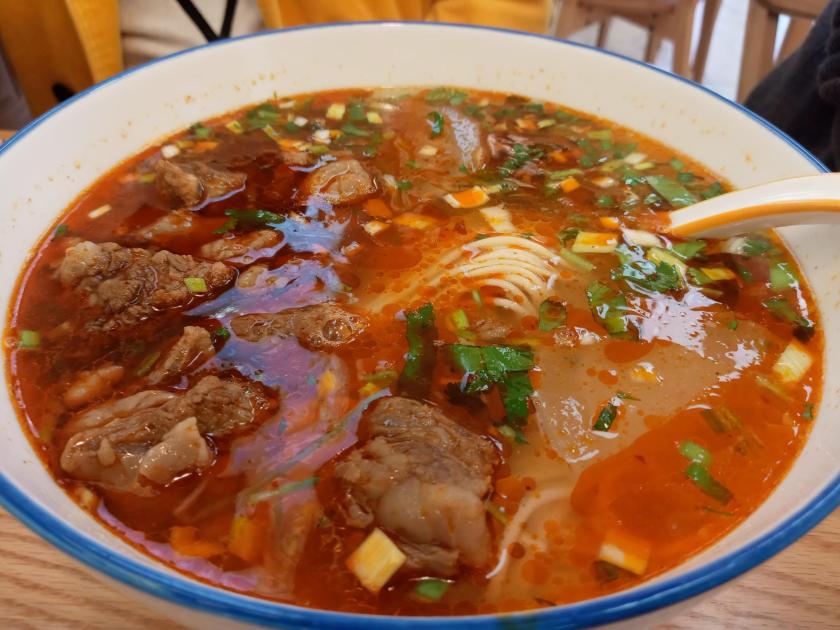
Earlier this year, I met two foodie friends at a relatively new restaurant in Orlando’s “Chinatown,” a huge plaza in Pine Hills on West Colonial Drive that is absolutely full of Asian-owned restaurants and other businesses, including Enson, a sprawling supermarket.  I’ve eaten at a few places in the Chinatown plaza and reviewed two of them, both of which have since closed.  But one that I know isn’t going anywhere anytime soon is Walala Asian Noodle House (https://walalaasiannoodlehouse.toast.site/), specializing in hand-pulled noodles in rich, beef-based soups from Lanzhou, China.  The noodles are called lamian, the term that gave us both Chinese lo mein and Japanese ramen.  Don’tcha love etymology?

Back in 2023, I visited and reviewed Mr. J’s Hand-Pulled Noodle in Ocoee, but I really preferred my meal at Walala.  Not only was it a lot closer to home, but everything had more flavor.  Of course, it helped that I went with two friends, and we shared everything.  That said, we all ended up with the same kind of long, thin lamien noodles, even though Walala also offers Japanese ramen (but there are so many good places for ramen already, especially my favorite, Ramen Takagi), Hunan-style rice noodles (which we all thought might be too similar to the familiar noodles in pho), hor fun noodles (I’m assuming wide, flat noodles like in beef chow fun or ho fun, even though hor fun cracked us all up), and they added knife-cut noodles  to the menu after our visit.

It was my choice to start with a tea-infused boiled egg for each of us.  I know, I know, in this economy?  But before eggs became a luxury good, I was experimenting with pickling eggs with different combinations of vinegar, herbs, spices, and other seasonings, and I enjoyed similar tea eggs at Mr. J’s.  (Anyone else reading that in the late Arleen Sorkin’s voice?  Seriously?  Just me?)  Just like at Mistah J’s, we had to peel the eggs ourselves, but these came pre-cracked:

Due to the cracks, they took on beautiful patterns from the tea infusion process:

We shared an order of rich, chewy pig ear slices tossed with spicy chili oil and fresh herbs, including lots of fresh, bright-tasting cilantro.  This is probably better than you are thinking.  They were cartilicious!

One of my friends got braised beef boneless short rib soup with the hand-pulled noodles.  I was tempted by it, because I love any braised meats and especially short ribs, but she let me try a piece, and it was an excellent choice.

Another friend, much more familiar with Lanzhou cuisine than the rest of us, ordered braised honeycomb tripe soup with the same hand-pulled noodles.  I enjoy some unpopular organ meats (give me all the liver, beef tongue, beef tendon, and chicken hearts you have!), but I’ve never developed a big appreciation for tripe, despite all the times it has ended up in my pho and I still eat it.  It’s a texture thing, but this tripe looked a lot different from the style most Vietnamese restaurants add to pho. 

I ended up getting the large sliced beef shank noodle soup because I love lamb shanks so much, and because this one also came with beef skewers on the side.  I couldn’t pass that up!  The meat was very tender, the broth was a little spicy and very unctuous from all the meat (including bones and fat), and the noodles were nice and springy and chewy.  Totally different consistency from Italian pasta or the rice noodles in pho.

Why didn’t at least one of us order a different kind of noodle?  The world will never know.  (But they also offer rice noodles and ramen, although you can get good-to-great ramen at so many other places.)

Anyway, Walala does something I’ve never seen a restaurant do before.  If you eat all your noodles but still have a lot of soup left, they will bring you another order of plain noodles to add back into your soup, and it’s free!  It almost sounded too good to be true, but two of us tested it.

And here are the heavily seasoned, slightly spicy skewers of slightly chewy beef.  These are individual cubes, not whole pieces, so it was very easy for us to share.  

Unfortunately, I didn’t get to try the Chinese pickles, but there are so many interesting things on the menu, including new knife-cut noodles they didn’t have on my initial visit (wider and flatter noodles, essentially shaved off the block of dough straight into boiling water, so they end up with beautiful fluted edges), a return trip can be easily justified.

So that’s Walala, although you’re probably hearing A LOT more about it, since it just received a prestigious Michelin recommendation at the recent ceremony last month.  I personally have more faith in my own taste and that of my friends, acquaintances, and mutual followers than a non-transparent process and anonymous reviewers from a tire company, but I am still thrilled for Walala and all the other local Michelin award recipients (see my recent reviews for others).  Regardless of my own skepticism and misgivings, those awards will drive more business their way, and I don’t begrudge that to anyone.  It’s one of the most unique Chinese restaurants in Orlando, and especially if you love noodles like I do, you must get over there as soon as possible.

CLOSED: Mr. J Hand-Pulled Noodle

EDIT: On August 11, 2025, Mr. J Hand-Pulled Noodle announced it has permanently closed.

***

A month or two back, I found myself in Ocoee, an area of West Orlando I never end up in, so I invited a work colleague who lives out there to meet me for lunch at Mr. J Hand-Pulled Noodle (https://www.mrjhandpullednoodle.com/).  I had heard lots of praise about the new Chinese restaurant, one of the only ones in Florida to offer Lanzhou-style hand-pulled noodles called lamien, served in halal Chinese Muslim beef noodle soup.  I was excited to try it, and so was my foodie friend.

Mr. J (which I can only hear in Arleen Sorkin’s New Jersey-inflected Harley Quinn voice) opened next to a Publix in a little shopping plaza at 1688 East Silver Star Road in Ocoee.  The sign for the previous restaurant, Crab & Wings, was still up when we visited.  It is a relatively small dining room, with are four tables for parties of four, three tables for parties of two, and a counter in the back with four additional seats (stools), where we sat.  You order at the counter, and they bring your food to you when it is ready.

There are eight different noodle shapes to choose from, all made by the chef-owner, Jiqing “James” Meng: flat, thin, small flat, normal, triangle, leek leaf, thick, and thicker.  I half-expected him to be putting on a show for the diners, pulling and twisting and whipping and winding noodles, like a scene out of Kung Fu Hustle, but all the action was taking place in the kitchen, out of sight.  You should definitely come to Mr. J for an awesome lunch or dinner, but don’t expect a show.  That was fine with us — it should end up getting hype and praise for the awesomeness and authenticity of the food, not for any kind of performative aspect.   

The Mr. J’s Hand-Pulled Noodle Soup ($15.95) was a clear, consomme-style beef bone broth that reminded me more of Vietnamese pho than the familiar wonton soup I have ordered countless times at countless Chinese restaurants in Orlando, Miami, and Gainesville.  I could not begin to identify all the herbs and spices that gave it its complex yet subtle flavors, but I know coriander and garlic leaves are involved.  It was not as spicy as I was expecting or hoping, despite knowing a bit of chili oil was in there, but that allowed me to focus more on the thin slices of tender beef and the perfectly soft and chewy “small flat” noodles I ordered.   

Here’s one of those noodle-pull action shots all food bloggers try to do.  I always try to be a cool man of the world and eat my noodle soups with chopsticks, but that just means I splash my shirts, no matter how cool I try to look.  The noodles were much softer than Italian “al dente” pasta, and because they are made with wheat flour, they were also softer than the rice vermicelli in bowls of pho.  But even when I couldn’t finish all of mine and took some home, they kept their shape and firm, springy chewiness.  Note the thin slice of crunchy white daikon radish in the bowl with all the diced leeks, a nice addition.

I figured the noodle soup would not travel well, so I also ordered stir-fried hand-pulled noodles to go ($16.95), to share with my wife at home.  This dish included more of the sliced beef, stir-fried with either “thick” or “thicker” noodles.  I chose “thicker,” because I love ’em thick, and the only thing better could be thicker.  Onions, green and red bell peppers, tomato, and even pumpkin (according to the menu) are stir-fried in the mix too, although I admit I couldn’t identify the pumpkin in with all that other goodness.  The red sauce was tangy and mildly spicy, and it was topped with fresh cilantro.This was another tasty dish, but I would definitely advise first-time diners to go with the soup if they are dining in, if they have to choose between the soup and the stir-fried noodles.  The soup is definitely the house specialty, and it is the most unique dish.  You also have more noodle shape choices if you go with the soup.

I neglected to take a close-up, but in the background, you can see the tea eggs I ordered for my colleague and I to try ($1.50 each), since I had never had a tea egg before.  They were delectable hard-boiled eggs dyed a rich brown hue from tea once we shelled them, and they took on some of that unique flavor.  I eat hard-boiled eggs a lot at home and in my boring work lunches, and the tea eggs inspired me to do more exciting things with them in the future, like this.  There were also “thousand-year-old eggs” on the menu, another kind of egg I’ve never tried before, but I figured I would not push my luck.

Like I said, I am never this far west in Orlando, so I have no idea when I will return to Mr. J, so I’m glad I tried everything I did when I did.  If you make it to Ocoee more than I, you owe it to yourself to try it for yourself.  Chef Meng is a master of his craft, elevating noodles to an art form.  I can safely say you have never tried noodles like these or soup like this in Orlando.  Even though it feels like 2023 has skipped spring and gone straight to summer, get some of his beef noodle soup with these fresh, hand-pulled lamian noodles before it gets even hotter out there, and don’t let the heat and humidity stop you even in the epicenter of August’s armpit.

Caribbean Shack, formerly known as Vindi’s Roti Shop and Bar

EDITOR’S NOTE: As of mid-March 2023, I learned that Vindi’s Roti Shop and Bar has changed its name to Caribbean Shack.

***

After discovering the delicious new world of West Indian food with my review of Singh’s Roti Shop earlier this year, I craved more.  The Trinidadian and Guyanese flavors were similar to Jamaican dishes I had always loved, with with some Indian influences too.  After posting my review of Singh’s on the Orlando Foodie Forum on Facebook, a lot of people recommended Vindi’s Roti Shop and Bar (https://www.facebook.com/VindisRotiShopAndBar/), formerly known as Annie’s Roti Shop, located at 805 S Kirkman Road, Suite 106, Orlando, FL 32811, mere minutes away from Singh’s on Old Winter Garden Road.  I visited Vindi’s a while back and ordered a bunch of different dishes to sample, enough for three or four meals, so I could compare and contrast them.

First of all, since Vindi’s doesn’t have a menu online or paper menus to take with you, I took photos of the menu screens on their large TVs:

I ordered:

An oxtail meal ($14.50), which comes with stewed potatoes, curried chickpeas called channa, and a choice of either rice or a choice of huge, fluffy, soft flatbreads called roti.  My trip to Singh’s clued me in to the two different kinds of roti, so I chose my favorite, the “buss up shot,” like a big, chewy paratha, named for the “busted-up shirt” it resembled when torn into pieces to scoop up the tender stewed meat and vegetables.  Because my wife and I both loved the buss up shot so much at Singh’s, I ordered a second one for $3.

The buss up shot, which unrolls and unfolds to become an absolutely huge blanket of soft, fluffy wonderfulness:

This was the boneless curry/stew chicken meal ($10), also served with stewed potatoes and channa.  I love Jamaican-style brown stew chicken, which is usually cooked until tender with the bones, but this chicken being boneless made it easier to scoop up with roti.  This is after I transferred it to a microwavable plastic container for later.  I realize it might not look appetizing in this photo, but it smelled so delicious and tasted even better.

I decided to go with the other roti variety with this meal, the dhal puri, which is more of a golden color and stuffed with seasoned chickpea particles that add texture.  I can’t seem to find that photo, but it looked very similar to the dhal puri I got at Singh’s and photographed in that review back in March.

Vindi’s came highly recommended for its doubles ($1.50), a beloved Trinidadian street food with channa sandwiched between two fried paratha-like patties.  This doubles had a slight sweetness to it, and I liked the flavor and texture even more than Singh’s version of the doubles.

A peek inside the doubles:

Similar to how saltfish is a popular breakfast food in Jamaica (and the national dish when served with a local fruit called ackee), Vindi’s serves smoke herring as a breakfast dish, stuffed into a fried bread called fried bake (sometimes “fry bake” or just “bake”).  I am all about smoked fish at any time of day, whether it’s delicate, luxurious sable on a bagel, whitefish salad on a bialy, saltfish with ackee or stuffed into a golden fried patty, or even good sardines or sprats out of a can.  I loved this fried bake with smoke herring ($6.50), which was mashed up, served warm, and mixed with some spicy vegetables.  I ate half for lunch and half for dinner, but I can only imagine it would be a breakfast of champions.  The thing on the left above is an extra plain fried bake ($2) that I ordered for my wife, since I knew she wouldn’t be into the smoke herring.

I also got two aloo pies ($2 each), one for me and one for my wife — a soft, fluffy fritter stuffed with seasoned mashed potatoes.  It was very good, and very similar to the aloo pie I tried at Singh’s.  I couldn’t tell any major difference between the two.

Finally, I got a Solo brand cream soda for myself, and a Solo sorrel drink for my wife.  (Solo is a Trinidadian brand, and these were $2.50 each.)  I asked what sorrel tasted like, and a helpful guy waiting in line next to me said it tasted like hibiscus.  My wife loves jamaica (hibiscus-flavored) aguas frescas from Mexican restaurants, so I knew she would appreciate that.  I tried a sip, and it had an aftertaste that included cloves and possibly cinnamon — not my thing, but she seemed to like it.  The cream soda reminded me a little of a bubble gum flavor, maybe banana, possibly cotton candy, but it didn’t have the vanilla flavor I’m used to from American cream sodas.  But don’t get me wrong, I liked it, and I’m glad I tried it.  I’m trying really hard to drink less soda, but I always like to try different root beers, cream sodas, and orange sodas.

Anyway, Vindi’s Roti Shop and Bar was awesome.  I can’t tell you if it is better than Singh’s, but I loved both, and I’d be a regular at both if they weren’t so far across town.  My recommendation, whether you’re familiar with the delicacies of Trindad and Guyana or not, is to visit both Singh’s and Vindi’s on the same trip to compare and contrast similar dishes, since they’re so close to each other.  Singh’s has the West Indian takes on Chinese food to set itself apart a bit, but both restaurants serve up the standard West Indian dishes.  They are delicious and ridiculously cheap, for the quality and quantity of food you get.  It has been a while since I went to Vindi’s and wrote the bulk of this review, so I think I’ve inspired myself to schlep out there for a return trip very soon.  Maybe I’ll see you there… except I probably won’t recognize you, since hopefully you’ll be masked, and I definitely will be.

Tight Chips: Asian Potato Chips, Part 1: Savory Flavors

Orlando is a diverse and inclusive city with a huge Asian-American community, which means we are lucky to have so many terrific restaurants and markets representing our Vietnamese, Chinese, Japanese, Thai, Korean, Filipino, and Indian neighbors and their cuisines. Most of our Asian markets are located along Colonial Drive, with good ones on both the east and west sides of downtown Orlando. They are treasure troves of ingredients you can’t find at Publix and other mainstream American supermarkets, along with high-quality produce, meat, and seafood that are often cheaper than anywhere else. And of course, the snacks alone are often worth the trip.

My readers know I often review potato chips and other snacks as Tight Chips features, so this is the first of what will surely be several write-ups of potato chips with unique flavors from the Asian markets.

I chose these particular chips to review here because they are all savory flavors: various meats, chicken, and egg-flavored chips.  And please note that I tried these and wrote down my opinions over the course of several months, rather than ripping all the bags open and gorging on them in one sitting, as soon as I got home from the market.  

Salted egg-flavored chips have a bit of a fan following, so I had to try these salted egg Lay’s from Thailand.  I believe I found these at Eastside Asian Market in East Orlando.   

They were salty and eggy (mostly a yolk flavor).  I don’t know what else I was expecting, but this was the only flavor that had a lot of built-up hype ahead of time.   

The salted egg flavor above was much better than these other egg-flavored Lay’s, which were more of a thick, ridged chip (kind of like “Wavy Lay’s” and much thicker than Ruffles).  These had a strong and very dry egg yolk aroma and flavor.  I wouldn’t bother getting these again, and I even forgot to take a photo of the actual chips, so I guess the yolk was on me.

I must have gotten these Roasted Chicken Wing Lay’s on the same visit to New Golden Sparkling Supermarket on West Colonial Drive in Orlando’s Pine Hills neighborhood, because they are the same thick, ridged style, and I also forgot to take a photo of the open bag.  They were savory and salty,  containing “chicken powder” and “chicken oil,” but I detected soy sauce more than anything strongly chickeny.  I think I just don’t care for the thicker texture of these kinds of ridged “Wavy” Lay’s.

I couldn’t resist being lured in by this eye-catching bag design, only to discover this was Lay’s Mexican Chicken Tomato flavor.  Now I’ve enjoyed plenty of Mexican dishes that included chicken and tomatoes among the ingredients, but I don’t automatically match them up in my head.  These were definitely more tomatoey than chickeny, and disappointingly not spicy at all.  

So which came first, the chicken-flavored chips or the egg-flavored chips?  I have no idea, but that sounded like a Scott Joseph joke, now that I’ve written it out.  

These next Lay’s chips have a braised pork flavor.  The bag has a picture of a bearded fellow who looks like most of the guys you see in comic book stores, who usually have strong opinions about nerdy topics and demand to be heard.  This is the logo of Formosa Chang, a Taiwanese restaurant chain that began with a single food stall in a market, but now has 30 locations in Taiwan and a few in Japan as well.  Just like Lay’s did some co-branding with American restaurants last year, with flavors inspired by their signature dishes, they must have worked out a similar deal with Formosa Chang for one of their more popular dishes.   

Braised pork sounded like a really great savory chip flavor, and I love the Taiwanese food I’ve tried at Mei’s Kitchen and Ms. Tea’s Bento, both in East Orlando.  But these were pretty bland and unmemorable.  I would love to try the real version of this dish from a Formosa Chang restaurant.

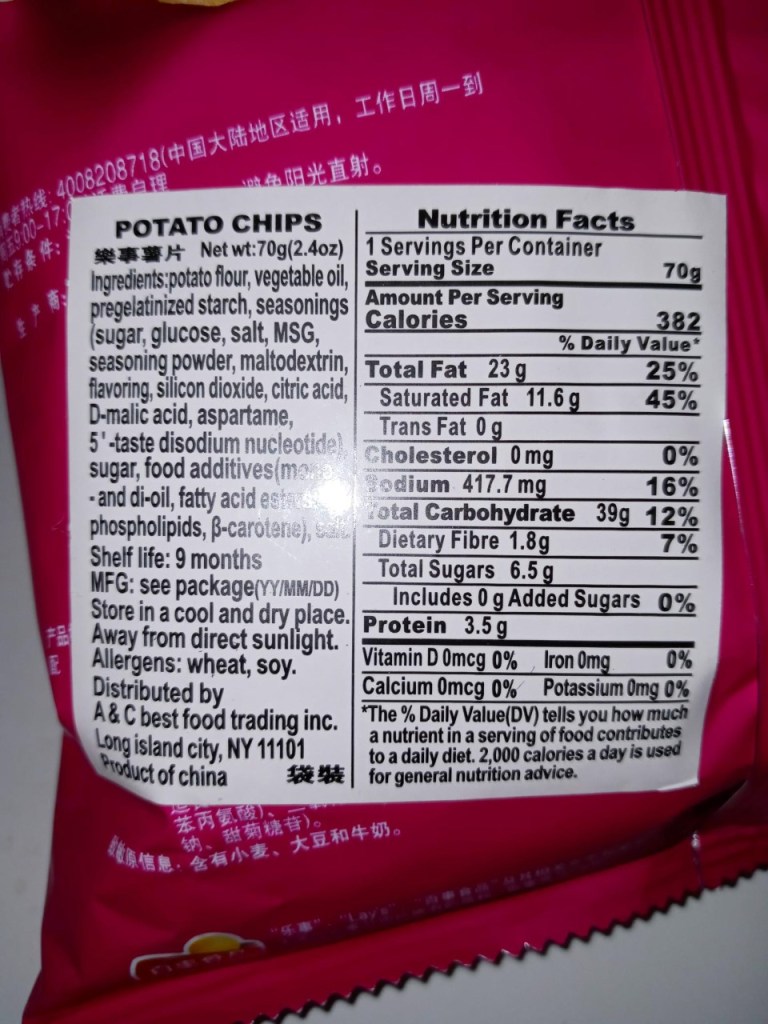
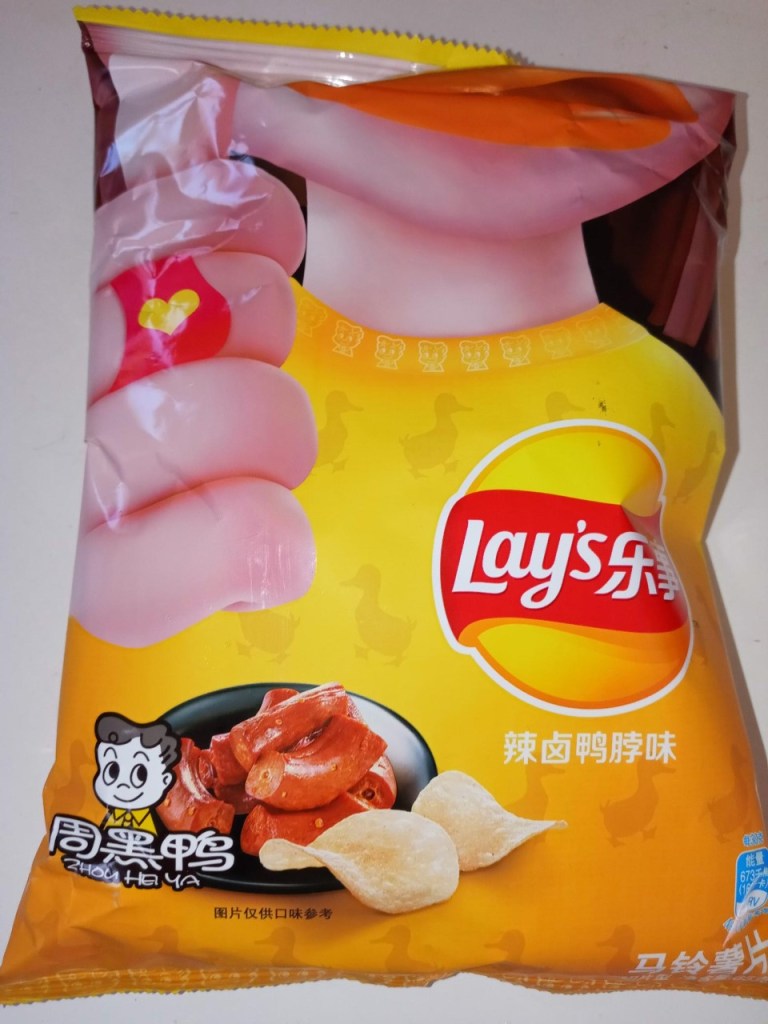
I didn’t even look at the label on the back of this bag of Lay’s until I got them home, but even though I was expecting some kind of sausage flavor from the look of the image below, this is a “spicy stewed flavor.”

Once again, this was a nondescript flavor, and look at how light they went on the seasoning on these chips!  They didn’t even taste spicy, and I was looking forward to feeling some kind of burn.  

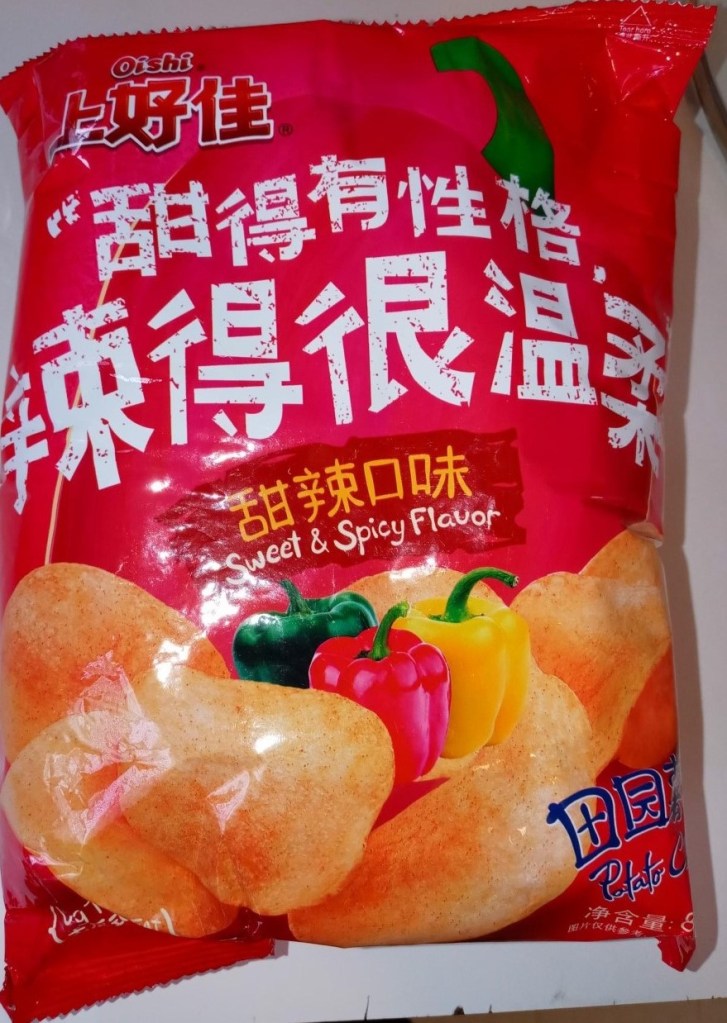
I have finally moved past Lay’s for now, to review two chips from Oishi, a very good snack company based in the Philippines.  Oishi products always have good, strong flavors.  These are sweet and spicy potato chips that did not disappoint, after most of the above Lay’s flavors did.

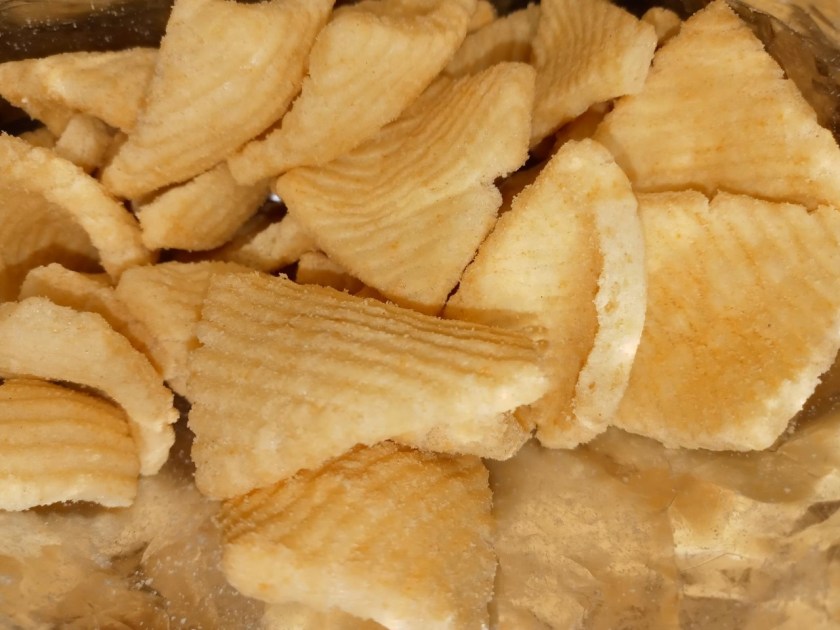
Oishi is much more liberal with the seasoning!

And finally, these are Oishi “Ribbed Cracklings” (ribbed for her pleasure?), which are salt and vinegar flavors, or as I always call them, “salty vinnies.”  These are not potato chips, since they are made of wheat flour and tapioca starch.  They also aren’t pork rinds, despite being called “cracklings,” but they are not vegetarian because they contain fish sauce.  

These are AWESOME.  I saved the best for last because they have a terrific texture — crispy but not crunchy, sort of airy, kind of a middle ground between crunchy Cheetos and puffy Cheez Doodles, if you will.  If you’ve ever tried shrimp chips from an Asian market, it’s the same kind of texture.  They are addictive.  And if you love vinegar as much as I do, they are really intense with the vinegar powder, giving them a powerfully pungent, puckery punch.  If you don’t already like salt and vinegar chips, definitely spare yourself some torture!  But if you do, face it tiger, you just hit the jackpot.  

Don’t worry, folks — I’ll publish a new restaurant review next week, but I like to pepper in the Grocery Grails features from time to time to keep things interesting, including the spinoffs Cutting the Mustard (mustard reviews), The ‘Dines List (canned sardine reviews), and Tight Chips (snack chip reviews).  I swear I don’t go out to eat as much as you probably think I do, but I sure love grocery shopping and discovering interesting new foods at the store.  

Caribbean Sunshine Bakery

Jamaican food is one of my favorite kinds of food.  For many years, I was loyal to the Golden Krust location in East Orlando, and that’s because it is awesome.  But when I started branching out, I discovered Mark’s Jamaican Bar & Grill last year, and that was pretty good too (even if they left the roti I paid for out of my order; I have a long memory).  My most recent Jamaican discovery is Caribbean Sunshine Bakery, a restaurant with two locations in west Orlando and one in Winter Garden.  I have paid two visits to the location on West Colonial Drive and John Young Parkway.

I was surprised to see they had multiple small restaurants on the inside: the Jamaican place (the main attraction) taking up the left side of the space, and small soul food and Haitian restaurants off to the right, along with a T-shirt shop.  I went straight to the thatched hut to place my order, then waited for it along the left side, so I didn’t get to check out the menus of the Soul Food Cafe or the Haitian restaurant.

But since the website listed on the door and the website listed on the paper menu are different, and neither work, I took the liberty of scanning the paper menu:

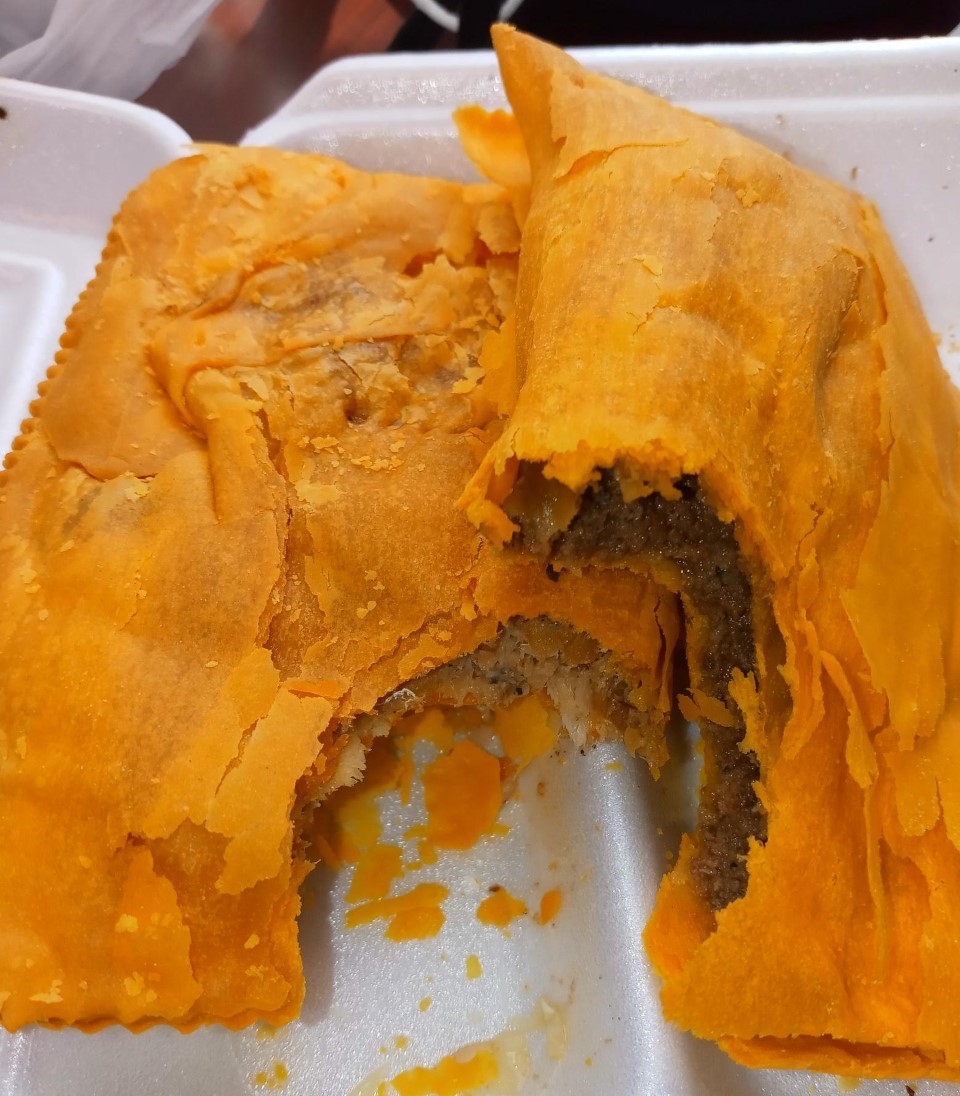
I always love spicy beef patties, but that’s what I almost always get.  I even have a frozen Golden Krust spicy beef patty in my freezer right now!  So when I saw Caribbean Sunshine Bakery offered a salt fish patty ($2.35), I had to try that.  First I asked for an ackee and salt fish patty, to represent the national dish of Jamaica, but they were sold out of those.  I’m glad they still had regular salt fish patties available when I got there in the afternoon, since that is traditionally a Jamaican breakfast dish.  Because Caribbean Sunshine is a bakery, I decided to get my patty wrapped in coco bread ($1 additional) to try their version of the soft, fluffy bread.  Carbs on carbs!

The crispy golden patty had a nice flakiness and tasted very fresh.  The fish inside was suitably salty, surprisingly smoky, and seasoned well with some red pepper — maybe pimiento?  It wasn’t spicy, for those who fear Jamaican food might be too spicy for them.  This sandwich, laden with carbs, salt, and grease, had a nice blend of textures, and everything was fresh and delicious.  Salt fish patties, where have you been all my life?

This is the large oxtail meal ($11.95), served over rice and peas with steamed cabbage, sweet fried plantains, and a round fried dumpling with the very festive moniker of festival.  Oxtail and maduros are two of my favorite foods in the entire world, together or separately, and these were awesome.  I wish I could cook rice and peas and cabbage like this!  The rice has the slightest coconutty flavor, and I wish I could duplicate the magical recipe that most Jamaican restaurants use at home.   

I almost never order jerk chicken, but I don’t know why that is, because I feel more comfortable eating meat when I know the animal had been a jerk.  Also, I usually prefer brown stew chicken, but I asked the friendly woman at the counter which one of the two she recommended, and she said to go with the jerk.  I didn’t want to be a jerk after asking for her recommendation, so I went for it.  This was another large meal ($11.95), and it was great.  I forgot to specify I always prefer dark meat chicken, so I was disappointed to see breast meat when I got it home.  But even though some restaurants overcook their white meat chicken, this was very moist, tender, juicy, and full of incredible flavor.  The jerk seasoning had a little bite, but wasn’t overwhelmingly spicy at all.  I loved it.   

I returned to Caribbean Sunshine about a month back, to pick up lunch for myself and three co-workers.  One woman ordered the jerk chicken I enjoyed so much last time, and two others ordered the brown stew chicken.  This was a small brown stew chicken meal ($9.75), with rice and peas, cabbage, and festival:I traded a piece of my jerk pork for a piece of her brown stew chicken, and all three of us who tried it agreed how good it was.

Oh yeah, the jerk pork!  I ordered a small meal ($10.85) and really liked it.  There were a few large bone fragments to pick out, but the meat was so tender, it was easy to pull the bones out cleanly, with no shreds of meat sticking to them.  Never mind the chicken wing on top of the cabbage in the picture above — you won’t get that in a jerk pork meal unless you trade some food with your friend.

I had to get another salt fish patty on this takeout trip, but this time I also tried my old standard, the spicy beef patty ($2.35).  These are much larger patties than you get at other Jamaican restaurants, convenience stores, and random Cuban restaurants and pizzerias.  You can tell they are made fresh here at Caribbean Sunshine Bakery.  After taking this first taste, I ended up eating the patties the next day.  They were still nice and flaky after a quick trip through the microwave.  (Not at work; I don’t microwave fish at work because I am not a sociopath.)  The salt fish was nice and smoky like last time, and the beef patty was quite spicy, which was what I hoped for.  It made my tongue tingle for a while afterwards!

I really love Jamaican and Caribbean food, and I’m glad to discover new restaurants around Orlando all the time.  If you haven’t been to Caribbean Sunshine Bakery, definitely make a special trip to one of the three locations some time.  The West Colonial one is directly across the street from Lotte Plaza Market, the sprawling Asian supermarket that houses another one of my favorite restaurants in its food court, the Filipino-American fusion restaurant Taglish.  That whole stretch of West Colonial Drive has some of Orlando’s best Caribbean and Asian grocery shopping and dining options, so don’t sleep on it, even though it isn’t a toney or touristy part of town.  You’ll be missing out on some real shining gems, like Caribbean Sunshine.

Singh’s Roti Shop

It’s not every day I get to try a whole new regional cuisine, but my first visit to Singh’s Roti Shop (https://www.facebook.com/SinghsRotiShop/) on Old Winter Garden Road, just east of Kirkman Road in West Orlando, was my first experience eating Trinidadian and Guyanese food.  Trinidad and Tobago is a small dual-island country in the southern Caribbean Sea, just off the northern coast of South America, while Guyana is a slightly larger country in the north of the South American mainland, directly east of Venezuela.  The two countries are relatively close, geographically, and both have similar demographics, with large Indo-Caribbean populations who influenced their culinary cultures.

I was so excited to make the schlep out to Singh’s for the first time, and I loved all the West Indian delicacies I brought home.  The closest I’ve come to this cuisine is Jamaican food, which is one of my favorites.  Many of the dishes at Singh’s were familiar to me from Jamaican menus, but the flavors here were somewhat different, and often spicier.  But Singh’s food also had a strong Indian influence, and then they even had an entire Chinese menu with West Indian takes on familiar Chinese dishes.

The menu is not available online, so I scanned their paper menu.  Right-click these menu images to open larger images in new tabs.  When you enter Singh’s, you will see illuminated menu signs above the counter.  I took pictures of those too, but I think it will be easier to read this printed menu.

This was the stew oxtail meal ($15.50).  I can’t go to a restaurant with oxtail on the menu and not try it!  It is one of my favorite meats, and one of my favorite dishes, period.  Each culture prepares oxtail a little differently, but usually stewed or braised to break down all that wonderful collagen for some of the most tender, unctious meat.  This oxtail was spicier than the Jamaican-style oxtail I’m used to, which is savory but also a little sweet, in a darker sauce.  I loved this hotter, redder regional variation!

And this was the curry duck meal ($13.50).  It was a very generous portion of bite-size pieces of duck stewed with potatoes and some chick peas in a thick, rich, very spicy curry sauce.  I love duck almost as much as I love oxtail, so when I saw it on the menu, any thoughts of other meats went out the window.  The duck was so tender, it was very easy to pull the bones right out.  I wonder if it was cooked in a pressure cooker.  This was probably a mild curry, but it was noticeably, pleasantly spicy by my standards. 

Note on the above menu that main entree meals come with either roti or rice, and they way I see it, the place is called Singh’s Roti Shop, not Singh’s Rice Shop.  I’m sure the rice is good, but you can also get rice almost anywhere, and roti is something you would probably love if you haven’t tried it before.

This is the dhal puri, one of two kinds of roti that you can choose with the main entree meals, or you can order it separately for $2.50.  It is a huge, round, chewy, golden blanket of dough stuffed with seasoned ground chickpeas.  If you unfold the whole thing or tear off a piece, be really careful to avoid causing a messy shower of fine chickpea crumbs.  I made that mistake the first time I ever ordered a roti at the Jamaican restaurant Golden Krust, so I moved a little more gingerly as I tore into this one. 

But because I am a bit of a rube, I didn’t even realize there was a whole other kind of roti, listed on the menu as the paratha buss up (also $2.50 if you get one a la carte, or included with a meal).  The name comes from “buss up shut,” West Indian slang for a tattered, torn, “busted up” shirt.  I think I accidentally ordered the dhal puri with the oxtail meal and the paratha buss up with the curry duck meal, which was a lucky break.  If I had known what I was doing, I’d place the exact same order.  The paratha buss up was even softer, fluffier, and chewier than the dhal puri, but equally gigantic when unfurled.  But this was a little more buttery and less “earthy”-tasting than the dhal puri — more like a cross between really soft and fresh Indian naan and a puffy, fluffy Mexican flour tortilla.  Here it is after my wife and I had torn it up a little — a buss up shot of a buss up shut.

The top item on the plate below is a fry bake ($2), a breakfast offering that is warm, soft, fluffy fried dough, much like Native American fry bread, and very similar to the batura I enjoyed so much at Rasa, an Indian restaurant I reviewed months before it closed last year.  I would have also ordered some smoke herring to go with this, but breakfast hours were over, and they were all out!  The fry bake would have also been delicious drizzled with honey and cinnamon for a dessert, like a giant sopapilla, but that would be a bastardization of this wonderful, simple treat.  But to be fair, it’s so good and such a perfect blank canvas that it would go well with anything, savory, spicy, or sweet.  The pastry below it is an aloo pie ($1.50), a soft fritter that is stuffed with spiced mashed potatoes.  Both of these were a little greasy, but very tasty, with great textures — the lightest outer crispiness but so perfectly fluffy, soft, and warm on the inside.  These were my wife’s two favorite things I brought home.

Here is a separate aloo pie split down the long way and stuffed with tender and spicy curry beef ($4.50).  I chose the beef after getting oxtail and curry duck in the main meals, but the nice folks at Singh’s let you choose whichever meat you want!  This could be a terrific option for visitors wanting to maximize the things they can sample on a single visit — a few aloo pies with different meats. 

This is a doubles ($1.50), a popular Trinidadian street food dish of curried chickpeas called channa, served as a sandwich between two soft fried flatbreads called baras.  Baras are direct descendants of South Indian vadas, another fried bread I tried for the first time at the Hindu Society of Central Florida’s cafeteria in Casselberry.  The classic doubles costs only $1.50, and most people in front of me in line were ordering several of them.  Indian food aficionados might have noticed this is similar to the South Indian dish chole poori, another lesson in how immigration and diaspora inspire regional recipes. As much as I love foods made out of chickpeas, particularly falafel and hummus, I’ve never been too keen on plain old chickpeas, because my mom used to buy cans of them, and I hated that texture and the slippery, goopy liquid they were packed in.  These curried chickpeas in the doubles were so flavorful, and had a good soft texture too, like well-cooked beans.

I brought home a doubles with meat ($4.50) as well, choosing chicken as the meat option, so we could sample yet another meat too.  That photo didn’t come out looking very appetizing, so I spared you, but I assure you the chicken was tasty!

Finally, this is a piece of macaroni pie ($3.50), very much like a baked macaroni and cheese casserole that uses long bucatini-like noodles.  I wish it was a little cheesier and gooier, as I always do with baked mac and cheese dishes that crisp up the cheese too much on top and aren’t cheesy enough all the way through, but I’m glad I tried it too.

Singh’s Roti Shop doesn’t have a working website at the moment, but the address is 524 Old Winter Garden Road, Orlando, FL 32811.  The phone number is 407.253.2900.  You have to go!  I just wish I had gone sooner, but hopefully I have demystified the basic menu options for first-timers.  Once again, I recommend a new visitor try the doubles and the aloo pie because you can’t go wrong for $1.50 each.  They would be perfect vegetarian snacks, and then you can order more with different meats for $4.50 each.  And you absolutely can’t miss the two kinds of roti — the dhal puri and the paratha buss up — for $2.50 each.

Plenty of people around Orlando have probably been fans of Singh’s for years and years, but it is one of my favorite recent discoveries.  I’m always a late bloomer, but better late than never!

Bread & Co. / Nakada’s Kitchen

Bread & Co. (https://www.facebook.com/breadncokitchen/) is a Korean bakery that serves Korean and French-inspired breads, sweet and savory pastries, and other baked goods.  It opened in the spring of 2019, and my wife and I were overjoyed on our first visit.  Similar to the French-Vietnamese bakery Paris Banh Mi, that early incarnation of Bread & Co. had long shelves and tables teeming with beautiful baked goods, and you were encouraged to grab a tray and some tongs, to grab whatever you wanted and bring them to the cashier to be rung up.  Everything was quite affordable, mostly in the $2-$4 range.
DSC02048DSC02051DSC02052

This is what we picked during our first visit.  The large round pastry was mostly savory, but the cream cheese in the middle had a slight tangy, citrusy sweetness to it.  The other crust was very soft, and I liked it a lot.DSC02056
I believe the pastries on the left were financiers, and one might have been almond, and another might have been maple.  The shell-shaped pastry that is second from the top left was a madeline, which my wife always loves.  Bottom right is a red bean doughnut.  I wish I remembered exactly what that slice was, but I think it contained blueberry compote and had a subtle, tangy, creamy topping.

The inside of the red bean doughnut:
dsc02058.jpg

That Milkis beverage tastes like a liquid version of those strawberry candies that elderly people always seem to have, but I never see them actually sold anywhere.DSC02057

Back home from that first visit from mid-2019, with even more goodies they were kind enough to throw in as samples.  The round ring on the left was similar to a stollen, and the two buns along the top had a peanut butter-like top crust but were harder rolls on the inside (and not sweet).  The yellow round bun in the middle was called a crayon bun, and it was very fluffy, with a moist, buttery top and a hollow center with onions baked into it, like a bialy or an onion schnecken roll.  dsc02059.jpg

Winter Park and Orlando were struck with sadness when the location on Fairbanks suddenly closed for remodeling later in 2019, but I was thrilled to discover a second, smaller Bread & Co. location inside the awe-inspiring Lotte Market, the huge pan-Asian supermarket on West Colonial Drive and John Young Parkway.  Lotte Market is the home of the Filipino-American fusion resturant Taglish, among others, in its excellent food court.  Since I started making the haul out to Lotte in West Orlando, I’ve returned to that Bread & Co. to purchase the best white sandwich bread ever, which is perfect for grilled cheese sandwiches.  It is simply called sandwich loaf, and the ingredients are flour, egg, sugar, butter, milk, powdered milk, malt, and RICE WINE!dsc02704.jpg

There is another, larger loaf of bread available for sale that is even better: a milk loaf that contains flour, sugar, butter, milk, yeast, malt, and salt.  It is similar to brioche, soft and rich, and it makes OUTSTANDING French toast and equally awe-inspiring grilled cheese sandwiches.

This is a small Japanese cheesecake, which was marked down to $5 on the day I tried it.  DSC02684

This cheesecake had more of a fluffy, bread-like texture than the richer, creamier cheesecakes I’ve had (like from Publix, Cheesecake Factory, or the best of them all, Junior’s), and it was much less sweet than all of the others.  I’ve always heard it described as “jiggly,” but this one didn’t jiggle.  It was a nice little treat, but I probably wouldn’t get it again.  It’s just not my kind of cheesecake.

Well, the larger Bread & Co. in Winter Park finally reopened in January 2020 after some renovations, so I recently returned to see what changed and to finish this long-overdue review.  I’ve popped in there twice in March: once on my way down to Miami in early March, to bring milk loaves and sandwich loaves for my family and best friend down there, and made another trip more recently, in the midst of coronavirus panic, to pick up lunch and some sweet snacks to go.

Since the remodeling, Bread & Co. has decreased its pastry offerings from what they used to have, but they still have many of people’s favorites from before.  Check out that gorgeous (mislabeled) tiramisu cake in the top left!DSC03037

DSC03038

I’m the guy who doesn’t care for macarons, but if you like them, here’s your place:DSC03039

DSC03040

DSC03041

But even better: since the remodeling and reopening, they have added a menu of Japanese food from Nakada’s Kitchen, a Japanese restaurant set up as a new part of the bakery.  By the time I visited this weekend, all local restaurants have temporarily transitioned to offering takeout food only, and they were no longer serving tempting-looking ramen or udon noodle bowls.  Luckily, they were still offering several intriguing sandwiches, and I picked one of the best things I’ve eaten in a long, long time: the menchi katsu sandwich ($8), a panko-crusted and fried meatloaf sandwich on a soft bun, served with finely-shredded cabbage on top.
DSC03042

This was a perfect sandwich, perfect for allaying worry and dread and filling my mouth and heart with joy for a few valuable minutes.  The textures of this thing were unreal.  I already love meatloaf — I make a damn fine one, and I’ve enjoyed great versions from Se7en Bites and The Coop — but wasn’t sure what to expect from Japanese meatloaf.  I should have expected greatness.  I’ve also read that menchi katsu is sometimes a Japanese version of a hamburger, but panko-breaded and fried.  However, this has a lot more seasonings than your average burger, as well as a softer and “spongier” texture, making it more meatloaf-like to me.  The breading was light and crispy, and the bun was surprisingly soft and simple.  It just worked so well on every possible level.  Pure comfort food, and it even came with a generous order of tasty fries that were still warm by the time I got home, and ketchup that was slightly spicier than your typical Heinz, but definitely not adulterated with sriracha (I am NOT a fan of that ubiquitous hipster hot sauce).
DSC03043

I also picked up a beautiful-looking onion bread (the big thing with cheese in the middle; $3.99), and a small custard tart similar to the egg tarts I’ve enjoyed at Peter’s Kitchen China Bistro.DSC03046

I’m so glad Bread & Co. is back in Winter Park, and now with Nakada’s Kitchen serving up Japanese food too.  If the rest of their offerings are as impressive as my menchi katsu sandwich, they have a hit on their hands.  Now we just need the world to get back to normal to fully enjoy things, but at least they are serving takeout in the meantime.  Please stop by and give them some of your business, because they are friendly and nice people, and we need carbs to get through the coming weeks.

I got restaurant reviews in the Orlando Weekly again!

For the third year in a row, I was honored to submit some of my favorite dishes of the year to the Orlando Weekly, which got published in its final issue of 2019:

https://www.orlandoweekly.com/orlando/the-eight-best-orlando-dishes-of-2019/Content?oid=26523651

It was an even bigger honor for my picks to be mixed in with favorites of the Orlando Weekly’s regular food writer Faiyaz Kara, who is my favorite food writer in Orlando, period.  They didn’t credit who wrote which ones, but I had three contributions, all from longer reviews I wrote on The Saboscrivner this year:

  • The Nashville hot chicken sandwiches from Swine & Sons.
  • The paccheri amatriciana pasta from Sette.
  • The pork sisig over garlic rice from Taglish.

This means the world to me, to see that some people have actually responded to my food writing, enough so that I can even reach beyond this blog.  I especially want to thank the Orlando Weekly‘s tireless Editor, Jessica Bryce Young, for offering me these opportunities.

And here are links to my favorite dishes from 2018 and 2017, also published in the Orlando Weekly.

CLOSED: Taglish

EDITOR’S NOTE: Taglish closed its Lotte Plaza Market and East Orlando locations in late October, 2022.  Its final location in Sanford closed December 31st, 2022.

***

Taglish (https://www.taglishfl.com/) just soft-opened a few weeks ago, and it quickly became one of my favorite restaurants in Orlando.  “Taglish” is clever shorthand for Tagalog, the main language of the Philippines, and English, and the name fits perfectly, because Chef Michael Collantes envisioned it as a Filipino-American fusion restaurant.DSC02696

Located in the small-but-bustling food court of one of my new favorite foodie destinations in Orlando, Lotte Plaza Market on West Colonial Drive and John Young Parkway in West Orlando, Taglish has filled a void that many of us didn’t even realize was there — an introduction (for many foodies) to the delicious flavors and textures of Filipino food.  Filipino restaurants are still rare in most parts of the country, especially here.  But since Taglish announced its soft opening, I’ve been twice so far, a week apart, and I fantasized about returning that whole week in between.  On my first visit, knowing Taglish opened at 11 AM and wanting to beat the rush, I arrived around 11:15 and barely had to wait in line at all.

The first thing  you might notice upon lining up are the four drinks served in “bubblers”: ube horchata, strawberry hibiscus, cucumber pear, and mango calamansi lemonade.  (The lady in front of me in line moved a bag at the exact wrong moment to cover that last sign, but trust me.)  Drinks are $2.70, except for the ube horchata, which is $3.95.  But you can always make any meal into a combo for $4, which includes a drink (plus a nominal upcharge if you want the ube horchata, which you probably will).DSC02694

On my first visit, I chose the ube horchata.  Ube is a purple yam that is popular in Filipino desserts, and horchata is one of my favorite drinks to order with Mexican food: a rice milk often flavored with cinnamon and vanilla, perfect for cutting the heat of spicy dishes.  It was thick and rich and sweet, but not overwhelmingly sweet.  Having no experience tasting ube before, it reminded me of the vanilla-scented taro milk tea my wife always orders at Vietnamese restaurants and Asian tea shops, right down to the similar shade of lavender.  dsc02680.jpg

Although the dish I ordered wasn’t spicy at all, it was one of the tastiest, most satisfying meals I’ve eaten anywhere, in a long, long time.  I asked Barbara, the extraordinarily friendly and welcoming cashier, what she recommended, because everything sounded interesting, and she recommended I try the sisig ($9.50) — a dish of crispy pork pan-seared in garlic, tomato, onion, and jalapeno, served over rice (I opted for garlic rice instead of the regular white rice), topped with a poached egg and a drizzle of garlic mayo.  I made it into a combo for an additional $4, to include the above drink and two lumpia, crispy pork-stuffed spring rolls served with sweet chili sauce for dipping (just out of frame).DSC02681

Constant readers, I can’t sing the praises of this sisig dish nearly enough, or in enough detail to honor the fictional definition of the term Saboscrivner.  It exceeded my every expectation in the best possible way.  I splashed on a bit of spicy vinegar from a glass bottle in a small condiment area next to the cash register, and that spicy sourness just brought out all the strong, rich flavors even more.  The perfectly poached egg ran richly over everything, and the bits of tomato, onion, jalapeno, and garlic added the slightest spice.  I would eat this dish every week if I could.  I felt like I was floating afterwards, and I surely bored my wife and a few acquaintances raving about it for days after the fact.  I even e-mailed Chef Collantes to gush about how much I enjoyed it, and he was kind enough to take time out of his busy schedule to write me back.

By the way, you give them your phone number when you place your order, and they text you to come pick up your food on a tray when it’s ready.  This could get precarious later in the day when every seat in the food court is taken, so I encourage you to arrive with friends, or make some once you get there!

Well, after that auspicious first visit, I returned a week later, on another Saturday.  Unfortunately I got to Lotte Plaza Market around 1:30 PM that second visit, so there was already a long line at Taglish — great for them, and only the most minor of annoyances for me.  But good word has been spreading, and I only hope to spread it further.

Barbara even remembered me from the previous week, and I remembered her second-place recommendation from when she suggested the sisig.  As much as I loved it, I had to try something new, for the sake of the Saboscrivner’s subscribers.  So I ordered the chicken adobo burrito ($8.95) — a thick burrito stuffed to the bursting point with classic Filipino dish chicken adobo (also served as a bowl over rice), garlic rice, fried potatoes, and stewed mung beans, wrapped in a large flour tortilla and almost defying the laws of physics.  It was outstanding!  So many flavors, textures, and even colors to appreciate and explore.
DSC02699

This was a perfect example of a fusion dish, and I loved it.  My only regret is very minor — I might have been able to analyze each component better and savor the ingredients if I had ordered this as a bowl over rice, instead of wrapped in the lightly grilled tortilla.  For example, I’ve never had monggo (stewed mung beans) before, and I still can’t really describe it, since it melded together with everything else in the burrito.  But it was all fantastic!DSC02701

But as long as I was there, I had to try something else that has always caught my eye on the menu: the longaniza burger.  Longaniza is a Filipino pork sausage that is a little bit sweet, often eaten as a breakfast meat (if I’m not mistaken).  Here, the homemade longaniza sausage was crafted into a burger patty and served on a soft, buttered, grilled bun (possibly a King’s Hawaiian roll), topped with a slice of grilled pineapple, garlic mayo, and a salad of sweet, tangy, vinegary, pickled, shredded papaya called atchara, which I loved.  DSC02702Note the two included lumpia and the serving of crispy seasoned potatoes, which stayed warm and crispy throughout my meal.  I got another small cup of sweet chili sauce, but next time I will request banana ketchup for the fried potatoes, just because I love dipping sauces and condiments — especially new and unfamiliar ones.

Close-up on the slaw-like atchara, which I would love to buy a jar of and put on everything.  I really like vinegar, and I am drawn to Filipino cuisine because vinegar is such a common and important ingredient.  Also dig that wonderful grilled, buttered bun.  I wish everyone who served burgers, dogs, and sandwiches would take a lesson from this.DSC02698

A cross-section.  The slight crispiness of the atchara really balanced out the softer ingredients (the bun, grilled sausage patty, and pineapple slice).  DSC02703

On this second visit, I paid $4 for the combo again (dig the lumpia above), and tried the refreshingly tart mango calamansi lemonade.  Calamansi, also known as the Philippine lime, is a small citrus fruit used in a lot of Filipino recipes.  I had never tasted it before, but my research tells me it’s a hybrid of the kumquat and mandarin orange.  Plus, I already love mangoes in anything, and I’ll always drink lemonade when it’s an option.
dsc02700.jpg

This time, I was lucky enough to meet the amiable Chef Collantes, shake his hand, and tell him in person how wonderful his food is, and how friendly, patient, and helpful his staff is.  He is the former Culinary Director of Bento, a small, local chain of pan-Asian restaurants I have been a big fan of since the first one opened in Gainesville in 2003, the last year I lived there.  I’ve eaten countless custom poke bowls, sushi rolls, bento boxes, and udon noodles at Bento’s numerous Orlando locations — even on my wedding day, ten years ago — but this reminded me to make it back there soon to write a Saboscrivner review.  The fact that Chef Collantes might have created some of my favorite dishes at Bento before opening Taglish (and subsequently blowing my mind with that sisig) makes all the sense in the world.

I wish him and his staff the best of all things, but they already have a huge hit on their hands.  For many, Filipino food will be unfamiliar and novel, but even though people will come in to try something new and different, I’m convinced they will get hooked and become regulars, like I hope to be.