Selam Ethiopian and Eritrean Cuisine

A while back, I went to a Transformers convention here in Orlando with one of my closest friends.  We went to high school together in Miami, and he was in town for the show, visiting from Tampa.  He is a vegetarian, so afterwards, I suggested lunch at Selam Ethiopian and Eritrean Cuisine (https://www.ethiopianrestaurantorlando.com/), located at 5494 Central Florida Parkway in Orlando, just off International Drive and close to the Sea World theme park.  I’ve only ever had Ethiopian food once before, a long time ago, at Orlando’s only other Ethiopian restaurant, Nile, which I need to get back to.  But I had been hearing great things about Selam for years (including a Michelin recommendation), and it lived up to every bit of hype.

We started our epic lunch by sharing this order of two lentil samosas, fried to perfection in their thin, crispy shells.  These were flatter triangles than the pyramid-like Indian samosas most of us are probably used to, with lighter, thinner shells that were more like spring roll wrappers than the empanada-like exteriors of Indian samosas.  They were stuffed with a blend of lentils (a legume I love), onions, jalapenos, and herbs.  Selam also offers samosas with minced beef or chicken, as an alternative to these vegetarian ones.  The chunky hot sauce was absolutely delicious.  I’d say it had a medium-hot spice level, so too much for my wife, parents, and in-laws, but not hot enough to make people run to the bathroom or beg for a glass of milk.

We each ordered lunch combination platters that are served on injera, which is a thin, sourdough-based bread that you rip apart with your hand and use it to scoop up or dip into various stewed meats and vegetables.  It’s a similar concept to Turkish lavas bread and Indian naan, but the injera is much thinner, more like a crepe or a very thin pancake, and almost spongey in consistency.  I’m always a little surprised Ethiopian food hasn’t caught on more as a mainstream cuisine, because Americans do love dipping things into other things.  Be prepared to scoop and dip, because there are no utensils!  The cuisine offers some of the most delicious vegetarian dishes I’ve ever tasted, and I say that as a committed omnivore.

This was my meat combination platter, which included four different meats.  The green vegetables on the left are gomen besiga, a dish of sautéed collard greens with beef, ginger, garlic, onions, and jalapenos.  I am a huge fan of collard greens, even though I didn’t grow up eating them, but now I am delighted to try every version I can, usually on barbecue and soul food menus.  But these were like nothing else.  To the right of the greens is ye beg wot, chunks of lamb stewed with onion, garlic, ginger, and turmeric.  I love lamb and stewed meats in general, and that had so much flavor.   The redder chunks of meat in the middle are beef wot, a similar stew made with beef that was a little spicier.  (If I mixed up the lamb wot and beef wot, I apologize to everyone!)  The dark red dish on the right with the hard-boiled egg (a pleasant surprise) is doro wot, a spicy chicken stew flavored by seasoned butter called niter kibbeh and a pretty spicy spice blend called berbere.  After this meal, I bought a little thing of berbere at Penzey’s Spices, and I need to experiment with it more.  That is homemade cottage cheese in the top right.  I loved everything.  I’m always excited to explore a new cuisine, and whenever a restaurant offers some kind of combo to let me sample multiple dishes and flavors, I will take that opportunity.
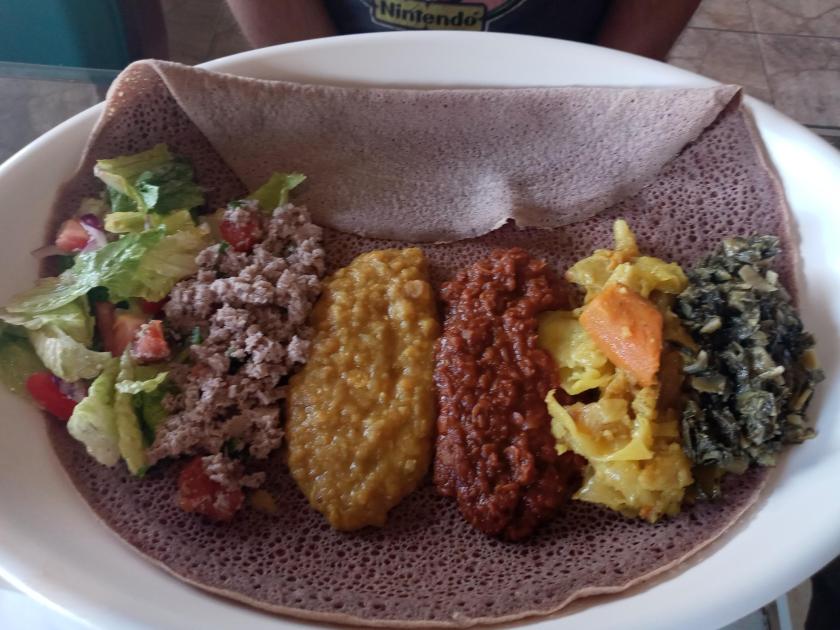
My friend did the same thing by ordering the vegetarian combination platter.  That’s a little side salad on the left, followed by ye timatim fitfit, which is the injera bread chopped up and sauteed with fresh tomatoes, green chilies, onions, garlic, and herbs.  It was cool to see how versatile the injera is, and kind of a meta thing to use the flat injera to scoop it up with, like dunking Oreos into cookies and cream ice cream.  The next one over, the yellow-orange dish, is ye kik alicha wot, which is mild split peas stewed with onion, garlic, ginger, and turmeric. After that, the dark red is ye misir wot, with pureed split red lentils simmered in chopped onions, garlic, ginger, vegetable oil, and berbere sauce, so it was spicier than the split peas next to it.  Next up is atakilt (vegetable) wot with the most delicious potatoes, carrots, green beans, onions, cabbage, and ginger, all stewed together.  Finally, the vegetarian combo platter had ye gomen (collard green) wot on the right side, which was probably similar to my gomen besiga, only with no beef in this one.

My friend, who is always a generous guy, let me sample all of those, and I have to say that as tasty as my meats were, and how exciting it was to try all those unfamiliar flavors, the vegetarian combo blew them away with depths of flavor.  If I was skilled enough to cook Ethiopian and Indian recipes well, I could probably go vegetarian, or at least eat vegetarian more often than I do, which is not as often as I should.  But I recommend this highly to everyone, whether you eat meat or not, to demonstrate the absolute wonders and miracles you can achieve with vegetables and spices.

In fact, two years before I published this review, I listed Selam’s vegetarian combination platter in Top Tastes, where I listed my favorite local restaurant dishes of 2023 in Orlando Weekly, back when I was writing those every year.  (Somehow we skipped 2024, and who knows what’s going to happen this year.)

I hardly ever drink coffee, but if you go to an Ethiopian restaurant, it almost feels like a necessity to do the traditional coffee ceremony, so we did.  While I don’t pretend to be a coffee connoisseur, this was really delicious and strong coffee, with a depth of flavor I never notice in plain black American-style coffee.  That said, I’ve never been into plain black coffee, and here at Selam, I needed some sugar in mine to mellow it out.

While this meal goes back a while, I remember it like it was yesterday.  I kept holding off on publishing this review because I was hoping to return, ideally with other friends to try other dishes.  Unfortunately, it is far from home, and Ethiopian food is a hard sell for most people I know (including my wife, who was brave enough to try it with me that one other time, 16 years ago, but it wasn’t her thing).  But I give Selam my highest possible recommendation, whether you are familiar with the cuisine or completely uninitiated and a little intimidated.  Don’t be intimidated!  Everything was a hit, and it’s FUN.  It would actually be a fun place to take a date, because you eat with one hand, which is kind of sensuous, and you share everything.  But if any of my friends ever want to go to there on a weekend, I’m your huckleberry!

Howlin’ Ray’s (Los Angeles)

Howlin’ Ray’s (https://howlinrays.com/) is a beloved Los Angeles institution for Nashville-style hot chicken, which is one of my favorite styles of fried chicken.  I got to try the iconic Hattie B’s Hot Chicken on my first and only trip to Nashville back in 2017, and I am a HUGE fan of Chicken Fire and JAM Hot Chicken, our two beloved Nashville hot joints back home in Orlando.  I crave Chicken Fire a lot, but fried chicken and fries are the very definition of “sometimes foods,” so I rarely go.

I’ve been hearing raves about Howlin’ Ray’s ever since I started making these occasional work trips to L.A., and I swore I would try it on my most recent visit.  From all accounts, it is one of those much-hyped places that actually lives up to all the hype.  It started out as a food truck in 2015, founded by former fine dining chef Johnny Ray Zone (who sounds like a psychobilly musician or a cyberpunk protagonist) and his wife Amanda Chapman.  A year later, they opened their first permanent location in Chinatown, which is the closest to my job, but not close enough to walk to.  I figured it would be a good place to have delivered to work on my longest day, when I was staying late to teach part of a nighttime class.  I don’t usually like getting food delivered, but it would be a lot more convenient than making it over to a place that doesn’t even have seating in my very limited time in the city.

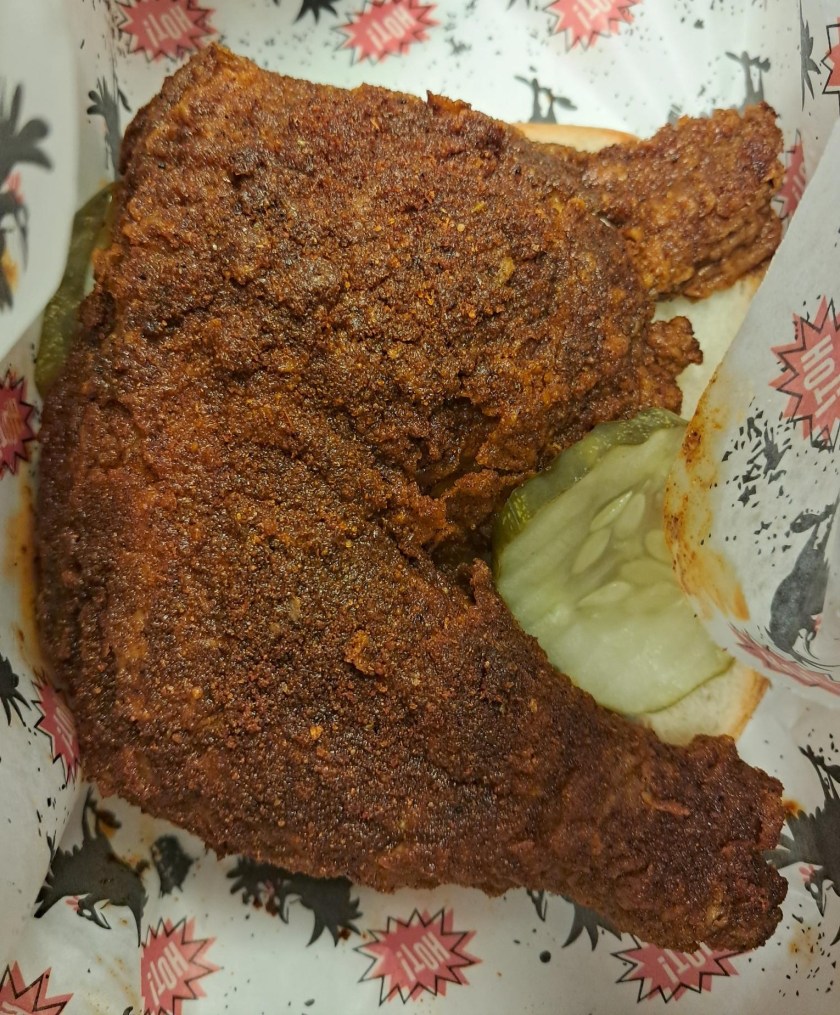
I started out with a quarter chicken that was a leg and thigh, since I always prefer dark meat.  I went with the hot flavor as a benchmark, to see how hot Howlin’ Ray’s hot actually is, and to also gauge how much I could take.  It was delicious, tender, juicy chicken under that intense seasoning, fried to perfection.  But holy moley, that seasoning!  It definitely made my eyes water, nose run, lips tingle.  It was hot, but tasty, and that’s the most important thing.  I’m not a masochist — not totally, anyway — but as much as I love spicy food, I want flavor, not just pure pain.  And this delivered plenty of delicious flavor!

At Hattie B’s, I ordered a medium thigh and a hot thigh to figure out a similar benchmark, and I have no regrets about either order.  Like at Hattie B’s, Howlin’ Ray’s hid a slice of white bread underneath that quarter bird, and I was so glad to find it under there.  Chewing it helped with the burning sensation.

I don’t go hotter than the hot level at any of these Nashville places, but I also wanted to scale back.  And while they had chicken sandwiches that I’m sure are wonderful, I eat a lot of sandwiches, and I’ve even eaten sandwiches on this same L.A. trip.  I wanted to try a few things from the menu, and Howlin’ Ray’s has a concoction called Mario Style that combined a few of them.  This is a mountain of “shake fries” (crinkle-cut fries with spicy seasoning shaken over them), topped with chopped chicken breast at the flavor/heat level of your choice (I chose medium-plus, a half-step between medium and hot), vinegar slaw, pickles, creamy comeback sauce, and more of that shaken seasoning.  I think there might have even been some cheddar cheese in there, but maybe not.     
I figured I could eat this mess with a fork at my desk, but of course I dropped one piece of chicken that hit one of my favorite ties in three different places on its way down to also hit my crotch.

Here’s another pic showing you that there actually were fries underneath there.  Mario Style was a huge portion of food, more than enough for a full meal.  And assuming there was cheese in there, or if there was any dairy in the comeback sauce, then all four food groups are covered!

I can’t go to a restaurant that serves collard greens and not try them!  These tender greens were braised with onions and also tomatoes, which is a new one for me.  They were so good, I slurped the “pot likker” broth when I was done with the greens.   And before I could check my teeth for rogue greens, two students chose that moment to come to my office to chat.  (I checked after they left, and thankfully I didn’t have anything stuck in my teeth, but the timing really was impeccable.)

As I’ve said before, I also can’t go to a restaurant that serves macaroni salad or pasta salad and not try them!  This cool and creamy macaroni salad included diced green bell peppers, piquillo peppers (an impressive touch), and a lot of fresh dill, which was interesting.  I saved it for last to cool things down, even though it didn’t help with my burning lips. 

This was all a huge treat.  I loved it!  The menu was very similar to Hattie B’s in Nashville, and I’d say Howlin’ Ray’s is on the same level, flavor-wise and overall quality-wise.  I still have nothing but love in my heart for Orlando’s own Chicken Fire, and I appreciate a slight sweetness in the hot chicken from Chicken Fire, maybe due to a drizzle of honey.  But my favorite thing about Howlin’ Ray’s compared to our beloved Orlando establishments is that they serve bone-in chicken, which Chicken Fire and JAM Hot Chicken do not do.  That thigh and leg I had were straight fire — no pun intended — and totally worth the temporary pain.  The chicken itself was fried to perfection, and people like my wife who don’t like spicy food would probably love their country style, which is even more mild than their mild.  This is delicious food that I highly recommend to Angelenos and tourists alike, but I’m glad I ate it alone in my little office at my L.A. job site, so nobody else saw me tearing up and blowing my nose… except those two students who caught me mid-meal.  They might have seen my tears of discomfort, but they were also tears of joy.  I guess I am a little masochistic after all.

Bari Italian Subs, D’Amato Bakery and Subs, and J.P. Graziano Grocery: An Italian Sub Tour of Chicago

Everyone associates certain foods with Chicago: deep-dish pizza (even though I like thin-crust tavern-style pizza better than those casseroles), Vienna beef hot dogs on poppyseed buns “dragged through the garden,” and Italian beef sandwiches dipped in au jus and topped with spicy giardiniera.

But Chicago has a lot of old-school Italian grocery stores, delis, and bakeries, so when I went there for two separate work trips over the summer of 2022, I researched what sounded like three local favorites and made a plan to sample Italian subs from each of them, in a little feature I like to call “Dare to Compare.”

The first two were easy.  Bari Italian Subs (opened in 1973), a great little Italian grocery store where you order subs at a deli counter in the back, and D’Amato’s Bakery and Subs (opened in 1970), were literally next door to each other, so that was convenient.  I hit them back to back and ordered my subs to go, since neither had any tables for dining in.  When I had some free time the next day, I took a Lyft ride to visit a third location, J.P. Graziano Grocery (opened in 1937) in the foodie-heaven neighborhood known as the West Loop, but it was closed for renovations.  Noooooooo!  (But relax, constant readers; a happy ending awaits.)

My first stop was D’Amato’s Bakery and Subs (https://damatoschicago.com/), where I ignored the glass cases full of tempting pastries and ordered a 9″ Italian sub ($9) with Genoa salami, mild capicola, mortadella, provolone, lettuce, tomato, oil, Italian seasoning, and hot giardiniera, a relish of chopped onions, celery, carrots, cauliflower, peppers, herbs, and spices, marinated in olive oil and vinegar.

I would have asked them to go harder on the giardiniera, but I had no idea.  Being a bakery, D’Amato’s sub roll was soft and fresh, and my sub tasted even better marinating in its butcher paper wrapper for a while before I got to enjoy it back in my hotel room.

The 9″ Italian sub I got at Bari Italian Subs (https://www.bariitaliansubs.com/) next door was also $9.  It contained capicola ham, Genoa salami, mortadella, provolone cheese, lettuce, tomatoes, onions, and Bari’s house-made hot giardiniera, a great twist on the standard pickled banana peppers, jalapeños, or hot cherry peppers that standard sub shops provide.  I believe Bari Foods even uses the rolls baked next door at D’Amato Bakery!

Once again, they went lighter on the giardiniera than I would have liked.  Was it still a killer sandwich?  Absolutely, yes.  Due to the ingredients alone, I think it barely edged out D’Amato Bakery’s similar version, although both were very good.   

I also got a container of macaroni salad at Bari Foods that I enjoyed back in my hotel room with both subs.  In fact, I don’t know if anyone else ever enjoyed two subs in a hotel room as much as I did.   Maybe a dom somewhere.  Don’t worry — I got two meals out of the two sandwiches and this eight-ounce container.   

As I said earlier, when I discovered J.P. Graziano Grocery was closed for some remodeling, I started wandering the West Loop on foot and accidentally discovered Au Cheval, where I ate what still remains the best cheeseburger of my entire life, three years later.

But on a subsequent trip to Chicago, later that same summer, I returned to J.P. Graziano Grocery (https://jpgraziano.com/) and was relieved to see it had reopened.  I ordered a Spicy Italian sub ($12) and a Mr. G sub ($13), knowing I could get at least two meals out of them back in my hotel room.

The Spicy Italian contained hot capicola, hot soppressata, pepperoni, provolone, lettuce, and tomato, with red wine vinegar and oregano.  No giardiniera here, sorry, but it would have fit well.  It was a pretty terrific version of an Italian sub, especially on the nice, soft roll.

Here’s a peek inside.  Pardon the not-great lighting.  I had a different phone back then, too. 

The Mr. G is the famous house specialty, with hot soppressata, prosciutto di parma, Volpi genoa salami, sharp imported provolone, J.P. Graziano’s own truffle mustard balsamic vinaigrette (ridiculously good), marinated Roman-style artichokes, fresh basil, and lettuce, with hot oil, red wine vinegar, and oregano.  As good as the spicy Italian was (and it was), Mr. G was even better.

Lookit dat!

I can’t believe I visited these three iconic Italian sub destinations three years ago, but much more recently, the website The Infatuation listed and ranked the 15 Best Italian Subs in Chicago, and all three of my choices made their list.  Earlier this summer, a website called Mashed published their list of The 15 Absolute Best Italian Subs In The US.  Since I am an Italian sub connoisseur, I naturally had to check it out, and I’m thrilled to say I have been to four of their 15 picks (so far): the Italian sub at Bari AND the Mr. G at J.P. Graziano Grocery in Chicago (two out of three right here!), the #1 at Mazzaro’s Italian Market in St. Petersburg, Florida, and a Los Angeles classic that I’ll get around to reviewing at some point.  I would have expected Mashed to write about potatoes rather than subs, and I don’t love that some of the subs on their list aren’t actual Italian subs with a variety of cured meats, served cold, but other sandwiches from Italian delis with Italian ingredients (chicken cutlets and pepper steak).  But despite the lack of consistency on the Mashed list, I’m glad websites like this are shining a well-deserved spotlight on great sandwich shops, and that others agree with me.

Istanbul Grill

I love Turkish food.  It might be my second-favorite cuisine of all time, after Italian, and the insidious social media algorithms are always sending me reels of the most amazing-looking Turkish street foods that always make me hungry.  Unfortunately, Turkish restaurants don’t always last here in Orlando.  I was a big fan of Beyti and Cappadocia, but they didn’t survive.  Luckily, I have a new favorite, Istanbul Grill (https://istanbulgrillorlando.com/), but unfortunately, it isn’t close to home like Beyti was or close to work like Cappadocia was (especially because my work and home are now one in the same).  It is way far south on Orange Blossom Trail, south of the Florida Mall, south of the 528.  It’s a haul — about 45 minutes each way in good traffic on a weekend during the day.  But I’ve brought home takeout twice from Istanbul Grill, and it was so worth it both times.

It is a big attention-getter to order lavas bread in a Turkish restaurant.  They walk it out to your table, this big, beautiful bread puffed up with hot air like a football, and then you stab it with utensils to deflate it (and watch out for the hot steam escaping).  It is very soft, and you rip off pieces and use it for dipping and scooping.  Of course, if you get lavas bread to go, it deflates on the long drive home, but if you’re lucky, it stays warm and may stay soft overnight if you have any left.

And why do you need soft bread for dipping and scooping?  For this mixed appetizer platter!  Almost every Turkish restaurant offers a variety of cool, fresh, refreshing dips, and you can usually order some kind of assortment.  My favorite is spicy ezme in the top left, almost like Turkish salsa — a combination of fresh tomatoes, onions, parsley, green and red bell peppers, hot peppers, garlic, tomato paste, and lemon juice.  My wife wants nothing to do with ezme, so I get it all.  In the top right, the tabouli salad is all hers — crushed bulgur wheat, parsley, scallions. and tomatoes with olive oil and  fresh mint.  She told me this is her favorite tabouli from any restaurant, Turkish or otherwise.In the bottom left, we have baba ganoush — fresh smoked eggplant puree with tahini (sesame paste), olive oil, labneh (strained yogurt thickened into a cheese-like form), mayonnaise, garlic, and lemon juice.  We both love this one, but it is her absolute favorite.  In the cup in the middle, we have cacik — a dip of creamy yogurt, shredded cucumber, mint, dill,  and garlic, perfect for cutting spice and mellowing out rich meats.  And in the bottom right, we have the old classic hummus — chick peas, tahini, olive oil, garlic and cumin.
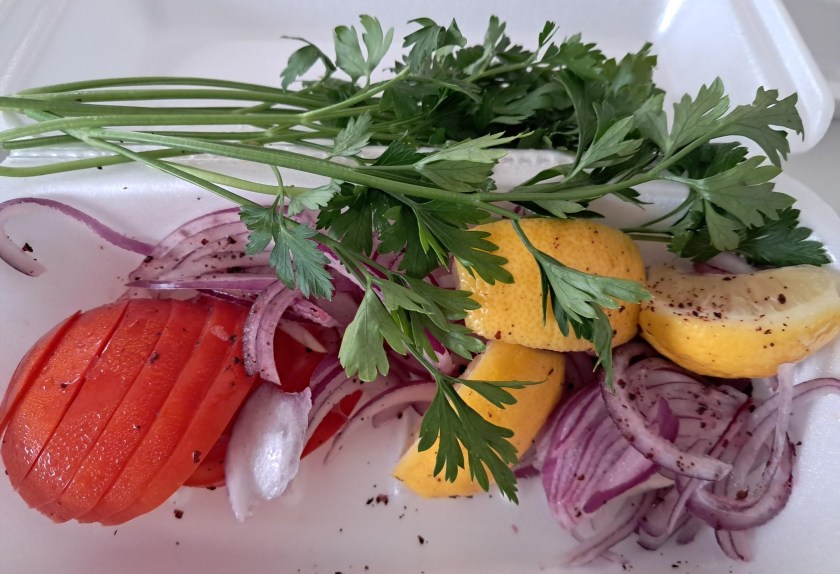
As great as this mixed appetizer bounty is, I do wish Istanbul Grill served two more dips that I rank even above ezme: soslu patlican (eggplant sauteed with tomatoes, onions, and peppers, like a spicy ratatouille) and taramasalata (a creamy dip made with salted, cured fish roe).

For my first visit, I made sure to order lahmacun, one of my Turkish favorites.  These thin, round flatbreads look like pizza without cheese, but they are much thinner than even tavern-style pizza and not as crispy, and aren’t sliced.  They are topped with a delicious mixture of ground lamb, tomatoes, onions, and peppers, and then baked.  Here you get three in an order.
I’ve made lahmacun from scratch before, and I think I’m going to have to do it again soon, since I have ground lamb in the freezer and want to use it up before hurricane season gets hot and heavy.  Mine are pretty awesome, but not quite as perfect as Istanbul Grill’s.

Instead of eating lahmacun like pizza, you are supposed to roll it up and fill it with sliced tomatoes, red onions, fresh cilantro, and a squeeze of lemon juice.  It is so refreshing and light, much moreso than you would think a pizza-looking thing would be.

My wife ordered “mosakka” (often called moussaka on other restaurants’ menus), an oven-baked dish of eggplant with ground beef and tomato sauce, topped with mozzarella cheese.  If you’ve made it this far, you might be more familiar with the Greek version of moussaka, which is often assembled in layers and topped with a bechamel sauce, but both of us really love the tomatoey Turkish variant.  I tried a bite, and folks, you have to try this some time!  This is actually my preferred moussaka/mosakka.

It was hard for me to choose, but I made the game-time decision (standing at the counter placing my order) to go with lamb adana, grilled kebaps of ground lamb seasoned with red bell peppers.  Think of it as a grilled meatloaf with a firmer texture.  These were fine, especially when I added some of the house-made hot sauce, but I was hoping they would be a little more exciting, flavor-wise.  I almost always gravitate toward lamb dishes at Turkish, Middle Eastern, and Greek restaurants, but I probably would have been happier with the special beef adana, grilled ground beef shoulder kebabs tender seasoned with mint, red bell pepper, onions, chili flakes, and cumin.  There seems to be more going on in that one.  Leave it to me to choose the lesser adana!  Or maybe I should have tried a different lamb dish.  Luckily, there would be a next time.   They came on a bed of rich rice pilaf (which gets so much better with all the meat drippings soaking in) with a small salad and crunchy pickled red cabbage.

My wife had asked me to pick her a dessert, so instead of baklava, I brought home this kunefe, because she is in her pistachio-loving era.  This Middle Eastern dessert is a large “patty” of very fine shreds of dough that almost look like vermicelli strands, often with a sweet cheese filling, soaked in a sugary syrup and topped with crushed pistachios.  It looks a bit dry in this photo because the sugar syrup came in a separate little ramekin (not pictured) for us to pour over the kunefe when we got it home.  That definitely improved its looks, texture, and most importantly, its taste.  I didn’t try it, so I don’t know if this one had cheese inside or not, but she liked it, so that made us both happy.   

For our second visit, we got Istanbul bread instead of the fluffy, puffy lavas (that is actually quite thin once you rip it apart).  This was very similar to a thicker pita bread or a good pizza crust, minus toppings, and much thicker than the lahmacun.  It held up well dipping and scooping the mixed appetizer platter I brought home again.

My wife asked for an order of falafel, which came with four decent-sized discs and a little cup of tahini, which really surprised me when I took a big dip, expecting it to be hummus.  I like hummus (who doesn’t?), but straight-up tahini, not so much.    These looked darker than your average falafel, so she thought they were burned and ended up not having any after all.  I ate them a few days later, so I can vouch for them not being burned and actually being delicious.  I made them into two separate sandwiches (two falafels in each) on onion naan bread with homemade pickled cabbage, homemade pickled red onions, tomatoes, Istanbul Grill’s own hot sauce, and Flavortown Secret Sauce from my giant collection of condiments.  I should have taken a picture of one of those, because they turned out pretty.

One thing my wife ate with gusto was this order of four beautiful grilled lamb chops, seasoned to perfection.  I asked them to grill them as rare as possible.  Despite being very thin (much thinner than the thick lamb loin chops I buy at Costco), they were delicious, and seasoned so well.  The rice pilaf underneath them got better and better as it soaked up all those savory drippings.  She actually got four separate meals out of this, with one lamb chop and a little rice in each portion!

She surprised me by taking a big bite of the grilled pepper on the left, before I could warn her it would be too spicy for her.  It was.  She won’t do that again!  And I ate all the crunchy red pickled cabbage, of course.

This was my lamb shank, a tender, braised chunk of meat barely clinging to a large bone, which was stewed in a tomatoey gravy.  This is one of my favorite dishes to order at Turkish or Greek restaurants, but because I love it so much, I learned how to make braised lamb shanks myself at home, and my sauce is a lot thicker, spicier, and more robust overall, especially since I braise mine in the oven for five to six hours.  This was perfectly good, but just like I’m exceptionally picky about restaurant lasagna because I love my homemade version so much, I also like my lamb shanks a lot more than this one.  Sorry, Istanbul Grill.  It’s not you, it’s me. 

It came with a big styrofoam container of rice pilaf, which I dumped into the lamb shank’s somewhat thin gravy to soak it up. 

And this was the iskender style kebab, a dish I was introduced to a long time ago at Bosphorous, the first Turkish restaurant I fell in love with, and then Cappadocia (RIP) raised the bar even higher.  I didn’t eat this until the following day, but it consists of “signature house prepared meat” sliced  thin over “garlic bread” (I’m thinking fried Istanbul bread) topped with  a tangy, tomatoey “special sauce” and served with yogurt.  It is mildly spicy, acidic, and also creamy, and you get the crispiness of the fried bread underneath catching all those meat and sauce drippings.  The other Turkish restaurants used their doner kebap meat (think sliced gyro meat, all salty and garlicky usually grilled to make it a little firmer), but this was definitely different from those. 

Like I say at the end of too many of these reviews, we both really liked Istanbul Grill, but it is too far from home to return with any regularity, and too far to even drag my wife down there to dine in the restaurant.  But I recommend it, and I will challenge myself to keep ordering different things off the expansive menu whenever I return.  And FYI, there is a second location in Kissimmee, which is even further from me, but might be more convenient for some.

Lim Ros Thai Cuisine

Lim Ros (https://limrosthairestaurant.com/) is a new Thai restaurant in Maitland that opened in the fall of 2024.  According to the website, “Lim Ros” means “to taste” in Thai, and there is plenty to taste on the menu.  It is located on the bottom floor of a fancy-looking apartment building on the corner of State Road 17-92 (aka Orlando Avenue, which turns into Mills Avenue as you head south) and Lake Avenue.  The interior of Lim Ros is modern, spacious, and upscale, with high ceilings and lots of natural light that make the dining room look even larger.  When we went for lunch a few weeks back, it wasn’t very busy, but I imagine it is poppin’ on Friday and Saturday nights.

My wife started her meal with a Thai iced tea, as she will at any Thai restaurant.  This one was sweet, creamy, slightly smoky, and refreshing, as they should be.

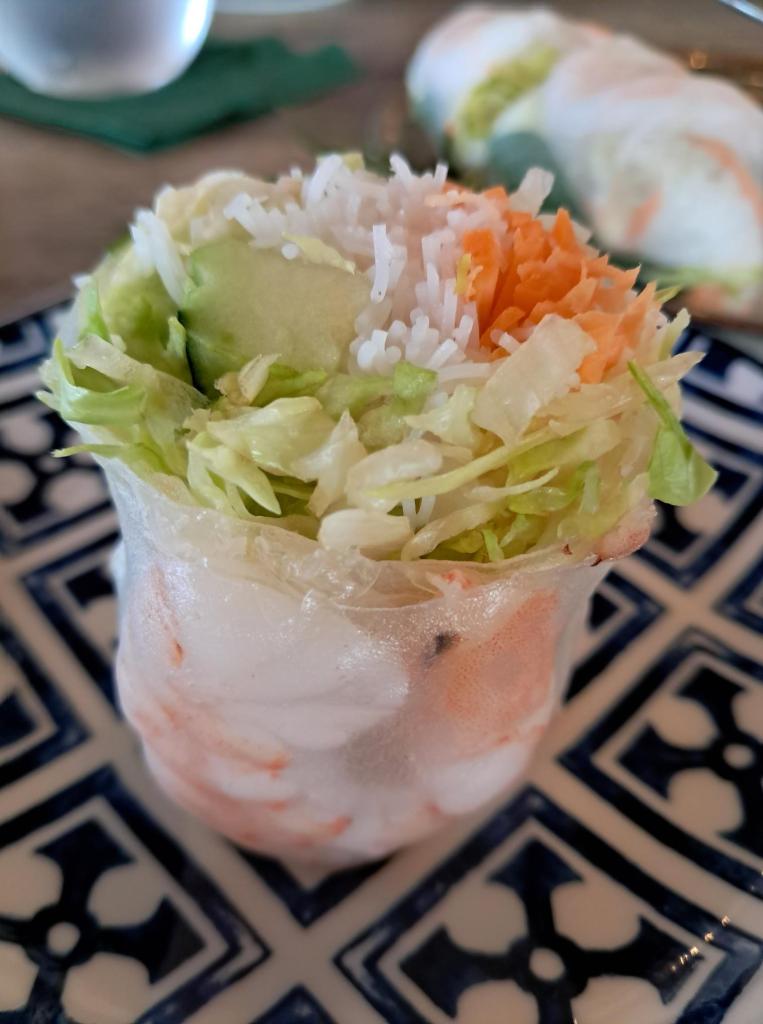
She also started with an order of summer rolls, her go-to appetizer at any Vietnamese restaurant we visit, so she wanted to try them on a Thai menu.  The soft rice paper wrappers held massive amounts of finely shredded lettuce, chewy rice vermicelli noodles, julienned carrots and cucumbers, Thai basil, and shrimp , but vegetarians and folks who keep kosher can also order them with tofu instead of shrimp.   That is peanut sauce on the top, even though it looks like it could have been cocktail sauce. 

I’m not a big summer roll guy, but she insisted I try half of one, and these were a lot more substantial than the usual summer rolls at Vietnamese restaurants.  Thicker.  Girthier, if you will.  Okay, that’s enough of that.

After being introduced to life-changing larb last year at Isan Zaap Thai Cafe, my favorite Thai restaurant in Orlando, I decided to try the larb gai here at Lim Ros.  It is a spicy, tangy, refreshing, cool salad made with ground chicken and various crunchy vegetables and fresh herbs: carrots, red onion, cilantro, mint, kaffir lime leaves, roasted rice powder, and served with cucumber slices for scooping and crisp iceberg lettuce leaves for making lettuce wraps.  Dig this gorgeous plating:

I must admit I preferred the taste and texture of the larb at Isan Zaap, which was made with ground pork and pork liver, as opposed to the ground chicken in this larb gai.  This one also seemed to have a lot of funkiness from fish sauce.  Trying to roll up some larb gai lettuce wraps was a messy business, and my fingers smelled like fish sauce for a day or two after this meal.

For entrees, we both ordered off the lunch menu, which has some nice specials.  Everything comes with a house seaweed soup and a crispy fried spring roll, so you get a filling meal with a couple bonus items for less than the price on the regular menu.

My wife defaulted to pad Thai, a safe choice for her because she isn’t into spicy food at all.  If the classic dish of rice noodles, eggs, bean sprouts, chives, peanuts, and pork sounds basic or unadventurous, I would disagree, because every restaurant’s pad Thai is different, and a truly great one can be a monumental discovery.  She said this one was just okay.  I tasted it, and she agreed with my criticism, that it lacked the acidic tang from citrus it needed to achieve perfect balance.  To be fair, that is my biggest complaint about most versions of pad Thai that I try. 

Since my go-to Thai dish, drunken noodles, wasn’t on either menu at Lim Ros, I decided to try something totally new (to me): Panang curry.  Here is the whole lunch platter:

This is the actual Panang curry, with Thai eggplant, Thai basil, kaffir lime leaf, chili, and pork (which I chose, but you can also choose chicken, tofu, or vegetables, or beef or shrimp for a $2 upcharge).   I wanted something spicy, and I would have to describe it as “medium hot,” but next time I will challenge myself with “Thai hot.”  I added all my rice to the bowl of curry and mixed it all up, so that alone dampened the heat level.   
I was surprised that the Thai eggplants were little, round, and green, not at all like the huge purple-black eggplants all of us are used to.  They looked like tiny round watermelons on the outside, and they had a texture similar to zucchini.

This was the house seaweed soup, which reminded me a lot of the standard miso soup served in Japanese restaurants, but with a delicious “roasted” flavor from the seaweed.  Umami?  Maybe your mommy.  There were tiny little white tofu cubes in there, along with all the seaweed, carrot, onions, and scallions.  It was a very nice soup, and it reminded me that I never order Thai soups, but I should branch out.

And the spring roll was a standard spring roll — no big surprises there — but you can’t go wrong with a spring roll!  I took the shredded cabbage and carrots home, mixed in with most of my larb gai, so I had a whole meal for the following day. 

We both thought Lim Ros was perfectly fine, but there are other Thai restaurants we like more, including another recent discovery I will be reviewing soon, so watch this space.  It’s a very nice restaurant and would probably be great for a date, a business lunch, or for bringing family and friends who are unfamiliar with Thai food and nervous about trying it.  If you want Thai and you’re already in Maitland or surrounding Fern Park to the north or Winter Park to the south, you can’t go wrong.  However, the next time my wife and I are craving Thai, I might drive farther in other directions.

Cutting the Mustard IV: Mustard on the Beat

Well, it’s Memorial Day weekend, 2025 — a time for many people to get a three-day weekend and get together with family and friends for cookouts.  That usually means hamburgers and hot dogs, so that usually means mustard.  And because I am obsessed with mustard, that means it is time for my fourth Cutting the Mustard feature, where I spend the better part of a year hunting, discovering, sampling, and reviewing massive multitudes of mustard.  These take me a while to write because our fridge is only so big, and I can’t have too many open bottles and jars taking up space at the same time, so I try to finish jars before opening new ones.

For my first-ever Cutting the Mustard back in 2021, I reviewed seven different mustards.  In 2022, I raised the stakes by reviewing ten different mustards in Cutting the Mustard II: The Quest for More Mustard.  In 2024, I went above and beyond by reviewing 26 mustards (making up for skipping 2023) in Cutting the Mustard III: Mustardy Agreement.  And now I’m back again, with more of that yellow condiment you may tolerate, but I love!

Since I’m trying to eat somewhat healthier, with fewer carbs, I tried a lot of these mustards with Kirkland oven-browned turkey breast, which I buy at Costco.  It is a boneless, skinless, fully cooked, unsliced turkey breast that is relatively cheap, lean protein.  Best of all, it is a blank slate for any kinds of recipes or sandwiches, and it goes with almost any condiments or other accompaniments.  Kirkland oven-browned turkey breast is like the vanilla of meats, and I am not saying that as a diss to the turkey or to vanilla.  Everyone knows that really good vanilla is delicious, but what I mean is that almost any other flavor goes well with it.  So I guess I’m saying that turkey breast is like the capybara of meats, because it gets along well with everything the way capybaras get along with all the other animals.

Way back in Cutting the Mustard II, I reviewed Zakuson Russian Standard mustard, a real sinus-burner.  I got the Zakuson Canadian mustard on the left at the same store, the Eastern European grocery store Green Hills Supermarket in Altamonte Springs.  Instead of having that nasal burn like Chinese mustard, this one was toned down with a sweet maple flavor.  I usually find sweet mustards to be too sweet, but this one was mostly just sticky and bland.  I wouldn’t get it again. 
I think I found the Simply Supreme Craft Beer mustard at Clemons Produce, arguably Orlando’s best produce market, and my personal favorite.  In addition to the freshest fruits and vegetables from Florida and beyond, Clemons always stocks a huge selection of Amish products and other interesting condiments, sauces, sodas, and snacks, plus they have an Amish deli that slices Troyer brand meats and cheeses.  This Simply Supreme Craft Beer mustard is a Woeber’s product; I’ve reviewed their Sweet & Spicy and and Hot & Spicy Sandwich Pal mustards before, and both were better.  This one lacked the “zing” I always appreciate in mustards, so I could see it going better with bratwurst and other German-style sausages that have stronger flavors of their own.

I know I found the Duke’s spicy ground mustard at Winn-Dixie, and it was really good.  I would happily get it again and use it anytime I might employ a spicy brown or deli-style mustard.  I am a Duke’s mayonnaise loyalist, and I am happy to report this mustard was on par with the excellent quality of their mayo.

On a rare day I found myself with time to kill in Winter Park, I found a parking space along busy, bougie Park Avenue and went into the busy, bougie Ancient Olive, a store that specializes in different flavors of olive oil and balsamic vinegar.  If you love to cook and especially if you make a lot of salads at home, this is a wonderful place to browse, especially since you can sample any of the flavored oils and vinegars before you buy them.  I love vinegars almost as much as I love mustard, and I have a little collection of them, but that’s not what you’re here for.  I decided to try two fancy mustards from unfamiliar but posh-looking brands.

This is Fischer & Wieser mesquite horseradish mustard, which was as delicious as it sounds.   The mesquite smoke flavor sets it apart from other horseradishy, deli-style mustards, and I loved it.  Here are two tiny turkey sandwiches on leftover pão de queijo, Brazilian cheese buns, with more of that turkey, a bit of cheese, tomato, and I probably put some hot pickled cherry peppers on those, since I bought a gallon jar and have been putting them on everything lately.  But if you’ve ever had pão de queijo before, you know they are really little, so these aren’t big sandwiches by any means.   

Here’s a close-up of the jar.  This would be terrific on turkey (obviously), roast beef, ham (especially a sweeter ham), you name it.

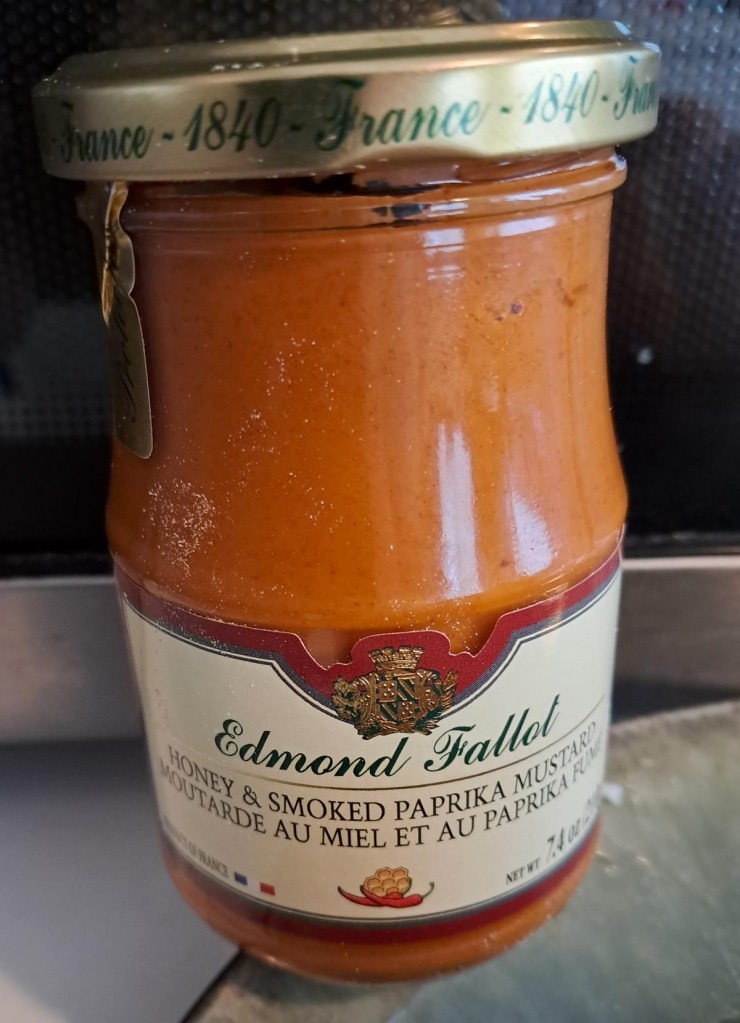
This is Edmond Fallot honey & smoked paprika mustard, another impulse buy from The Ancient Olive.  It is a French brand I’ve never heard of, but it looked interesting, and I’m a sucker for anything smoky, as I just demonstrated.  Lately I’ve been making nice pita bread sandwiches with the same turkey, and I tried the honey & smoked paprika mustard alongside turkey, feta cheese, tomatoes, cucumbers, pickled onions, hot pickled cherry peppers, and I think some bleu cheese dressing, which I always get to have for myself when I bring home wings for my wife.

This isn’t a bad condiment, but it is very salty, even by mustard standards.   The smokiness is subtle because I think paprika is always a subtle spice, and I didn’t detect any honey flavor or general sweetness.  Unfortunately, it doesn’t taste anything like mustard either!

This small jar is still open in my fridge, with a lot left to go.  I bought some giant pork loins at Aldi recently, for even cheaper, lean, versatile protein to mess around with, and I intend to experiment more and figure out the best things to do with it.  I think it might go better with pork than it did with turkey and all those fresh-tasting accompaniments.

When I reviewed my favorite place in Florida, Mazzaro’s Italian Market in St. Petersburg, last summer, of course I picked up a few unfamiliar mustards while I was there.  I had never seen or heard of the MadeWith brand, but I bought their Organic Stoneground and Organic Horseradish mustards, but forgot to take any pictures of the Horseradish one while I was working my way through the bottle.  They were very similar, with a thick and almost creamy texture, but the stoneground was a little blander and the horseradish had more flavor without being overpowering or burning my sinuses.  MadeWith makes a big deal about their products not containing any GMOs, in case anyone is really into that.   
Yes, this was a turkey sandwich on a savory homemade waffle.  It was okay, but the waffle got too soft and soggy too quickly and lost its crispness.  And that Sir Kensington’s chipotle mayonnaise is awesome on anything and everything.  Despite my Duke’s love, I snatched up a few of these bottles when Publix put them on clearance earlier this year.  I’ve enjoyed two of Sir Kensington’s mustards in the past as well.

I also found this Pilsudski Polish style mustard at Mazzaro’s.  It was thicker and spicier than your typical Gulden’s-style spicy brown mustard, without being as bright as something like Ba-Tampte.  It was very good on the best pastrami sandwich in Florida, from The Pastrami Project food truck.  Chef-owner George Markward saved our Christmas AND Hanukah by being open on Christmas Day, so I brought home pastrami and brisket sandwiches for us, and the Pilsudski mustard was a good choice to accompany the best pastrami from a place not named Katz’s or Langer’s.

Last year, Beaverton Foods, the Oregon-based company that produces Beaver and Inglehoffer mustards, offered a sale with free shipping, so I ordered six mustards from them.  

Every so often, I will treat myself to a whole ham at Aldi, usually when they discount them after a ham-centric holiday like Easter, Thanksgiving, and Christmas.  I always joke about my “half-price Hanukah hams,” and how that makes me a good Jew and a bad Jew at the same time.  Anyway, I rubbed my most recent ham  with a blend of Beaver deli mustard and a pineapple-Scotch bonnet pepper Jamaican hot sauce from a company called Spur Tree, and then I made sure to use a lot more of the deli mustard on the ham sandwiches that followed.  It was a very tasty deli mustard,  but again lacking the brightness of Ba-Tampte, Boar’s Head, and Kosciusko, three of my all-time favorites. 
I should note that the Inglehoffer deli mustard in the round bottle tasted almost identical.  I wondered if Beaverton Foods just repackaged the same mustard for their two different brands, and upon checking the website (now that my bottles are long gone), they are similar, with a few minor differences.  I noticed they both contain sugar and soybean and/or canola oils, which was disappointing, especially since most mustards don’t contain (or need) any oil or sugar at all, and the Beaver deli mustard contains corn syrup too!  I’ve never been big on reading ingredient labels, which probably explains a lot about me, but I need to become more diligent.

Here’s that Beaver deli mustard again, for a taste test with one of those Deutsche Kuche soft pretzel sticks (I pronounce it “Douche cooch”) from Aldi.  The mustard in the middle is Bertman Original Ball Park Mustard, which I believe I found at Cavallari Gourmet, an upscale grocery store in Oviedo.  It’s a great store, but I can’t say the same about the mustard.  It didn’t have any zing or zip, and it was quite bland and uninspired.  I’m never sorry I tried anything, but I definitely wouldn’t buy it again.  Sorry, Cleveland — you might rock, but your Bertman mustard doesn’t.

On the other hand, the Beaver Coney Island mustard in the above and below photos, did indeed rock.  I loved this one.  The Coney Island mustard contains cucumbers, red bell peppers, red and green chili peppers, pimento, paprika, onion,  garlic, and tomato paste, and it had a lot of rich flavor, especially on the hot dog below.  Disappointingly, it also contained soybean oil, wheat flour, sugar, and corn syrup.  Seriously, Beaver?  Did you really have to go there?
When I think of Coney Island, I definitely think of hot dogs (specifically Nathan’s) and The Warriors, the great 1979 film and recent musical concept album.  But “Coney dogs” are a very specific style of hot dog that are not local to Coney Island in Brooklyn; they are from Detroit diners founded by Greek immigrants, and they are smoky dogs topped with a smooth chili sauce, raw onion, and yellow mustard, somewhat similar to the chili-topped hot dogs from Cincinnati chili parlors like Skyline Chili.  Here in Orlando, SoDough Square Pizza serves an authentic Detroit coney dog that I loved, but they just use regular yellow mustard.  I figured Beaver was trying to approximate the Midwestern chili flavors of Coney dogs rather than anything associated with Nathan’s or the historic Coney Island amusement park.

The Inglehoffer spicy brown mustard was pretty standard.  Here it is on the free Chorizo Sunrise breakfast sandwich I get from Einstein Bros. Bagels every year on my birthday: an over-hard egg, a chorizo sausage patty, cheddar cheese, smashed avocado, and jalapeño salsa cream cheese on a green chile bagel.  While I try my best to avoid chains and I have high standards for bagels, I admit I really like this breakfast sandwich and the green chile bagels from Einstein Bros.  They are much more like rolls than bagels, but I enjoy them a lot just the same.  And I always like mustard on my eggs and breakfast sandwiches, so this was a good combination.

Because we were both wondering, the Inglehoffer spicy brown mustard doesn’t contain any oil, the way the deli mustard does.

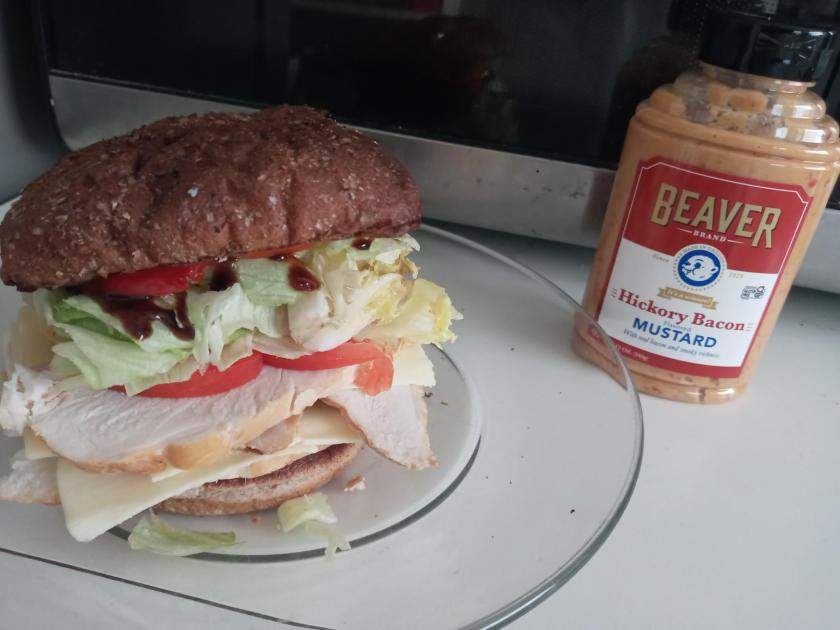
The Beaver hickory bacon mustard, which I had on this turkey sandwich on a depressing whole wheat roll, was tasty, creamy, and smoky, and it contains actual bacon, so watch out, kosher and halal folks.  But I would have been disappointed if I bought a hickory bacon mustard that didn’t contain bacon.  Unfortunately, it also contains sugar, honey, and high fructose corn syrup!  Like I said, I’m always happy to try anything new, but knowing how Beaverton Foods adulterates its mustards with oils and sweeteners, I wouldn’t get them again.  This is why I write reviews, folks, and why I hope people read them.  According to my monthly analytics, the jury is still out on that one.

I found this photo of my mustard collection from many years ago, long before I even started writing this blog.  You may remember most of these mustards from previous Cutting the Mustard reviews, but you can see I also tried the Beaver spicy hot stone ground and extra hot jalapeño mustards in the past (see them on the right, the two bottles of orangey mustard with red caps).   I bought them at Mr. Dunderbak’s, the good and fun German restaurant in Tampa, after trying them with my food.  It has been a few years since I’ve tried either of those flavors, but they were delicious and very hot — hotter than most other mustards I’ve had. 
The spicy hot stone ground mustard seems to be discontinued, but the extra hot jalapeño mustard does contain soybean oil.  Take several seats, Beaverton Foods!

But this is the spiciest thing I am reviewing here today: Matouk’s Calypso hot sauce, a mustard and Scotch bonnet pepper-based hot sauce from the Caribbean island of Trinidad & Tobago.  I loooove Trinidadian food (and if you like Jamaican food, you will too), but this sauce was a lot for me.  I put some on this simple chicken sandwich on a soft roll with tomato and probably a little onion, knowing me, and it was the most dominant flavor by far.  I love spicy food, but I needed to eat a bit of yogurt or drink some milk every time I used the Matouk’s Calypso sauce.  It made my tongue and lips tingle and burn that much, but despite all that, it is tasty.
It has been far too long since I’ve had a Jamaican patty, but this mustardy hot sauce would be great with them.

So after a whole year of anticipation (by absolutely nobody), this was the latest crop of new mustards I have found, sampled, and earnestly evaluated.  Somehow, it feels like a bit of a letdown after previous years, if I do say so myself.  But fear not, stalwart Saboscrivnerinos — I already have a dozen new mustards waiting in the wings to try, after a fruitful trip to South Florida earlier this year.  I went down to visit my family and attend a concert with my best friend, where we happened to eat one of the best restaurant meals of my entire life.  But I also stopped at an Italian gourmet market and two kosher grocery stores and stocked up on plenty of new and exciting mustards for the 2025-2026 year, so stay tuned, true believers!

Walala Asian Noodle House

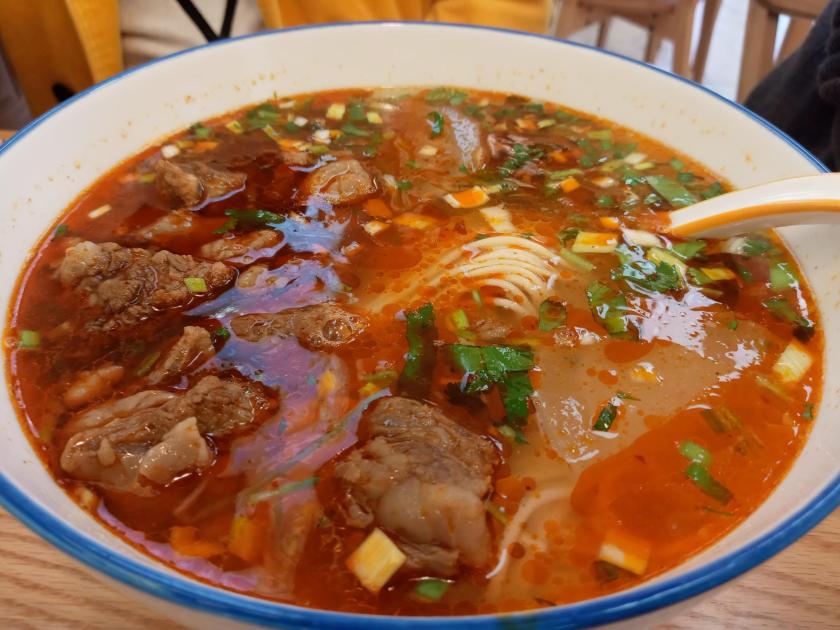
Earlier this year, I met two foodie friends at a relatively new restaurant in Orlando’s “Chinatown,” a huge plaza in Pine Hills on West Colonial Drive that is absolutely full of Asian-owned restaurants and other businesses, including Enson, a sprawling supermarket.  I’ve eaten at a few places in the Chinatown plaza and reviewed two of them, both of which have since closed.  But one that I know isn’t going anywhere anytime soon is Walala Asian Noodle House (https://walalaasiannoodlehouse.toast.site/), specializing in hand-pulled noodles in rich, beef-based soups from Lanzhou, China.  The noodles are called lamian, the term that gave us both Chinese lo mein and Japanese ramen.  Don’tcha love etymology?

Back in 2023, I visited and reviewed Mr. J’s Hand-Pulled Noodle in Ocoee, but I really preferred my meal at Walala.  Not only was it a lot closer to home, but everything had more flavor.  Of course, it helped that I went with two friends, and we shared everything.  That said, we all ended up with the same kind of long, thin lamien noodles, even though Walala also offers Japanese ramen (but there are so many good places for ramen already, especially my favorite, Ramen Takagi), Hunan-style rice noodles (which we all thought might be too similar to the familiar noodles in pho), hor fun noodles (I’m assuming wide, flat noodles like in beef chow fun or ho fun, even though hor fun cracked us all up), and they added knife-cut noodles  to the menu after our visit.

It was my choice to start with a tea-infused boiled egg for each of us.  I know, I know, in this economy?  But before eggs became a luxury good, I was experimenting with pickling eggs with different combinations of vinegar, herbs, spices, and other seasonings, and I enjoyed similar tea eggs at Mr. J’s.  (Anyone else reading that in the late Arleen Sorkin’s voice?  Seriously?  Just me?)  Just like at Mistah J’s, we had to peel the eggs ourselves, but these came pre-cracked:

Due to the cracks, they took on beautiful patterns from the tea infusion process:

We shared an order of rich, chewy pig ear slices tossed with spicy chili oil and fresh herbs, including lots of fresh, bright-tasting cilantro.  This is probably better than you are thinking.  They were cartilicious!

One of my friends got braised beef boneless short rib soup with the hand-pulled noodles.  I was tempted by it, because I love any braised meats and especially short ribs, but she let me try a piece, and it was an excellent choice.

Another friend, much more familiar with Lanzhou cuisine than the rest of us, ordered braised honeycomb tripe soup with the same hand-pulled noodles.  I enjoy some unpopular organ meats (give me all the liver, beef tongue, beef tendon, and chicken hearts you have!), but I’ve never developed a big appreciation for tripe, despite all the times it has ended up in my pho and I still eat it.  It’s a texture thing, but this tripe looked a lot different from the style most Vietnamese restaurants add to pho. 

I ended up getting the large sliced beef shank noodle soup because I love lamb shanks so much, and because this one also came with beef skewers on the side.  I couldn’t pass that up!  The meat was very tender, the broth was a little spicy and very unctuous from all the meat (including bones and fat), and the noodles were nice and springy and chewy.  Totally different consistency from Italian pasta or the rice noodles in pho.

Why didn’t at least one of us order a different kind of noodle?  The world will never know.  (But they also offer rice noodles and ramen, although you can get good-to-great ramen at so many other places.)

Anyway, Walala does something I’ve never seen a restaurant do before.  If you eat all your noodles but still have a lot of soup left, they will bring you another order of plain noodles to add back into your soup, and it’s free!  It almost sounded too good to be true, but two of us tested it.

And here are the heavily seasoned, slightly spicy skewers of slightly chewy beef.  These are individual cubes, not whole pieces, so it was very easy for us to share.  

Unfortunately, I didn’t get to try the Chinese pickles, but there are so many interesting things on the menu, including new knife-cut noodles they didn’t have on my initial visit (wider and flatter noodles, essentially shaved off the block of dough straight into boiling water, so they end up with beautiful fluted edges), a return trip can be easily justified.

So that’s Walala, although you’re probably hearing A LOT more about it, since it just received a prestigious Michelin recommendation at the recent ceremony last month.  I personally have more faith in my own taste and that of my friends, acquaintances, and mutual followers than a non-transparent process and anonymous reviewers from a tire company, but I am still thrilled for Walala and all the other local Michelin award recipients (see my recent reviews for others).  Regardless of my own skepticism and misgivings, those awards will drive more business their way, and I don’t begrudge that to anyone.  It’s one of the most unique Chinese restaurants in Orlando, and especially if you love noodles like I do, you must get over there as soon as possible.

That Wing Spot

That Wing Spot (https://www.instagram.com/thatwingspot/) is one of the many successful restaurants from chef-entrepreneur Kwame Boakye, one of the nicest men in Orlando.  He brought us Chicken Fire, which started as a humble food trailer in 2019 before moving into its permanent location in the Milk District on East Colonial and Bumby.  It remains one of my favorite restaurants in Orlando, and I crave it often.  More recently, in 2023, he brought us Cow & Cheese in Maitland, serving up some of the city’s best smash-style burgers.

In between, he rolled out the first That Wing Spot location on South Orange Avenue, which is pretty far from me, so I admit I’ve never made it down there.  But since then, Kwame opened up a combination That Wing Spot/Cow & Cheese at the intersection of University Boulevard and Goldenrod Road in Winter Park.  I no longer had any excuse, so I made my way down there to try those wings, and of course I had to catch up with an old favorite, too.

At the combination That Wing Spot/Cow & Cheese (better than a Combination Pizza Hut and Taco Bell!), you order at touchscreen monitors, just like at Chicken Fire and the original Cow & Cheese.  I was bringing wings and fries home for my wife, but I figured I would enjoy a little treat while I waited: The Doc, Kwame’s signature smash-style burger from the Cow & Cheese side of things.  I sang its praises in my original review: “an Oklahoma-style burger, featuring ‘thinly sliced onions smashed into two angus beef patties, each topped with premium American cheese, CC sauce, and deeply caramelized onions, all on a fresh baked toasted brioche bun.'”  This one at the new combo location was as messy and as good as the decadent Docs I’ve enjoyed at Cow & Cheese on my past visits, even though I wolfed it down while it was still too hot to fully appreciate.   

The burger came out much faster than my order from That Wing Spot, and by the time I was done with it, the wings and fries were ready to go.

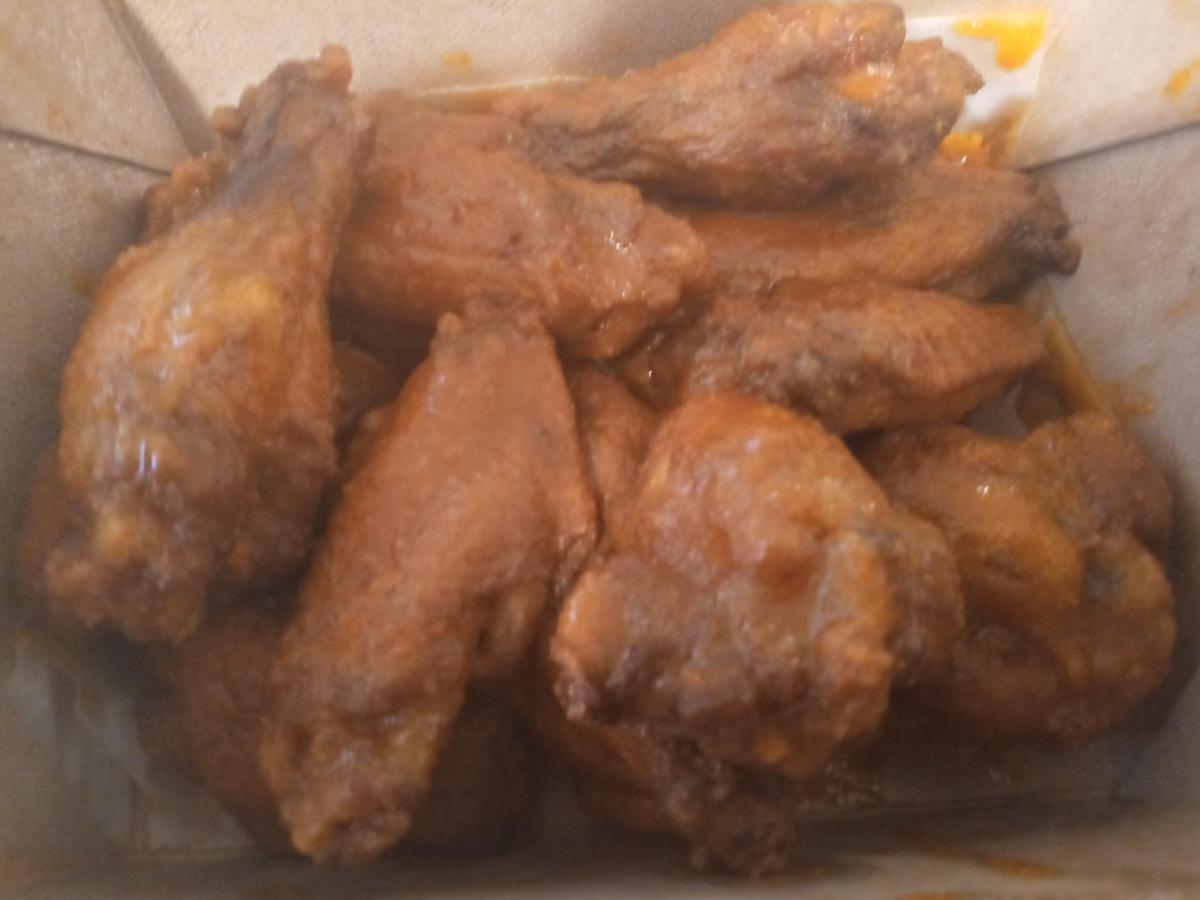
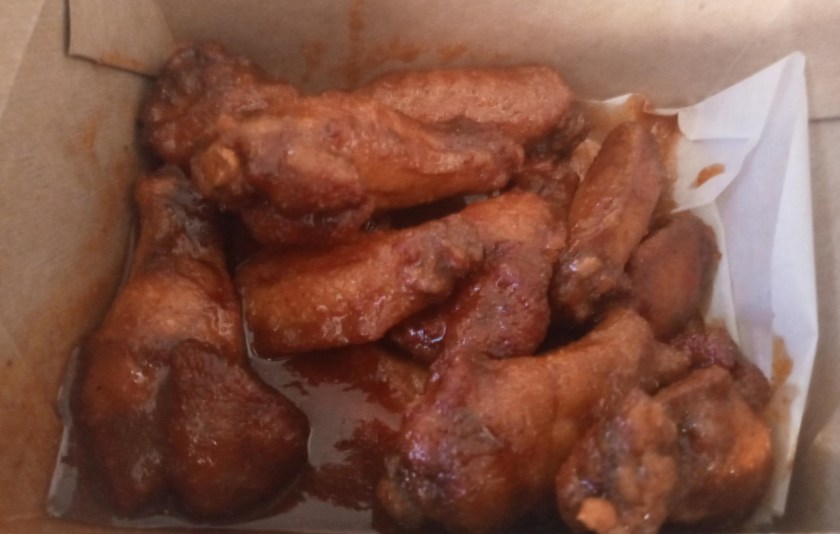
I got an order of 20 wings divided into two separate flavors for myself,  knowing I’d have leftovers for the following day.  I started with KB’s Sweet Heat (KB for Kwame Boakye, of course).  I love sweet and spicy flavors together, but I was expecting something a lot spicier, considering the endorphin rush I get from Kwame’s Nashville-style hot chicken tenders at Chicken Fire.  There, the medium makes my eyes water and the hot makes my nose run, but they taste so good, the pain is worth it (and I need to drink milk with those tenders).  These wings were tasty, but didn’t come close to that level of heat. 

My second wing flavor was That Fiery BBQ, which was both sweeter and spicier than KB’s Sweet Heat, with the added bonus of a smoky flavor from the barbecue sauce.  I liked these more and would totally get That Fiery BBQ again.  Aw heck, who am I kidding?  I would definitely try other flavors next time, but I would get both of these again!

I ordered That Big Wing Combo for my wife, which comes with ten or fifteen wings, fries, and a dipping sauce.  She asked for Plain Crispy wings, which we both thought could have benefitted from a sauce or seasoning — any sauce or seasoning at all.   They were nice, meaty wings, and definitely crispy even after the drive home, but all of Kwame’s sauces and seasonings are so good, even a simple mild buffalo sauce or smoky-sweet “secret” dry rub would have improved the experience with these.   

We upgraded our regular fries to Kwame B’s Secret Rub fries, which was as wise a move as getting the plain wings was unwise.  These crinkle-cut fries were completely covered in a savory-sweet seasoning that was reminiscent of barbecue-flavored potato chips, and I would put that stuff on any food, including vanilla ice cream.  I was completely on board for these, and even my seasoning-averse wife really liked them.  Seasoned fries superior, plain fries inferior.  Needless to say, they would have been crispier if enjoyed in the restaurant, but at least they were still warm by the time I got home. 

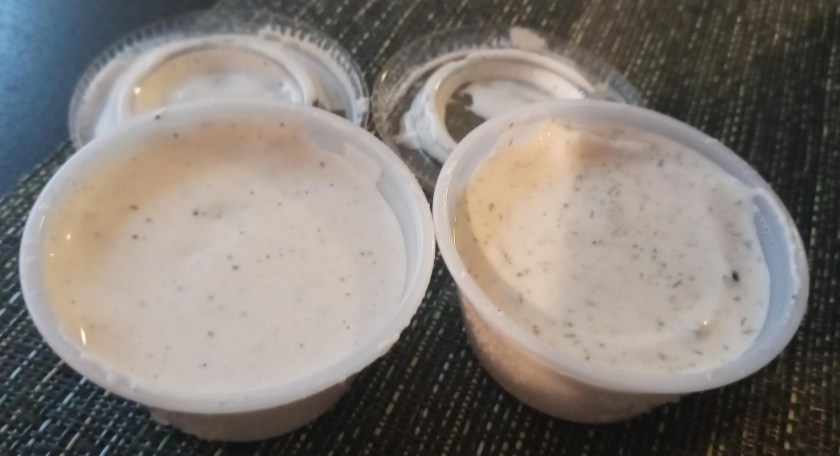
That Wing Spot’s house-made bleu cheese AND buttermilk ranch are both worth trying.  Don’t settle for just one!  I tend to prefer bleu cheese with my wings, the thicker and chunkier the better. 

There is one well-known wing joint around here that my wife loves, but I HATE.  I can’t stand their wings, and their food always upsets my stomach… but their bleu cheese dip is excellent, so I will still go there to pick wings up for her but always get bleu cheese for myself, since she’s not a dipper or a sauce person anyway.  But unlike that restaurant that will go unnamed, here at That Wing Spot, everything is good, and it doesn’t make me sick.  I can have it all (even one of the best burgers in Orlando along with these fine wings and fries), and I sure did on this visit.  And I will again!  Thank you, Kwame.  I hope you’re always planning your next restaurant concept, because you’re three for three so far!


The Prince (Los Angeles)

The Prince (https://www.instagram.com/theprincela) is a classy, old-school Los Angeles Korean restaurant and lounge that is most famous for appearing in multiple movies and TV shows over the decades, including Chinatown (one of the greatest L.A. movies, neo-noirs, and movies in general of all time), Mad Men (one of my favorite shows of all time), and New Girl (where it was the characters’ regular hangout).  I’ve never actually watched New Girl, but now I am imagining Zooey Deschanel with bangs and glasses, singing a silly old song (maybe “Dream a Little Dream of Me”?) and strumming a ukulele in this dusky, dark red hipster hangout.

Back in November, I was on a work trip to L.A. and had a chance to join some of my amazing co-workers for dinner.  I always stay in Koreatown, where my employer is located, and where there seem to be hundreds of Korean restaurants to choose from, at all different styles and price points.  I am still very new to Korean food, but the more things I try, the more I feel inspired to branch out and try more.  The Prince was walkable from our campus, so since I was already aware of its cinematic résumé and timeless cool décor, I convinced this small group to trust and follow me.

I must apologize in advance for the photos that follow in this review.  It’s a gorgeous room, dark and anachronistic, but as soon as I took my first photo to set the scene, a server yelled at me to not use flash photography inside.  So I did my best, such as it is, to share the red vinyl booths, the dark wood, the dim lighting, and even these hale and hearty knights standing guard.

Also, I swear I saw Spike Jonze, director of super-creative movies and iconic music videos, dining there, but I wasn’t 100% sure it was him.  As much as I wanted to thank him for “Sabotage,” Adaptation, and Jackass, I didn’t want to be That Guy who disturbed his dinner… especially if it wasn’t Spike.

Anyway, our group was a mix of adventurous and unadventurous eaters, so we picked five things that looked good to everyone, and we all shared them.   That is my favorite way to dine with friends.

These are the onion rings (RING THE ALARM!) and cheese balls, because you know if I go anywhere and see onion rings on the menu, I have to order them.  They were crowd-pleasers, and it was not the first time I had really good onion rings at a Korean restaurant.   The cheese balls were even better — perfect, golden-fried, golf ball-sized orbs with melty cheese in the middle, under the breading.  I should have tried to get a shot of a bisected cheese ball to show you their molten, sticky, creamy centers, but they went fast!

When you’re introducing Korean food to unfamiliar diners, beef bulgogi is one of those perfect gateway dishes.  Bulgogi is a dish of thin-sliced beef (often sirloin steak), marinated in a savory-sweet sauce, and then grilled or stir-fried with onions and green bell peppers.  The bulgogi marinade contains soy sauce, sugar, sesame oil, garlic, ginger, and pear juice, which tenderizes the meat.  There is nothing spicy or “weird” to scare off the unadventurous diner, so it was another hit at our table. Just FYI: “bul” is Korean for fire, and “gogi” means meat.

We also ordered galbi (sometimes called kalbi), a very similar dish but with beef short ribs sliced cross-wise against the bones, rather than thin-sliced steak.  It has a similar flavor due to the marinade, but I already love short ribs in any form — not just the flavor, but the wonderful texture.  I especially like the chewy part of the meat right around the bones, which you can just pull off with your fingers if you don’t want to gnaw it off.  This was served over onions and scallions, and there wasn’t a morsel left.

I didn’t have any input in choosing this garlic shrimp dish, served with fresh, raw, shredded cabbage, but I was happy to try a couple of the shrimp, which came in their shells and had to be peeled.  It was delicious — different from scampi or any other garlic shrimp dish you might be envisioning, but still very satisfying.

I did choose this dish, though: thick, perfectly al dente udon noodles served with mixed seafood: shrimp, mussels, squid, and tiny crab legs (more trouble than they were worth to crack open).  The menu describes it as coming in a spicy broth, but it could be served mild upon request.  I honestly don’t remember what we decided as a group, but I think we went with spicy and almost everyone still loved it.

Real Korean food aficionados might be rolling their eyes, disappointed that we made relatively staid and familiar choices, but that’s often what happens in a “family-style” group dining situation.  I would have loved to try the soondae, since I always love blood sausage in all its other forms, from Argentinian morcilla to British black pudding, but nobody else was on board with this one.  It’s all good!

I have no regrets or complaints about The Prince, especially because it is such a part of Los Angeles and Hollywood history.  I would not be surprised if there are better Korean restaurants in L.A.’s Koreatown, but the vibes at The Prince are unmatched.  Every time I make it out there for work, I try to visit at least one historic, iconic L.A. landmark, whether it’s a tourist attraction, a restaurant, or both.  So far, I’m making quite a list.  I love my job, and I love L.A.!

Over the Border Taqueria

As a food blogger, nothing makes me feel more like a cool, in-the-know insider than discovering the latest pop-up restaurant, but you have to move fast to catch those before they either explode in popularity or disappear forever.  A few parking lot pop-ups I wrote about way back in the day turned into popular area restaurants in permanent locations, including Chicken Fire, Smokemade Meats + Eats, and QuesaLoco — now established local favorites that I count among my personal favorites as well.

I recently learned about the existence of Over the Border Taqueria (https://www.instagram.com/overthebordertaqueria/), Chef Samuel Aguilar’s Tijuana-style taco pop-up featuring authentic al pastor — marinated pork flavored with onions and pineapple and sliced off a trompo (a vertical spit, like the best gyro places do with their seasoned meat).  I have written before about my love of al pastor in tacos, burritos, and tortas.  It is something I’ll order anytime I see it on a Mexican restaurant menu, to the point where I judge Mexican restaurants that don’t serve al pastor.

This particular pop-up was from 6 to 10 PM on a Saturday at a small mechanic shop, Goodfelo’s, on East Colonial Drive and Dean Road, but Over the Border has even popped up at apartment complexes before.  Because I worry about parking and hate long lines, I showed up right at 5:30 and was the first person there.  There was a crew of about six people already set up, with a tent, staging tables, a simple charcoal grill with one guy grilling marinated, sliced carne asada, and of course the al pastor being licked with flames on the trompo:
Here are the menus.  Tacos come on a fresh corn tortilla (from Tortilleria El Progreso, the Mexican market and restaurant I reviewed in the first year of this blog), lightly crisped up on their flattop grill, and a mulita is like a sandwich of two tortillas with a little cheese melted in between, plus the meat of your choice and the same toppings as the tacos.  Tortas are the largest and most expensive menu items: huge and beautiful sandwiches on soft, fresh telera rolls, which are sliced in half and also lightly grilled on the flattop.  The al pastor and carne asada are finely chopped, and the orangey-red chorizo sausage is crumbled.

I brought home three tacos: an al pastor taco for myself with the works (diced onions and cilantro and their red salsa and slightly spicy guacamole) and two carne asada tacos for my wife, sin cebollas (hold the onions).  I typically don’t order carne asada for myself at taquerias because sometimes it is dry or flavorless or too chewy, or all of the above.  I just ate a few morsels that were left on her plate when she finished those two, and I don’t mind telling you, dear readers, that this was the most flavorful carne asada I’ve ever had in my life.  It had a complex and smoky flavor, and I’m sure it helped that the meat was all grilled up fresh on the type of grill everyone’s dads cursed over in their backyards.

This was my chorizo mulita, which was also terrific.  Chorizo is usually my second or third choice when it comes to meats in a taco, at places like Francisco’s Taco Madness (still my favorite spot for tacos and burritos in the entire Orlando area), Orange Blossom Trail landmark Tortas El Rey, and the aforementioned QuesaLoco, and this chorizo did not disappoint.  The shredded, melted white cheese (mozzarella?) gets a bit lost in the shuffle, and the mulita is actually messier to eat than the taco, but I have no regrets.

But this was the star of the show: the al pastor torta on that soft telera roll.  I think it was one of the most satisfying things I’ve eaten in a long time, and it’s HUGE.

Here’s an inside shot.  The torta contains the meat of your choice, the same diced onions and cilantro, red salsa, and guacamole, plus melted cheese and mayonnaise, which I think is important for flavor, holding the crumbly ingredients together, and as a “sandwich lubricant” to add some additional moisture.  And since I haven’t said much about the actual flavor of the al pastor yet… WOW.  You can definitely taste all the seasonings — garlic, vinegar, brown sugar, and especially the necessary onions and sweet, bright, tangy pineapple.  It has a nice orange color from the achiote paste (made from the spice annatto), which also adds some subtle but important earthy flavor.  If you’ve never tried al pastor before, I strongly recommend it whenever you see it on a Mexican menu, but to start with some of the best al pastor and set your expectations high from now on, get it from Over the Border Taqueria, next time they pop up anywhere.

They also had two huge, clear plastic barrels of aguas frescas: jamaica (reddish-purple sweet hibiscus drink) and horchata (creamy rice milk, flavored with cinnamon, sugar, and a bit of vanilla).  I brought home two horchatas for myself and my wife after texting her to see which one she wanted.  I always love aguas frescas at any Mexican restaurant, and even though fruity flavors are my favorites, horchata always hits the spot, especially for cutting the heat from spicy dishes. 

I will note that Over the Border Taqueria does NOT accept credit card payments — just cash, Venmo, and Zelle.  I was glad I had just enough cash on me to cover our order, since I don’t use Venmo or Zelle (just Paypal for my collectible wheeling and dealing).  But now you can plan accordingly when you go!

So where can you find these pop-ups?  Follow Over the Border’s Instagram (I included the link at the very top), and you’ll notice they announce their locations for every Friday and Saturday evening.  Right now, those seem to be the only nights Samuel Aguilar and his talented crew are popping up anywhere, so start planning ahead.  You won’t want to miss incredible food like this.  And trust me — get there early, because the legend is only going to continue to grow (and so will the lines) as more people discover Over the Border Taqueria for themselves.  Maybe one day they can figure out longer hours, more nights per week, a permanent location, or even a brick and mortar restaurant, but for now, Orlando is lucky to even experience these fleeting pop-ups.  You won’t be sorry, trust me.  I guarantee you’ll hear more about them in the weeks and months ahead.  This is one time to believe the hype, and if you don’t believe your friendly neighborhood Saboscrivner, my friend and role model, Amy Drew Thompson of the Orlando Sentinel, also wrote about Samuel Aguilar and Over the Border over a year ago!