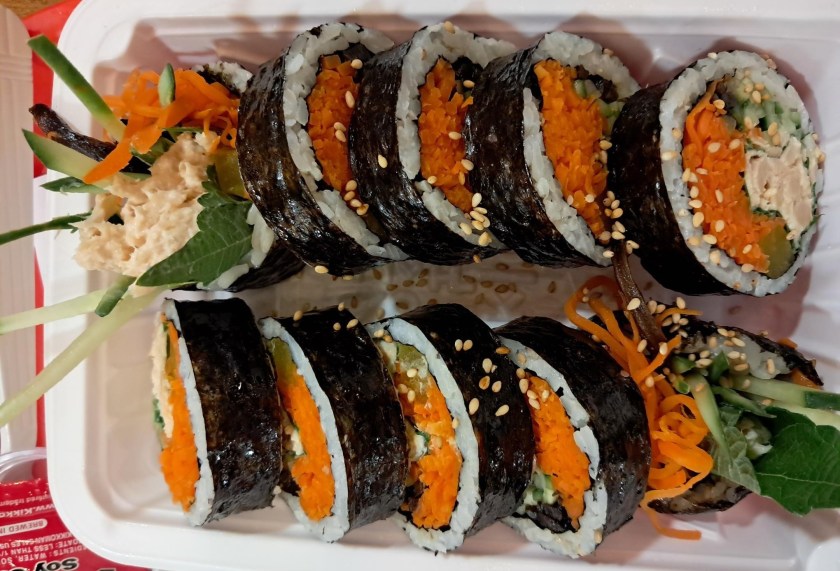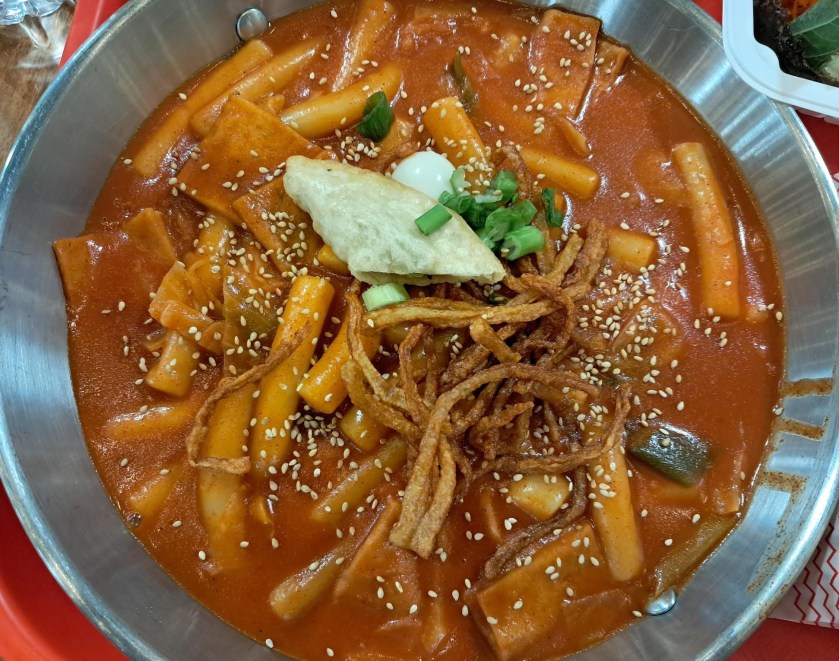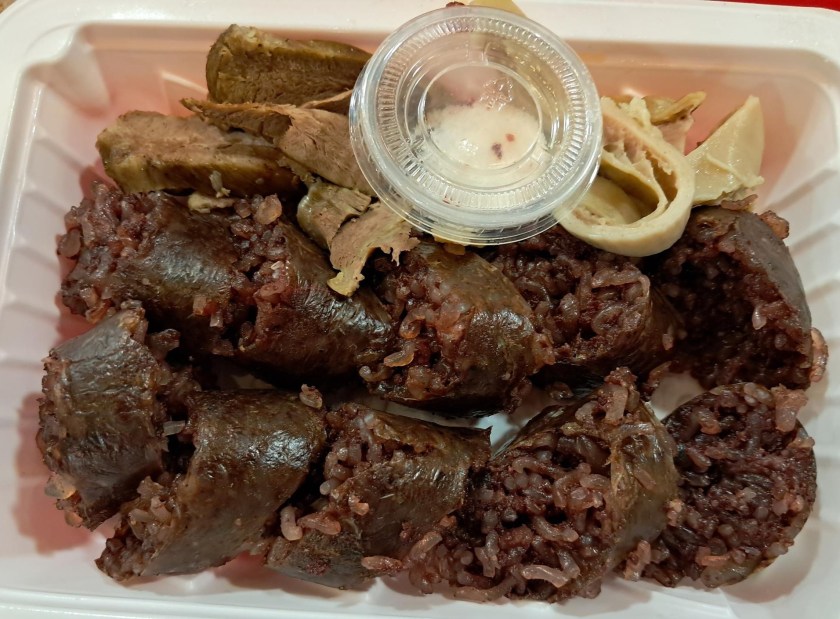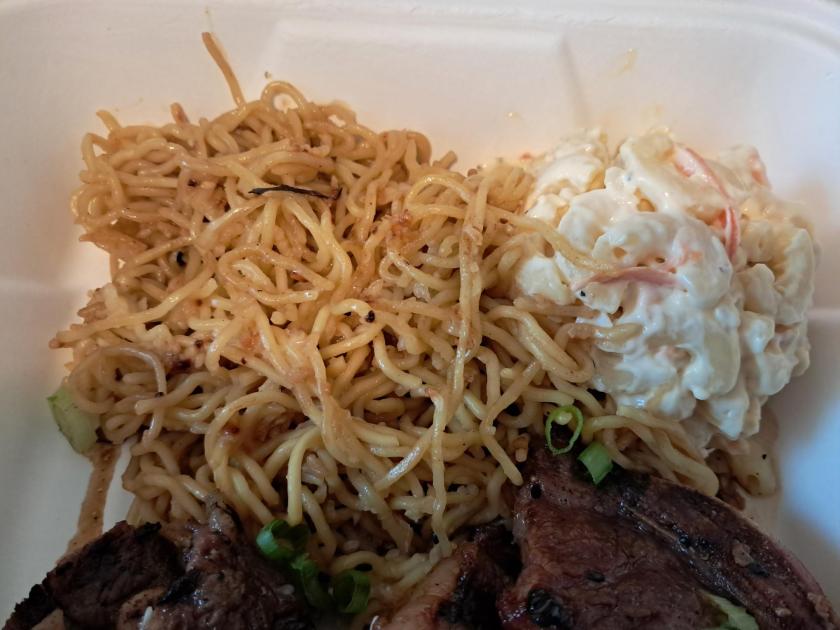
GG Korean BBQ

GG Korean BBQ (https://ggkoreanbbq.com/) is an all-you-can-eat Korean barbecue restaurant located at 5319 West Colonial Drive in Orlando’s Pine Hills neighborhood.  I recently went for the first time with two good friends, including one of my inspirations as a food writer, the illustrious Amy Drew Thompson of the Orlando Sentinel.  It was the first time I ever got to meet her in person, and I’m sure I made a great first impression, stuffing my face with delicious Korean food that we cooked ourselves on the tabletop grill.

This was my second time doing all-you-can-eat Korean barbecue ever, after trying it with a friend at Hae Jang Chon in Koreatown in L.A. last year.  I was lucky to be dining with two sophisticated, experienced, worldly gastronomes who knew what they were doing much more than I.

GG Korean BBQ offers two options: $27.99 per person for the basic all you can eat experience (seven different fresh and marinated meats), or $39.99 per person for a more premium selection: 18 different fresh and marinated meats, plus two seafood options, shrimp and baby octopus.  I was curious about the expanded option, and my friends were both kind enough to humor me and go along with it.  Just FYI, your whole party has to choose the same option.

Many Korean meals start out with banchan, tiny plates of sharable side orders.  My favorite thing here was the slightly sweet and crunchy yellow pickled daikon radish slices on the bottom left.  I am not a fan of bean sprouts, so I left them alone, and as much as I have tried to become a kimchi fan (especially as a lover of sauerkraut and cabbage in general), it hasn’t happened for me yet.  I tried a customary piece but left the rest for my colleagues.  A sharp-eyed reader told me more about the yellow pickled radish: “The yellow pickle is called Takuan. It is a Japanese pickle that was invented in the 17th century by the Zen Buddhist monk named Soho Takuan. The pickle spread to Korea and very popular.”  Thank you so much, bkhuna!

Both dining choices come with a variety of other sides to choose from.  This was corn cheese — kernels of fresh corn heated over the grill with shredded mozzarella cheese, and probably some butter too.  It looked better when it was done, and it was a decadent hit at our table.

I really liked these japchae, savory translucent noodles made out of sweet potato starch, seasoned with sesame oil.  They had a nice al dente chew. 

We also tried the steamed egg side, but I didn’t get a good picture of it.

Here were three dips for our barbecued meats.  That was a seasoned salt on the left that accented the grilled flavors perfectly.  I really liked the sauce in the middle, and the one on the right had its own spicy charm.

When you go out for Korean barbecue, the group orders a few meats at a time.  Sometimes the server cooks them for you, and sometimes you get left to your own devices.  There can be a lot going on, so every group needs an experienced leader to make sure the meat is cooking but not overcooking, and that everyone has something ready to eat at all times.  When you’re all having a nice conversation, that can be distracting, but my friend stayed on top of everything for us.

This mixed grill included beef bulgogi on the bottom (a sweet and savory marinated meat that is a great “gateway” dish for folks who are unfamiliar with Korean cuisine), and I honestly don’t remember if the two long pieces of meat along the sides were beef rib fingers or pork belly.  I’m sure we got both, though.  That’s a thick slice of onion in the top right and some big slices of mushroom on the left — more for them!

Here’s a close-up of the beautiful, rich, marbled meat that was on top in the above photo.  I think this was ribeye, due to that lush, lovely marbling.

More meat!  Those off-white thingees on the right are large and small beef intestines.  I first tried those at an all-you-can-eat Argentinian-Jewish churrascuria restaurant in Altamonte Springs called Steak in the City, similar to the Brazilian all-you-can-eat rodizio concepts (like Adega Gaucha and Texas de Brazil).  Steak in the City closed abruptly over 15 years ago, taking my good friend and former roommate’s deposit for a wedding rehearsal dinner with them.  (Luckily, he paid with a credit card, so he was able to get refunded, but the restaurant folks disappeared into the night with his money.)   Anyway, the intestines (Steak in the City called them chinchulines) grill up with a crispy exterior, but they are mostly soft and chewy.  They don’t have a strong flavor, but I’d say they are worth trying at least once, if you’ve never had them before.  They would mostly take on the flavor of a marinade or dipping sauce.

Even more meat!  We were all losing steam by this point.
What do you think those thin, wavy, round slices of meat on the right are?

They were fresh beef tongue, sliced almost paper-thin.  As a Jewish person, I can’t go somewhere that offers tongue and not try it, whether it’s a Jewish deli, a Mexican taqueria, a Vietnamese pho restaurant, or in this case, a Korean barbecue establishment.  These slices grilled up to a nondescript brownish-gray color, so they looked a lot interesting here, before cooking.  But they were extremely tender! 

Anyway, I’m glad I went with two experienced, worldly gourmets who had done this before, because I trusted my one friend to do a lot of the cooking for us (he’s a team player and a tireless mensch), and I followed their lead.  It was a really nice lunch with two of my favorite people in Orlando, but here’s my hot take: I cook at home all the time (although I don’t grill because I don’t have a grill), but if I go out to a restaurant, I would rather rely on the chef to prepare food for me than have to do it myself.  Most of the time I go to restaurants these days, I either fly solo or bring home takeout to share with my wife, and you can’t really do Korean barbecue in either scenario, so it’s a moot point anyway.  I feel similar about hot pot places – fun with a group once or twice as an interactive activity, but maybe more trouble than they are worth.  But if you’re going to do Korean barbecue, especially with a good group, I think GG Korean BBQ would be a fabulous place to enjoy it together.

Moa Kai Hawaiian Diner

Moa Kai Hawaiian Diner (https://www.moakaidiner.com/) just opened the week before last in the old Mongolorian location at 2217 East Colonial Drive in Orlando, just west of Bumby Avenue.  The restaurant is still in its soft opening phase, but it is fully open for business every day except Sunday.  Sunday brunch hours will be added in due time.  It is owned by the same owner of my beloved Poke Hana (honestly one of my favorite restaurants in Orlando since 2018) and Korean fried chicken joint Chi-Kin, which I still haven’t been to yet.

I love Hawaiian food, and Poke Hana is a big reason for that, since I’ve never actually been to Hawaii.  Even before that, there was a short-lived Hawaiian restaurant in Oviedo called Hawaiian Grindz that introduced me to most Hawaiian dishes.  Unfortunately, it didn’t last very long, perhaps because the owners seemed to be very laid-back, to the point of not always opening when their posted hours said they would.

Anyway, Moa Kai Hawaiian Diner is a very professional setup with a busy, happy-looking staff, all in festive aloha shirts.  It is a classic diner layout with booths along the window, tables, stools overlooking an open kitchen (separated by a plexiglass screen) and more stools at the bar.  For my first visit earlier this evening, I sat at the bar and placed my takeout order with the very friendly and welcoming Olivia, the bartender.

While I waited for my takeout, I ordered a POG juice.  I remember how popular Pogs were in the early ’90s, especially at the comic book shops I used to frequent, and how quickly the Pog fad came and went.  But don’t worry — POG juice is passion fruit/orange/guava juice, and it is so sweet and tangy and tasty.  It is surprisingly thick and heavy, as fruit juices can sometimes be, but I already love all tropical fruits, especially passion fruit and guava, so I enjoyed it and highly recommend it.

(That is the ever-patient Olivia’s arm back there.)

After that, I also tried the lychee lemonade, since I am now a lemonade connoisseur.  It was also wonderful, and a lot lighter and more refreshing than the POG juice.  I would definitely order that again.

I placed a large order, figuring my wife and I would get four total meals out of everything, and it was ready quite quickly.

My wife requested the shoyu poke bowl, with cubes of raw ahi tuna marinated in house shoyu (soy) sauce with Hawaiian salt, shelled edamame soybeans, macadamia nuts, chili flakes, sweet onions, and dried seaweed called ogo.  These are all flavors she likes (except the onions, which she figured out after one harsh bite), so she was really happy with it.  She said she liked this poke even more than Poke Hana, where we have eaten dozens of times, so that’s high praise coming from her.

I couldn’t decide between a few things, so I ordered an assortment, hoping to share, and if not, knowing I’d have leftovers for tomorrow.  These were the kalbi ribs, beef ribs marinated in shoyu and fruit juices, sliced across the bones, and grilled.  They had a lot of flavor from the grilling process and were so tender.  I always love peeling the flat bone slices out of kalbi and enjoying the almost chewy meat around the edges of the bone.  Even my wife liked the piece she had.

All “plate lunches” at Moa Kai come with two scoops of white rice and one scoop of macaroni salad, but you can also choose different sides, and some require a nominal upcharge.  I already know I love Hawaiian-style macaroni salad, including from Poke Hana, so I was looking forward to this, but instead of white rice, I got garlic pan-fried noodles, hoping my wife would want to try them.  We both loved them!  As great as the kalbi and macaroni salad were (and they were), these garlic noodles were the truth.  Whenever we return, we will split a full-size order of them.

Kai Asian Street Fare on the edge of Casselberry and Winter Park makes the closest thing in town to these garlic noodles, and theirs are also awesome, just a little more buttery-greasy.  But I had a lousy phone camera back then, so forgive the ugly, blurry shots in that early review.

I got a second plate lunch, the mix plate, where you can select two house favorites.  For one of my choices, I went with the spicy ahi poke with cubed, marinated ahi tuna, sweet onion, masago, and crushed macadamia nuts in house-made spicy sauce  (think spicy mayo), topped with scallions.  This was fire!  Poke is one of my favorite foods, whether from Poke Hana, Rion’s Ocean Room, or even Costco, and I especially love spicy ahi or salmon poke like this.  It was a small serving, but that’s what happens in a sampler platter like this.  I could eat this by the bucketful.

The other thing I ended up with was the grilled shoyu chicken, which was a shoyu-marinated, grilled boneless chicken thigh, topped with teriyaki sauce and scallions.  It was so tender and juicy and well-seasoned, and I always say chicken thighs are the best part of the chicken, aside from the oysters.  Thick thighs save lives!  (And if you were intrigued by the garlic noodles above, the full-size order comes topped with this shoyu chicken.)
The only reason I said I “ended up with” it was because I ordered the Korean chicken instead, which sounds like it would have been similar shoyu-marinated chicken, but cubed, battered, fried, and tossed in house-made Korean garlic sauce.  I am not disappointed at all that I ended up with the grilled chicken instead.  It was a slightly healthier option, and so damn delicious, I would happily order it again.  I don’t own a grill, merely because it is so blasted hot and humid in Orlando nine months out of the year, I know I wouldn’t use it much.  Knowing myself, that would lead to all kinds of cognitive dissonance and self-resentment, and I deal with that enough already without feeling guilty about buying a grill and not using it often enough.  But I always miss the flavor of good grilled meats, and the grilled shoyu chicken thigh was a perfect piece of chicken.  WE HAVE SUCH SIGHTS TO SHOYU!
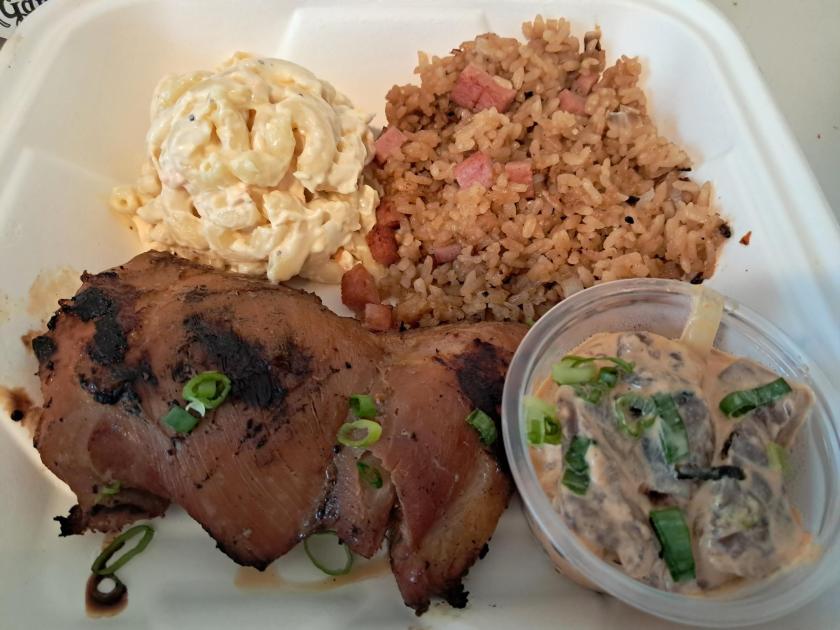
I got macaroni salad with this plate lunch too, but instead of the white rice, I got Spam fried rice for an upcharge.  Spam is so good, y’all!  It is the very definition of a “sometimes food,” as heavily processed and salty as it is, but fried up with rice or noodles and wrapped in rice and seaweed as a Spam musubi, it is tastier than you would believe.  The Spam lovers know what’s up, and the squeamish among you will just have to take my word for it.  This Spam fried rice didn’t have anything else in it (no eggs or vegetables), but just Spam and fried rice were great by themselves.      

But wait, there’s more!  That old Hawaiian restaurant in Oviedo introduced me to saimin, a Hawaiian noodle soup similar to Japanese ramen, but with Spam.  Saimin soup with Spam is on the menu here at Moa Kai, but we’re still in August, and I couldn’t conceive of ordering soup.  But I still had to try some form of saimin, so I got the local style stir-fried saimin noodles with char siu (Chinese-style barbecue pork with a slight sweetness that you may know and love from Kai Kai or Tasty Wok), Spam, sliced kamaboko (cured surimi, similar to the fish cakes in ramen), scrambled eggs, carrots, and scallions, seasoned with shoyu and dashi, a Japanese cooking stock flavored with fish and kelp.
I’m going to enjoy this tomorrow, but I couldn’t resist a few bites while it was still fresh and hot, and it was on point.  It reminded me of a Hawaiian version of lo mein (but better) or Filipino pancit bihon.  The char siu pork was sweet and tender, and the Spam was sliced into tiny cubes and perfected by the stir-fry process.  You could enjoy these local style stir-fried saimin any day of the week, not just on stir-Friday.

My wife had requested an açaí bowl for a bit of a dessert tonight and breakfast tomorrow.  This was a huge helping of açaí sorbet blended and topped with fresh strawberries, blueberries, pineapple, and kiwi, shredded coconut, peanut butter, and granola.  Knowing it was sorbet, I brought a cooler in the car with a couple of reusable fake-ice blocks to keep it cold on the drive home, but it still got a little melty.  The tiny taste I had when she had enough for the night was soooo nice and refreshing, though.

I had never even heard of açaí until a few years ago, when everyone started touting its benefits as a healthy “superfood.”  I can’t speak on that, but the dark purple sorbet made from the açaí berries is a nice blend of sweet and tart, especially when mixed with other, sweeter fruits.

And finally, we were both curious about the ube haupia pie, so I guess that makes us pie-curious.  I couldn’t resist ordering a piece for us to share.  Haupia is coconut pudding, a popular Hawaiian dessert made from coconut milk, sugar, cornstarch, and water, and it is surprisingly jiggly and bouncy like Jell-O.  Poke Hana serves haupia in crispy fried spring rolls, which are terrific, but this was different.  Moa Kai serves their haupia in pie form with a macadamia nut-graham cracker crust (superb) with a layer of creamy ube pudding in between.  Ube is a purple yam with a vanilla-like flavor, common in Filipino and Vietnamese desserts and sweet drinks, and it is as tasty as it is beautiful.  Someone call Yam Grier and send me to Yamsterdam, because these were some sweet-ass yams under that haupia, with more bounce to the ounce.

Folks, I am thrilled to report that Orlando has another winner.  We first heard earlier this year that Moa Kai Hawaiian Diner was coming, and months passed with no updates.  The menu surfaced online back in April, and it all sounded so good, I hoped plans wouldn’t change, since some  announced restaurants never see the light of day.  It was so worth the wait, and all the time and effort and money they put into it are paying off.  You can see we tried many things so I could write a worthy review and share as much information as possible.  Yeah, that’s the ticket.  The diner setting is going to be a fun, welcoming atmosphere for dining in, and the location, right in our Mills 50 district with so many other fantastic restaurants nearby, will hopefully help keep them busy and garner them the success they deserve.  I don’t know if I’ll ever make it to beautiful Hawaii, but at least we can all have a taste of it right here in Orlando.  Whether you dine in or order takeout like I did tonight, look for Olivia, who might be behind the bar.  She is awesome, and even in the brief time I waited for my takeout order at the bar, she made me feel like a valued customer, patiently answered any questions I had, asked if I needed anything, and represented the restaurant so well.

Finka Table & Tap (Miami)

Finka Table & Tap (https://www.finkarestaurant.com/) is a Cuban-Peruvian-Korean fusion gastropub in Miami.  If that sounds too good to be true, trust me — it’s real, and it’s spectacular.  My best foodie friend took me there on my a recent trip to visit him and my family down in Miami.  It is one of his favorite restaurants in the city, and he knew I would dig it too.

Finka is probably considered to be off the beaten path in Miami, far from the tony and trendy areas like Wynwood, Brickell, South Beach, and Coral Gables, but tucked away in the West Kendall suburbs.  But just like another kick-ass Miami restaurant my friend brought me to, the award-winning, Cuban-inspired barbecue paradise Smoke & Dough, which is only five minutes away, Finka is worth a trip to Kendall to discover and experience for yourself.

It has been a while since our visit, so I didn’t remember what impressive-looking cocktail my friend ordered, but he identified it as a mai tai, one of his favorite drinks.  He said it was a particularly good one, too, since Finka uses orgeat syrup.

It was your typical sweltering Miami summer day, and I have become a true lemonade connoisseur.  Finka’s lemonade hit the spot.

Finka serve croquetas de jamon from the iconic Islas Canarias Cuban restaurant in West Kendall, and they are the absolute best croquetas anywhere in Miami.  If you don’t believe me, my best foodie friend reviews Cuban cuisine and especially croquetas all over the city in his Croqueta Diaries, and he agrees.  I admire his focus, and he is an excellent food writer.  He’s brought me to the Islas Canarias ventanita before, to try croquetas straight from the source, but it felt like a bonus to be able to order them at Finka.  They are never burnt or greasy — just fried to golden-brown perfection, smoky, creamy, and rich.  A squirt from the lime wedge brought a nice acidic tang to cut the savory richness.  

We set to work sharing those as well as the malanga nachos, crispy malanga (taro root) chips smothered with ribeye picadillo, a three-cheese sauce, maduros (we both love sweet fried plantains), pink pickled onions, leche de tigre sour cream, Fresno peppers, and scallions.  It was a fusion feast. 
By the way, leche de tigre is the spicy marinating liquid left over from marinating ceviche, so don’t worry — no real tigers were milked for this sour cream.  Can you imagine?

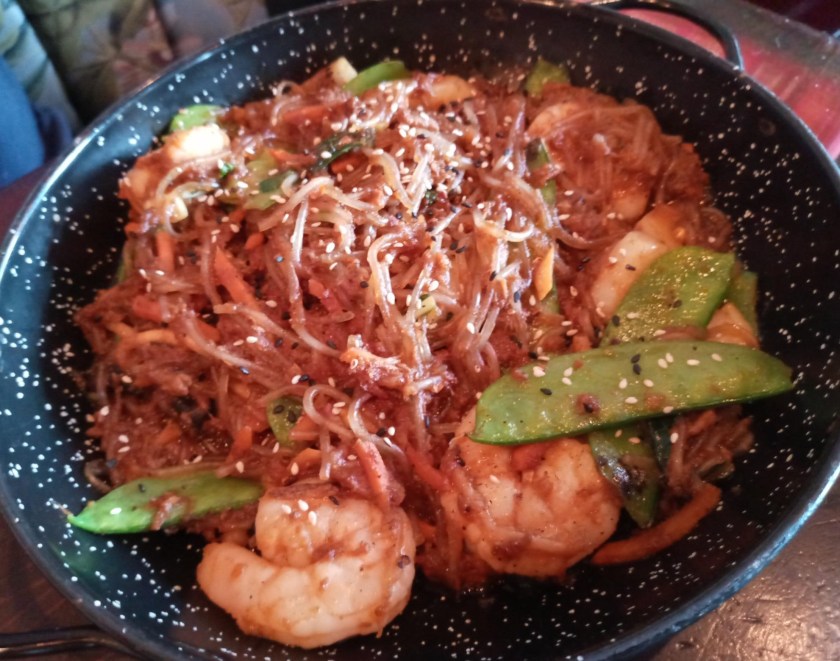
I don’t think this is on the menu anymore, but my friend ordered the gochujang noodles, a dish with spicy sweet potato noodles, shrimp, snow peas, bok choy, squash, carrots, and mushrooms.  I didn’t try it (I avoid mushrooms), but he seemed to like it. 

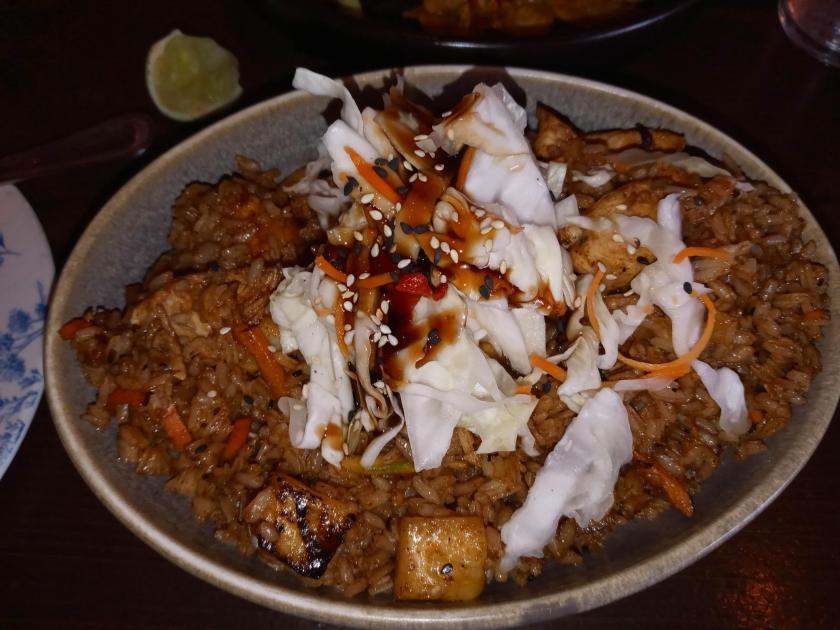
I got “dak-galbi”-style chicken fried rice, with queso frito (fried cheese!), pineapples, red peppers, seasonal veggies, maduros, sesame seeds, spicy gochujang sauce (which I have become a huge fan of), and pickled cabbage.  It was hard to choose, with so many interesting dishes on the menu, but this seemed to exemplify Finka’s commitment to fusion cuisine, while a few other things seemed a little more “normal.”

I know tourists, hipsters, and bon vivants probably avoid Kendall for their grand nights out in Miami, but there are more top-notch, destination-worthy restaurants there than when I left that area for good and moved to Orlando, at the end of 2004.  My best foodie friend and I grew up in Kendall.  We survived Kendall.  Whether you’re a Miami local or just passing through for a good time, if not a long time, you could do a hell of a lot worse than venturing into West Kendall for a memorable fusion feast at Finka.  Maybe plan accordingly and hit Finka and the outstanding Smoke & Dough on the same trip — possibly dinner at one place and takeout for lunch the next day from the other!

The Prince (Los Angeles)

The Prince (https://www.instagram.com/theprincela) is a classy, old-school Los Angeles Korean restaurant and lounge that is most famous for appearing in multiple movies and TV shows over the decades, including Chinatown (one of the greatest L.A. movies, neo-noirs, and movies in general of all time), Mad Men (one of my favorite shows of all time), and New Girl (where it was the characters’ regular hangout).  I’ve never actually watched New Girl, but now I am imagining Zooey Deschanel with bangs and glasses, singing a silly old song (maybe “Dream a Little Dream of Me”?) and strumming a ukulele in this dusky, dark red hipster hangout.

Back in November, I was on a work trip to L.A. and had a chance to join some of my amazing co-workers for dinner.  I always stay in Koreatown, where my employer is located, and where there seem to be hundreds of Korean restaurants to choose from, at all different styles and price points.  I am still very new to Korean food, but the more things I try, the more I feel inspired to branch out and try more.  The Prince was walkable from our campus, so since I was already aware of its cinematic résumé and timeless cool décor, I convinced this small group to trust and follow me.

I must apologize in advance for the photos that follow in this review.  It’s a gorgeous room, dark and anachronistic, but as soon as I took my first photo to set the scene, a server yelled at me to not use flash photography inside.  So I did my best, such as it is, to share the red vinyl booths, the dark wood, the dim lighting, and even these hale and hearty knights standing guard.

Also, I swear I saw Spike Jonze, director of super-creative movies and iconic music videos, dining there, but I wasn’t 100% sure it was him.  As much as I wanted to thank him for “Sabotage,” Adaptation, and Jackass, I didn’t want to be That Guy who disturbed his dinner… especially if it wasn’t Spike.

Anyway, our group was a mix of adventurous and unadventurous eaters, so we picked five things that looked good to everyone, and we all shared them.   That is my favorite way to dine with friends.

These are the onion rings (RING THE ALARM!) and cheese balls, because you know if I go anywhere and see onion rings on the menu, I have to order them.  They were crowd-pleasers, and it was not the first time I had really good onion rings at a Korean restaurant.   The cheese balls were even better — perfect, golden-fried, golf ball-sized orbs with melty cheese in the middle, under the breading.  I should have tried to get a shot of a bisected cheese ball to show you their molten, sticky, creamy centers, but they went fast!

When you’re introducing Korean food to unfamiliar diners, beef bulgogi is one of those perfect gateway dishes.  Bulgogi is a dish of thin-sliced beef (often sirloin steak), marinated in a savory-sweet sauce, and then grilled or stir-fried with onions and green bell peppers.  The bulgogi marinade contains soy sauce, sugar, sesame oil, garlic, ginger, and pear juice, which tenderizes the meat.  There is nothing spicy or “weird” to scare off the unadventurous diner, so it was another hit at our table. Just FYI: “bul” is Korean for fire, and “gogi” means meat.

We also ordered galbi (sometimes called kalbi), a very similar dish but with beef short ribs sliced cross-wise against the bones, rather than thin-sliced steak.  It has a similar flavor due to the marinade, but I already love short ribs in any form — not just the flavor, but the wonderful texture.  I especially like the chewy part of the meat right around the bones, which you can just pull off with your fingers if you don’t want to gnaw it off.  This was served over onions and scallions, and there wasn’t a morsel left.

I didn’t have any input in choosing this garlic shrimp dish, served with fresh, raw, shredded cabbage, but I was happy to try a couple of the shrimp, which came in their shells and had to be peeled.  It was delicious — different from scampi or any other garlic shrimp dish you might be envisioning, but still very satisfying.

I did choose this dish, though: thick, perfectly al dente udon noodles served with mixed seafood: shrimp, mussels, squid, and tiny crab legs (more trouble than they were worth to crack open).  The menu describes it as coming in a spicy broth, but it could be served mild upon request.  I honestly don’t remember what we decided as a group, but I think we went with spicy and almost everyone still loved it.

Real Korean food aficionados might be rolling their eyes, disappointed that we made relatively staid and familiar choices, but that’s often what happens in a “family-style” group dining situation.  I would have loved to try the soondae, since I always love blood sausage in all its other forms, from Argentinian morcilla to British black pudding, but nobody else was on board with this one.  It’s all good!

I have no regrets or complaints about The Prince, especially because it is such a part of Los Angeles and Hollywood history.  I would not be surprised if there are better Korean restaurants in L.A.’s Koreatown, but the vibes at The Prince are unmatched.  Every time I make it out there for work, I try to visit at least one historic, iconic L.A. landmark, whether it’s a tourist attraction, a restaurant, or both.  So far, I’m making quite a list.  I love my job, and I love L.A.!

The Moderne

I guess I haven’t published a new review in about a month, since work has been keeping me so busy.  Working from home, I also haven’t been able to go out to eat quite as often, which means I’m cooking more and saving money (yet not losing any weight).  But this review is long overdue, from a date night about a month ago at one of the prettiest, swankiest, sexiest restaurant/bar/lounges in Orlando, The Moderne (https://www.themodernebar.com/) in the foodie dream district of Mills 50.  I’m sure a lot of my regular readers have already been here, but this was our first visit to The Moderne.  I had been wanting to try it for a while, since it features an eclectic menu of small plates — mostly pan-Asian dishes, but some include other international influences, ranging from Italian to Peruvian.

This was my wife’s beautiful mojito mocktail, served with a dehydrated lime slice as a garnish.  I tried a sip, and it was delicious.  The Moderne features an enticing cocktail menu, but we were both happy to see a few mocktail options for non-drinkers like us.  I guess you could call this one a “no”-jito.   My wife reminded me to mention that she first asked for a simple Shirley Temple, but the gorgeous, well-stocked bar did not have any grenadine syrup, something we both thought was odd at the time.

Our order of duck wontons came out first.  These hand-folded wonton wrappers were stuffed with shredded duck seasoned with Chinese five-spice powder and fried until crispy.  They were served with chili oil peanut sauce.  We both wished they had been served with more duck inside, even though they tasted good and were surprisingly not that oily.

This beautiful dish was the tuna kobachi, with spicy cubed tuna, avocado, Japanese-style marinated cucumbers, scallion, red tobiko, micro cilantro, and a dish of ponzu sauce for dippin’ and dunkin’.  I loved it so much.  I could eat this every day of my life and never get tired of it, although I’d hate to think of what my mercury levels would be.  It was my favorite dish that we tried, a perfect 10/10. 

Next came our chashu quesadillas, which were plated beautifully.  Quesadillas are the easiest thing to make at home, but my homemade ones never feature chashu pork, (like the kind of pork you get in a bowl of “real” (not instant) ramen), shredded cheddar and mozzarella cheeses, Japanese Kewpie mayo, chili amarillo sauce, and pickled onions.  Well, mine would have the cheeses and Barbie Dream House-pink pickled onions, but that’s where the similarities begin and end.

This was another hit with both of us: yellowtail (hamachi) ceviche, with cubes of cool, refreshing yellowtail in mango wasabi lime sauce, diced onion, serrano, red tobiko, micro cilantro, all encased in perfectly thin, crispy, delicate spheres of pani puri, the Indian street food classic (see my Bombay Street Kitchen review for authentic pani puri).  It was a gorgeous fusion experience that dazzled all of our senses.

My wife chose these miso cream noodles, which sounded like something she would love.  The dish featured thin pasta (like angel hair or vermicelli), that chashu pork again, mushrooms, miso, fried garlic, toasted bread crumbs, parmesan cheese, and scallions.  She admitted not really being into it and said it was both very rich and on the bland side — an interesting dichotomy, kind of like fettuccine alfredo from the Olive Garden (although this definitely had more flavor than that)!  She picked at it and brought most of it home, where I happily finished it after picking the mushrooms out.  I’m a pretty tolerant guy, but I have this unfortunate intolerance to mushrooms, and chefs freakin’ love throwing them into things.

I chose a different noodle dish for myself that seemed like another fragrant fusion feast: seafood pappardelle, with pappardelle pasta (wide, flat noodles that are wider than fettuccine), shrimp, tamarind Nikkei sauce (Nikkei being a Peruvian-Japanese fusion due to all the Japanese immigrants in Peru), carrots, red peppers, onions, peanuts, and a cilantro-heavy “Asian herb salad.”  It was okay.  The sauce was a little sweet and tangy, not as spicy as I had hoped, and very thin.  I thought it was odd that the dish was called “seafood pappardelle” when the only seafood in it was shrimp.  This was a last-minute choice when the server was already taking our orders, but I think I would have enjoyed one of the other noodle dishes more.  Oh well, you live and you learn!

So that was our first experience at The Moderne.  I liked it and would go back, but my wife admitted it was not one of her favorite restaurants.  Oh well, people have different tastes and like different things — that is no surprise.  My favorites were the two dishes with raw fish, which is usually one of my favorite things to eat.  (This also explains why The Moderne’s neighbor a few doors down, Poke Hana, remains one of my favorite restaurants in all of Orlando all these years later.)  I might get those again, or other raw fish options, and I would definitely try a different noodle dish on a second visit.  Plus, after dinner at The Moderne, you can go next door and have some of Orlando’s finest ice cream at Sampaguita, which is exactly what we did on this date night!


Kung Fu Dumpling

I remember reading about Kung Fu Dumpling (https://www.kungfudumplings.com/) some time last year.  A new Chinese restaurant that specializes in dumplings and noodles sounded great, but it’s in Oviedo, at 7 Alafaya Woods Blvd #4000, right off Alafaya Trail — a direction I rarely drive in.  I tried it for the first time this past summer when I got home late from an out-of-town work trip, exhausted and hungry after dropping a co-worker off at home near there.  I figured I would end up with disappointing fast food, but when I drove by Kung Fu Dumpling and saw the lights on, you won’t believe how quickly I turned in there.

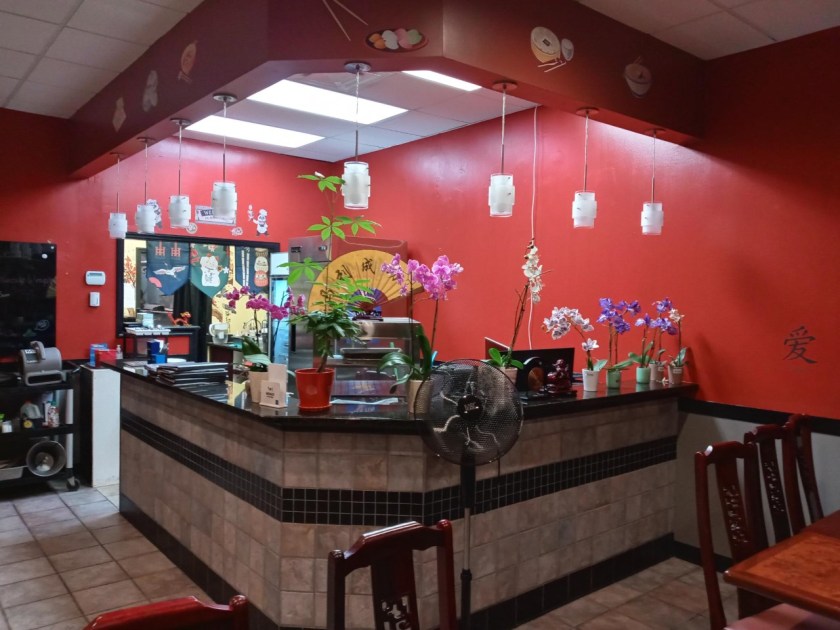
This is the inside.  There are several tables, but it was pretty quiet after 10 PM on a Sunday.  Since I didn’t even plan to stop by, I perused the menu and ordered at the counter, overjoyed that this long travel day was going to have a happy ending.   

The space is brightly lit with festive decor, and it’s sparkling clean inside.  I was relieved to hang around in the dining room while they prepared my food, after the stress of flying.  I was messing around on my phone, but it seemed like all the food I ordered was ready in about ten minutes.   

Kung Fu Dumpling offers many familiar dim sum dishes, and I couldn’t resist bringing home an order of homemade fried pork, shrimp, and chive dumplings (three for $6), since I know my wife likes those too.  If you’ve had these dumplings anywhere else, you know what you’re getting, and you’ll be very happy with them.  I figure some restaurants serve frozen ones, but these tasted very fresh.  

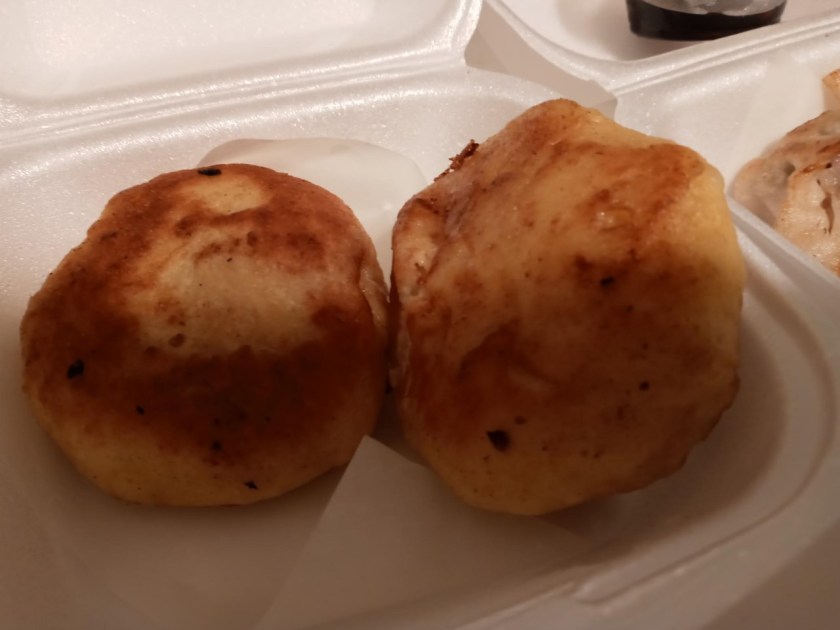
Pardon the shadows, but these were another dim sum favorite of mine, pan-fried pork buns (two for $5).  I wolfed these down, standing up in my kitchen, before I could even unpack my luggage.  We all know they’re never as good the next day!

I was thrilled to see my go-to standard Chinese restaurant dish, beef chow fun ($17), made with homemade wide, flat, chewy rice noodles, stir-fried with sliced beef, onions, and scallions.  Neither of us are huge fans of bean sprouts, so I asked them to hold those, and I was happy to not have to pick them out.  This was a shining example of beef chow fun.  In fact, one could consider it beef chow fun for the whole family.

I couldn’t help ordering a second dish I knew my wife and I could share: pad Thai ($15), a classic dish of stir-fried noodles (also homemade!) with eggs, chicken, shrimp, scallions, carrots, peanuts, and lime wedges to give it a little tangy tartness.  There is a mysterious sour-sweet flavor I often encounter in pad Thai that I love that might be tamarind, but it could also be lime.  Anyway, I don’t order pad Thai often enough at Thai restaurants, but I’m glad I ordered this version at Kung Fu Dumpling, especially with the homemade noodles.  My wife liked it too.

This is from the “Asian Wraps” section of the menu: a green scallion pancake wrap, with sweet red char siu barbecue pork stuffed inside ($10).  I’ve had similar scallion pancakes at Chuan Lu Garden, and this one worked well as a tortilla-like wrap.  I loved the combination of flavors and textures here.

This is a black sesame pancake ($5.50) that was very similar to a Malaysian paratha or roti, but not as buttery.  I know my wife doesn’t like onions or scallions, but she absolutely loved this, as I figured she would.  I resolved to return and bring her more, since I thought the pancakes and wraps were limited-time specials.  But looking at the Kung Fu Dumpling menu online, I’m pleased to say both the black sesame pancake, the green scallion pancake (also $5.50), and all the “Asian wraps” continue to be available.

So I returned to Kung Fu Dumpling a week or two later, bringing her two of those black sesame pancakes.  My wife also requested the teriyaki Buddha’s Delight ($14), a vegetarian dish with stir-fried tofu, broccoli, carrots, and onions (which I dutifully picked out and ate for her) in a lightly sweet teriyaki sauce.  I didn’t take a picture of it, but it came with fragrant jasmine rice.

And after over-ordering on my first visit, when I was delirious from travel fatigue, I stuck to one new dish the second time: Korean pan-seared braised pork belly over lo mein noodles ($16).  I hoped she would want to share this dish too, and I believe she liked the slice of tender pork belly she tried.  As for me, I loved it.  

So that’s my review of Kung Fu Dumpling, after two visits.  I’m still rarely in that part of Oviedo, where it approaches East Orlando and turns into UCF before you know it.  But even if you don’t live or work anywhere in the area, I still highly recommend Kung Fu Dumpling for your pan-Asian comfort food needs.  Whether you’re craving Chinese, Thai, Korean, Japanese, or Taiwanese flavors, you will find something you love here.  If you want late-night dim sum, they have you covered.  If you crave tender homemade noodles (as I so often do), you’ll be in for such a treat.  As the great thespian Keanu Reeves said after a grueling training session in The Matrix (1999): “I know kung fu.”  Now you, constant reader, also know Kung Fu.

Chain Reactions: bb.q Chicken

This past Tuesday was the grand opening of Orlando’s first bb.q Chicken (https://bbdotqchicken.com/), a Korean chain restaurant that was founded in 1995 and expanded into the U.S. in 2014, with franchise locations in 19 states so far and continuing to grow rapidly.  This was the first of many planned locations in Florida, right in our Mills 50 district, one of the best food neighborhoods in Orlando (in the old Tasty Wok location on the corner of East Colonial Drive and Shine Avenue, no less).

The restaurant name is a bit misleading, because bb.q Chicken does not sell barbecued chicken.  No grilling or smoking here!  The name is an acronym for “Best of the Best Quality” chicken, so if you go in expecting barbecued chicken, you’ll be confused or disappointed (although some of the sauces are sticky, tangy, sweet, and/or spicy, as many barbecue sauces and glazes are).  The chain specializes in Korean-style fried chicken wings and “boneless” chicken — think chicken tenders, strips, or fingers.  They are made of white meat from chicken breasts, so I appreciated them not being called “boneless wings,” which always annoys me for its inaccuracy.  Anyway, this is masterful fried chicken, with the perfect texture and so many different flavors to choose from.

The menu is on the website linked above, but I’ve taken the liberty of scanning the menu for this particular Orlando location, with prices that were accurate on the opening day: December 14, 2021:

I arrived a few minutes after it opened, after taking a while to find parking.  I met two other guys from the Orlando Foodie Forum presented by Tasty Chomps!, a Facebook group that has been my best source of local food news and reviews for many years, where I try to contribute and share all the information I can, along with asking questions of my own from time to time.  One of these guys is my local food guru — a guy who knows even more good places than I do, who never steers me wrong.  They arrived slightly before me, placed their orders, and got their lunches before I got mine, but we all shared our food — a perfect opportunity to try as many new things as possible.

These are someone else’s soy garlic boneless chicken strips — a small order of eight pieces for $12.  We all tried them and thought they were tasty, with a really nice, crispy, crunchy breading.  If you’ve never had Korean fried chicken before, it is truly fried to perfection, with a different kind of breading than Southern-style fried chicken that we automatically think of, like Popeyes or K-Fry-C.  It is both light and airy while also being really crunchy, even holding up well under sticky sauces. 

These were the Golden Original wings (an order of eight for $14), served with no sauce.   Yes, maybe that seems a little high, but chicken wing prices are much higher everywhere this year due to nationwide supply chain issues — this isn’t completely new, and isn’t unique to bb.q Chicken, either.  I didn’t actually try these at the time, because I had plenty of my own food coming, and I was all about sampling the different flavors while I could.  Just like with chips, I’ll rarely settle for plain when I can try all the different versions and varieties.   

One of my fellow diners ordered the rosé ddeok-bokki, a traditional Korean dish of chewy rice cakes and fish cakes in a spicy sauce ($12.95).  It was a huge portion, but I think I was more into it than either of them.  I’ve only ever had these kinds of rice cakes once before, mixed in with a Korean brand of instant ramen noodles I ate out of the pot while standing up over my kitchen sink, like a very civilized adult.   
As you can guess, these are completely different from the “rice cakes” you may be thinking of right now — hockey puck-shaped patties of crunchy white Styrofoam that our dieting moms snacked on back in the 1980s.  To this day, it never occurs to me to seek these out, just because when I think of rice cakes, I think of one of the worst snacks ever.  These ddeok-bokki (sometimes called tteokbokkiare very different — extremely chewy, with a texture like a cross between al dente pasta and Starburst candy, if that makes any sense at all.  They usually take on the flavor of their sauce, which is usually a bright red, very spicy sauce.  This rosé version scaled back the heat from the traditional version, but the orange sauce that resembled Italian vodka cream sauce was still moderately spicy.  I was the only person at lunch who is really into spicy food, but I don’t have a lot of experience with the spices used in Korean cuisine.  I was already curious about this dish, and so relieved someone else ordered it so I was able to try it!

The ddeok-bokki also included some tender cabbage and flat things that turned out to be fish cakes — not as chewy as the baby carrot-shaped rice cakes, but still chewy, with a pleasant processed-seafoody taste like surimi (or “krab,” if you prefer).   Oh, and there was half a hard-boiled egg in there too, as you can see, but the guy who ordered it got the egg.  He deserved that egg.

My friend also got a side order of these fried dumplings ($8.95) for us to share, which came with some kind of soy-based dipping sauce that may have been just plain soy sauce.  I didn’t get to try the sauce, but the dumpling on its own was pretty good.  You can’t ever go too wrong with crispy fried dumplings, unless someone sneaks mushrooms into them, in which case I might as well just throw them directly into the toilet, cutting out the middleman.  But I am relieved to report there were no mushrooms in these! 

These guys were kind enough to share their food while I waited for mine, and I was overjoyed when all of my stuff came out at once.  I picked up a tray from the front of the fast-casual restaurant, starting with a small eight-piece order of the galbi chicken strips ($12).  I know galbi (sometimes kalbi) refers to Korean-style barbecued or grilled short ribs, cut into thin slices across the bone, and marinated in a sweet, sticky, soy-based barbecue sauce.  So this is how these crispy chicken strips were seasoned, tossed in a galbi glaze and topped with green onions and sesame seeds, similar to how short ribs might be served.  Everyone at the table liked these.

I am not good at giving myself credit for accomplishments, but I don’t mind saying that I chose the best stuff of all of us, especially these outstanding Gangnam Style wings (an order of eight for $14.95).  I think these were the unanimous favorite at the table, tossed in “a sweet aromatic black pepper sauce sautéed with green onions, garlic, and peppers,” according to the menu.  They were sweet, savory, and just barely spicy, but they were the absolute best of the four kinds of chicken we shared.  They were definitely the most flavorful chicken we all tried, and also the crunchiest.These wings made me think of “Gangnam Style,” the one U.S. hit by Korean pop performer Psy, for the first time in many years.  It is an interesting footnote in music history that the frenetic dance-pop bop “Gangnam Style” is very likely the first song that most Americans ever heard by a Korean recording artist, a whopping nine years ago, long before K-Pop exploded here and became a major cultural phenomenon.

Oh yeah, RING THE ALARM, because bb.q Chicken also serves onion rings ($6.95), and they were terrific.  Large, firm, golden-brown, beer-battered onion rings — the kind I love — but they also had a light, airy texture and weren’t dripping with grease, no scorched spots, no rings falling apart.  Like I said, they fry everything to perfection here, even in their first hour open for business.  Even sharing my food with two other hungry guys, I had some leftovers to take home, including  a few assorted pieces of chicken and the vast majority of the onion rings!  Hey, I filled up on ddeok-bokki, which is the first time I’ve ever written that, but it may not be the last.

Finally, all of our meals came with plastic cups of pickled daikon radish, chopped into cubes.  I absolutely love most pickled vegetables, including these.  They are sweet and crunchy and cool with the slightest vinegary tang, perfect for cutting the rich, sweet, spicy flavors of Korean fried chicken.  I’ve only ever had pickled radish like this once before, from another Korean wing chain that I didn’t enjoy nearly as much as bb.q Chicken.  Those wings from the other place didn’t strike me as anything special, and the pickled radish was my favorite part!  Here at bb.q Chicken, the radish was just one more element that made this a winning lunch and a great new addition to Orlando’s dining scene.   My dining companions weren’t into these at all, so I ended up with almost four full cups of the pickled radishes to take home and enjoy later, along with the leftover wings and rings.  The next evening, I heated everything back up in the toaster oven (no fancy air fryer for me!), and they crisped back to life rather well.  Even my wife, who was skeptical because she despises anything spicy, was really impressed by the flavors (which weren’t spicy at all) and crispy fried coating on both kinds of chicken, even 24 hours in the fridge and a reheating later.

So bb.q Chicken was a big hit with me and the three people I shared my food with, and I think it will be a huge success in Orlando’s Milk District.  Score!  Or should I say: “OPPA GANGNAM STYLE!”

CLOSED: Uncle Dendog’s

UPDATE: Sadly, Denni Cha, the chef-owner of Uncle Dendog’s, moved his family to Austin, Texas, in 2022, so Uncle Dendog’s is no more.  Orlando’s loss is definitely Austin’s gain.

Ever since I was a little kid, I’ve been obsessed with comic books, to the point of making it a serious field of academic study.  Heck, this food blog is even inspired by a comic book series called Chew.  (Check the page heading, in case you’ve never glanced at it before.)  But as much as I love the characters, I focus the most on the creators who write and draw them, and I can always identify their unique, defining styles.  For example, the legendary Jack Kirby (co-creator of most of the Marvel characters you would recognize) specialized in burly, square-jawed heroes and imposing alien technology surrounded by crackling energy.  Jim Lee‘s human figures look like flawless gods and goddesses.  Arthur Adams draws huge monsters and super-cute women, always with extraordinary attention to detail.  Kevin Maguire and Steve Lieber are masters of expressive faces, who can convey so much emotion — and especially humor — with just a look.

Where am I going with this?  Well, as a self-proclaimed food writer, I don’t pretend to be the expert on food that I am on comics, but I feel like I’m at a point where I recognize the signature styles and flourishes of some of the talented chefs who prepare the food I love so much.  I can always identify the best comic creators by their written voices and artwork, whether they work on a mainstream superhero comic, a crime graphic novel for “mature readers,” or a deeply personal, autobiographical, self-published story, and some chefs stand out to me the same way, even when they transcend cuisines.

Orlando is home to some real innovators and creative dynamos who have built a strong culinary culture here, and one of my favorite local chefs is Denni Cha.  He has been cooking since he was nine years old, ever since his grandmother taught him to cook in the kitchen of her Korean restaurant.  I first discovered his food in the summer of 2020, when he ran a Japanese pop-up called Itamae Densho out of The Local Butcher, the Winter Park meat market that also hosts previous Saboscrivner review subject Swine & Sons and Da Kine Poke.  I reviewed the gorgeous, almost otherworldly looking chirashi bowls I brought home from Itamae Densho — maybe the most beautiful things I saw in 2020, an otherwise ugly and stressful year.  They were like little landscapes in a bowl — multiple kinds of fresh fish and vegetables over rice, even adorned with edible flowers and ziggurats of fractal romanesco jutting past gleaming orbs of salmon roe.

Unfortunately, Itamae Densho is no more, but Chef Denni is back with his latest venture, something far removed from chirashi bowls but still totally in character and on brand: Uncle Dendog’s (https://www.instagram.com/uncle.dendogs/), a food truck (really a trailer) that specializes in Korean corn dogs and other street foods with a foreign, fusiony focus.  Follow his Instagram page to see where he’s going to turn up next!

I was the first person to arrive at Uncle Dendog’s this past Friday night, set up outside Orlando Brewing, the brewery and taproom south and west of downtown Orlando.  Not being a drinker, I had never been there before, so I didn’t know how busy it would get later or how the parking situation would be.  But I do prefer to grab my food on the early side, especially since I was bringing it home after work. 

I have taken the liberty of posting photos of the menu, although it may change from week to week or even night to night.  I knew I had to try one of Uncle Dendog’s signature K-Dawgs, so it was just a question of choosing which one.   
But I knew he had a new special, just weeks after opening for the first time, and that was what drew me out on this rainy evening.

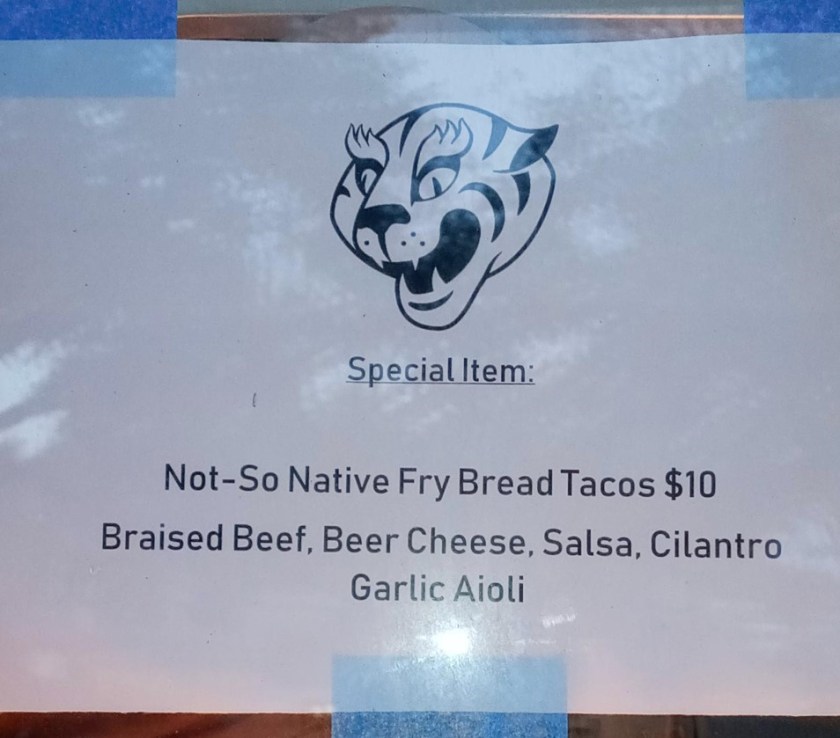
This was it: “Not-So Native Fry Bread Tacos.”  For many years, I’ve heard and read about Navajo-style tacos, a Southwestern delicacy of meat, cheese, peppers, corn, beans, sauces, and more, served on crispy, pillowy, salty, greasy fry bread, a traditional staple food of Native Americans throughout the American Southwest.

Fry bread may be delicious, but it has a fraught, controversial history in Navajo culture due to the lasting effects of colonialism, when the U.S. government gave the Navajo people flour, sugar, salt, and lard as they were forced to relocate onto desolate, dusty reservations where they could no longer grow traditional, healthy crops like corn, beans, and squash.  There is a schism within the Native American community, and even among Native American chefs, about whether fry bread is an unhealthy, lasting symbol of oppression or a tasty treat born out of resistance and resilience.  It is absolutely not my place to decide or judge which side is right, but I can say a few non-controversial things with certainty, though:
1.) Chef Denni Cha is of Native American (and Korean) descent,
2.) He told me a while back that he planned to offer fry bread tacos as a tribute to his Native American heritage, so I’ve been looking forward to them ever since, and
3.) They were one of the best things I’ve ever eaten.  Yes, in my LIFE.

But first things first: I asked Chef Denni’s lovely wife and partner, Monica, which K-Dawg (Korean corn dog) she recommended, and she told me to go with the Korean in Bogota ($10), a massive meat treat with the lightest, crispiest batter coating a perfect, smoky, salty sausage.  Korean corn dogs are definitely Internet- and Instagram-trendy right now because of how photogenic and eye-catching they are, and this one was no exception.  It was a true fusion: an all-beef Nathan’s hot dog lovingly skewered, dipped in a special batter, and fried until it is crispy outside and lusciously soft inside — an archetypal Korean corn dog even if I had ordered it plain.  But Colombian hot dogs and hamburgers are famous for being served with lots of condiments and toppings, so this was a tribute to those — hence “Korean in Bogota.”  More fusion.  More loving, respectful tribute.  Just like in comic books, this was a legit crossover.     
As the menu said, the corn dog is topped with shiso-cilantro garlic aioli, salsa rosada, pineapple salsa, and crunchy potato sticks, and sprinkled with sugar, for a variety of colors, flavors, and textures — salty, crunchy, spicy, creamy, fruity, greasy, soft, cool, sweet, hot.  (When I asked about the sugar, Denni said “Korean Hotdogs usually get heavily dusted in sugar. We do so much else with them that we just lightly sprinkle it.”)  Anyway, I’m glad I took this home and ate it over a table, because it would have been really messy eating standing up at the brewery or in the parking lot outside.

Next up, I brought home an order of lightly breaded wings ($9).  My wife loves wings, but as much as I appreciate sauces and condiments, she isn’t big on them, so I got these plain with her in mind.  The order came with six huge wings in crispy golden-brown batter, and they were really good.  The battered exterior was still crunchy and warm by the time I got home.  I asked, and this batter for the wings is different from the batter he uses for the corn dogs and fry bread.   

If you want something a little more exciting than plain wings, the other alternative is to get them tossed in a sweet, sticky kimchi sauce.  When Chef Denni kindly asked if I wanted a little ramekin of the sauce on the side, I said YES, which is what you say if someone asks if you are a god, or if you want some sauce on the side.  That sauce was so good, we poured it over the four and a half wings we hadn’t eaten yet, and it made them even better.  Even after saucing, they stayed crunchy and never got soggy, even after reheating some leftover wings in the toaster oven the next day!   
I don’t have a lot of experience eating kimchi, which is weird, because I love pickled vegetables, I’ll eat sauerkraut straight out of the jar or can, and I regularly cook braised cabbage at home.  I need to develop my taste for kimchi, just like I did for pickles.  But this sweet kimchi sauce made these fine wings even finer.

I saved the best for last, which speaks volumes, considering how great the corn dog and the wings were.  I ordered two of the Not-So Native fry bread tacos ($10 each), one for each of us.  They came in the same box and looked like the stuff that dreams are made of.  Topped with braised beef, beer cheese, cilantro-garlic aioli, salsa, corn, black beans, and more potato sticks, they were another amazing, astonishing amalgam of fantastic, fabulous flavors and terrific, tantalizing textures.  But what really took these from tasty street food to next-level works of art was the fry bread itself.  
Chef Denni was very forthcoming when I asked him about the fry bread later on.  He uses the same batter he uses for the K-Dawgz (corn dogs), only he lets it proof longer, for a total of 48 hours, to get to the right consistency for his fry bread.  My wife described the texture of being like a really good, really thick “old-fashioned” doughnut (those wrinkly glazed ones, sometimes called sour cream cake doughnuts), only crispy on the outside.  Denni agreed, saying he has compared them to “savory doughnuts” before, but more airy and fluffy.  I swear, you’ve never had tacos like this before, and I’m 100% sure nobody else in Orlando is making these.  The closest thing I could compare them to are sopes, but they are way better than any sopes my wife and I have ever tried.  I can’t imagine anyone not liking these, unless you keep kosher (in which case, ask to hold the warm, gooey beer cheese) or are a vegetarian (in which case, ask to hold the delicious, tender, savory braised beef).  Heck, even going to town on some plain fry bread would be a treat, maybe with some hot honey squirted on it like the best sopapilla ever.  But don’t miss these Not-So Native tacos!

And here’s a mediocre photo of Uncle Dendog himself, Denni Cha, hard at work in the trailer, packing up my takeout order in his panda sushi apron.  He actually took a moment to pose for me, but I said “Thank you!” like a boob before actually taking the picture, so he moved, and this is what I got — totally my fault.  I’m sorry, Chef.

So what does this have to do with the comic book artists?  Well, I told you I’m starting to identify local chefs from their styles, just like the artists I’ve admired for decades.  And after having Chef Denni’s chirashi bowls at Itamae Densho and now his Colombian-inspired Korean corn dogs and Native American fry bread tacos, I think the common element that identifies and unifies his style as a chef is the sheer beauty of it.  His serving dishes are the canvases of an iconoclastic visionary artist, whether they’re bowls with a base of rice or takeout boxes with paper trays inside.  And he builds these mixed-media structures, assembling them from diverse, colorful, fresh, dazzling ingredients that you might not even think belong together, but that’s only because we don’t think like he does.  Especially here in Uncle Dendog’s trailer/studio, he’s creating cross-cultural culinary mashups and remixes — appropriate, because he is also a musician — and elevating humble, familiar street food to eye-catching, awe-inspiring fine art.  You’ll know it when you see it, because you won’t forget it… especially once you taste it.

The Pass Progressive Cuisine

Not being an influencer, I sometimes arrive a little late to the hottest foodie trends. But for a couple of months, I’ve been salivating over photos and videos of birria tacos made with braised, shredded beef brisket or goat and served with a dipping cup of rich, glistening, orangey-red consommé. Now Orlando has a few Mexican restaurants that serve birria, and today I finally tried it at one of our newest birria boutiques: The Pass Progressive Cuisine (https://www.thepassprogressive.com/), located in a nondescript industrial warehouse plaza in Altamonte Springs. It’s a little off the beaten path, but the best places often are. And you don’t want to pass on The Pass Progressive, trust me.

My wife wasn’t as psyched for birria as I was, but at all of our favorite taquerias and Mexican restaurants like Tortas El Rey and Francisco’s Taco Madness, she always requests carne asada tacos, so that’s what she wanted to try here. You get an order of three for $11.95. I took one little bite and loved what I tasted, but more importantly, so did she. The steak was tender and picked up nice flavor from being grilled, and I think I detected some lime juice in there.

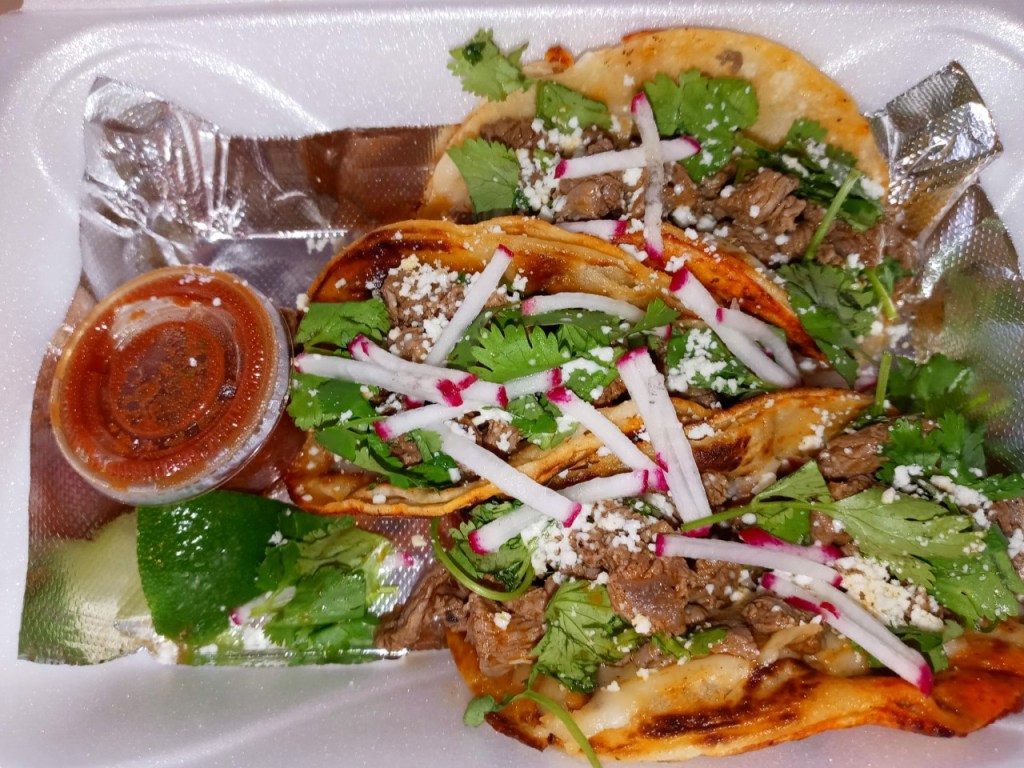
You can see they are absolutely stunning, topped with a snow flurry of Oaxaca cheese, fresh cilantro, and julienned radishes on soft corn tortillas. The carne asada tacos come with guajillo chile salsa, but my wife isn’t big on salsas, sauces, or anything too spicy, so I ordered it on the side for her (so I could have it).

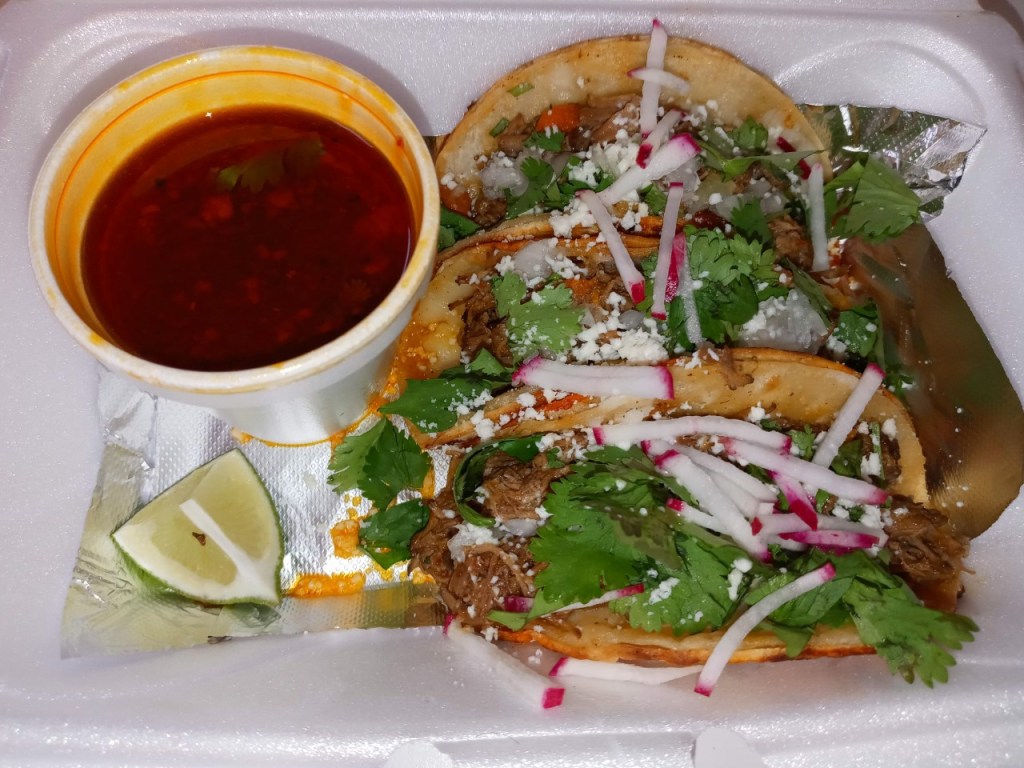
But here it is, the star of the show: birria tacos! These also come in an order of three for $11.95. They were also topped with cilantro, radish, onion (I asked them to hold the onion for my wife’s tacos), and a dusting of Oaxaca cheese, plus there’s that rich, flavorful consommé.

The meat was so flavorful and tender from being braised and shredded, it didn’t even need the consommé, but you can bet I dipped anyway. Things got a little drippy and greasy from there, but we were at home, so all was well.

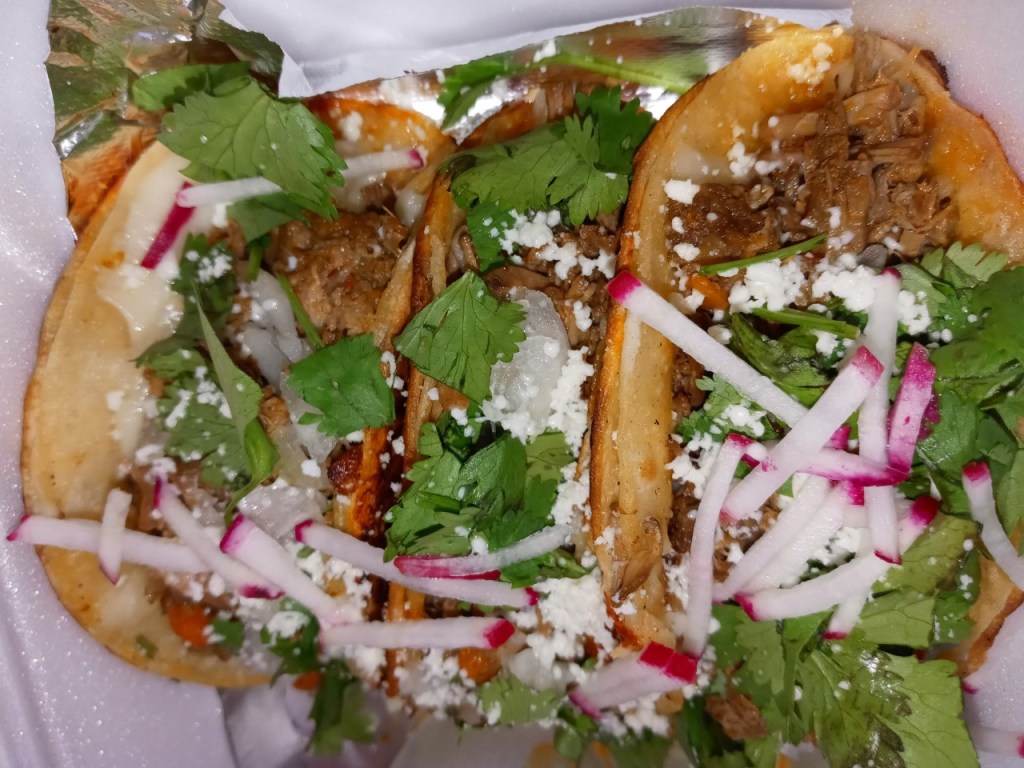
Close-up of these beautiful birria tacos:

They must season and grill these corn tortillas, because they are some of the best corn tortillas I’ve ever had. They held up to a lot of heavy ingredients and hungry handling, and really helped make the tacos into something special.

Since this was my first visit, I couldn’t resist ordering something else for later, so I went with something completely different: the Jaeyook Korean pork burrito ($11.20), with white rice, black beans, cheese, sour crema, avocado, kimchi cabbage, perilla leaf (a plant in the mint family, related to Japanese shiso), and spicy gochujang sauce wrapped up in a huge flour tortilla. I often like burritos even more than tacos, but I wanted to try birria in its traditional taco form and get something else as a burrito.

This one was a little spicier from the gochujang sauce, but nothing I couldn’t handle. Like all the other food from The Pass, it was gorgeous, with such an eye-catching blend of colors and textures, in addition to all the flavors at play. All their burritos come with excellent fresh, crispy, salty tortilla chips that we shared, and a different salsa that was all mine.

Sauce gallery!

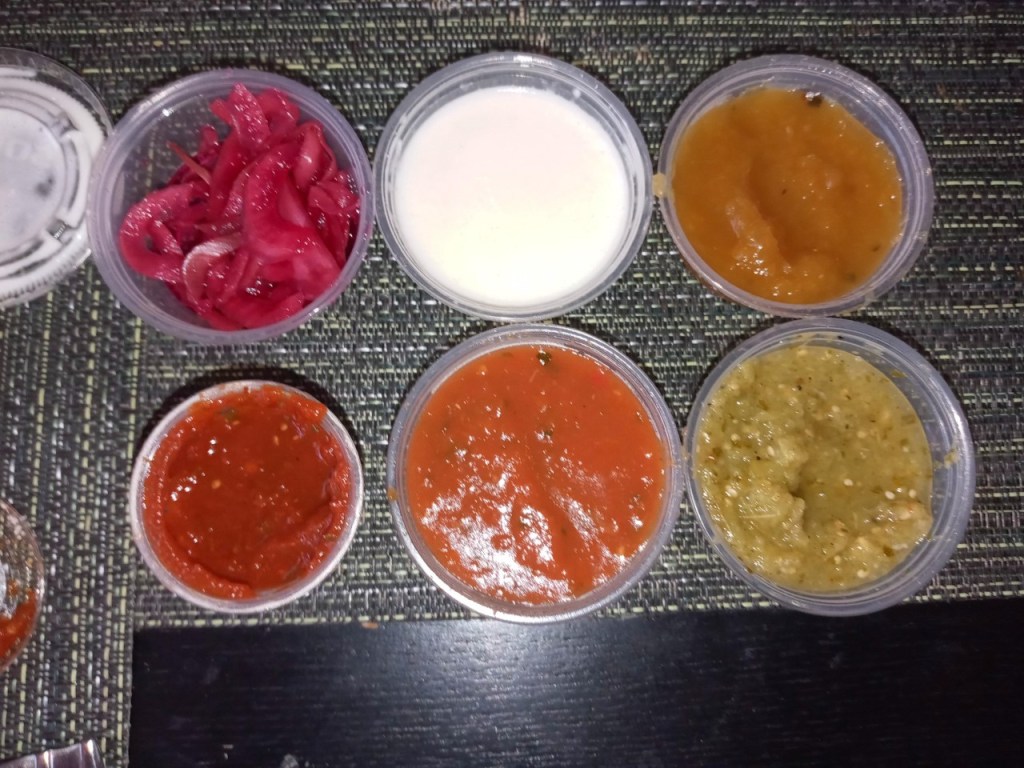
Here you see pickled red onions that came with something, garlic aioli that had a thinner, more crema-like consistency than I expected (50 cents), the most delicious pineapple chutney that was so sweet it could have gone on an ice cream sundae (50 cents), the guajillo chile salsa that would have come on my wife’s carne asada tacos that she asked for on the side, the salsa that came with the burrito and chips, and some tomatillo salsa. Of all of these, the pineapple chutney was the big winner for both of us, and I also loved the smoky guajillo chile salsa. I’d buy both of those by the jar or bottle.

As you might guess, The Pass Progressive Cuisine was a big hit, and I know we’re not the only people falling in love with their food. I expect the legend will only grow, so you (possibly) heard it here first, on The Saboscrivner! I can’t wait to return and try their Caribbean wings, their ancho-braised beef or chicken empanadas, their lobster tacos (with lobster consommé!), but I know I won’t be able to resist the birria, so I’ll just keep ordering multiple things. And in case you ever tire of tacos or burritos (the horror!), you can also get almost everything as enchiladas or quesadillas too.

Just remember that The Pass Progressive Cuisine doesn’t have seating, so it’s a takeout-only place — but that’s perfect during a pandemic anyway. And they are open Tuesday through Friday, 12 – 8 PM, and Saturdays 12 – 5 PM.

Tako Cheena

My wife and I have always been huge fans of Tako Cheena (http://mytakocheena.com/), the creative and bohemian Asian-Latin fusion restaurant on Mills Avenue, north of Colonial, in one of Orlando’s finest foodie neighborhoods, Mills 50.  It used to be in a tiny space in a little strip plaza on Mills, with very few parking spaces in front, to the point where we’d often have to circle the block six or ten or twenty times, or more realistically, time our visits for when the place was just opening up.  There was a somewhat steep step up that limited the accessibility for my walker-wielding wife, and a tiny, cramped dining room that further limited her mobility inside once I helped hoist her up.  The food was always delicious, but it wasn’t the most comfortable surroundings, despite the hip, colorful, artsy decor.
DSC03091

Well, I was recently craving Tako Cheena after a rough week, and to my great joy, they recently moved into a larger building mere steps from their old location.  And it has an actual parking lot, plus a spacious outdoor patio.  I was just picking up takeout from an outside-facing window, so I didn’t linger or even peek inside to look at indoor seating.  However, the new location already looks so much more comfortable and accessible, and that is like a dream come true for us.
DSC03093

The covered patio overlooks Mills Avenue, and you can see it is steps away from the original location:
DSC03095

Since the menu on the website doesn’t have most of their newer menu additions of the last few years, or any prices, this was the best shot I could get of the posted menu.  A past favorite, Mary’s Greek Lil Lamb (a gyro in taco form) has never been on their old menu on the website, so I didn’t even think to order one this time, but I was glad to see it has been added to the new menu.  The pernil asado, slow-roasted, marinated pork, is pretty darn great too, but I didn’t order that either on my most recent visit.
DSC03096

Since I haven’t even been here since I started this blog two years ago, I ordered a bunch of our old favorites.  I got us each a panko-crusted cod “tako” ($4.50), with spicy mayo, shredded cabbage, and scallions on a soft flour tortilla.  This was the first time they asked me if I wanted flour or corn tortillas, but they could have started giving customers that choice at any point in the last two or three years.  These are my favorite fish tacos in Orlando, and I was sad to learn they were out of the usual sweet and sour onion sauce that goes on them, but they were still delicious.  My wife, who always used to love these, thought hers was too spicy, so I ended up eating most of hers too.  I love spicy mayo on anything, so they were perfect for me, as usual.
DSC03097

Miami kid that I am, I have a hard time turning down empanadas, those crispy-fried half moon-shaped pastries stuffed with a variety of savory or sometimes sweet fillings, sealed with a crimped edge.  Different cultures make different empanadas, but I always prefer a deep-fried, crispy flour pastry shell, and those are the ones they make here.  Tako Cheena always offers different beef, chicken, and vegan empanadas of the day ($3.25 each), always rotating creative fusion ingredients in each one.  I asked what the beef empanada of the day was, and this one had seasoned ground beef like picadillo with mashed potatoes and sweet plantains.  Yes please!  I could have easily eaten two of more of those crispy fried pastries, especially since sweet plantains are a top ten favorite food for me, but I stuck to one.
DSC03098

The empanadas come with a very small plastic dipping cup of salsa.  When I placed my phone order, the guy asked if I wanted sweet or spicy.  I asked if I could try both, and he said yes.  Well, my bill had a “GG” next to the empanada at no charge, and an “HJ” that I was charged 50 cents for, so that’s how I learned additional salsas come at a cost.  I don’t mind, because I always love trying new salsas.  I could be wrong, but looking at Tako Cheena’s website and the menu above, I’m guessing the “GG” refers to ginger guava salsa, and the “HJ” is probably habanero jackfruit salsa, even though they list it as “jackfruit habanero.”

The website advertises “BURRITOS THE SIZE OF BABY’S [sic] ARMS,” and they aren’t exaggerating.  I ordered the Korean burrito ($10.75), stuffed to almost bursting with sweet and savory marinated beef bulgogi, kimchi fried rice with mixed vegetables, crema, sriracha, ginger scallion oil, and cilantro.  It was a really interesting blend of flavors and textures wrapped in that huge, straining flour tortilla, which is one reason I prefer burritos to tacos.  (GASP!)  It’s so huge, I saved half for the next day, and even the half is a generous portion.  That isn’t something I normally order at Tako Cheena, but I wanted to present more of a variety of options for my baker’s dozens of readers.

Look at how much room it takes up on our now-familiar green plates!
DSC03101

Here’s a shot with burrito and empanada interiors:
DSC03102

Another one of our long-time favorites isn’t listed on the menu on the website, but Tako Cheena has incredible arepas, sweet corn patties stuffed with a variety of ingredients.  Our favorite is the four-cheese arepa ($7.50) with a big fried cheese patty, topped with pickled shredded carrots and other vegetables (maybe jicama or daikon radish?  Although it looks similar to Filipino atchara, or pickled papaya salad), and spicy mayo.
DSC03099

Picking a favorite item on the whole menu feels like being forced to pick a favorite child, for those who have more than one child, but this arepa might be it:DSC03100

Cross-section.  I should note that the cheese is lightly fried on its exterior, but not battered or breaded like my beloved mozzarella sticks.  It’s more like halloumi cheese that way, with a similar texture.DSC03104

One thing you probably noticed by now, that I definitely appreciated, was how they packed all our takeout food either wrapped in foil wrappers or placed in cardboard boxes.  It was nice to see some eco-friendly alternatives to styrofoam.

Even though some restaurants are reopening for dining in, my wife and I are in no hurry to start doing that again anytime soon.  But now that Tako Cheena has a parking lot of its own and that convenient walk-up window, I’ll probably order more takeout from them in the weeks and months to come.  I’m glad an old favorite is more accessible than ever before, and as good as ever.