Walala Asian Noodle House

Earlier this year, I met two foodie friends at a relatively new restaurant in Orlando’s “Chinatown,” a huge plaza in Pine Hills on West Colonial Drive that is absolutely full of Asian-owned restaurants and other businesses, including Enson, a sprawling supermarket.  I’ve eaten at a few places in the Chinatown plaza and reviewed two of them, both of which have since closed.  But one that I know isn’t going anywhere anytime soon is Walala Asian Noodle House (https://walalaasiannoodlehouse.toast.site/), specializing in hand-pulled noodles in rich, beef-based soups from Lanzhou, China.  The noodles are called lamian, the term that gave us both Chinese lo mein and Japanese ramen.  Don’tcha love etymology?

Back in 2023, I visited and reviewed Mr. J’s Hand-Pulled Noodle in Ocoee, but I really preferred my meal at Walala.  Not only was it a lot closer to home, but everything had more flavor.  Of course, it helped that I went with two friends, and we shared everything.  That said, we all ended up with the same kind of long, thin lamien noodles, even though Walala also offers Japanese ramen (but there are so many good places for ramen already, especially my favorite, Ramen Takagi), Hunan-style rice noodles (which we all thought might be too similar to the familiar noodles in pho), hor fun noodles (I’m assuming wide, flat noodles like in beef chow fun or ho fun, even though hor fun cracked us all up), and they added knife-cut noodles  to the menu after our visit.

It was my choice to start with a tea-infused boiled egg for each of us.  I know, I know, in this economy?  But before eggs became a luxury good, I was experimenting with pickling eggs with different combinations of vinegar, herbs, spices, and other seasonings, and I enjoyed similar tea eggs at Mr. J’s.  (Anyone else reading that in the late Arleen Sorkin’s voice?  Seriously?  Just me?)  Just like at Mistah J’s, we had to peel the eggs ourselves, but these came pre-cracked:

Due to the cracks, they took on beautiful patterns from the tea infusion process:

We shared an order of rich, chewy pig ear slices tossed with spicy chili oil and fresh herbs, including lots of fresh, bright-tasting cilantro.  This is probably better than you are thinking.  They were cartilicious!

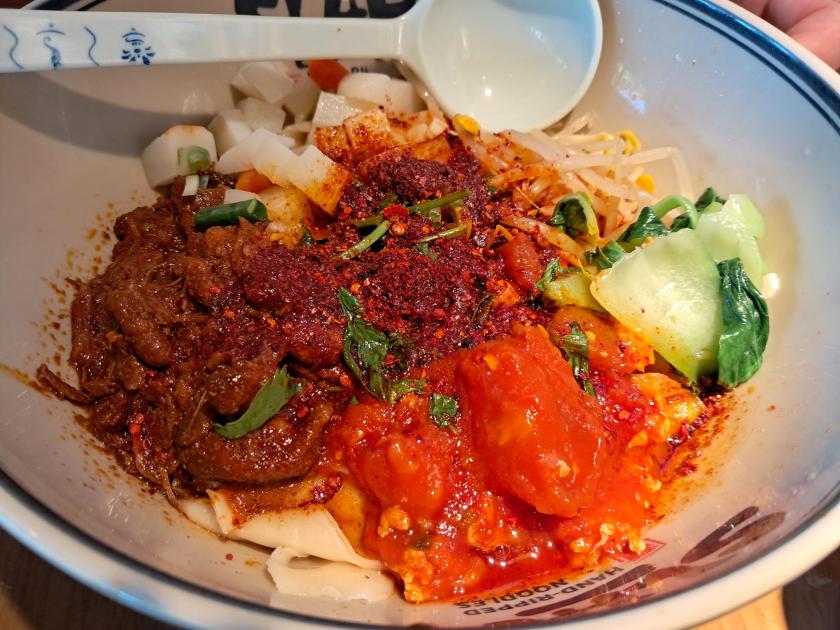
One of my friends got braised beef boneless short rib soup with the hand-pulled noodles.  I was tempted by it, because I love any braised meats and especially short ribs, but she let me try a piece, and it was an excellent choice.

Another friend, much more familiar with Lanzhou cuisine than the rest of us, ordered braised honeycomb tripe soup with the same hand-pulled noodles.  I enjoy some unpopular organ meats (give me all the liver, beef tongue, beef tendon, and chicken hearts you have!), but I’ve never developed a big appreciation for tripe, despite all the times it has ended up in my pho and I still eat it.  It’s a texture thing, but this tripe looked a lot different from the style most Vietnamese restaurants add to pho. 

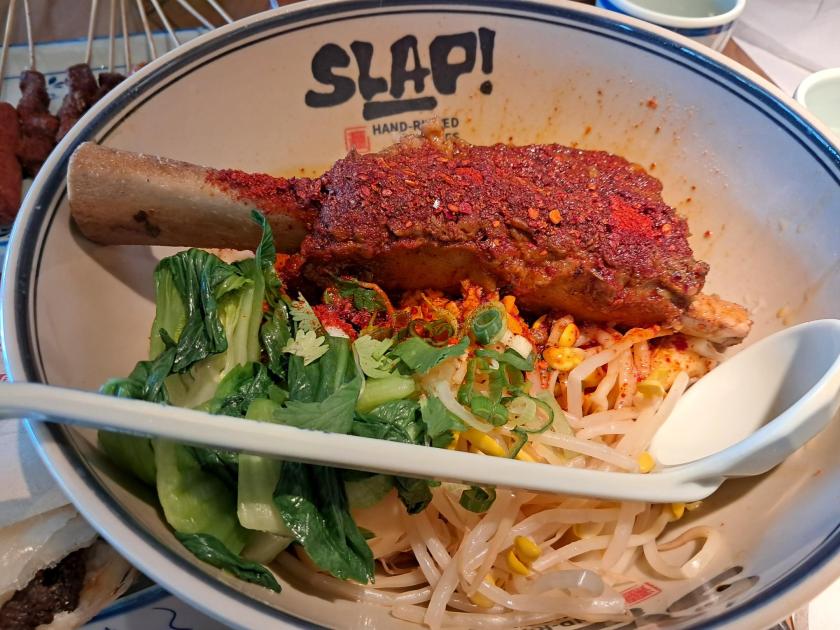
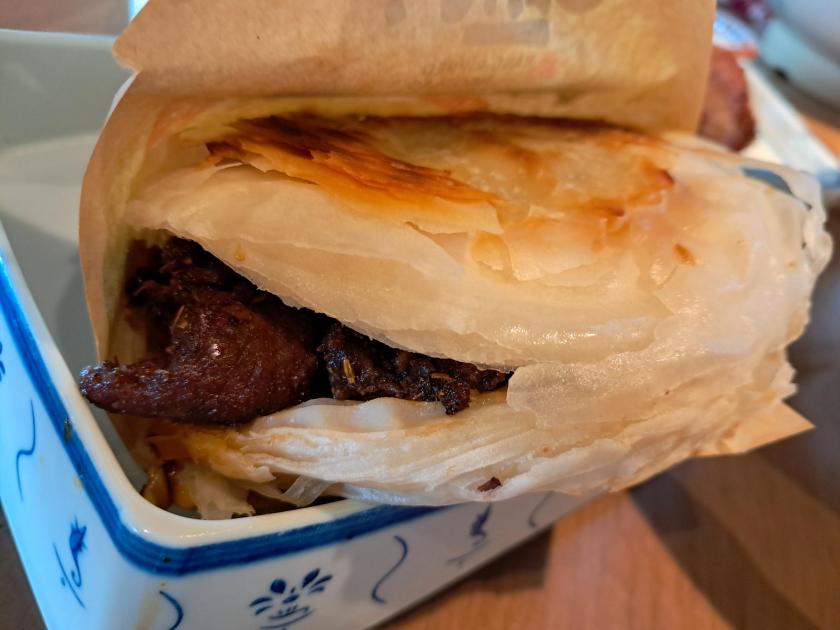
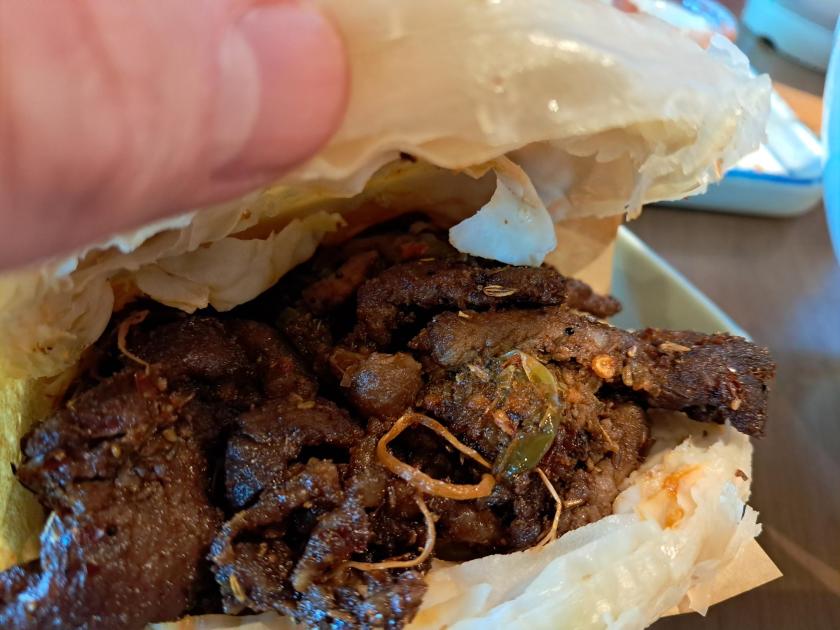
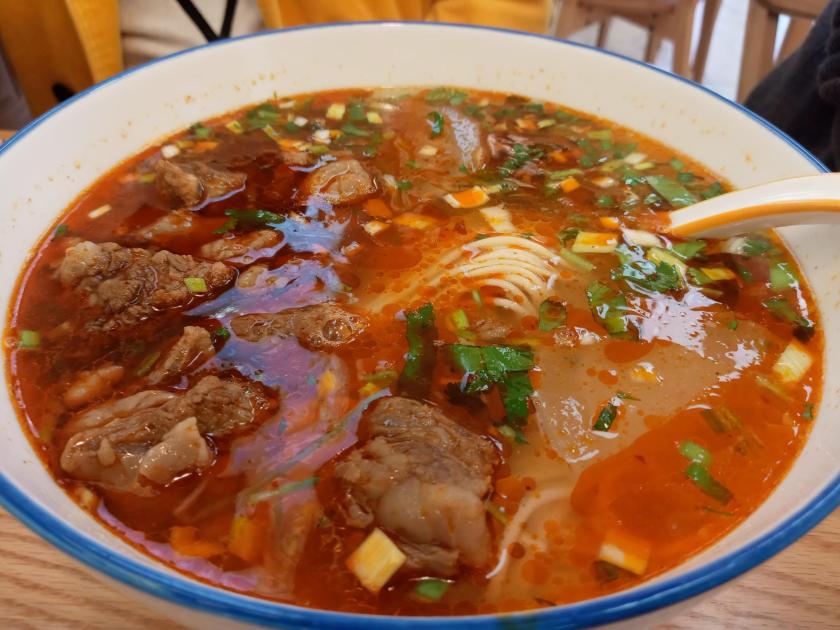
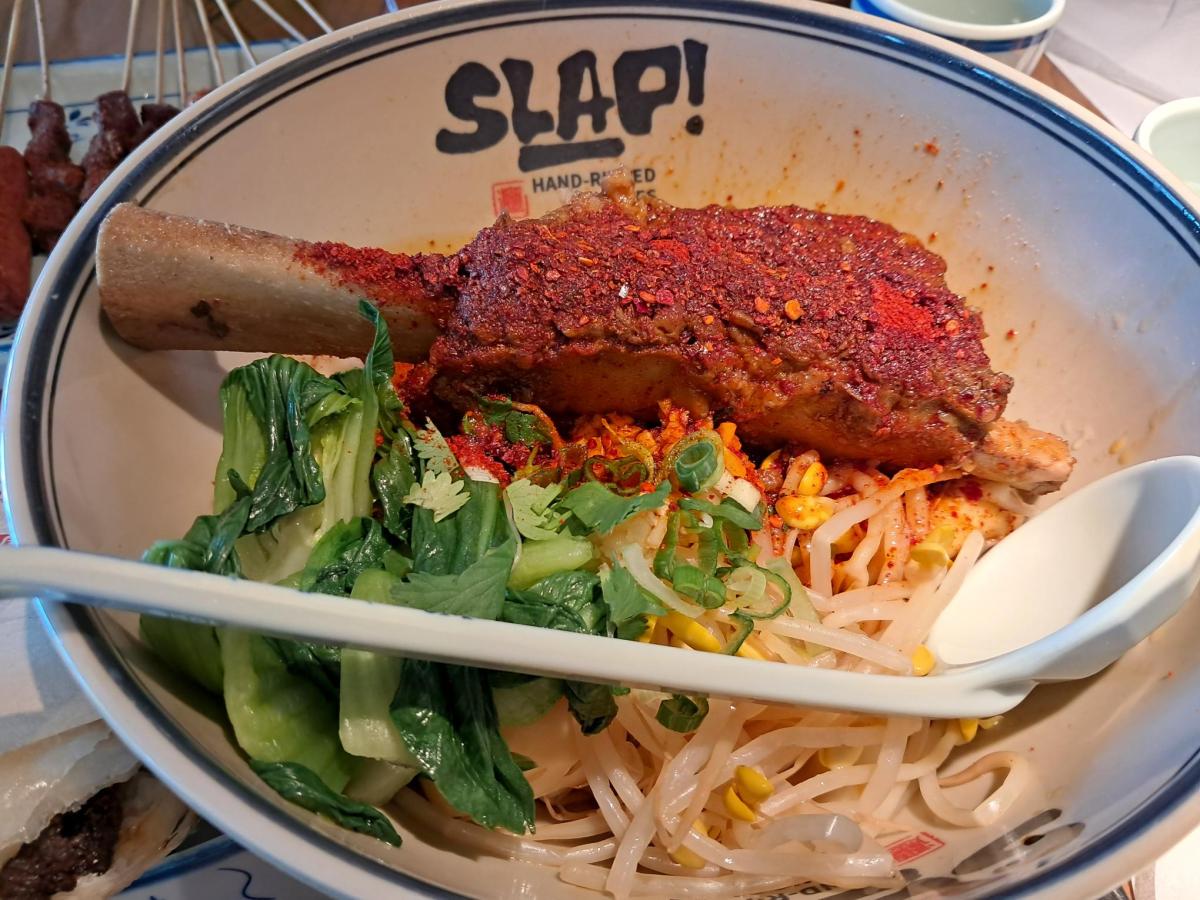
I ended up getting the large sliced beef shank noodle soup because I love lamb shanks so much, and because this one also came with beef skewers on the side.  I couldn’t pass that up!  The meat was very tender, the broth was a little spicy and very unctuous from all the meat (including bones and fat), and the noodles were nice and springy and chewy.  Totally different consistency from Italian pasta or the rice noodles in pho.

Why didn’t at least one of us order a different kind of noodle?  The world will never know.  (But they also offer rice noodles and ramen, although you can get good-to-great ramen at so many other places.)

Anyway, Walala does something I’ve never seen a restaurant do before.  If you eat all your noodles but still have a lot of soup left, they will bring you another order of plain noodles to add back into your soup, and it’s free!  It almost sounded too good to be true, but two of us tested it.

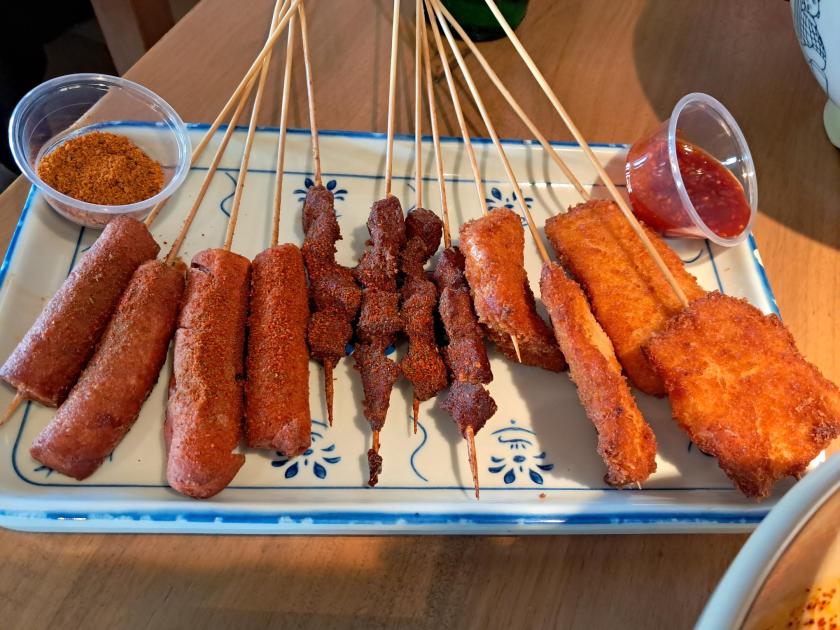
And here are the heavily seasoned, slightly spicy skewers of slightly chewy beef.  These are individual cubes, not whole pieces, so it was very easy for us to share.  

Unfortunately, I didn’t get to try the Chinese pickles, but there are so many interesting things on the menu, including new knife-cut noodles they didn’t have on my initial visit (wider and flatter noodles, essentially shaved off the block of dough straight into boiling water, so they end up with beautiful fluted edges), a return trip can be easily justified.

So that’s Walala, although you’re probably hearing A LOT more about it, since it just received a prestigious Michelin recommendation at the recent ceremony last month.  I personally have more faith in my own taste and that of my friends, acquaintances, and mutual followers than a non-transparent process and anonymous reviewers from a tire company, but I am still thrilled for Walala and all the other local Michelin award recipients (see my recent reviews for others).  Regardless of my own skepticism and misgivings, those awards will drive more business their way, and I don’t begrudge that to anyone.  It’s one of the most unique Chinese restaurants in Orlando, and especially if you love noodles like I do, you must get over there as soon as possible.

Kai Kai

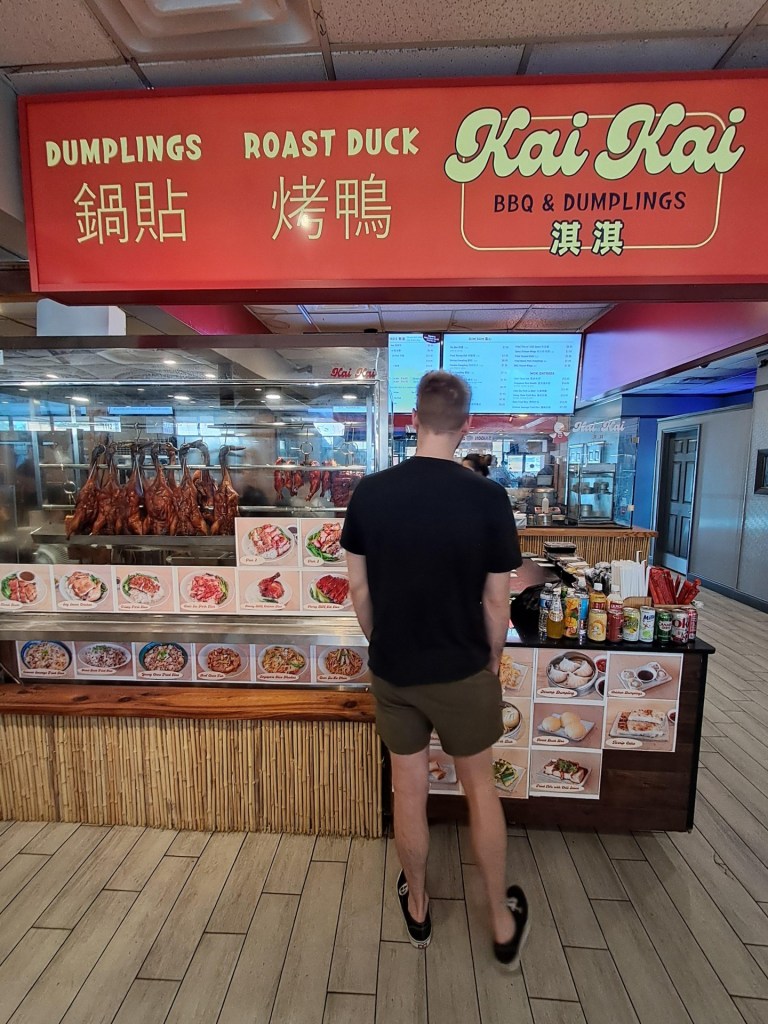
This week, I want to talk about Kai Kai (https://www.instagram.com/kaikai.bbq/), Jerry and Jackie Lau’s stall that serves up Cantonese barbecued meats, as beautiful as they are delicious.  Kai Kai is located inside Mills Market, the new Asian food hall on East Colonial Drive between Mills and Thornton Avenues in Mills 50, arguably Orlando’s best foodie neighborhood.  Last week’s review recipient UniGirl is one of Kai Kai’s neighboring stalls inside Mills Market, and so is former favorite Banh Mi Boy, that Vietnamese sandwich stall sandwiched between UniGirl and Kai Kai.
Before Mills Market opened last year, Kai Kai was located inside of iFresh Supermarket, the Asian market on the corner of East Colonial and Bumby Avenue (next door to Chicken Fire and Lam’s Garden!), but since then, Meng’s Kitchen has moved into the former Kai Kai space inside iFresh Market.

I swear I’m going to move on, but I feel the need to say that Kai Kai is not to be confused with Michelin-recommended Kai Asian Street Fare, one of my favorite restaurants in the Orlando area (just over the Casselberry border in Winter Park).  Everybody still with me?

Well, I dare you to walk up to Kai Kai and not be entranced and enthralled by the barbecued ducks and chickens hanging on display… unless you’re a vegetarian, that is.

I appreciate that they have photos of all their dishes on display.  I honestly wish more restaurants would do this.

Something else I appreciate about restaurants is when they offer some kind of sampler plate with two or three items to choose from so you can try a few things.  I will almost always choose this option, whether it’s an American barbecue joint or a Cantonese restaurant like Kai Kai.  If you order a “rice box,” you can choose two or three of the six house specialty meats.  I, of course, went with three meats, which only costs $2 more than the two-meat option, so it seems like a no-brainer.  I treated myself to roast duck, honey barbecue char siu pork, and soy sauce chicken (from top to bottom in the photo below).

The sliced meats are served over white rice with some garlicky sautéed bok choy, but you can pay a small upcharge for either fried rice or Hainanese garlic rice.  I chose the garlic rice, and I have zero regrets.  I strongly encourage my readers to do the same.  But look at this gorgeous plate of food!  It is huge and heavy, so much so that even *I*, chronic overeater that I am, easily got two and a half meals out of it.

Just because this is a feast for all the senses, including the eyes, here is a close-up of that lovely roast duck with crispy, crackly skin, and the tender, sweet, slightly sticky char siu pork beneath it:

And here is that soy sauce chicken, with lightly crispy skin as well.

They also offer honey barbecue chicken, honey barbecue ribs, and “crispy pork,” either in these rice boxes or by the pound or half-pound, but I feel like I made great choices.  I’ll have to try the ribs next time, though!

I also brought home an order of beef chow fun — chewy, wide, flat rice noodles (made from scratch by Jackie Lau herself!) wok-fried with tender sliced beef, onions, and green onions in a savory brown sauce.  Forgive me for not snapping a “noodle pull” pic, but I ate it too quickly.  This is one of my go-to dishes at any Chinese restaurant, especially as a way to evaluate places that are new to me.  If they have beef chow fun on the menu, I consider it a good sign, and if they do a good job of it, I feel more confident that anything else that comes out of the kitchen will be equally solid.

Spoiler alert: they did a great job of it.

On top of everything else, Kai Kai also serves Singapore rice noodles (another dish I love, the spicier the better), char siu pork lo mein noodles, young chow fried rice with shrimp, chicken, and pork, duck fried rice, and Chinese sausage fried rice, which I love so much that I will definitely try their version next time.  But that’s not all!  They also have an entire scratch-made dim sum menu featuring siu mai, multiple dumplings and bao buns, spicy Szechuan wings, and even cucumber salad (regular or spicy) that is probably super-refreshing to balance out all those heavy barbecued and roasted meats and fried noodle and rice dishes.

Obviously I enjoyed the food at Kai Kai, but I’m far from the only one.  The latest round of Florida Michelin awards were announced on Friday, April 5th, and Kai Kai received a vaunted Michelin recommendation, alongside its Mills Market neighbors UniGirl and Banh Mi Boy, which both received Bib Gourmand awards.  Congratulations go out to Jerry and Jackie Lau, who are absolutely killing it at Kai Kai.  I look forward to returning, but in the meantime, there is magic happening in the stall kitchens of Mills Market.    Whatever restauranteurs Johnny and Jimmy Tung of the Bento Group are doing to build their brands and spread the word, it is paying off!

Genghis Cohen (Los Angeles)

When I visited Los Angeles for work earlier this year, my supervisor and I went to the “New York-style” Chinese restaurant Genghis Cohen (https://www.genghiscohen.com/), which first opened in 1983.  In addition to the truly great name, I chose the restaurant because it has special significance to me as a comedy nerd.  There was an entire episode of Seinfeld where the characters were stuck at a Chinese restaurant, waiting for a table that never became available.  That episode was instrumental in forming that sitcom’s (somewhat overused) description of “a show about nothing.”  Co-creator, genius comedy writer, and awe-inspiring altacocker Larry David, the brains of the operation and the main reason anyone still fondly remembers Seinfeld today, was inspired by a similar experience at Genghis Cohen in L.A., so there you go.

We started out by sharing these excellent pan-fried pork pot stickers.  There was nothing unique about them, but fried pot stickers are always a delicious appetizer, and you can never go wrong with them.

My supervisor chose the happy family, a dish I never would have considered ordering myself, although it really looked and smelled great.  It included chicken, shrimp, barbecue pork, carrots, cabbage, onions, bean sprouts, and crunchy fried noodles, all stir-fried together.  He really liked it.

And while I had other dishes in mind, I absolutely had to order the shalom pork, with sliced barbecue pork (think char siu), onions, cabbage, and green bell peppers, all stir-fried together with barbecue sauce (not the sweet and smoky American style barbecue sauce, of course).  Not only was the Genghis Cohen name hilarious to me, but so was the shalom pork, so I couldn’t resist. 

Since I am lucky enough to take work trips to L.A. twice a year, I plan my restaurant excursions as far in advance as possible, considering I never rent a car out there and usually don’t have much down time to play tourist.  I don’t know if I’ll ever make it back to Genghis Cohen, but I’m really glad I went, and that my supervisor was willing to join me.  There’s a helpful hint for aspiring restauranteurs: if you open a place with a funny, punny name, you will probably get at least one customer.

The Moderne

I guess I haven’t published a new review in about a month, since work has been keeping me so busy.  Working from home, I also haven’t been able to go out to eat quite as often, which means I’m cooking more and saving money (yet not losing any weight).  But this review is long overdue, from a date night about a month ago at one of the prettiest, swankiest, sexiest restaurant/bar/lounges in Orlando, The Moderne (https://www.themodernebar.com/) in the foodie dream district of Mills 50.  I’m sure a lot of my regular readers have already been here, but this was our first visit to The Moderne.  I had been wanting to try it for a while, since it features an eclectic menu of small plates — mostly pan-Asian dishes, but some include other international influences, ranging from Italian to Peruvian.

This was my wife’s beautiful mojito mocktail, served with a dehydrated lime slice as a garnish.  I tried a sip, and it was delicious.  The Moderne features an enticing cocktail menu, but we were both happy to see a few mocktail options for non-drinkers like us.  I guess you could call this one a “no”-jito.   My wife reminded me to mention that she first asked for a simple Shirley Temple, but the gorgeous, well-stocked bar did not have any grenadine syrup, something we both thought was odd at the time.

Our order of duck wontons came out first.  These hand-folded wonton wrappers were stuffed with shredded duck seasoned with Chinese five-spice powder and fried until crispy.  They were served with chili oil peanut sauce.  We both wished they had been served with more duck inside, even though they tasted good and were surprisingly not that oily.

This beautiful dish was the tuna kobachi, with spicy cubed tuna, avocado, Japanese-style marinated cucumbers, scallion, red tobiko, micro cilantro, and a dish of ponzu sauce for dippin’ and dunkin’.  I loved it so much.  I could eat this every day of my life and never get tired of it, although I’d hate to think of what my mercury levels would be.  It was my favorite dish that we tried, a perfect 10/10. 

Next came our chashu quesadillas, which were plated beautifully.  Quesadillas are the easiest thing to make at home, but my homemade ones never feature chashu pork, (like the kind of pork you get in a bowl of “real” (not instant) ramen), shredded cheddar and mozzarella cheeses, Japanese Kewpie mayo, chili amarillo sauce, and pickled onions.  Well, mine would have the cheeses and Barbie Dream House-pink pickled onions, but that’s where the similarities begin and end.

This was another hit with both of us: yellowtail (hamachi) ceviche, with cubes of cool, refreshing yellowtail in mango wasabi lime sauce, diced onion, serrano, red tobiko, micro cilantro, all encased in perfectly thin, crispy, delicate spheres of pani puri, the Indian street food classic (see my Bombay Street Kitchen review for authentic pani puri).  It was a gorgeous fusion experience that dazzled all of our senses.

My wife chose these miso cream noodles, which sounded like something she would love.  The dish featured thin pasta (like angel hair or vermicelli), that chashu pork again, mushrooms, miso, fried garlic, toasted bread crumbs, parmesan cheese, and scallions.  She admitted not really being into it and said it was both very rich and on the bland side — an interesting dichotomy, kind of like fettuccine alfredo from the Olive Garden (although this definitely had more flavor than that)!  She picked at it and brought most of it home, where I happily finished it after picking the mushrooms out.  I’m a pretty tolerant guy, but I have this unfortunate intolerance to mushrooms, and chefs freakin’ love throwing them into things.

I chose a different noodle dish for myself that seemed like another fragrant fusion feast: seafood pappardelle, with pappardelle pasta (wide, flat noodles that are wider than fettuccine), shrimp, tamarind Nikkei sauce (Nikkei being a Peruvian-Japanese fusion due to all the Japanese immigrants in Peru), carrots, red peppers, onions, peanuts, and a cilantro-heavy “Asian herb salad.”  It was okay.  The sauce was a little sweet and tangy, not as spicy as I had hoped, and very thin.  I thought it was odd that the dish was called “seafood pappardelle” when the only seafood in it was shrimp.  This was a last-minute choice when the server was already taking our orders, but I think I would have enjoyed one of the other noodle dishes more.  Oh well, you live and you learn!

So that was our first experience at The Moderne.  I liked it and would go back, but my wife admitted it was not one of her favorite restaurants.  Oh well, people have different tastes and like different things — that is no surprise.  My favorites were the two dishes with raw fish, which is usually one of my favorite things to eat.  (This also explains why The Moderne’s neighbor a few doors down, Poke Hana, remains one of my favorite restaurants in all of Orlando all these years later.)  I might get those again, or other raw fish options, and I would definitely try a different noodle dish on a second visit.  Plus, after dinner at The Moderne, you can go next door and have some of Orlando’s finest ice cream at Sampaguita, which is exactly what we did on this date night!


CLOSED: Mr. J Hand-Pulled Noodle

EDIT: On August 11, 2025, Mr. J Hand-Pulled Noodle announced it has permanently closed.

***

A month or two back, I found myself in Ocoee, an area of West Orlando I never end up in, so I invited a work colleague who lives out there to meet me for lunch at Mr. J Hand-Pulled Noodle (https://www.mrjhandpullednoodle.com/).  I had heard lots of praise about the new Chinese restaurant, one of the only ones in Florida to offer Lanzhou-style hand-pulled noodles called lamien, served in halal Chinese Muslim beef noodle soup.  I was excited to try it, and so was my foodie friend.

Mr. J (which I can only hear in Arleen Sorkin’s New Jersey-inflected Harley Quinn voice) opened next to a Publix in a little shopping plaza at 1688 East Silver Star Road in Ocoee.  The sign for the previous restaurant, Crab & Wings, was still up when we visited.  It is a relatively small dining room, with are four tables for parties of four, three tables for parties of two, and a counter in the back with four additional seats (stools), where we sat.  You order at the counter, and they bring your food to you when it is ready.

There are eight different noodle shapes to choose from, all made by the chef-owner, Jiqing “James” Meng: flat, thin, small flat, normal, triangle, leek leaf, thick, and thicker.  I half-expected him to be putting on a show for the diners, pulling and twisting and whipping and winding noodles, like a scene out of Kung Fu Hustle, but all the action was taking place in the kitchen, out of sight.  You should definitely come to Mr. J for an awesome lunch or dinner, but don’t expect a show.  That was fine with us — it should end up getting hype and praise for the awesomeness and authenticity of the food, not for any kind of performative aspect.   

The Mr. J’s Hand-Pulled Noodle Soup ($15.95) was a clear, consomme-style beef bone broth that reminded me more of Vietnamese pho than the familiar wonton soup I have ordered countless times at countless Chinese restaurants in Orlando, Miami, and Gainesville.  I could not begin to identify all the herbs and spices that gave it its complex yet subtle flavors, but I know coriander and garlic leaves are involved.  It was not as spicy as I was expecting or hoping, despite knowing a bit of chili oil was in there, but that allowed me to focus more on the thin slices of tender beef and the perfectly soft and chewy “small flat” noodles I ordered.   

Here’s one of those noodle-pull action shots all food bloggers try to do.  I always try to be a cool man of the world and eat my noodle soups with chopsticks, but that just means I splash my shirts, no matter how cool I try to look.  The noodles were much softer than Italian “al dente” pasta, and because they are made with wheat flour, they were also softer than the rice vermicelli in bowls of pho.  But even when I couldn’t finish all of mine and took some home, they kept their shape and firm, springy chewiness.  Note the thin slice of crunchy white daikon radish in the bowl with all the diced leeks, a nice addition.

I figured the noodle soup would not travel well, so I also ordered stir-fried hand-pulled noodles to go ($16.95), to share with my wife at home.  This dish included more of the sliced beef, stir-fried with either “thick” or “thicker” noodles.  I chose “thicker,” because I love ’em thick, and the only thing better could be thicker.  Onions, green and red bell peppers, tomato, and even pumpkin (according to the menu) are stir-fried in the mix too, although I admit I couldn’t identify the pumpkin in with all that other goodness.  The red sauce was tangy and mildly spicy, and it was topped with fresh cilantro.This was another tasty dish, but I would definitely advise first-time diners to go with the soup if they are dining in, if they have to choose between the soup and the stir-fried noodles.  The soup is definitely the house specialty, and it is the most unique dish.  You also have more noodle shape choices if you go with the soup.

I neglected to take a close-up, but in the background, you can see the tea eggs I ordered for my colleague and I to try ($1.50 each), since I had never had a tea egg before.  They were delectable hard-boiled eggs dyed a rich brown hue from tea once we shelled them, and they took on some of that unique flavor.  I eat hard-boiled eggs a lot at home and in my boring work lunches, and the tea eggs inspired me to do more exciting things with them in the future, like this.  There were also “thousand-year-old eggs” on the menu, another kind of egg I’ve never tried before, but I figured I would not push my luck.

Like I said, I am never this far west in Orlando, so I have no idea when I will return to Mr. J, so I’m glad I tried everything I did when I did.  If you make it to Ocoee more than I, you owe it to yourself to try it for yourself.  Chef Meng is a master of his craft, elevating noodles to an art form.  I can safely say you have never tried noodles like these or soup like this in Orlando.  Even though it feels like 2023 has skipped spring and gone straight to summer, get some of his beef noodle soup with these fresh, hand-pulled lamian noodles before it gets even hotter out there, and don’t let the heat and humidity stop you even in the epicenter of August’s armpit.

Kung Fu Dumpling

I remember reading about Kung Fu Dumpling (https://www.kungfudumplings.com/) some time last year.  A new Chinese restaurant that specializes in dumplings and noodles sounded great, but it’s in Oviedo, at 7 Alafaya Woods Blvd #4000, right off Alafaya Trail — a direction I rarely drive in.  I tried it for the first time this past summer when I got home late from an out-of-town work trip, exhausted and hungry after dropping a co-worker off at home near there.  I figured I would end up with disappointing fast food, but when I drove by Kung Fu Dumpling and saw the lights on, you won’t believe how quickly I turned in there.

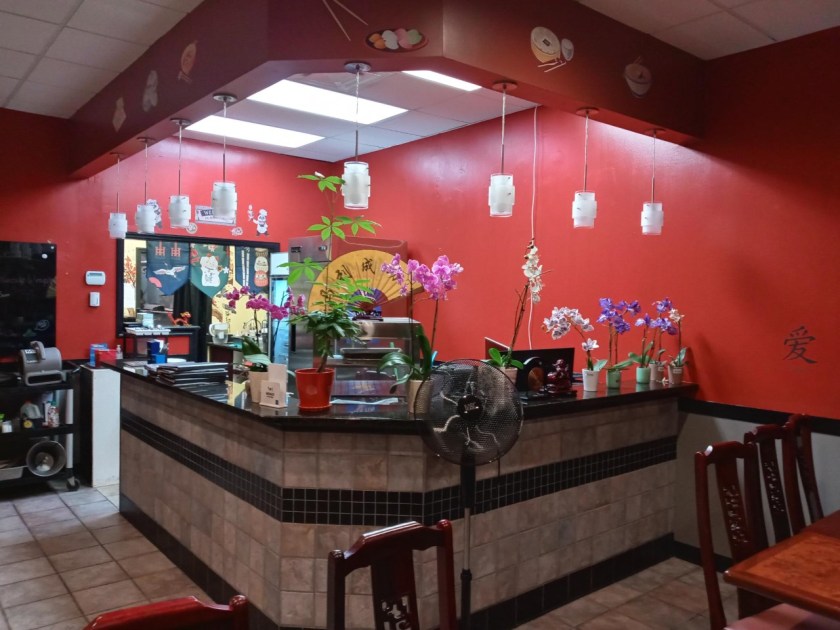
This is the inside.  There are several tables, but it was pretty quiet after 10 PM on a Sunday.  Since I didn’t even plan to stop by, I perused the menu and ordered at the counter, overjoyed that this long travel day was going to have a happy ending.   

The space is brightly lit with festive decor, and it’s sparkling clean inside.  I was relieved to hang around in the dining room while they prepared my food, after the stress of flying.  I was messing around on my phone, but it seemed like all the food I ordered was ready in about ten minutes.   

Kung Fu Dumpling offers many familiar dim sum dishes, and I couldn’t resist bringing home an order of homemade fried pork, shrimp, and chive dumplings (three for $6), since I know my wife likes those too.  If you’ve had these dumplings anywhere else, you know what you’re getting, and you’ll be very happy with them.  I figure some restaurants serve frozen ones, but these tasted very fresh.  

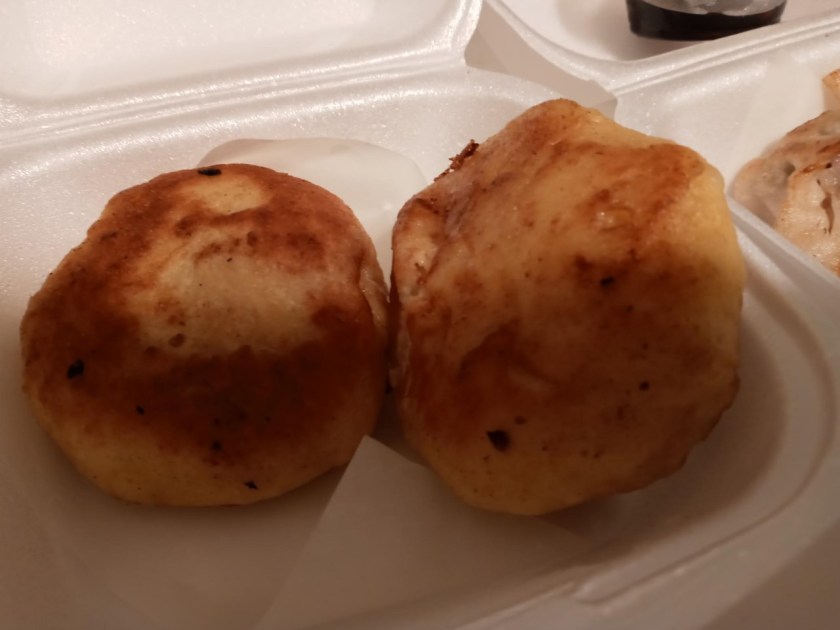
Pardon the shadows, but these were another dim sum favorite of mine, pan-fried pork buns (two for $5).  I wolfed these down, standing up in my kitchen, before I could even unpack my luggage.  We all know they’re never as good the next day!

I was thrilled to see my go-to standard Chinese restaurant dish, beef chow fun ($17), made with homemade wide, flat, chewy rice noodles, stir-fried with sliced beef, onions, and scallions.  Neither of us are huge fans of bean sprouts, so I asked them to hold those, and I was happy to not have to pick them out.  This was a shining example of beef chow fun.  In fact, one could consider it beef chow fun for the whole family.

I couldn’t help ordering a second dish I knew my wife and I could share: pad Thai ($15), a classic dish of stir-fried noodles (also homemade!) with eggs, chicken, shrimp, scallions, carrots, peanuts, and lime wedges to give it a little tangy tartness.  There is a mysterious sour-sweet flavor I often encounter in pad Thai that I love that might be tamarind, but it could also be lime.  Anyway, I don’t order pad Thai often enough at Thai restaurants, but I’m glad I ordered this version at Kung Fu Dumpling, especially with the homemade noodles.  My wife liked it too.

This is from the “Asian Wraps” section of the menu: a green scallion pancake wrap, with sweet red char siu barbecue pork stuffed inside ($10).  I’ve had similar scallion pancakes at Chuan Lu Garden, and this one worked well as a tortilla-like wrap.  I loved the combination of flavors and textures here.

This is a black sesame pancake ($5.50) that was very similar to a Malaysian paratha or roti, but not as buttery.  I know my wife doesn’t like onions or scallions, but she absolutely loved this, as I figured she would.  I resolved to return and bring her more, since I thought the pancakes and wraps were limited-time specials.  But looking at the Kung Fu Dumpling menu online, I’m pleased to say both the black sesame pancake, the green scallion pancake (also $5.50), and all the “Asian wraps” continue to be available.

So I returned to Kung Fu Dumpling a week or two later, bringing her two of those black sesame pancakes.  My wife also requested the teriyaki Buddha’s Delight ($14), a vegetarian dish with stir-fried tofu, broccoli, carrots, and onions (which I dutifully picked out and ate for her) in a lightly sweet teriyaki sauce.  I didn’t take a picture of it, but it came with fragrant jasmine rice.

And after over-ordering on my first visit, when I was delirious from travel fatigue, I stuck to one new dish the second time: Korean pan-seared braised pork belly over lo mein noodles ($16).  I hoped she would want to share this dish too, and I believe she liked the slice of tender pork belly she tried.  As for me, I loved it.  

So that’s my review of Kung Fu Dumpling, after two visits.  I’m still rarely in that part of Oviedo, where it approaches East Orlando and turns into UCF before you know it.  But even if you don’t live or work anywhere in the area, I still highly recommend Kung Fu Dumpling for your pan-Asian comfort food needs.  Whether you’re craving Chinese, Thai, Korean, Japanese, or Taiwanese flavors, you will find something you love here.  If you want late-night dim sum, they have you covered.  If you crave tender homemade noodles (as I so often do), you’ll be in for such a treat.  As the great thespian Keanu Reeves said after a grueling training session in The Matrix (1999): “I know kung fu.”  Now you, constant reader, also know Kung Fu.

Lam’s Garden

Lam’s Garden (https://www.lams-garden.com/) is a respected and venerated Chinese restaurant in Orlando, on the border of two of the city’s best foodie neighborhoods, Mills 50 and the Milk District.  It is in the shopping plaza with iFresh Market (a really good Asian grocery store, not to be confused with Fresh Market) and my beloved Chicken Fire, on the northeast corner of East Colonial Drive and Bumby Avenue.

But me being a lifelong late bloomer, I only recently visited Lam’s Garden for the first time.  (I told an older man that after my meal, and he said “How?  We’ve been here since 1975!”)  Well, better late than never, because it was really good.

I thought it was very old-school to get a bowl of crunchy fried noodles to snack on while we waited for our orders to come out.  This took me right back to all the Chinese restaurants my dad took me to in Miami, growing up in the ’80s, where he knew all the owners and they all knew him because he taught their children and grandchildren. 

At first, they just presented us with a laminated menu of lunch specials, but I asked for a longer menu if they had one.  They brought us two additional menus, with standard Americanized Chinese food favorites and another with Chinese “home cooking,” as the server described it.  Whenever you go, make sure they give you all the different menus to maximize your choices!

My vegetarian colleague ordered Buddha’s delight off the lunch specials menu ($9.95), and got a huge plate of broccoli, crisp snow peas, bok choy, baby corn, onions, mushrooms, water chestnuts, and bamboo shoots, in a brown sauce.  Her white rice was served on the side.

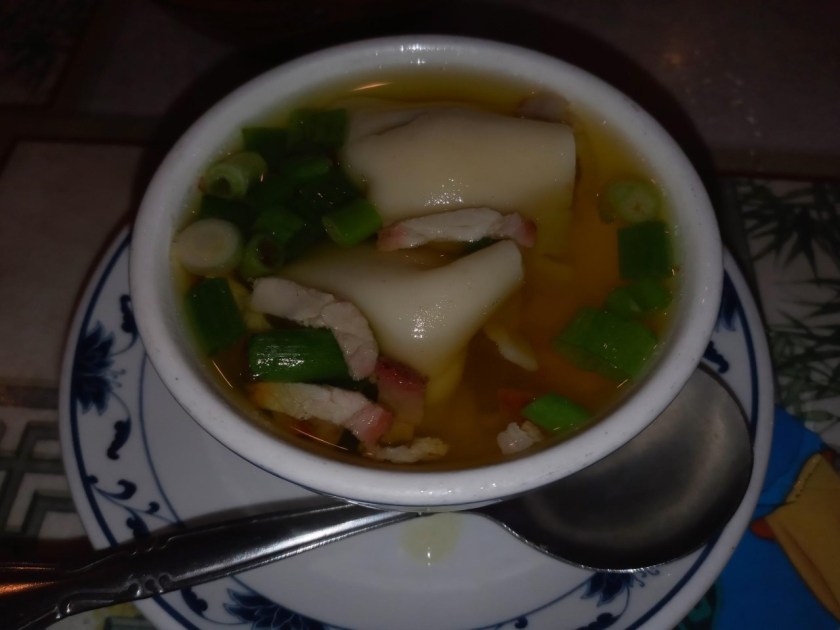
The lunch specials came with plenty of other stuff she couldn’t eat, so like a good friend, I volunteered to eat everything, like this small bowl of wonton soup:

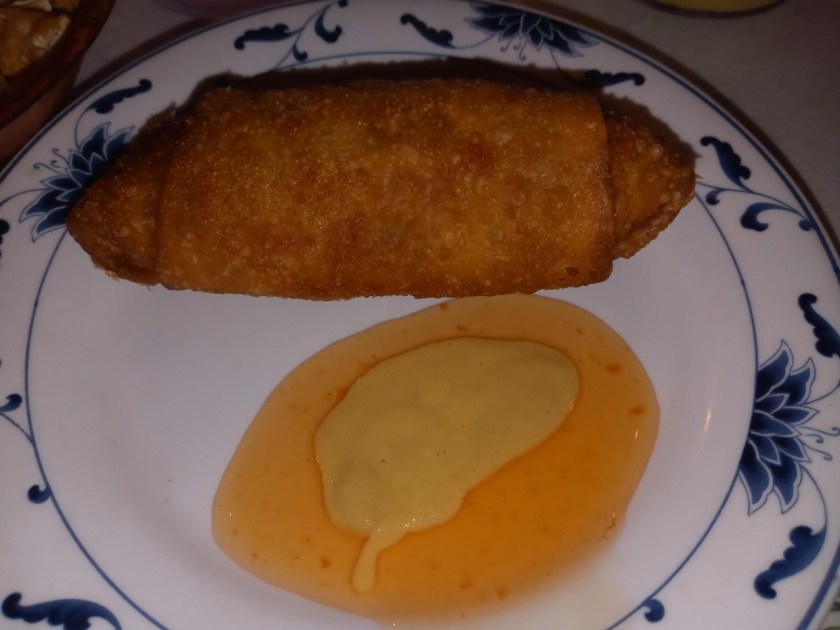
A crispy eggroll:

And a little dish of fried rice:

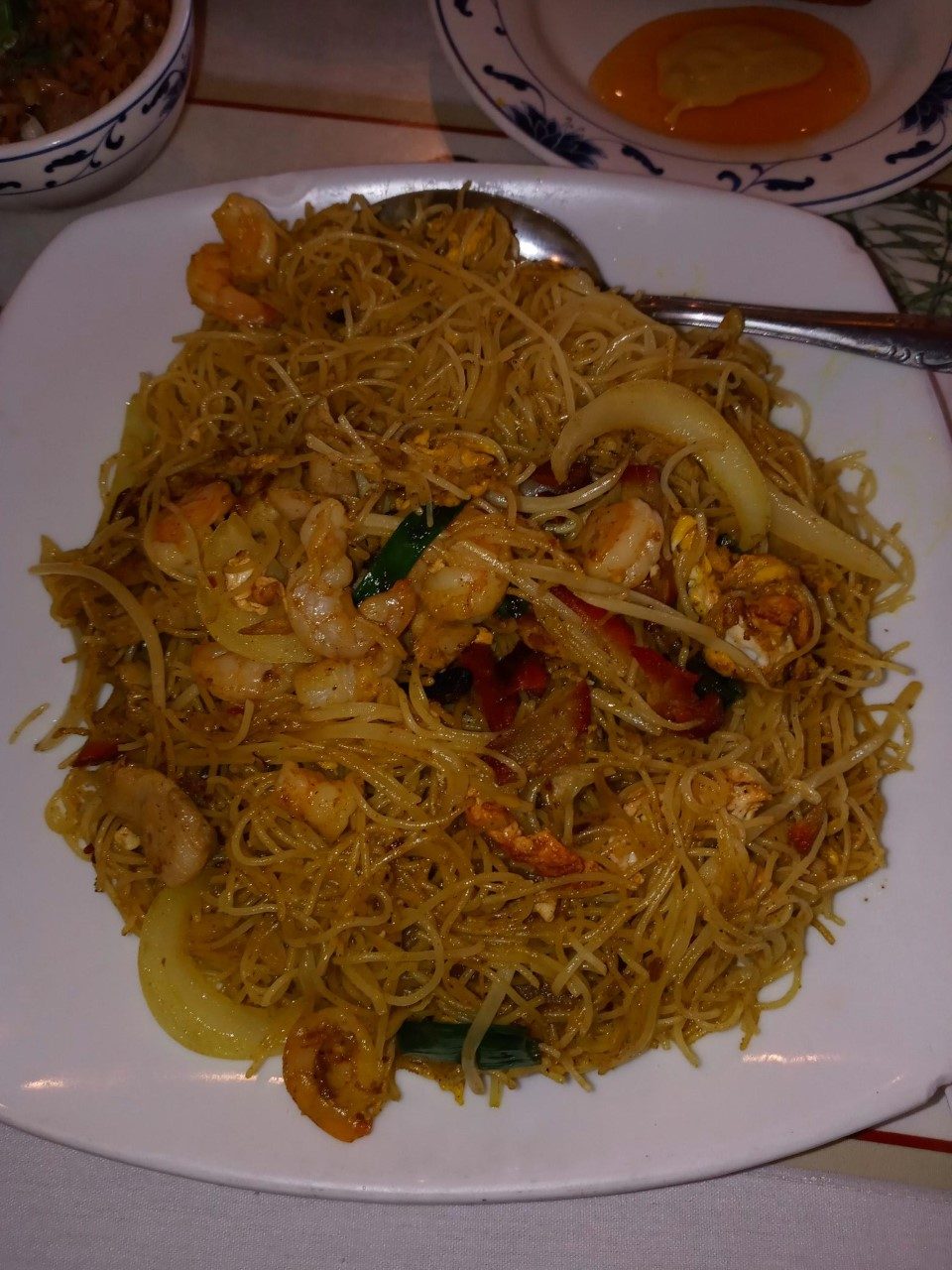
I had a really hard time making a decision, since this was our first time here, so I went with a dish that never disappoints, and definitely didn’t disappoint at Lam’s Garden: Singapore curry rice noodles ($15.95), served with chicken, pork, and shrimp.  It was kind of medium-spicy and so flavorful, with the thin, tender noodles.

I would be tempted to order this again and again, but after finally visiting Lam’s Garden, I definitely want to start working my way through the large menu on future trips.  Lam’s might very well be the oldest Chinese restaurant in Orlando, and since it has been proven to have staying power, I look forward to trying other dishes, making up for lost time.

Ming’s Bistro

I recently met a friend at the Chinese restaurant Ming’s Bistro (https://www.mingsbistro.net/), in the heart of Orlando’s Mills 50 district, full of Asian restaurants, markets, and shops centered around the busy intersection of East Colonial Drive and Mills Avenue, near downtown Orlando.  This was our first time at Ming’s Bistro, but we had both heard for years that it specialized in dim sum, and that’s what lured us out there — better late than never.

What is dim sum, you ask?  It’s a Cantonese tradition that started in teahouses that served little snacks with the tea, now most commonly served as brunch (yum cha).  A lot of restaurants push carts around the dining room, allowing diners to point and grab what they want, while other places have you check off your choices on a paper menu, like how some sushi restaurants do it.  Ming’s Bistro mostly does it the latter method, with an illustrated menu to give you ideas and a paper menu you check off next to each item.  The prices are listed, which helps, since you can get in some real trouble grabbing too many dishes off the rolling carts.  But they push some carts around too, and we picked a few random things that came by our table, just because they looked good.  And just to clarify, Ming’s also offers a whole regular menu of Chinese food to choose from, in addition to the dim sum menu.  So all your usual favorites are probably available here, too.

Ming’s opens at 10:45 AM (every day except Thursdays, when it is closed), and I was there right when it opened to grab a table.  We didn’t have to wait at all, and it was slammed by the time we left, a little after noon.  I have written many times that I’m not a brunch person, but dim sum is a unique brunch experience, where you ideally go with a group, hang out for a long time, order a bunch of small plates, and share everything, including good times.  Even though it was only two of us, we shared nine different dim sum items, and we chose wisely.  There wasn’t a dud in the whole bunch!

We started out with an order of steamed roast pork buns (top; $4.50) and an order of baked pineapple buns (bottom).  The roast pork buns are a dim sum classic for good reason.  For the uninitiated, the steamed buns are kind of like soft, bready rolls, and the pork inside is in a red sauce, savory but also slightly sweet.I love pineapple anything, and these baked pineapple buns were a subtly sweet treat that would have been ideal as a dessert, but they came out early, so we enjoyed them early in the meal.  I was expecting something more like sticky pineapple preserves in the centers, but it was creamier than I thought.  Still good, though.
EDITOR’S NOTE: Two sharp-eyed Saboscrivnerinos confirmed my suspicion that dim sum pineapple buns don’t contain any pineapple, but get their name from the crackly crust.  I still liked them, but thought it was odd they were generically sweet without any obvious pineapple!

We didn’t even order these, but a nice lady wheeled a cart next to our table, loaded up with several dim sum dishes already on plates, and asked if we wanted any.  These looked like jalapeño peppers stuffed with something, which is all good with me, so we went for it.  It turned out to be a shrimp filling, but the shrimp was processed into a soft, savory paste, and the peppers were lightly roasted.  I make similar roasted jalapeños once or twice a year, stuffed with light cream cheese and sometimes topped with bacon, chorizo, or prosciutto.  They are a delicious, keto-friendly snack, and these were equally delicious.  I’m not sure what the sauce on top was, but it added to the experience of flavors and textures without overpowering the shrimp or the peppers.  They weren’t very spicy at all, so don’t worry about that if you’re the type who sweats when the heat is on.

These are pan-fried pork pot stickers ($5.50), which had a wonderful crispy shell and a strong ginger flavor inside.  I always appreciate pot stickers, but my friend liked these even more than I did, so I only had one.   

Another foodie friend introduced me to rice paste dim sum during a feast at another great local Chinese restaurant, Peter’s Kitchen, a few years ago.  I probably never would have tried them on my own, but now I recommend them to everyone else.  This is beef rice paste ($4.75), where the rice paste itself is kind of a slippery, chewy crepe wrapped around a filling — almost like a thicker and more slippery manicotti pasta.  I’m not a fan of things that are too chewy and starchy, like certain bao buns and Jamaican boiled dumplings, but these are terrific, especially swimming in the soy-based sauce.  It’s a challenge to keep them from sliding out of your chopsticks, but we both persevered like the functional adults we are!

We also randomly picked these off a later cart that came by our table.  Some kind of fried dumplings that are both crispy and chewy.  I think they are crispy taro dumplings ($4.75), and they were yet another pleasant surprise.

Here’s a cross-section of one of them.  They were stuffed with shrimp and green vegetables, and we joked that these were the healthiest part of our dim sum brunch, despite obviously being fried.  
EDITOR’S NOTE: A sharp-eyed Saboscrivnerino informed me these might have been pan-fried chive dumplings ($5.50).

I always like beef short ribs — I rank them up there near oxtails on a list of favorite meats.  This was beef short ribs with black pepper ($5.80), which I enthusiastically ordered, despite not knowing exactly what to expect.  It was great.  It was a relatively small portion, like so many of these diverse dishes, but still plenty for two people to share.  The short ribs came chopped into tiny chunks of rich, succulent, moist, fatty meat, braised until they were very soft and easy to pull off the shards of bone.  They were extremely flavorful and easier to eat than I expected.  I wished I had saved some of the doughier buns and dumplings to dip into the short ribs’ sauce.

I ordered us the pan-fried sticky rice ($5.50) because the couple at the table next to us got it, and it looked good.  That was another pro move on my part.  It was sticky and savory, with maybe the tiniest bit of subtle sweetness you get from Chinese five-spice powder, a blend of Chinese cinnamon, fennel seed, star anise, cloves, and peppercorns (or sometimes ginger).  It also would have been good to soak up some of the short rib sauce, but the rice was so flavorful, we ate it on its own. 

The last dim sum dish we ordered was another winner: fried meat dumplings ($4.75).  I can’t tell you if the meat was beef or pork, or maybe a combination of both, or something else entirely.  It was ground, spiced (but not spicy), and saucy, and served in these awesome dumplings that reminded me of Indian batura, Native American fry bread, hand pies, lightly fried empanadas, or even funnel cakes at a fair.  That perfect flaky dough that is lightly crispy but mostly soft, that leaves your fingers greasy and your soul happy.  

Like I said, not a bad dish in the bunch.  It was a great meal, and while we probably could have done more damage, it was the perfect amount of food for two people, with some leftovers at the end.  I’m guessing most of my readers are already familiar with the joy of a communal dim sum brunch, and many know the wonders of Ming’s Bistro.  But if you don’t know, now you know!  I hated crowds and lines long before there was a pandemic, so in addition to recommending all these delicious dishes we tried, I also strongly suggest getting to Ming’s early — ideally in that golden half hour between 10:45 and 11:15 AM — to beat the lunch rush and avoid having to wait.

Meng’s Kitchen

EDIT: It is the year 2025, and Meng’s Kitchen currently resides inside iFresh Supermarket on the corner of East Colonial Drive and Bumby Avenue.  It moved there from its original location a couple of years ago.  Okay, on with the review from 2021!

***

Meng’s Kitchen (https://www.mengskitchensorlando.com/) is one of my favorite kinds of restaurants: a bit of a secret because it’s a restaurant inside something else — in this case, inside another restaurant, U-Roll Sushi on East Colonial Drive, directly east of Goldenrod Road (which I really need to review some other time).

When you crave Chef AJ’s eclectic comfort food with origins in China, Thailand, and India, you have to place an online order on the website above, then pick it up from U-Roll Sushi or make a note that you’re going to eat it there, as I did recently.  I met one of my closest foodie friends here in Orlando, a true bon vivant who knows even more good local places to eat than I do, and also one of the most upstanding, civic-minded, honorable people I know.  He has been a Meng’s mark for a while now, and I was glad to finally catch up with him over lunch on a workday, to see what all the hype was about.  This guy has never steered me wrong, and he definitely helped me choose wisely this time.

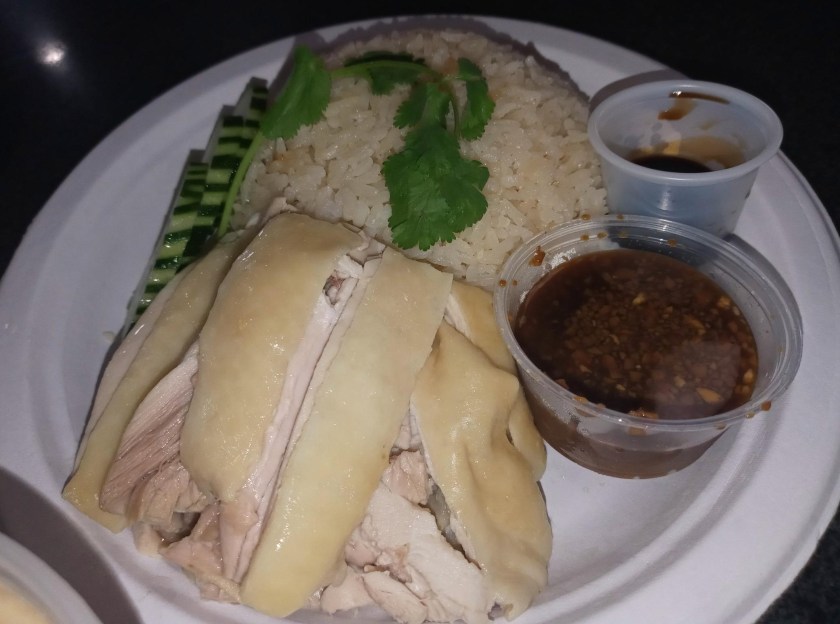
This is Chef AJ’s famous Hainanese chicken and rice ($10) — poached chicken served over Hainanese style rice pilaf with the most amazing ginger, garlic and soy dipping sauce.  The online ordering system gives a choice of white or dark meat, and I will always choose dark meat, 100% of the time.  It came boneless and fully sliced, with the soft skin on.  It also came with a side of broth that I forgot to photograph.  It looked like plain broth, just like this looks like plain chicken, but looks are deceiving, because everything had so much incredible flavor, I was blown away. 

My wise and worldly friend chose the chicken, so I had to make a decision.  With so many intriguing and unfamiliar options, I chose the braised pork Hunglay curry ($10) — marinated pork belly and pork shoulder with toasted garam masala, slowly braised with Hunglay curry paste, shallots, pickled garlic, fresh mango and ginger, and tamarind paste.  It was one of the best things I’ve eaten all year, so I chose wisely too.  Every piece of pork was tender enough to cut with our plastic forks, and they just melted in my mouth.  I’m such a fan of saucy, braised meats, and this was an outstanding dish, full of strong flavors I wasn’t overly familiar with, but they all worked so well together.   

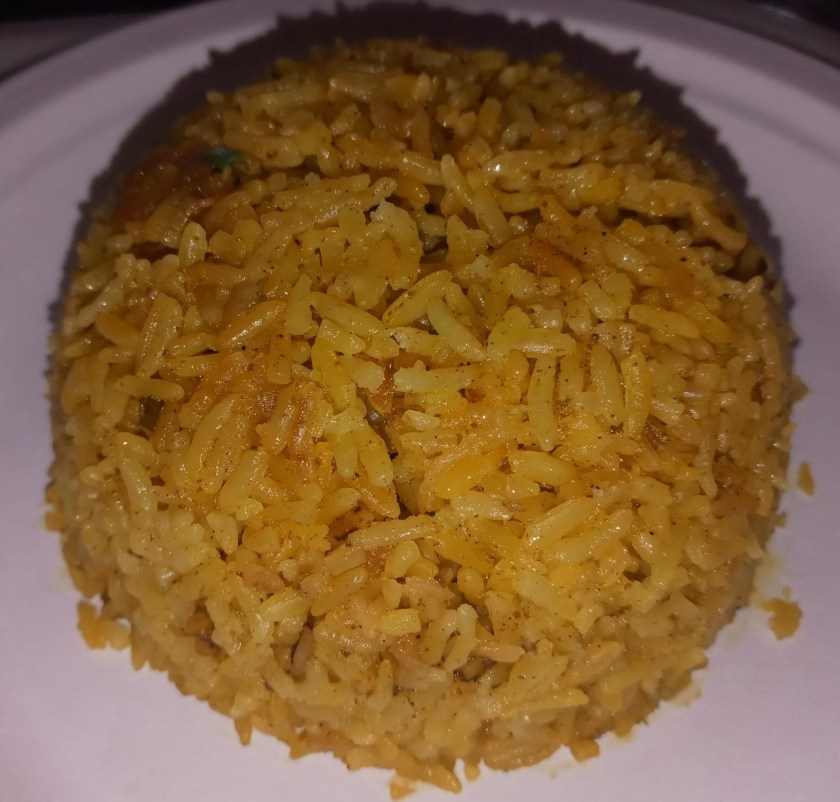
The online menu said this braised pork curry came with steamed jasmine rice, but I requested a substitution of the spiced yellow rice that came with some other dishes, and I noted that it was okay if Chef AJ couldn’t substitute it.  Well, he did, and the spiced yellow rice was triumphant as well.  I have a rice cooker at home, and I can still NEVER cook rice as well as Asian and Latin restaurants.  But both this rice and the Hainanese rice pilaf that came with the chicken were something really special.  Spooning some of the pork curry sauce, which was savory but not spicy at all, over both kinds of rice opened up whole new worlds of flavor.   

My friend ordered this cucumber salad ($4) for us to share — chunks of cucumber and tomato and thin slivers of red onion in Thai sweet and sour dressing.  It might not have occurred to me to order this, but I’m so glad he did, and I’d get it again.  It was crisp and crunchy and sweet and spicy and cool and refreshing, especially with the heavy chicken, pork, and rice and the rich sauces they came with.  The sweet and sour dressing reminded me of Thai sweet chili sauce, a beloved condiment, but not as thick, sticky, and jelly-like.  True to its name, there was also a sour, slightly pungent component in the dressing that played well with the cucumbers.

My friend also ordered tom kha gai ($5), a Thai soup made with coconut milk, curry paste, lemongrass, kaffir lime leaves, and big ol’ chunks of mushrooms, which I cannot eat.  Normally I like to try everything, but I am allergic or intolerant or something.  It always ends badly for me, so I passed.  But the soup looked and smelled good, and he seemed to like it. 

So far, this was my only visit to Meng’s Kitchen, but I need to return sooner rather than later for more Hainanese chicken and rice, more of that incredible braised pork Hunglay curry, and to eventually make my way through the menu and try everything else (as long as it doesn’t contain mushrooms).  It was terrific — one of those hidden gems that are all over Orlando, if you just give them a chance.

Tasty Wok BBQ & Noodle House

Tasty Wok BBQ & Noodle House (http://www.tastywok.net/) is the first Chinese restaurant I fell in love with in Orlando — before Chuan Lu GardenPeter’s Kitchen, and Taste of Chengdu opened.  Add in Yummy House in Altamonte (the others are all clustered around the Mills 50 district, with Taste of Chengdu recently relocated to Baldwin Park), and that rounds out my official Top Five Orlando Chinese restaurants.  I’m sorry I haven’t been back to review Tasty Wok sooner, but better late than never.

The Tasty Wok website I linked to above definitely does not include the full menu.  You could click through that website that rhymes with “help” and hope to find photos posted by randos that may not even be up to date, but I took the liberty of scanning the most recent “New” Tasty Wok menu, updated as of July 2021.  If you right-click on each image and select “Open image in new tab,” you should be able to see much larger, more legible versions.

For my first trip back in far too long, I ordered all of our old favorites to bring home to share with my wife.  From the Appetizers page, I got the three BBQ combination ($18.95), with generous portions of tender roasted duck with crispy, delicate skin, sweet char siu (sliced roasted pork), and roasted pork with fatty belly and deliciously crispy skin.  I don’t think any of the Chinese restaurants in Orlando, as much as I love some of the others, do these meats better than Tasty Wok.

This is the masterful roasted duck, which you can also order as a separate appetizer portion for $7.95, or with steamed white rice for $11.95.  Look at how beautiful it is!  My wife and I both love duck — it is one of our favorite meats.   

This is the sweet, tender char siu pork, which is also available as an appetizer portion for $7.95 or over steamed white rice for $10.95:

And I really should have turned some of these over to get a glamor shot of that crackly golden skin, but this is the fattier barbecue pork with crispy skin, also available as an appetizer portion for $7.95 or over steamed white rice for $11.95. 

I’ve been to a few local Chinese restaurants where these meats were served swimming in pools of congealing grease, or worse yet, bland and dry, like they were chopped and sliced hours ago and just sitting under heat lamps.  That’s just sad, and I never bothered to review those places because I didn’t have much nice to say after that.  But Tasty Wok has never done us wrong.  Since we love all three meats, we always get the three BBQ combination and choose these three.  (There is a fourth option, soy sauce chicken, which is probably also outstanding, but we’ve never tried it in all these years!)

We also got my go-to dish at pretty much any Chinese restaurant, beef chow fun ($14.95), with tender beef and wide rice noodles with the most pleasing chewy texture that I just love, plus onions and green onions.

This ended up being a lot of food for two people, and we had enough left over that my wife got to have the rest for lunch the following day.

Someone once described Tasty Wok to me as “Chinese soul food,” and I never forgot that description.  All the dishes I tend to like to order — these very dishes — are on the greasy side, and nobody would ever confuse them for health food.  But they are made with skill, care, and love, and they are satisfying, delicious comfort food.  They are some of the best examples of roasted and barbecued meats and wok-fried noodles around, and I recommend them all highly.  if you are a Tasty Wok regular, let me know what your go-to dishes are, since I’m always looking to expand my palate.  Run, don’t wok, to Tasty Wok!