
“As I ate the oysters with their strong taste of the sea and their faint metallic taste that the cold white wine washed away, leaving only the sea taste and the succulent texture, and as I drank their cold liquid from each shell and washed it down with the crisp taste of the wine, I lost the empty feeling and began to be happy and to make plans.”
― A Moveable Feast
The Osprey (https://www.theospreyorlando.com/) is one of my favorite restaurants in all of Orlando, but it had been over three years since my last visit. They didn’t do anything wrong — owners Jason and Sue Chin run a tight ship, and it never disappoints. In fact, their restaurant is so good, they were recently named James Beard Award semifinalists, which is a huge honor in the restaurant industry. (And we here in Orlando feel like they were robbed of an official nomination!)
But so much had changed since my last visit, even the name! The restaurant was renamed The Osprey (it used to be The Osprey Tavern), and the menu was revamped to focus much more on local seafood. My last meal there with my wife was excellent, but that was in early 2018, before I started this blog. As a result, I never got around to writing a belated review, since most of my photos were of dishes we ordered that are no longer on the current menu (and my photos were also pretty bad back then). So I was long overdue for a return trip.
The Osprey does not serve lunch, but it opens for dinner at 5:00 PM every day of the week except for Monday. It runs one of the best happy hours in Orlando runs from 5:00 to 7:00 PM, Tuesday through Friday only. It is also open for brunch on Sundays, which was my first experience at The Osprey many years ago. I’m just not a brunch guy; it doesn’t matter where it is. But I am very much a lunch/dinner/happy hour guy.
But my favorite thing about The Osprey Tavern, and now The Osprey, was $1 oysters during happy hour on weeknights. Since I work so late, I was hardly ever able to make it over there to take advantage of one of my favorite meal deals in Orlando, so it was a rare and wonderful treat.
The $1 happy hour oysters were the main thing that recently drew me back to The Osprey in the middle of a long and exhausting recent workday where I had several classes to teach. (Since that visit, they are now $2 each.) I ordered an icy platter with a dozen fresh mid-Atlantic James River oysters on the half shell ($12), plump and juicy, from Virginia. These were much smaller and more delicate than the typical huge Appalachicola oysters I’m most used to, which come from Florida’s Gulf Coast. These James River oysters were slightly firmer in texture too, which may be a boon for those who don’t love the texture of oysters. I sipped their briny liquor and slurped them down with gusto; they didn’t need any lemon, cocktail sauce, or horseradish. I wrote about the raw oysters I enjoyed so much from High Tide Harry’s and the late, lamented Lombardi’s Seafood Cafe during the stressful, chaotic year of 2021, and I share my Saboscrivner Seal of Superiority with these oysters from The Osprey. I should have taken a close-up of that other little ramekin of sauce near the 2:00 position above. That is a mignonette, a unique condiment I tried for the first time on my previous visit to The Osprey for oysters, back in early 2018 — far too long ago — before I started this blog. I remember that mignonette was different from this one, but the menu refers to it as “seasonal” mignonette, so they may change out ingredients and flavor profiles throughout the year. I’ve never had anything like them before or since. It’s kind of like a peppery vinaigrette, with small bits of crispy shallots floating in it, and it’s a little sweet. I like my oysters straight-up to fully savor their flavor, but the mignonette was too delicious to leave behind… so I sipped and chewed it, just like I did in 2018. It’s that good.
This was the calamari ($9 during happy hour; otherwise $12). These tender, breaded squid rings and tentacles come adorned with paper-thin slices of piquant pickled peppers (a very nice and colorful touch), served on a bed of hazelnut romesco (the tangy orange sauce on the plate below, made with roasted tomatoes and peppers), and served with a ramekin of cool, creamy, slightly lemony citrus aioli. All the flavors and textures worked together perfectly for a beautiful harmony. 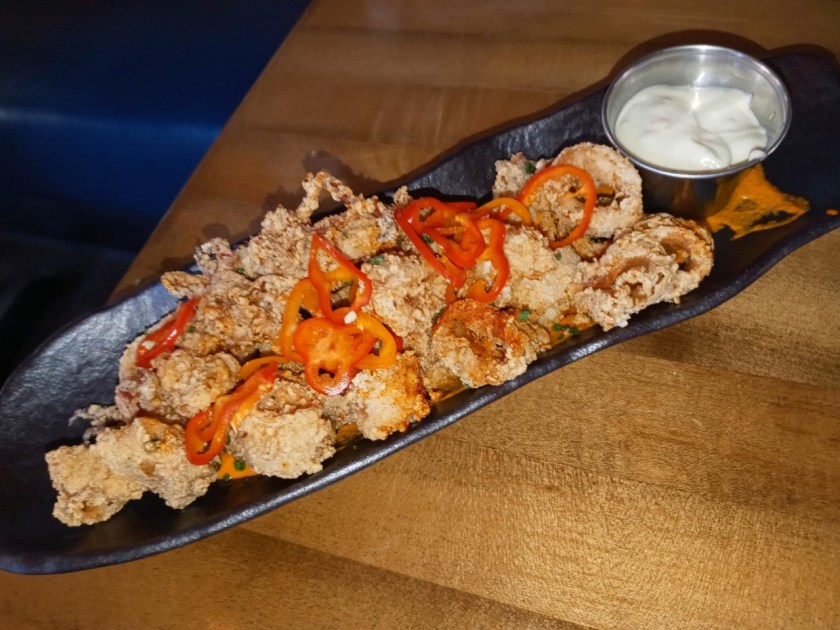
I usually love calamari, but some places serve you a greasy mess of chewy rubber bands, sometimes hidden under too much crunchy, overcooked, tasteless batter. Not here. If you had any doubt that a seafood restaurant as nice as The Osprey would excel at the calamari game, dispel those doubts now.
Now I come to one of the best pasta dishes I’ve ever had — certainly in Orlando, and possibly an all-time Top Tenner. It even made my list of Top Twelve Tastes of 2021 in Orlando Weekly, where it was the only dish from a restaurant I hadn’t reviewed yet. Well, here’s my full review, better late than never. This is spaghetti alla chitarra ($15; not a happy hour special), and this picture cannot possibly do it justice.

The pasta itself was freshly made in house, and it was tossed and served with shelled clams from Cedar Key, Florida, blistered tomatoes, herbs, and an ingredient I’ve been obsessed with since learning about it a few years back: bottarga. As if fresh, handmade pasta and local clams weren’t awe-inspiring enough, bottarga is the egg sacs of a fish (usually grey mullet or bluefin tuna), cured in salt, then pressed and dried until they are solid blocks of savory, salty, fishy goodness, then shaved or grated onto a dish to lend it an umami-laden intensity. If you’ve ever had bonito flakes on a Japanese dish, bottarga is like that, but more intense. At least to me, it is also vaguely reminiscent of caviar, only without the unique “popping” sensation and all the bougie attitude that goes along with caviar. As an unabashed aficionado of all cured, smoked, and pickled seafood, this is a dream ingredient, and the spaghetti alla chitarra was a dream dish.
Finally, I wasn’t sure if I’ve ever had the fries at The Osprey, but a trusted foodie friend had raved about them before. I saw the cheeseburger and fish and chips both came with fries, so I asked my wonderful, attentive server Savannah if they would consider selling me a separate order of fries, even though it wasn’t listed on the menu. She said they would, and she brought me a plate teeming with a huge “side order” of fries (only $4).  Folks, these join the potato pantheon of the finest fries in Orlando, alongside other fabulous fries from the likes of Mrs. Potato, Chicken Fire, Makani, and Se7en Bites. They have a crispy, seasoned outer coating like the fast food fries I love so much from Arby’s, but they are pillowy soft and potatoey inside. Not too thick, not too thin. Just fantastic fries all around. Savannah brought them with ketchup and a house-made creamy, tangy “comeback sauce” that you absolutely have to try, whether you get fries or something else to dip in it, or just shoot it out of the little metal ramekin.
I still had to return to work and teach one more late class after that luxurious dinner, but I ordered something to bring home to my wife, who loves desserts as much as I love oysters and pasta and cured stuff. This looked like a dessert that would bring us both joy: the s’mores tart ($7), with “smoky ganache,” graham cracker crust, and toasted meringue topping. This was another standout dish, even for me. I might not be the biggest dessert eater, but I sure do love pie, especially chilled pies with graham cracker crusts, and this one was right up my alley. We both had tiny tastes that night, and my wife liked it, but I liked it even more than she did. Because of that, she was kind enough to eat a little more for breakfast the next morning, but saved me some to enjoy when I got home from work that following evening. She’s the sweetest of all, but this was an excellent dessert I would recommend to anyone. It was so rich, we were able to get four servings out of this one slice! 
So that’s a long-overdue review of one of my favorite restaurants in Orlando. Even though oysters are $2 each at happy hour instead of the buck they used to be, I still strongly recommend them — even at full price. Jason and Sue Chin are building a local restaurant empire with their Good Salt Restaurant Group, and I look forward to returning to their other concepts and trying their newest place. But don’t sleep on The Osprey!
Hidden away on beautiful, idyllic New Broad Street in Orlando’s burgeoning Baldwin Park neighborhood, it feels like it exists in another world, another reality, compared to the industrial, somewhat dilapidated stretch of East Colonial Drive just minutes away (and minutes from my workplace). Making the short drive to savor a happy hour dinner on a busy, stressful workday transported me away from real life temporarily, as all the best meals should do, to one degree or another. If you like seafood, I hope you will allow yourself that experience as well.


 These wings made me think of
  Even sharing my food with two other hungry guys, I had some leftovers to take home, including a few assorted pieces of chicken and the vast majority of the onion rings! Hey, I filled up on ddeok-bokki, which is the first time I’ve ever written that, but it may not be the last.
 My dining companions weren’t into these at all, so I ended up with almost four full cups of the pickled radishes to take home and enjoy later, along with the leftover wings and rings. The next evening, I heated everything back up in the toaster oven (no fancy air fryer for me!), and they crisped back to life rather well. Even my wife, who was skeptical because she despises anything spicy, was really impressed by the flavors (which weren’t spicy at all) and crispy fried coating on both kinds of chicken, even 24 hours in the fridge and a reheating later.


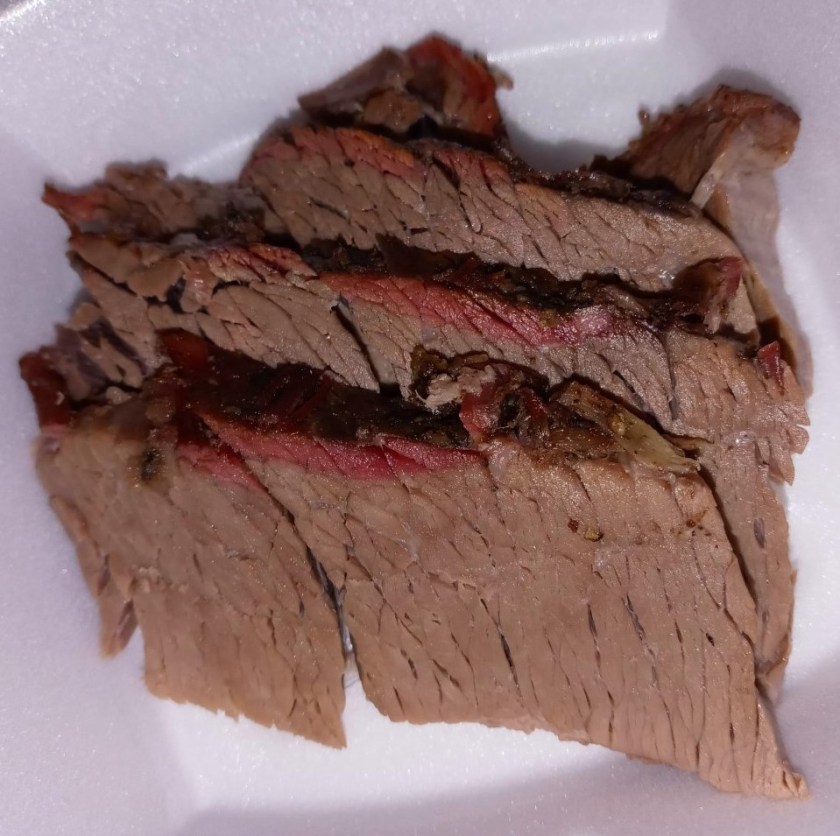
 But the platter is a gift that keeps on giving, because you can also choose between Texas jalapeño cornbread or a dinner roll. Of course I chose the cornbread, and of course I forgot to photograph it, but you can imagine what a square of cornbread looks like, especially if you’re reading a review of a barbecue restaurant on a food blog.




 I just heat up the frozen pretzel sticks on a tray in the toaster oven for nine minutes at 350 degrees, and they come out crackly and crispy on the outside, soft and fluffy on the inside. They are way better than you’d think frozen pretzels could possibly be — better than many fresh soft pretzels I’ve had. Plus, pretzels are a perfect mustard delivery device, so let the grand experiment begin! On to the mustards!
 I have never been a huge fan of any Dijon mustards for everyday use on things like sandwiches, hot dogs, or burgers, so I wasn’t enamored with a big dollop of Sir Kensington’s Dijon on the soft pretzel here. If you’ve had the more famous Grey Poupon (but of course!) or even a cheap store-brand Dijon, you know what you’re trying here — smooth texture, a little flavor from white wine, a little spice you can feel in your nostrils. But I keep this particular mustard on hand for one purpose: LAMB. Dijon goes so well with the rich and slightly gamey flavor of lamb, which my wife and I both love. I buy thick-cut lamb loin chops at Costco, rub them with Dijon mustard, sprinkle with salt and pepper and whatever herbs I feel like using, and roast them until they are rare. It’s a winning flavor combination, and one of the only situations where my wife tolerates any form of mustard.
 I don’t think Mild & Creamy Dijon is spicy or pungent enough to complement hot dogs or classic Jewish deli-style sandwiches like pastrami, corned beef, or tongue, where the salted, cured meats usually beg for something tangy, spicy, or garlicky. But for more everyday sandwiches, it’s a wonderful choice, and I did not mind having some straight up on the soft pretzel.
 I haven’t eaten enough tarragon in my lifetime to confidently, competently describe what it tastes like on its own, and it isn’t terribly garlicky either. Think of this as a yellow mustard that isn’t as “bright,” tangy, vinegary, or salty as you’re used to from a lifetime of cookouts. There is an extremely subtle sweetness to it that isn’t there in regular yellow mustard. I’ve tried it in several sandwiches since my first taste, including with some sardines, and also mixed it into chicken salad, where it is pretty inoffensive. I didn’t love it, but didn’t hate it either. At least the price was right.
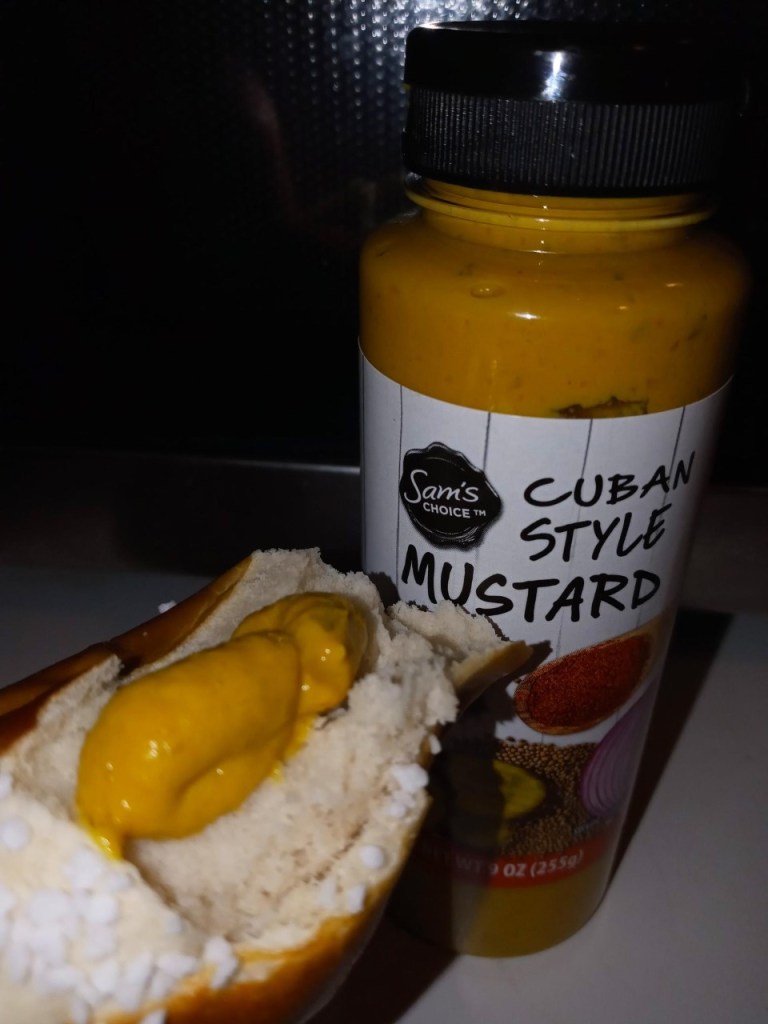 I stocked up on a few bottles of this, because I don’t go to Walmart that often, but it is really good. Publix doesn’t carry any equivalent of this, and Winn-Dixie carries a Cuban mustard from the Plochman’s brand, which is a few dollars more than the Sam’s Choice. I haven’t tried the Plochman’s Cuban yet, but at least I know I like this one a lot for anything that normally calls for yellow mustard.
 It’s on the creamy side, and very pickley. It tastes more like sour pickles than dill. Normally I’d put mustard and pickles on burgers or sandwiches, so I’m trying to think of uses where you might want this mustard to cover both bases, without making it redundant by using actual pickles. I also dipped some homemade sweet potato oven fries in it and mixed a lot of it into some chicken salad, and those worked okay. I think I’d rather use other mustards and then just add
  I think it would work well in a sandwich with savory meats like roast beef and turkey. It would be an inspired main ingredient in a glaze if you were baking a ham (and then you could leave out some sugar), but it might be a little much spread onto a sweet ham sandwich. It would be great as a dip for heavy, salty fried foods like french fries or fried chicken, or made into a barbecue sauce.
 This mustard would go well on or in anything. If you can find a jar, treat yourself and pick one up, even at regular Robert Rothschild prices. I give it my highest possible Saboscrivner recommendation.
