Build My Burgers

Build My Burgers (https://www.buildmyburgers.com/) sounds like something an old-timey Southern lady would say, as an expression of surprise or exasperation: “Well, build mah burgers!”  But no such phrase exists, although maybe it should.  Instead, Build My Burgers is a new fast-casual burger restaurant that opened in a small shopping plaza on University Boulevard, just a few minutes west of the University of Central Florida.  It is an independent, locally owned restaurant, and it could really use your support, because Build My Burgers will build you a tasty burger to your exact specifications, with dozens of options to customize it.  You can have a lot of fun here.  I sure did.

The burgers themselves are Black Angus beef, served as thin, “smashed” patties.  They might not be as thick or juicy as the patties from a burger joint like Fuddruckers or Teak, but they pack a lot of flavor and are clearly high-quality beef.  You can also choose regular or spicy fried chicken, a veggie burger, or an Impossible Burger if you don’t feel like beef.  Brioche is the standard bun, but you could also get your burger or sandwich on a thicker pretzel bun for a $2 upcharge or a lettuce bed for no additional cost, for the keto dieters out there.  (I did keto for five miserable months in 2017, and let’s just say it did not end well.)

But best of all about Build My Burgers, at least in my book, is the voluminous list of burger toppings and condiments to choose from.  I know some people’s brains short-circuit and shut down when faced with too many choices, but I love being able to choose so many different flavors and textures to make a one-of-a-kind meal, whether I’m customizing a poke bowl, a sandwich, a burrito, or a burger, in this case.

I opted for a double-patty burger ($8.99) with two slices of American cheese (75 cents each) on the standard brioche bun.  From there, I asked them to add ketchup, spicy mustard, barbecue sauce, lettuce, tomato, caramelized onions, pickles, roasted red peppers, crunchy potato sticks (making their second appearance in a row on The Saboscrivner blog), and guacamole.  Our food arrived on metal trays,  with the burgers wrapped up, fast food-style, already assembled.  Good grief, that was an insanely beautiful, messy, and delicious burger!

My wife likes to keep things simple, so she ordered a single burger ($6.49) on the pretzel bun (a $2 upcharge), and only opted to add thousand island dressing, which was a really good condiment pairing.  She ended up thinking the pretzel bun was just okay, but probably would have preferred the brioche.  I thought the denser, thicker pretzel bun would have been balanced better with a thicker, two-patty burger and more toppings and condiments. 
Next time she’ll get a burger on a brioche bun with guacamole, and next time I’ll probably get something very similar to what I got this time, but add thousand island.  We both thought the crinkle-cut fries, dusted with a peppery seasoning, were just okay.

What really sold me on finally trying Build My Burgers were people’s photos of the onion rings.  Sharp-eyed Saboscrivnerinos know I am an onion ring aficionado, and I’ll try onion rings anywhere I find them.  Those inevitable onion ring reviews get a special tag: RING THE ALARM!  And these onion rings ($4.99) are “my type,” with their golden brown batter.  Perfect size, shape, color, consistency, and taste.  Flawless onion rings, worth ringing the alarm for. 

My wife was really craving a chocolate shake ($5.99), but also asked me if I had any interest in sharing an order of fried Oreos ($5.99).  That’s a decadent double dessert right there, but I realized neither of us had ever had fried Oreos before, so why not?  Anything the Scots love has to be pretty good, right?  Well, she seemed to really like the shake, and I enjoyed the obligatory sip I took. 
Does anyone remember Pulp Fiction, one of the biggest movies to come out in 1994?  I was in 11th grade at the time, and I was absolutely obsessed with it.  Anywhere, there was a whole discussion about how a cheesy ’50s diner-themed restaurant in L.A. served five-dollar milkshakes, and what a ripoff that was.  I always think of that moment in the film whenever I encounter milkshakes, because over 25 years later, five dollars is pretty standard, and many places cost far more.  Vincent Vega would have lost his damn mind if he saw the $15.99 “freaky shakes” on the Build My Burgers menu, but those are huge, opulent, towering structures meant to be photographed and shared (but not picked up, because all kinds of stuff is stuck to the outside of the glasses).  This standard chocolate milkshake in a standard plastic cup suited my wife just fine.

And because you were wondering, here’s a cross-section of the fried Oreos.  They were actually better than I expected, in that the batter was crispy on the outside and soft on the inside, and the Oreo still had some crunch to it.  I was expecting a sad, greasy mess that would make me feel guiltier than usual, and also a little disappointed.  Well, they weren’t greasy or disappointing at all, I’m happy to report!

I don’t end up on the east side of Orlando near UCF to eat very often, but if you’re out there, you can definitely count on a tasty burger from Build My Burgers.  Any of my stalwart Saboscrivnerinos know how much I value freedom of choice, and how much I love being able to customize and trick out my meals with a variety of options.  This is the perfect place for that.  Even vegetarians would be very content.  I look forward to returning and improvising some new crazy burger combination, but in the meantime, I wanted to spread the word about a relatively new restaurant that could use every bit of support.

CLOSED: Uncle Dendog’s

UPDATE: Sadly, Denni Cha, the chef-owner of Uncle Dendog’s, moved his family to Austin, Texas, in 2022, so Uncle Dendog’s is no more.  Orlando’s loss is definitely Austin’s gain.

Ever since I was a little kid, I’ve been obsessed with comic books, to the point of making it a serious field of academic study.  Heck, this food blog is even inspired by a comic book series called Chew.  (Check the page heading, in case you’ve never glanced at it before.)  But as much as I love the characters, I focus the most on the creators who write and draw them, and I can always identify their unique, defining styles.  For example, the legendary Jack Kirby (co-creator of most of the Marvel characters you would recognize) specialized in burly, square-jawed heroes and imposing alien technology surrounded by crackling energy.  Jim Lee‘s human figures look like flawless gods and goddesses.  Arthur Adams draws huge monsters and super-cute women, always with extraordinary attention to detail.  Kevin Maguire and Steve Lieber are masters of expressive faces, who can convey so much emotion — and especially humor — with just a look.

Where am I going with this?  Well, as a self-proclaimed food writer, I don’t pretend to be the expert on food that I am on comics, but I feel like I’m at a point where I recognize the signature styles and flourishes of some of the talented chefs who prepare the food I love so much.  I can always identify the best comic creators by their written voices and artwork, whether they work on a mainstream superhero comic, a crime graphic novel for “mature readers,” or a deeply personal, autobiographical, self-published story, and some chefs stand out to me the same way, even when they transcend cuisines.

Orlando is home to some real innovators and creative dynamos who have built a strong culinary culture here, and one of my favorite local chefs is Denni Cha.  He has been cooking since he was nine years old, ever since his grandmother taught him to cook in the kitchen of her Korean restaurant.  I first discovered his food in the summer of 2020, when he ran a Japanese pop-up called Itamae Densho out of The Local Butcher, the Winter Park meat market that also hosts previous Saboscrivner review subject Swine & Sons and Da Kine Poke.  I reviewed the gorgeous, almost otherworldly looking chirashi bowls I brought home from Itamae Densho — maybe the most beautiful things I saw in 2020, an otherwise ugly and stressful year.  They were like little landscapes in a bowl — multiple kinds of fresh fish and vegetables over rice, even adorned with edible flowers and ziggurats of fractal romanesco jutting past gleaming orbs of salmon roe.

Unfortunately, Itamae Densho is no more, but Chef Denni is back with his latest venture, something far removed from chirashi bowls but still totally in character and on brand: Uncle Dendog’s (https://www.instagram.com/uncle.dendogs/), a food truck (really a trailer) that specializes in Korean corn dogs and other street foods with a foreign, fusiony focus.  Follow his Instagram page to see where he’s going to turn up next!

I was the first person to arrive at Uncle Dendog’s this past Friday night, set up outside Orlando Brewing, the brewery and taproom south and west of downtown Orlando.  Not being a drinker, I had never been there before, so I didn’t know how busy it would get later or how the parking situation would be.  But I do prefer to grab my food on the early side, especially since I was bringing it home after work. 

I have taken the liberty of posting photos of the menu, although it may change from week to week or even night to night.  I knew I had to try one of Uncle Dendog’s signature K-Dawgs, so it was just a question of choosing which one.   
But I knew he had a new special, just weeks after opening for the first time, and that was what drew me out on this rainy evening.

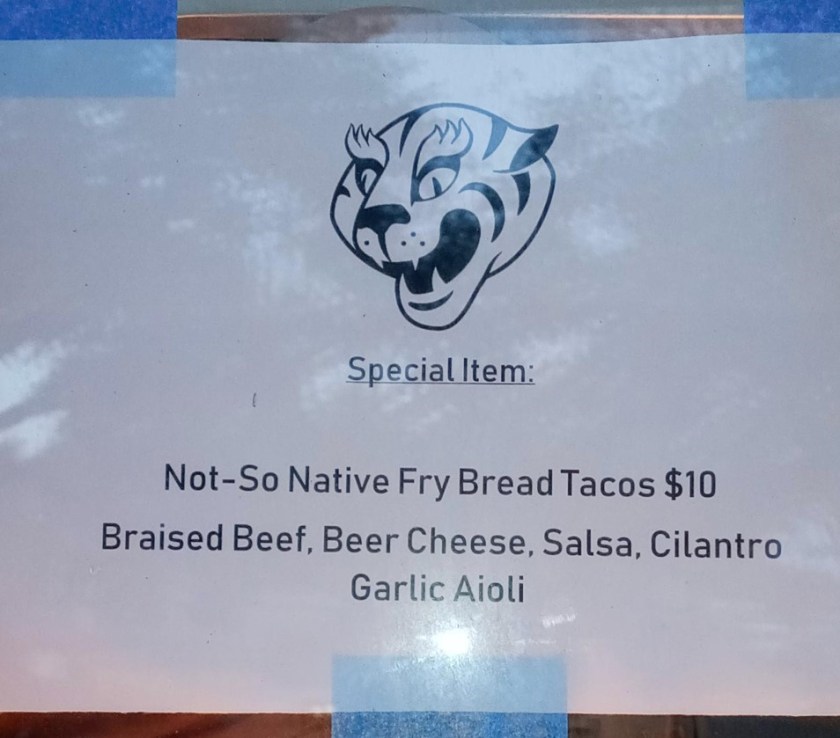
This was it: “Not-So Native Fry Bread Tacos.”  For many years, I’ve heard and read about Navajo-style tacos, a Southwestern delicacy of meat, cheese, peppers, corn, beans, sauces, and more, served on crispy, pillowy, salty, greasy fry bread, a traditional staple food of Native Americans throughout the American Southwest.

Fry bread may be delicious, but it has a fraught, controversial history in Navajo culture due to the lasting effects of colonialism, when the U.S. government gave the Navajo people flour, sugar, salt, and lard as they were forced to relocate onto desolate, dusty reservations where they could no longer grow traditional, healthy crops like corn, beans, and squash.  There is a schism within the Native American community, and even among Native American chefs, about whether fry bread is an unhealthy, lasting symbol of oppression or a tasty treat born out of resistance and resilience.  It is absolutely not my place to decide or judge which side is right, but I can say a few non-controversial things with certainty, though:
1.) Chef Denni Cha is of Native American (and Korean) descent,
2.) He told me a while back that he planned to offer fry bread tacos as a tribute to his Native American heritage, so I’ve been looking forward to them ever since, and
3.) They were one of the best things I’ve ever eaten.  Yes, in my LIFE.

But first things first: I asked Chef Denni’s lovely wife and partner, Monica, which K-Dawg (Korean corn dog) she recommended, and she told me to go with the Korean in Bogota ($10), a massive meat treat with the lightest, crispiest batter coating a perfect, smoky, salty sausage.  Korean corn dogs are definitely Internet- and Instagram-trendy right now because of how photogenic and eye-catching they are, and this one was no exception.  It was a true fusion: an all-beef Nathan’s hot dog lovingly skewered, dipped in a special batter, and fried until it is crispy outside and lusciously soft inside — an archetypal Korean corn dog even if I had ordered it plain.  But Colombian hot dogs and hamburgers are famous for being served with lots of condiments and toppings, so this was a tribute to those — hence “Korean in Bogota.”  More fusion.  More loving, respectful tribute.  Just like in comic books, this was a legit crossover.     
As the menu said, the corn dog is topped with shiso-cilantro garlic aioli, salsa rosada, pineapple salsa, and crunchy potato sticks, and sprinkled with sugar, for a variety of colors, flavors, and textures — salty, crunchy, spicy, creamy, fruity, greasy, soft, cool, sweet, hot.  (When I asked about the sugar, Denni said “Korean Hotdogs usually get heavily dusted in sugar. We do so much else with them that we just lightly sprinkle it.”)  Anyway, I’m glad I took this home and ate it over a table, because it would have been really messy eating standing up at the brewery or in the parking lot outside.

Next up, I brought home an order of lightly breaded wings ($9).  My wife loves wings, but as much as I appreciate sauces and condiments, she isn’t big on them, so I got these plain with her in mind.  The order came with six huge wings in crispy golden-brown batter, and they were really good.  The battered exterior was still crunchy and warm by the time I got home.  I asked, and this batter for the wings is different from the batter he uses for the corn dogs and fry bread.   

If you want something a little more exciting than plain wings, the other alternative is to get them tossed in a sweet, sticky kimchi sauce.  When Chef Denni kindly asked if I wanted a little ramekin of the sauce on the side, I said YES, which is what you say if someone asks if you are a god, or if you want some sauce on the side.  That sauce was so good, we poured it over the four and a half wings we hadn’t eaten yet, and it made them even better.  Even after saucing, they stayed crunchy and never got soggy, even after reheating some leftover wings in the toaster oven the next day!   
I don’t have a lot of experience eating kimchi, which is weird, because I love pickled vegetables, I’ll eat sauerkraut straight out of the jar or can, and I regularly cook braised cabbage at home.  I need to develop my taste for kimchi, just like I did for pickles.  But this sweet kimchi sauce made these fine wings even finer.

I saved the best for last, which speaks volumes, considering how great the corn dog and the wings were.  I ordered two of the Not-So Native fry bread tacos ($10 each), one for each of us.  They came in the same box and looked like the stuff that dreams are made of.  Topped with braised beef, beer cheese, cilantro-garlic aioli, salsa, corn, black beans, and more potato sticks, they were another amazing, astonishing amalgam of fantastic, fabulous flavors and terrific, tantalizing textures.  But what really took these from tasty street food to next-level works of art was the fry bread itself.  
Chef Denni was very forthcoming when I asked him about the fry bread later on.  He uses the same batter he uses for the K-Dawgz (corn dogs), only he lets it proof longer, for a total of 48 hours, to get to the right consistency for his fry bread.  My wife described the texture of being like a really good, really thick “old-fashioned” doughnut (those wrinkly glazed ones, sometimes called sour cream cake doughnuts), only crispy on the outside.  Denni agreed, saying he has compared them to “savory doughnuts” before, but more airy and fluffy.  I swear, you’ve never had tacos like this before, and I’m 100% sure nobody else in Orlando is making these.  The closest thing I could compare them to are sopes, but they are way better than any sopes my wife and I have ever tried.  I can’t imagine anyone not liking these, unless you keep kosher (in which case, ask to hold the warm, gooey beer cheese) or are a vegetarian (in which case, ask to hold the delicious, tender, savory braised beef).  Heck, even going to town on some plain fry bread would be a treat, maybe with some hot honey squirted on it like the best sopapilla ever.  But don’t miss these Not-So Native tacos!

And here’s a mediocre photo of Uncle Dendog himself, Denni Cha, hard at work in the trailer, packing up my takeout order in his panda sushi apron.  He actually took a moment to pose for me, but I said “Thank you!” like a boob before actually taking the picture, so he moved, and this is what I got — totally my fault.  I’m sorry, Chef.

So what does this have to do with the comic book artists?  Well, I told you I’m starting to identify local chefs from their styles, just like the artists I’ve admired for decades.  And after having Chef Denni’s chirashi bowls at Itamae Densho and now his Colombian-inspired Korean corn dogs and Native American fry bread tacos, I think the common element that identifies and unifies his style as a chef is the sheer beauty of it.  His serving dishes are the canvases of an iconoclastic visionary artist, whether they’re bowls with a base of rice or takeout boxes with paper trays inside.  And he builds these mixed-media structures, assembling them from diverse, colorful, fresh, dazzling ingredients that you might not even think belong together, but that’s only because we don’t think like he does.  Especially here in Uncle Dendog’s trailer/studio, he’s creating cross-cultural culinary mashups and remixes — appropriate, because he is also a musician — and elevating humble, familiar street food to eye-catching, awe-inspiring fine art.  You’ll know it when you see it, because you won’t forget it… especially once you taste it.

Tasty Wok BBQ & Noodle House

Tasty Wok BBQ & Noodle House (http://www.tastywok.net/) is the first Chinese restaurant I fell in love with in Orlando — before Chuan Lu GardenPeter’s Kitchen, and Taste of Chengdu opened.  Add in Yummy House in Altamonte (the others are all clustered around the Mills 50 district, with Taste of Chengdu recently relocated to Baldwin Park), and that rounds out my official Top Five Orlando Chinese restaurants.  I’m sorry I haven’t been back to review Tasty Wok sooner, but better late than never.

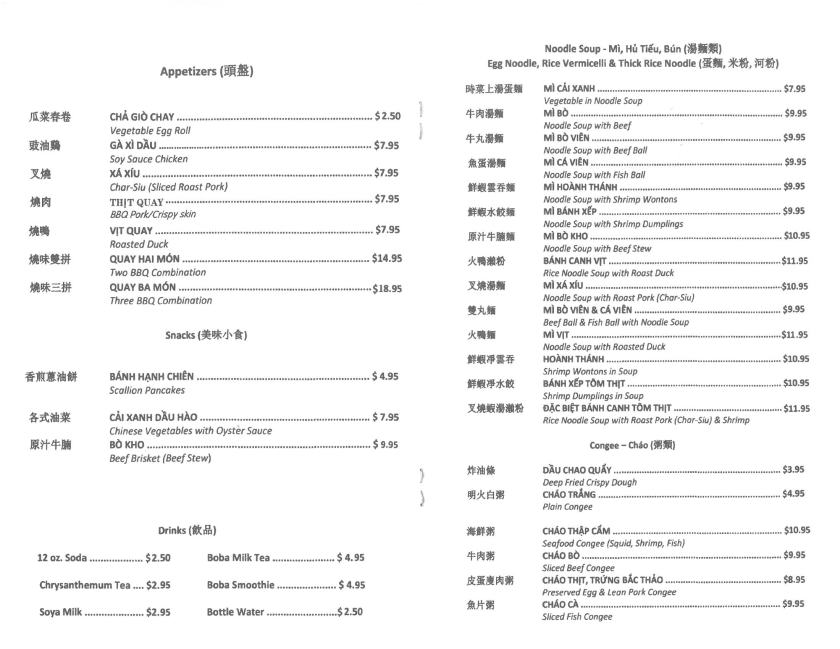
The Tasty Wok website I linked to above definitely does not include the full menu.  You could click through that website that rhymes with “help” and hope to find photos posted by randos that may not even be up to date, but I took the liberty of scanning the most recent “New” Tasty Wok menu, updated as of July 2021.  If you right-click on each image and select “Open image in new tab,” you should be able to see much larger, more legible versions.

For my first trip back in far too long, I ordered all of our old favorites to bring home to share with my wife.  From the Appetizers page, I got the three BBQ combination ($18.95), with generous portions of tender roasted duck with crispy, delicate skin, sweet char siu (sliced roasted pork), and roasted pork with fatty belly and deliciously crispy skin.  I don’t think any of the Chinese restaurants in Orlando, as much as I love some of the others, do these meats better than Tasty Wok.

This is the masterful roasted duck, which you can also order as a separate appetizer portion for $7.95, or with steamed white rice for $11.95.  Look at how beautiful it is!  My wife and I both love duck — it is one of our favorite meats.   

This is the sweet, tender char siu pork, which is also available as an appetizer portion for $7.95 or over steamed white rice for $10.95:

And I really should have turned some of these over to get a glamor shot of that crackly golden skin, but this is the fattier barbecue pork with crispy skin, also available as an appetizer portion for $7.95 or over steamed white rice for $11.95. 

I’ve been to a few local Chinese restaurants where these meats were served swimming in pools of congealing grease, or worse yet, bland and dry, like they were chopped and sliced hours ago and just sitting under heat lamps.  That’s just sad, and I never bothered to review those places because I didn’t have much nice to say after that.  But Tasty Wok has never done us wrong.  Since we love all three meats, we always get the three BBQ combination and choose these three.  (There is a fourth option, soy sauce chicken, which is probably also outstanding, but we’ve never tried it in all these years!)

We also got my go-to dish at pretty much any Chinese restaurant, beef chow fun ($14.95), with tender beef and wide rice noodles with the most pleasing chewy texture that I just love, plus onions and green onions.

This ended up being a lot of food for two people, and we had enough left over that my wife got to have the rest for lunch the following day.

Someone once described Tasty Wok to me as “Chinese soul food,” and I never forgot that description.  All the dishes I tend to like to order — these very dishes — are on the greasy side, and nobody would ever confuse them for health food.  But they are made with skill, care, and love, and they are satisfying, delicious comfort food.  They are some of the best examples of roasted and barbecued meats and wok-fried noodles around, and I recommend them all highly.  if you are a Tasty Wok regular, let me know what your go-to dishes are, since I’m always looking to expand my palate.  Run, don’t wok, to Tasty Wok!

Thirsty Gator

Thirsty Gator (http://thirstygator.net/) is a great dive bar and casual restaurant located on a lonely stretch of Goldenrod Road between University Drive and East Colonial Drive.  The address plants it firmly in Winter Park, but the surrounding area doesn’t look or feel like Winter Park.  To be completely honest, entering the bar feels like you’ve entered a portal that transports you to the Southern college town of Gainesville, Florida, two hours north of Orlando.  It doesn’t even matter when you knew Gainesville best — it will feel like Gainesville from “back in the day,” whenever that day was for you.

As if the name wasn’t a dead giveaway, Thirsty Gator is a Florida Gators-themed bar, so I’m sure it is a hot destination when Gator games are on or when University of Florida alumni in Orlando are feeling particularly nostalgic.  I have a few degrees from UF, but as I get older, I rarely feel that nostalgia for “bright college days, oh carefree days that fly” anymore.  I had some of the best and worst times of my life during my seven years as a UF student, but I met a lot of amazing friends there, and I’m so honored to know them and so proud of what they have all become.  Also, I fully realize I am able to lead the life I live now — educated, gainfully employed, happily married — because of what I accomplished back then, so in the end, it all worked out.  I never thought I’d feel more content and fulfilled in my 40s than I did in my late teens and 20s, but here I am.  Aw heck, when I was in my 20s, there were times I honestly didn’t think I would even make it to my 40s, but here I am, doing better than pretty much anyone expected, myself included.  Stalwart Saboscrivnerinos, it really does get better.  I’m living proof of that.

But enough about an old man’s reflections of times past.  On to the food!

I brought home an order of ten mild wings ($15):

And an order of ten garlic wings ($15):
These are some of my favorite wings in Orlando.  I’ve written before about how I dislike typical sports bar wings that are tiny, greasy, crunchy, and dry.  These are the exact opposite — decent-sized wings that are tender, moist, juicy, incredibly well-seasoned, and barely greasy at all because they are baked, not fried.  I probably would have preferred them hot, but then my wife couldn’t enjoy them at all, and we always endeavor to share.  Thirsty Gator may be known for its seafood, but don’t sleep on these wings!  Seriously, they have to be near the top of the Top Five in Orlando.

My wife and I can never refuse the allure of a soft pretzel.  This one was $3.25, and it was pretty large, soft, and buttery.  It wasn’t as flaky and perfect as an Auntie Anne’s soft pretzel (the only thing I like going to malls for anymore), but still hit the spot.  That is yellow mustard in the little plastic cup, not butter! 

I can never resist garlic rolls or garlic bread either, and this garlic bread was $3.25.  You get four pieces that are similar to the frozen loaves of Cole’s garlic bread I enjoy a little bit too much.  They had softened by the time I got everything home, but they had plenty of garlic, butter, and herbs on them.  You just can’t go wrong with garlic bread.

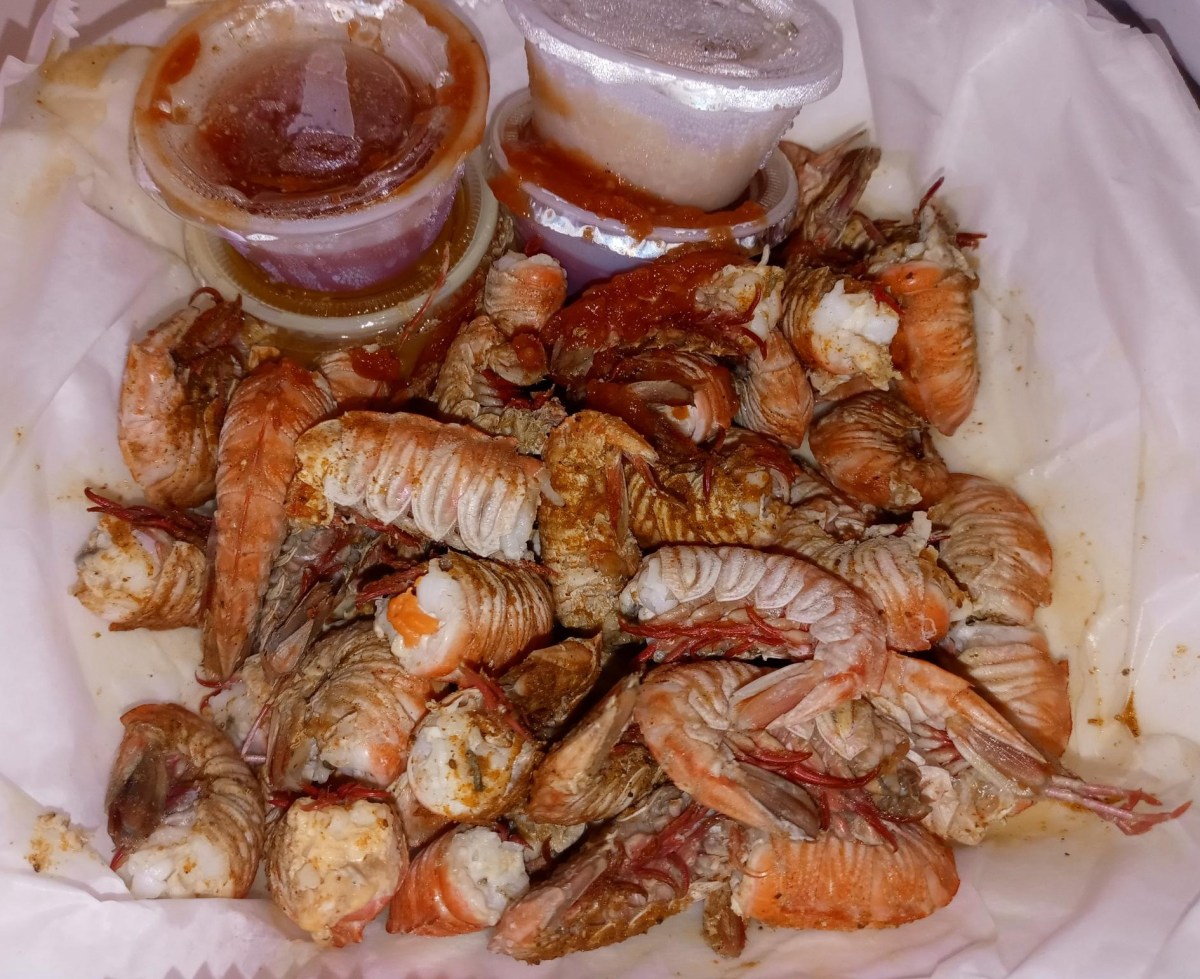
And the main reason I got takeout from Thirsty Gator, rock shrimp (market price; currently $21.95 per pound).  This delectable denizen of the deep rarely appears on any restaurant menus, and this is the one restaurant I know of in Orlando that specializes in the little crustaceans.  These are peel-and-eat rock shrimp, and their shells are slightly harder to pierce, penetrate, and peel than the typical shrimp we all know and love.  So they’re more work, but totally worth it.

This is what one of the rock shrimp looks like peeled.  The meat is succulent and sweet, and my wife and I agree they taste more like lobster than shrimp.   
Funny enough, one of our featured songs at our wedding was “Rock Lobster” by the B-52s.  If you’ve ever had spiny lobster, AKA langoustine or langostino, those guys are the real-life rock lobsters, and I honestly think they taste more like regular shrimp than lobster.

These are a real treat, and since each one is a bit of a hassle to peel, you never take these for granted.  The peeling process may not be appealing, but you never eat rock shrimp without appreciating each sweet, tender morsel.  As a result, we took our time making our way through the pound we got.  They are served warm, but we also enjoyed them chilled out of the fridge the next day.

Aside from the rock shrimp and the wings, the other big food specialty at Thirsty Gator is the fresh raw oysters, but those aren’t great takeout food.  I’ve made no secret of my great love of oysters, so I’ll just have to go back another time to enjoy them in person.  Whether you love the Gators, hate them, or just fear them as so many do, there is so much to love at Thirsty Gator.


Las Carretas Mexican Restaurant

The first time I ever heard of Las Carretas Mexican Restaurant (https://www.lascarretasmexicanrest.com/), my heart filled with joy and hope, then immediate disappointment.  When I first saw a sign that the restaurant was opening soon in the Publix plaza on the corner of University Boulevard and Goldenrod Road in east Winter Park, I was overjoyed, thinking at first it meant an outpost of La Carreta, my family’s favorite Cuban restaurant chain in Miami, was coming to the Orlando area.

But I quickly noticed the sign was pluralized: “Las Carretas,” not “La Carreta,” and that it was going to be a Mexican restaurant, not Cuban.  We already have far more good Mexican restaurants here than in Miami, but I got over that initial disappointment and forgot about it for a while.  It opened earlier this year, and diners started posting really positive reviews on the Orlando Foodie Forum Presented by Tasty Chomps!, and I started paying attention all over again.

Well, I have eaten there four times now, and I can happily report that Las Carretas is an excellent Mexican restaurant, and we should be happy it’s here.  The initial fault was mine for misreading the sign and getting my hopes up.  It might not be the beloved Cuban restaurant of my past, but it is the terrific Mexican restaurant of my present and future.

The Las Carretas menu is HUGE, so I strongly suggest studying it in advance.  On our first visit, my wife and I started our first meal with a couple of aguas frescas ($4.99 each), sweet, non-alcoholic, non-carbonated beverages that are much tastier and more refreshing than sodas, and much better for cutting the heat of spicy food.  I chose horchata (left), sweet, creamy rice milk seasoned with cinnamon and vanilla.  My wife chose coco nuez, a rich and creamy agua fresca made with coconut milk, coconut shreds, and crushed pecans.  I’m not big on nuts, but I do love coconut, and I liked her drink even more than mine.  These are gigantic glass mugs, by the way — think German biergarten mugs.  No free refills, though!  (Yes, I asked.)

They have a self-service salsa bar!  Just use hand sanitizer before and after, and fill the little plastic cups with chilled fresh salsas and pickled vegetables (jalapeños, carrots, onions, nopal cactus strips) to your heart’s content.  They will be perfect for the fresh, crispy, thin tortilla chips about to grace your table.

Here are those chips with an assortment of salsas.  The white stuff turned out to be a tangy, creamy, cool salad dressing, but it was nice to dip the chips in, and it works well cutting the heat of some of the spicier ones.   The dark salsa next to it is a smoky chipotle salsa, blended smooth so it is thin, with no chunks in it.  That one was my wife’s favorite by far.  They’re all a little bit different, so if you’re anything like me, a self-proclaimed salsaholic, you will want to try little dabs of all of them on your chips.  One or two are extremely spicy, but I honestly don’t remember which of these were the spicy ones.  I think the orange one on the left was fiery, so be prepared!

My wife ordered table-side guacamole ($8.99), hold the jalapeños and easy on the tomatoes and onions.  It was made with care and flair by a nice lady who probably has to make guacamole in front of people all day, pushing her cart around the restaurant like teachers who wanted to show a video in class back in the day.  It was some of the freshest, nicest guac I’ve ever had.

For her meal, my wife chose the alambre Mediterraneo ($17.99), a dazzling platter of grilled shrimp, scallops, octopus, squid, and bacon, with grilled peppers and onions, topped with melty oaxaca cheese and sliced avocado, tomato, and radish.  She loved it, except for the cheese.  She thought it overwhelmed the more subtle seafood flavors.  I’ve never noticed alambres on a menu before, but all of the ones at Las Carretas come with five tortillas.  She chose corn tortillas with it.   
This picture barely communicates the size of the platter and exactly how much food comes on it!

I couldn’t resist an alambre either, but I chose the alambre mata hambre ($16.99), which lived up to its name as a true “hunger killer.”  It was an equally massive platter of pork loin, al pastor pork, carne asada (grilled steak seasoned with lime), chorizo, bacon, ham, grilled bell peppers, onions, pineapple, melty oaxaca cheese, and topped with sliced avocado, tomato, and radish, and served with five tortillas (flour for me):

The a la carte menu has a lot of options for people who like to sample things, like a single cheese tamale ($3.50), which we both thought was just okay:

This is an a la carte beef burrito ($3.99), served “wet” (smothered in sauce and melted cheese).  It’s a classic wet burrito, which is making me reminiscent for Taco Viva, a South Florida fast food chain that predated Taco Bell in the ’80s.  They all closed decades ago, but they gave me my first tastes of Mexican food as a kid, igniting a lifelong love affair.  I don’t even know if Taco Viva was any damn good by Mexican food standards (probably not), but you know what is?  Las Carretas and this burrito right here:

This is a huge a la carte chile relleno stuffed with cheese ($4.99).  After I was so disappointed Tex-Mex chain Chuy’s removed chiles rellenos from its menu at some point in the last year and a half, I was thrilled to discover such a good one here at Las Carretas, with a lightly crispy batter that didn’t get soggy under all that sauce, and didn’t fall or peel off.

There were almost too many good choices for dessert, but on this first visit, my wife chose fried ice cream ($5.99).  The scoop of vanilla had a nice, thin, crackly coating she liked that reminded me of crushed corn flakes, and that was her favorite part.  I preferred the fried flour shell/”bowl,” so that worked out well for both of us.  But we had other dessert ideas that would have to wait for our second visit.

My wife and I went back for a second lunch a couple of weeks later (months ago, at this point), and met a good friend there.  I ordered the chimichanga ($9.99 on the lunch menu), sort of like a burrito wrapped in a flour tortilla, then lightly fried.  It was smothered with a sticky, thick cheese sauce and stuffed with beef tips that ended up being kind of like pot roast.  The Mexican rice, guacamole, pico de gallo, and sour cream were nice, fresh accompaniments that kept the beef, sticky cheese sauce, and crispy shell from feeling too heavy.

Our friend got enchiladas rancheras ($9.99) on the lunch menu — cheese-stuffed enchiladas topped with pulled pork, grilled onions, green and red bell peppers, and enchilada sauce.  I swear there are enchiladas under there!

My wife went back to the alambre Mediterraneo ($17.99) again, only asked for it without cheese this time.  She liked it even better without the melted cheese contrasting against the seafood.

This one cracked me up.  I always love tortas, Mexican sandwiches on bolillo rolls, so I ordered the one torta on Las Carretas’ menu, the torta toloqueña ($11.99 on the lunch menu), intending to split it with our friend.  The sandwich comes with chicken milanesa (a chicken cutlet, pounded thin, breaded, and fried), ham, oaxaca cheese, pineapple, “vinegar mixed manzano pepper,” tomato, avocado, ketchup, mayonnaise… and salchicha, which I know means sausage.  Well, I expecting more like a chorizo-like sausage, and not these hot dogs on top!  That’s my bad.  I should have known better.  All three of us had a good laugh over it, and we still shared the salty, overstuffed torta.  It was an unexpected surprise, but it was still a really decadent and satisfying sandwich.  This torta toloqueña was the only time in my life I’ve ever been okay with ketchup being anywhere near hot dogs.

We couldn’t decide between two desserts, so we got both!  These are the churros ($4.99), served with caramel and chocolate sauces:

And sopapillas ($5.99), fried flour tortilla wedges sprinkled with sugar and cinnamon, drizzled with honey, and served with a rapidly melting scoop of vanilla ice cream.

I couldn’t tell you which of the three desserts was my favorite, but they all involved comparable flavors.

On both of these visits, I was thinking about how much my co-workers would enjoy Las Carretas, so a few weeks later, at the first mention of a work lunch, I was quick to suggest this place.  When I returned to Las Carretas for my third time, I brought three co-workers with me.  None of them are the adventurous eaters I am, so we often end up at Chili’s, Miller’s Ale House, or Gator’s Dockside for work lunches.  But I implored them to give this new Mexican restaurant a chance, and they wouldn’t be disappointed.

They weren’t.

My vegetarian supervisor and friend ordered enchiladas vegetarianas ($10.99), three enchiladas stuffed with zucchini, yellow squash, spinach, and mushrooms, topped with ranchera sauce and mozzarella cheese:

Another co-worker, my former supervisor who has since been promoted, ordered this beautiful campeche quesadilla ($13.99), with grilled shrimp, onions, bell peppers, and mozzarella cheese:

I ordered the party tacos ($14.99), because nothing says “party” like a lunch with your current and former supervisors and one other guy, where you talk all about work before having to drive back to work and not fall asleep.  Anyway, you get an order of six tacos and can try two proteins in them.  Frankly, I would have preferred an option where I could buy six individual tacos, all with different proteins, but I chose wisely: cabeza (tender, moist, fatty beef head; along the top) and al pastor (slow-cooked pork marinated in pineapple juice; along the bottom).  Both were so delicious and satisfying, not dry at all like the meats occasionally are at even the best taquerias.  This is an incredible dish, and a good deal too.

And another guy got a trio of tacos, but I don’t remember which ones these are.  Carne asada would be my best guess.

On my fourth visit with one of the same co-workers, she got queso dip ($3.99) and table-side guacamole ($8.99) to go with the fresh tortilla chips:

And I tried yet another new dish, the Texas burrito ($11.99), a dry burrito (not smothered in cheese and sauce, so you can hold it and eat it), stuffed with crumbled chorizo sausage (another one of my favorite Mexican meats), rice, beans, shredded cheese, lettuce, tomatoes, sour cream, pico de gallo, and avocado sauce.  It was awesome and huge.  Look at it on this large, long plate:

And you thought it smelled good on the outside!

So that’s a massive review based on my four meals at Las Carretas, all eaten at the restaurant.  With how close it is to both work and home, I expect I will continue to be a regular at this place, especially since they have a large, covered outdoor seating area for when the weather finally cools down (and avoiding people carrying the Delta variant in the meantime).  Las Carretas may not be Miami’s La Carreta, but it is one of Orlando’s best Mexican restaurants, and now one of my favorites.  I can’t imagine anyone going out to eat here and being disappointed.  It’s a real crowd-pleaser in every way.

The ‘Dines List 2: Mission to Morocco!

Believe it or not, even though we’re finally into October, it’s still hurricane season, so this lifelong Florida Man isn’t relaxing just yet.  I usually don’t let my guard down until we get to Thanksgiving, so I still have a huge stash of shelf-stable food on hand, including plenty of my favorite quick, easy, healthy, delicious household staple, tinned sardines.

I don’t know if my first installment of The ‘Dines List, the new ongoing Saboscrivner feature where I review canned sardines and other tinned seafood, was a rousing hit among my dozens of readers back in July.  Most people come here for restaurant reviews, but because I don’t go out to eat as often as everyone thinks I do, I bolster those with reviews of other foods I enjoy and want to spread the word about in recurring features like Grocery Grails, Tight Chips, Cutting the Mustard, and now The ‘Dines List.  But the truth is, I eat a lot of sardines.  I got into them when I was a poor student, but now that I make the medium bucks in the high-stakes, high-pressure world of academia, I continue to dine on ‘dines because they’re so healthy, they’re environmentally sustainable (especially compared to most other fish), they’re cheap, they’re versatile, and I just like them.  Plus, as a lifelong collector of things like comic books, action figures, and music, I appreciate that there are seemingly infinite varieties of sardines, so I love discovering and collecting new brands and flavors and sharing information about them.

My first ‘Dines List feature, “Canned Sardines 101,” was a rundown of some of my all-time favorite sardines, meant as a guide for the unfamiliar and the skeptical, to ease new ‘dine eaters into those briny waters and introduce them to the tastiest and least-intimidating tinned ‘dines I know of.  But since there are so many more sardines out there, future ‘Dines List installments are going to have themes to them, and this one is going to be about sardines from Morocco.

Why Morocco?  Perhaps the better question is why not Morocco?  Located in the northwestern point of the African continent, Morocco borders the Atlantic Ocean and the Alboran Sea, which is the westernmost edge of the warm Mediterranean Sea.  This geographical area, where ocean meets sea, has a long history of fishing and trading, and there are commercial fisheries all through the region.  Morocco is right across from Spain and Portugal, and plenty of tinned sardines are products of those three countries.  I’ll cover Spanish and Portuguese sardines in future installments, but it is worth noting that due to European Union agreements regarding fishing rights, many Spanish vessels fish for sardines in Moroccan waters.

The first Moroccan sardines I found were from the Titus brand, which most Asian markets around Orlando seem to carry.  These had a very cool-looking can.  I love how sardine can graphic design tends to be “old-timey,” like they’ve had the same artwork, fonts, and colors for decades, or even longer.  You’ll never see tins emblazoned with a cartoon fish shredding on an electric guitar while riding a skateboard and wearing sunglasses and a backwards cap, because there are no focus groups warning the sardine companies they need to be more “extreme” and “totally in your face.”  And that’s just fine, really.

But the ‘dines inside weren’t the prettiest.  This was after I drained the oil, but don’t worry, you didn’t miss much.   

I just threw these over some pasta and didn’t bother to take a picture.  They were okay.  I don’t think I would get them again, but of course I bought two cans of the regular Titus and two cans of…

HOT TITUS!  I almost always gravitate toward spicy sardines, which are either packed in spicy oil or with some kind of hot peppers, or both.  They usually taste better than plain ones, at least to me.   
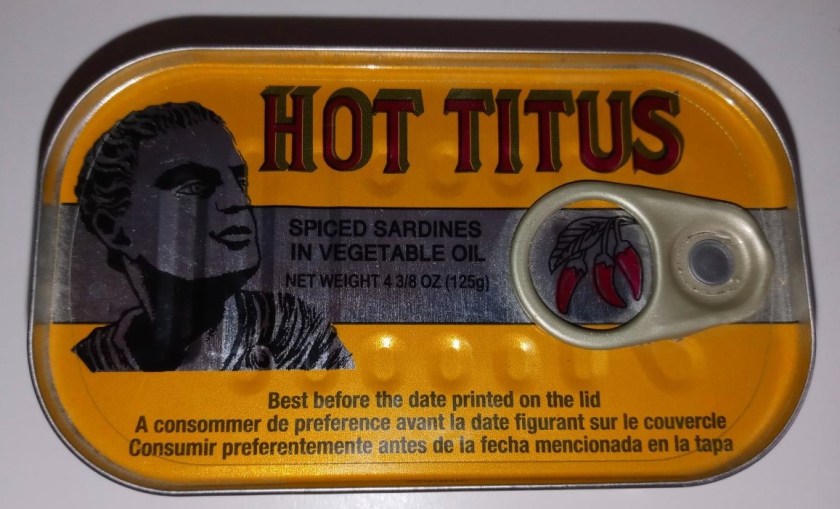
This can only included three large ‘dines, and in my experience, the bigger ones rarely taste as good as the smaller ones.  They tend to be drier and flakier in texture than smaller brisling sardines.   These Hot Titus ‘dines came packed with some very hot peppers (dry and full of spicy seeds) in addition to the bright orange spicy vegetable oil.

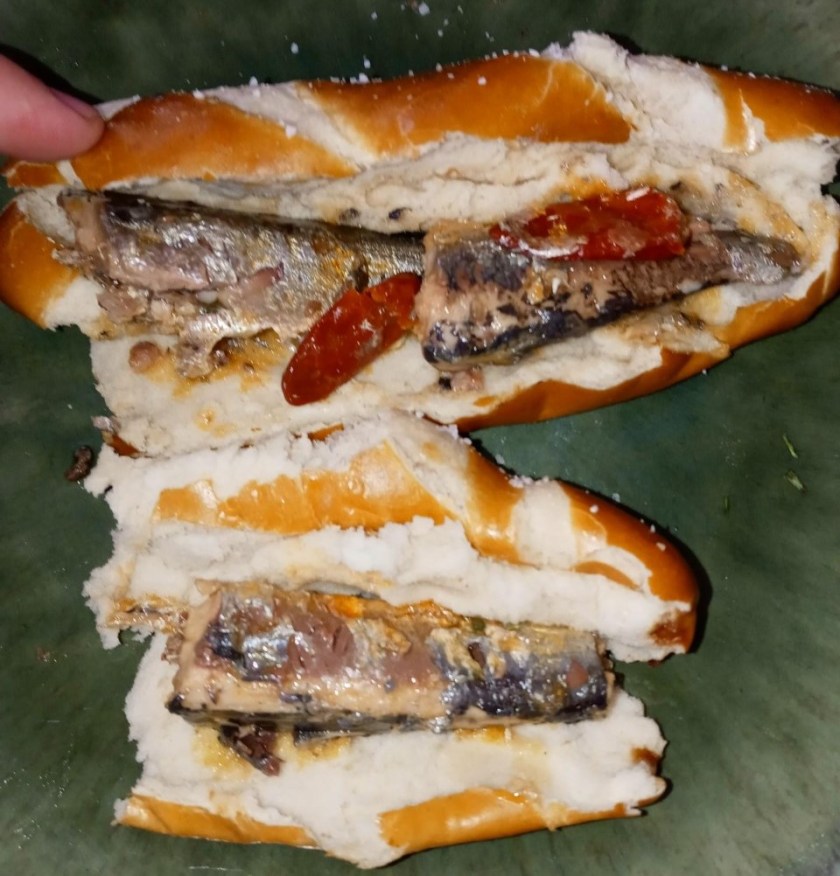
I made the Hot Titus ‘dines into one and a half sandwiches on delicious Deutsche Kuche soft pretzel sticks from my favorite grocery store, Aldi.  I pronounce the brand name “Douche Cooch,” because I am easily amused.  The pretzel sticks are imported from Germany, and I just bake them in the toaster oven at 350 for nine minutes.  They come out with perfect crispy, crackly exteriors and soft, fluffy interiors, ideal for salvaging sardines (or sampling mustards, as in my Cutting the Mustard feature from earlier this summer).I left off the condiments to get their full flavor… which wasn’t much to speak of, even with the two peppers they had been canned with.  I drained the oil, as I always do, but it didn’t impart much flavor either.  That could have been because it was vegetable oil instead of the superior olive oil.  A schmear of mustard and some fresh and pickled vegetables would have helped turn these into superior sandwiches, even with mediocre ‘dines, but I wanted the full, unadulterated Hot Titus experience.
Earlier this year, I found these Brother and Sister sardines at Tima’s House, a Euro-Balkan grocery store in Longwood, which has some neat stuff.  I don’t think they would have cost more than $3, or I would not have bought them.  You don’t usually see sardines in sunflower oil, but I’m a mark for spicy ‘dines with peppers, so I had to try them.  Plus, they were from Morocco!
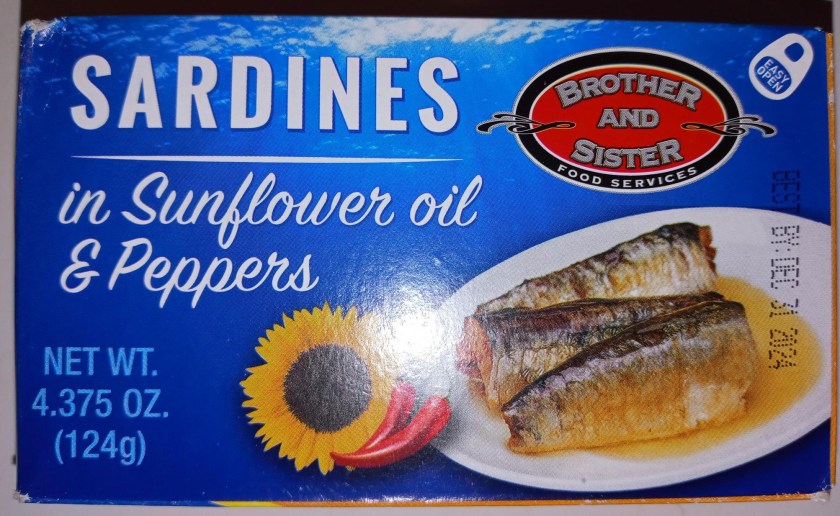
They were pretty typical-looking large sardines with dark skin, packed in a deep orange spicy oil that didn’t actually impart much flavor. 

I had these four Brother and Sister ‘dines over a simple salad, since I pack a salad in my lunches for work almost every day.  This salad looks like it was more simple than usual, since I just see lettuce and cucumber on it, but I probably splashed on a bit of a vinaigrette dressing.  They were okay.  I’ve made better salads and eaten better sardines, that’s for sure.  The little peppers aren’t very tasty, and they are full of seeds, so I tossed them after taking this picture. 

I don’t remember if I got these Baraka sardines at Tima’s House or at one of Orlando’s many Middle Eastern grocery stores.  Once again, they are products of Morocco, and they are packed in soy oil with chili peppers, so I was on board.  The price was definitely right on these, but sometimes you don’t want the absolute cheapest canned seafood out there. 

I instinctively drained the orange oil before taking this photo, so they weren’t just sitting in a completely dry can:

And I enjoyed them on some marble rye toast with a schmear of neufchatel cheese (like cream cheese, but low-fat, so the cheese and your life are both less enjoyable) and everything bagel seasoning.  The tin ended up having just three large sardines plus the long chili pepper that didn’t taste very good on its own.

The next Moroccan ‘dines I tried were from the Sultan brand.  First I tried spicy Sultan sardines, in oil with chili peppers.  I believe I found these at the Walmart Supercenter, of all places, in the small Middle Eastern food section.  They were cheap, so I figured “Why not?  I’m already in Walmart.  How much worse can things get?”

They were pretty large ‘dines, as all the Moroccan ‘dines tend to be.

I had these on Ritz crackers (the BEST crackers for any purpose), with dabs of my homemade tzatziki sauce underneath each one — Greek yogurt, cucumbers, garlic, salt, and a dash of dill.  These spicy Sultans weren’t bad at all.  They were very meaty ‘dines, with decent flavor from the spicy oil and some subtle heat.  The chili peppers, as usual, were barely edible.  

I also bought a can of plain Sultan sardines at the same time, and my hopes for these weren’t as high, especially after the relative disappointment of the plain, non-hot Titus ‘dines compared to the Hot Titus.
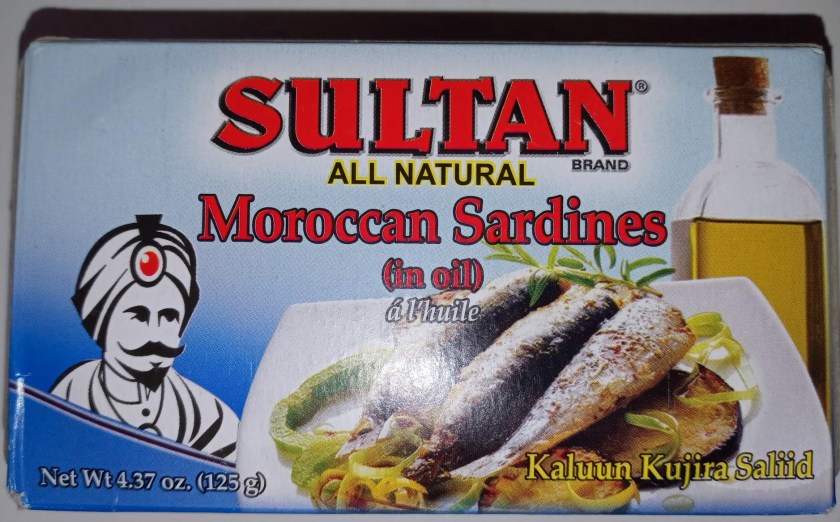
These were even larger fish:

But I worked some magic, following a Sicilian recipe for pasta con le sarde, a dish that includes onions, garlic, fennel bulb, golden raisins soaked in wine, seasoned bread crumbs, the plain Sultan sardines, and pasta — in this case, some perciatelli, which is essentially the same as bucatini (long, hollow tubes).  Of course I didn’t have any wine to soak the golden raisins in since neither my wife nor I drink, so I just threw them in there unaltered, thinking the sweetness and chewiness would bring something nice to the experience.  It was a tasty pasta dish, especially with that fragrant fennel, which is a truly underrated ingredient.  But I felt like it could be better.

In my first ‘Dines List write-up, I sang the praises of Norway’s King Oscar brand, some of the best sardines you can buy in terms of quality, variety, and value.  King Oscars are readily available at most major supermarkets, and I mentioned last time that they are terrific “gateway sardines” for the uninitiated.  Most King Oscar sardines are products of Poland despite being caught in Norwegian waters.  However, these skinless and boneless Spanish Style ‘dines, packed in olive oil and seasoned with chili peppers and tiny slices of carrot and pickle, are products of Morocco, hence their inclusion here.
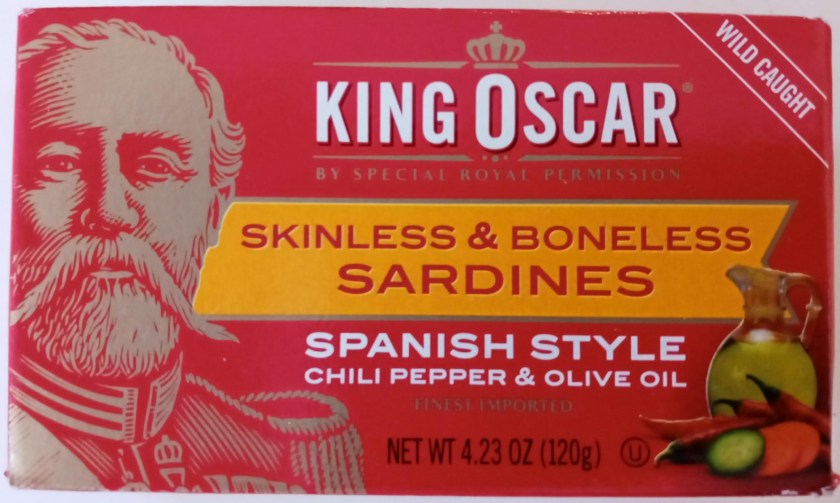
In that previous installment, I warned about avoiding boneless and skinless sardines.  That’s just a personal preference, but I felt obligated to try these for a more complete feature on the different varieties of Moroccan sardines.  These King Oscars are perfectly good sardines, but they never look right to me without the silvery skin.  And I think the bones add some interesting texture (plus calcium).

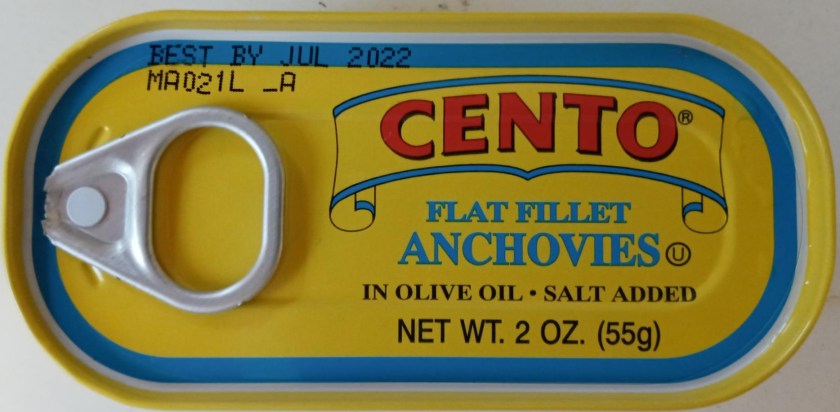
I decided to attempt pasta con le sarde again, to do something more exciting with these boneless, skinless ‘dines.  I started sautéing diced onions, garlic, and more of that awesome fennel bulb in extra virgin olive oil, then added a can of Cento anchovies, which I always stock up on at Trader Joe’s, because they are so good in recipes.  (They are also products of Morocco!)  I mashed up the salty anchovies and their oil in the aromatics and kept sautéing until the anchovies completely dissolved.  That added some saltiness and savory umami flavor, which is good because all boneless, skinless sardines are very mild.  (Although these Spanish Style King Oscars are the best boneless, skinless sardines I’ve ever tried, both flavor- and texture-wise.)
Once the aromatics were translucent and soft, I added sultanas (golden raisins) that I had been soaking in white wine vinegar as a substitute for wine, since I learn from my mistakes.  Then I stirred in the King Oscar ‘dines, their oil, and the tiny sliced vegetables straight out of the can, then some seasoned Italian bread crumbs and red pepper flakes, and let everything continue to sauté.  I tossed it all together with some al dente fettuccine pasta, threw some diced tomatoes on top, and boom: new and improved pasta con le sarde!  This was by far the better attempt, between the higher-quality King Oscar sardines that brought their own flavors, plus the can of anchovies, the red pepper flakes for some necessary heat, and the white wine vinegar-soaked golden raisins for sweetness and tartness.  I’ve never seen this pasta dish on a restaurant menu anywhere, but I am  obsessed with it now.

A long time ago, I bought a can of Alshark sardines from a Middle Eastern grocery store and thought they were pretty good, so I tracked down another can for the purposes of this review, since they are also Moroccan.  

This was the only sardine can I had trouble fully opening, but I was still able to get the four large ‘dines out.  
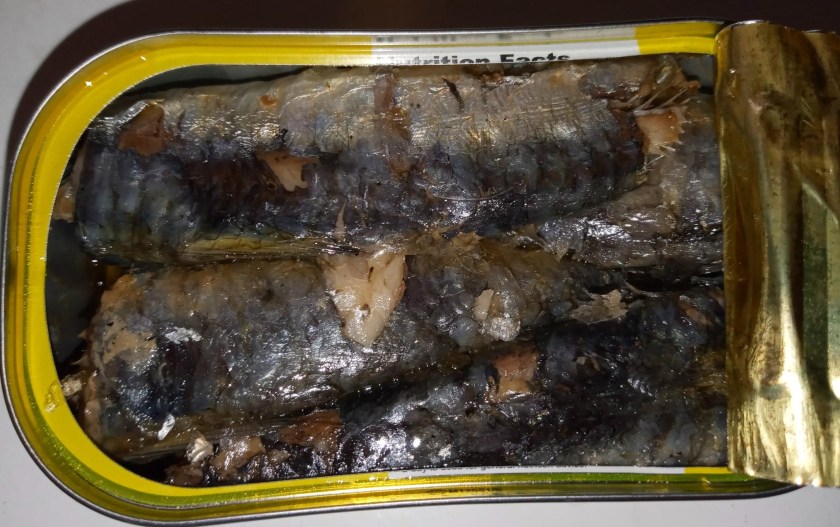
I ate them plain to really experience the flavor.  These were meaty and pleasantly spicy, moreso than any of the other so-called spicy ‘dines in this review.  I’d definitely get these Alshark ‘dines again.

Last but not least, I decided to try Wild Planet’s “Wild” white anchovies, another product of Morocco.  These are totally different from the salt-cured anchovies most people are familiar with, like the Cento anchovies shown above, which are one of my secret weapons when cooking.  These are more like typical tinned sardines than super-salty brown anchovy filets.  

White anchovies like this are popular in tapas dishes in Spain, where they are called boquerones.  I ate these straight out of the can after draining the oil because I had never had boquerones before, and they were okay.  Pretty plain and bland, like Wild Planet sardines I’ve tried before.  Despite the name of the company, there wasn’t much “wild” about their flavor.  Unfortunately I bought these at Costco, so I have four more cans to get through.  I will definitely jazz them up with more exciting recipes and serving methods to make them more interesting in the future.

So here ends our Mission to Morocco, the second of hopefully many ‘Dines List features right here on The Saboscrivner.  Expect to learn all about sardines from Spain, Portugal, and other parts unknown in the months (and years) to come, but at least I got this one out before hurricane season is over, just in case it inspires anyone to stock up on some sardines.

As always, stalwart Saboscrivnerinos, let me know what you try and if you like them or not, and if there are other sardines or tinned seafood you recommend.  I’m always happy to take requests and accept freebies, especially if any of you jet-setters travel to Europe, where grocery stores have mythical aisles of nothing but fancy tinned seafood.  But in the meantime, I’ll be on the hunt (or more accurately, gone fishin’) in Orlando’s many supermarkets and international grocery stores as a connoisseur of the canned, a professor of the preserved, the dean of sardines.

Pizzeria Valdiano

I have reviewed most of my favorite pizzerias in Orlando, but one of my oldest favorites that I hadn’t been back to in a while is Pizzeria Valdiano (http://www.pizzeriavaldiano.com/) in the Winter Park Village shopping center, right next door to my favorite movie theater.  I hadn’t been to a movie in over a year and a half thanks to the pandemic, but back in July, I finally broke down and saw a new release I’ve been looking forward to for over a year.

Unfortunately the movie (Snake Eyes: G.I. Joe Origins) was a colossal disappointment for this lifelong G.I. Joe fan and collector, but you know what wasn’t disappointing?  A quick lunch before the movie at Pizzeria Valdiano!

Here is one of the best slices of New York-style pizza in Orlando ($3.85), nice and crispy with melty cheese and garlicky, oregano-ey tomato sauce, the perfect New Yawk slice:

And one of my favorite slices of Sicilian pizza ($4.35), perfectly thick,  crunchy and fluffy at the same time.  Could this be the best Sicilian pizza in the city?  Top two or three, without a doubt!

Pizzeria Valdiano is the only pizzeria I know of in Orlando that serves a “Grandma” pizza — a Sicilian pizza without mozzarella cheese on top, just parmesan.  This is a single Grandma slice ($4.35), with the same blend of fluffy and crunchy attributes, and even more robust sauce.

Look, people have strong opinions about pizza, I get it.  I do too.  There are definitely trendier pizzerias, some of which I just love.  If you want Chicago-style deep dish or a fancy double-decker pizza, Brad’s Underground Pizza (now in a permanent location!) has you covered.  If you want Neapolitan-style, you can’t do better than Pizza Bruno.  But for the two kinds of pizza that are closest to my heart due to nostalgia, New York and Sicilian, there are only a few worthy options, especially if you prefer to order by the slice, as I do: Del Dio, Antonella’s, Paradiso, and right here at Pizzeria Valdiano.

Being next to the movie theater brings me even more nostalgia and warm feelings.  I’ve always loved going to the movies, especially catching an early weekend matinee and following it with a nice lunch out.  For so long, this theater was my tradition, to be followed by either a hoagie from nearby LaSpada’s or a couple of slices from Valdiano right next door.  I don’t know when I’ll feel comfortable enough to return to seeing movies in the theater, minus this one unfortunate miscalculation, but at least the pizza was as good as ever.


Caribbean Shack, formerly known as Vindi’s Roti Shop and Bar

EDITOR’S NOTE: As of mid-March 2023, I learned that Vindi’s Roti Shop and Bar has changed its name to Caribbean Shack.

***

After discovering the delicious new world of West Indian food with my review of Singh’s Roti Shop earlier this year, I craved more.  The Trinidadian and Guyanese flavors were similar to Jamaican dishes I had always loved, with with some Indian influences too.  After posting my review of Singh’s on the Orlando Foodie Forum on Facebook, a lot of people recommended Vindi’s Roti Shop and Bar (https://www.facebook.com/VindisRotiShopAndBar/), formerly known as Annie’s Roti Shop, located at 805 S Kirkman Road, Suite 106, Orlando, FL 32811, mere minutes away from Singh’s on Old Winter Garden Road.  I visited Vindi’s a while back and ordered a bunch of different dishes to sample, enough for three or four meals, so I could compare and contrast them.

First of all, since Vindi’s doesn’t have a menu online or paper menus to take with you, I took photos of the menu screens on their large TVs:

I ordered:

An oxtail meal ($14.50), which comes with stewed potatoes, curried chickpeas called channa, and a choice of either rice or a choice of huge, fluffy, soft flatbreads called roti.  My trip to Singh’s clued me in to the two different kinds of roti, so I chose my favorite, the “buss up shot,” like a big, chewy paratha, named for the “busted-up shirt” it resembled when torn into pieces to scoop up the tender stewed meat and vegetables.  Because my wife and I both loved the buss up shot so much at Singh’s, I ordered a second one for $3.

The buss up shot, which unrolls and unfolds to become an absolutely huge blanket of soft, fluffy wonderfulness:

This was the boneless curry/stew chicken meal ($10), also served with stewed potatoes and channa.  I love Jamaican-style brown stew chicken, which is usually cooked until tender with the bones, but this chicken being boneless made it easier to scoop up with roti.  This is after I transferred it to a microwavable plastic container for later.  I realize it might not look appetizing in this photo, but it smelled so delicious and tasted even better.

I decided to go with the other roti variety with this meal, the dhal puri, which is more of a golden color and stuffed with seasoned chickpea particles that add texture.  I can’t seem to find that photo, but it looked very similar to the dhal puri I got at Singh’s and photographed in that review back in March.

Vindi’s came highly recommended for its doubles ($1.50), a beloved Trinidadian street food with channa sandwiched between two fried paratha-like patties.  This doubles had a slight sweetness to it, and I liked the flavor and texture even more than Singh’s version of the doubles.

A peek inside the doubles:

Similar to how saltfish is a popular breakfast food in Jamaica (and the national dish when served with a local fruit called ackee), Vindi’s serves smoke herring as a breakfast dish, stuffed into a fried bread called fried bake (sometimes “fry bake” or just “bake”).  I am all about smoked fish at any time of day, whether it’s delicate, luxurious sable on a bagel, whitefish salad on a bialy, saltfish with ackee or stuffed into a golden fried patty, or even good sardines or sprats out of a can.  I loved this fried bake with smoke herring ($6.50), which was mashed up, served warm, and mixed with some spicy vegetables.  I ate half for lunch and half for dinner, but I can only imagine it would be a breakfast of champions.  The thing on the left above is an extra plain fried bake ($2) that I ordered for my wife, since I knew she wouldn’t be into the smoke herring.

I also got two aloo pies ($2 each), one for me and one for my wife — a soft, fluffy fritter stuffed with seasoned mashed potatoes.  It was very good, and very similar to the aloo pie I tried at Singh’s.  I couldn’t tell any major difference between the two.

Finally, I got a Solo brand cream soda for myself, and a Solo sorrel drink for my wife.  (Solo is a Trinidadian brand, and these were $2.50 each.)  I asked what sorrel tasted like, and a helpful guy waiting in line next to me said it tasted like hibiscus.  My wife loves jamaica (hibiscus-flavored) aguas frescas from Mexican restaurants, so I knew she would appreciate that.  I tried a sip, and it had an aftertaste that included cloves and possibly cinnamon — not my thing, but she seemed to like it.  The cream soda reminded me a little of a bubble gum flavor, maybe banana, possibly cotton candy, but it didn’t have the vanilla flavor I’m used to from American cream sodas.  But don’t get me wrong, I liked it, and I’m glad I tried it.  I’m trying really hard to drink less soda, but I always like to try different root beers, cream sodas, and orange sodas.

Anyway, Vindi’s Roti Shop and Bar was awesome.  I can’t tell you if it is better than Singh’s, but I loved both, and I’d be a regular at both if they weren’t so far across town.  My recommendation, whether you’re familiar with the delicacies of Trindad and Guyana or not, is to visit both Singh’s and Vindi’s on the same trip to compare and contrast similar dishes, since they’re so close to each other.  Singh’s has the West Indian takes on Chinese food to set itself apart a bit, but both restaurants serve up the standard West Indian dishes.  They are delicious and ridiculously cheap, for the quality and quantity of food you get.  It has been a while since I went to Vindi’s and wrote the bulk of this review, so I think I’ve inspired myself to schlep out there for a return trip very soon.  Maybe I’ll see you there… except I probably won’t recognize you, since hopefully you’ll be masked, and I definitely will be.

Kombu Sushi Ramen

Sushi is one of my favorite foods, but I rarely eat it because you pay for quality, and that means decent sushi isn’t cheap, and next-level sushi is expensive.  Plus, it takes so much sushi to fill me up, it isn’t a cost-effective meal for me (excluding my beloved all-you-can-eat Mikado in Altamonte Springs, which I still contend is one of the best bangs for your buck anywhere).

A few weeks ago, my wife and I agreed that sushi sounded good for dinner, and I asked her to choose one of three sushi restaurants near us to order takeout from: two we hadn’t been to, and one we hadn’t been to in a few years.  She looked at all three menus online and chose one of the new ones that opened earlier this year, not far from us: Kombu Sushi Ramen (https://www.facebook.com/KombuSushiRamen/) on Aloma Avenue in a less-traveled part of Winter Park.  We went a little bit nuts with ordering, but the sushi ended up being just what we dreamed of for far too long.  (The last time I had sushi was earlier this year, while we both spent 30 days together in the hospital.  That sushi was one of the best things I ate from the hospital cafeteria, but I was looking forward to something far better, in more pleasant surroundings.)

Kombu is in a little building that looks like a house, and it probably used to be a house a long time ago.  Once I arrived, I only had to wait a few more minutes for my takeout order to be ready.  The dining room was very nice, modern, and clean.  It was busy on an early weekend evening, always a good sign.  The sushi chefs were definitely hustling behind the sushi bar, and the hostess was kind enough to offer me a glass of water while I waited.  It was a nice place I would like to see succeed.

Always health-conscious, my wife gravitates toward sashimi, thin slices of fresh, raw seafood without the usual rice, to avoid some carbs (or preferably, to save the carbs for dessert).  She ordered this sashimi dinner ($24.95), with 20 assorted pieces of fresh fish and shellfish slices selected by the chef.  This lovely arrangement included tuna, salmon, escolar (AKA white tuna or butterfish), surimi (AKA “krab,” white fish processed to look and taste like crab), and one of her favorite seafoods, tako (AKA octopus, at the 12:00 position).  She really loves octopus, whether it is grilled, fried, or served like this (not raw but actually cooked; thanks to a sharp-eyed Saboscrivnerino for correcting me on this).   

Below on the left, you can see my order of mackerel sashimi ($4.50 for the three shimmering silver pieces of fish).  I always love saba (mackerel) because it tastes like pickled herring, with a little bit of sweetness and a light, vinegary tang.  Next to that, in the back, is my wife’s extra escolar sashimi ($5 for the three white pieces), and our bagel roll ($5.95), a favorite of mine, with smoked salmon, cream cheese, and avocado. 

Here are two more rolls we shared, a crunch roll ($5.50) and a crunchy spicy salmon roll ($6.95).  The crunch roll (left) included krab, spicy mayo, avocado, and tempura “chips” on the top, and it is drizzled with kabayaki sauce, a sweet soy-based glaze, similar to eel sauce. 
The crunchy spicy salmon roll (right) was a delicious blend of strong flavors and interesting textures, with spicy salmon, tempura chips on the inside, and drizzled with one of my favorite condiments (and not just for sushi, but especially for sushi), spicy mayo.

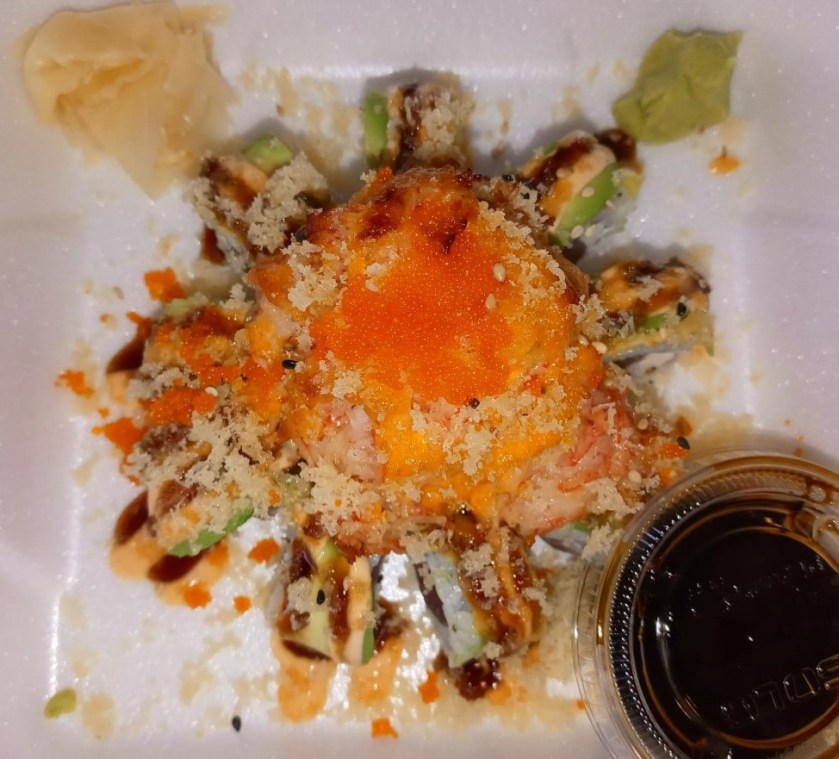
And this is one of my favorites anywhere, the volcano roll ($12.95).  This majestic mountain was built around a sushi roll containing tuna and cream cheese, topped with avocado, “baked krab special,” tempura chips, spicy mayo, kabayaki sauce, and tobiko, the tiny, salty, delicate orange pearls that are flying fish roe.  My wife liked this too, but I had been craving sushi for so long, it hit the spot so perfectly.   

Here’s another angle of the volcano roll, so you can see the rolls themselves.  All sushi is painstakingly prepared, with a lot of effort that goes into a beautiful presentation.   

The artful presentation is part of the price of admission right there, but I thought the prices at Kombu were all very reasonable for the good quality of this sushi and sashimi.  There are definitely fancier sushi places that are also more “authentic,” with less krab, less spicy mayo, fewer rolls in general.  There’s a time and a place for those upscale and authentic restaurants, at least for some, but this is the kind of sushi I know the best and love the most.  I’d consider Kombu more of an “everyday luxury,” and I mean that in the best possible way.  It isn’t exclusive or precious or snooty — it’s wonderful, fresh food made with precision and care, that you can enjoy whenever you want to do something really nice for yourself.  For me, believe it or not, that isn’t often enough.

Because Kombu has sushi and ramen in its title, I felt like I had to sample the ramen too, in order to write a worthy review.  I defaulted to my old favorite, tonkotsu ramen, but chose the mayu tonkotsu ramen here ($13.50) and asked them to hold the kikurage, those skinny little alien-looking mushrooms.  Note the noodles, two chashu pork slices, two ajitama egg halves, menma (AKA seasoned bamboo shoots), green onions, and lots of crunchy fried diced garlic.  The fried garlic and black garlic oil are what makes the mayu tonkotsu different from the regular tonkotsu, which comes with shredded red ginger instead.  As any restaurant packing up soup in a takeout order should, they packaged the tonkotsu broth in a separate container so the noodles wouldn’t get soggy on my way home.

Here is the mayu tonkotsu ramen with the broth added.  It was delicious, because you can’t ever go wrong with tonkotsu ramen (unless of course you’re a vegetarian or strictly kosher or halal, due to the broth being made from pork bones simmering for days).  My only issue with this takeout feast from Kombu is that the broth wasn’t the rich, creamy, opaque pork bone broth I’m used to from tonkotsu ramen.  This was more of a watery broth than I was expecting.  It was still tasty, salty, and porky, but not thick or creamy like I’ve gotten spoiled by.

So that’s my long-overdue review of Kombu Sushi Ramen.  I would happily return anytime for the sushi, but for ramen, tonkotsu or otherwise, I would probably sooner return to Ramen Takagi, just five minutes east on Aloma, still my favorite ramen spot.  Hey, that would be a great double feature dinner right there!

Jr Tropical Ice Cream

I think by now, we have established that I’m the “food guy” at work.  I’ve never been a fan of the word “foodie,” or anything else that sounds like baby talk, but I’ve embraced my role as the food guy, quick to make restaurant recommendations, show up with delicious snacks to share, or try to wrangle people to go out to lunch somewhere new and different.

My colleagues don’t always take my advice, especially when it comes to picking a place to go out to lunch, but today they did.  I drove three of them to a great, relatively new restaurant that none of us had been to before, but I had been reading good things about, that I had been wanting to try for a while.  That review is coming soon, but when we were almost back to work, someone mentioned ice cream, I mentioned I had heard about a new ice cream place that sounded good, and then they all demanded I keep driving and take them there next.

So we ended up at Jr Tropical Ice Cream (https://www.facebook.com/JrTropicalicecream), a small establishment on Goldenrod Road, in a little shopping plaza just south of East Colonial Drive.  I had driven by this place a couple of times, but never had a chance to stop and explore.  I saw in the window that Jr Tropical serves a bunch of unique flavors of ice cream, including several tropical fruits (my favorite, Miami boy that I am) and some Puerto Rican and other Latin flavors.  I was so excited my co-workers were on board, trusting me even though I hadn’t even been here yet myself.

Jr Tropical Ice Cream instantly reminded me of my favorite ice cream parlor I’ve ever been to, Azucar Ice Cream Company in Miami, which offers a lot of unique flavors based on tropical fruits and Cuban desserts.  I hope to make it back to Azucar some day to write a proper review, but in the meantime, I am thrilled that we have Jr Tropical Ice Cream here in Orlando.

Well, everyone loved it, I’m pleased to report.  It’s a delightful little place with a huge variety of ice cream flavors, all made in-house.  The young man and woman who worked there were extremely friendly and welcoming, and you could tell they took a lot of pride in their ice cream.  Not only do they have so many interesting flavors, but the prices are definitely right.

Everyone except me ordered a small, for a very reasonable $2.99.  You can try up to two different flavors in a small.  Me being me, I asked how many flavors you could try in a medium for $4.50, expecting three, but you can get *four*.  They had me at four! 

You can also upgrade to a small waffle cone for $3.75, a large waffle cone for $4.90, a waffle bowl for $5.60, or get a banana split for $5.57.  What isn’t listed on these TV menus is that you can also get ice cream in half of a fresh coconut, which they cut in half right then and there.   I don’t even know why I didn’t get my ice cream in half of a coconut.  Even though we all knew we had to go back to work, I would have totally felt like I was on vacation.  Next time!

So the next four slides are my less-than-perfect photos of all the flavors of the day.  I’ll type them out to make it easier:
Tamarindo/tamarind
Acerola/West Indian cherry
Parcha/passion fruit
Guayaba/guava
Almendra/almond
Mango piña/mango pineapple

Piña/pineapple
Guanabana/soursop
Arroz con dulces/rice pudding
Guava piña/guava pineapple
Maiz/corn
Piña colada/pineapple coconut

Fresa/strawberry
Vainilla/vanilla
Birthday cake
Panky (we asked about this one, and Panky is a popular Puerto Rican wafer cookie, so this is chocolate ice cream with crumbled chocolate Panky wafers mixed into it)
Chocolate
Anis/anise (the flavor of black licorice)

Coco/coconut
Ron con pasas/rum raisin
Tres leches (literally “three milks,” a traditional Latin American dessert that is one of the richest, creamiest, most decadent and delicious desserts ever, made from a sponge cake swimming in a combination of sweetened condensed milk, evaporated milk, and heavy cream)
Nutella
Cookies and cream
Chocolate chip

And here are all the toppings and syrups that are available.  None of us opted to get any toppings or syrups on our maiden voyage, but when I return, I may add some sweetened condensed milk to whichever ice cream flavors I choose.  It’s so good, a lot of the time I’d rather just spoon or pour some condensed milk out of a can than eat a conventional dessert like cookies, cake, or a lesser ice cream.

But these were not lesser ice creams, constant readers!  They all had a thick, rich texture with a nice “mouth feel” — no gritty iciness from freezer burn, no weird mouth-coating fattiness like you notice from some cheaper, low-quality ice creams.  We lingered to enjoy them inside the shop because it was so hot outside, and I appreciated nobody asking if we could eat them in my car on the short drive back to work.  That’s how you get ants!

One colleague sampled the West Indian cherry and thought it was a little sour.  He ended up getting a small with the parcha (passion fruit) and the rum raisin, and he raved about how terrific the rum raisin was.  That’s an underrated ice cream flavor, if you ask me.  Rum Raisin isn’t flashy or sexy, it doesn’t have half of a candy store mixed into it, kids would probably think it is gross, but it’s kind of sophisticated and adult, and you could pretend you were on vacation trying it, or at least pretend your workday was already over.

And what about my four flavors?  I started with the passion fruit myself, then asked for guava, then mango piña, and topped it all off with the corn flavor.  I’ve had a sweet corn ice cream before at Wondermade in Sanford (another fantastic local ice cream shop), so I wanted to try this one.  It tastes a lot like sweet corn, but it was a uniform consistency with no kernels or anything.  It was good, but the fruit flavors were the real draw.  I loved them all, but I am obsessed with pineapple, mango, guava, and passion fruit and anything with those flavors.  I was an easy mark, but they didn’t disappoint at all.

Another colleague got the tres leches and let me sample a taste of it.  It was so good, I preferred it to my top layer of maiz ice cream.  It definitely had cinnamon in it, so it reminded me almost more of horchata, that sweet Mexican rice milk flavored with cinnamon, than tres leches.  But unlike most of the other ice creams that were a uniform consistency without chunks, this one had the texture of little pieces of chewy cake.  It was great.

When I return to Jr Tropical Ice Cream, I will try some new flavors.  Even growing up in Miami and developing a taste for tropical fruits, I don’t think I’ve ever had guanabana, the fruit also known as soursop, despite being a popular juice and milkshake flavor at Cuban restaurants.  Next time I’ll try that, and also the straight-up pineapple and coconut flavors… and also the rum raisin my co-worker raved about so much.

This is a great little place that everyone should stop into and support.  And if the location on Goldenrod, just south of Colonial, isn’t convenient, there is a second location of Jr Tropical Ice Cream down in Kissimmee.  It might be September now, but we all know it’s going to be hot and humid up until Thanksgiving here in Orlando.  I hate the heat and humidity, but say what you will about it, it remains perfect weather to cool down and treat yourself with some ice cream.

If you feel like ice cream is too much of an indulgence and too “dangerous” or “naughty” to keep around, then don’t buy it at the supermarket to fill your freezer — just go out and treat yourself here once in a while!  A trip out to an ice cream parlor, especially a locally owned one like Jr Tropical Ice Cream with so many unique flavors, will make it seem so much more special than going through a pint (or a gallon) of mass-produced, corporate ice cream without even thinking about it, while binge-watching your favorite shows at night.

And when you go, remember to ask for your ice cream in the coconut, for the truest tropical experience.  Learn from my mistake, a mistake I will not be making a second time!