Lam’s Garden

Lam’s Garden (https://www.lams-garden.com/) is a respected and venerated Chinese restaurant in Orlando, on the border of two of the city’s best foodie neighborhoods, Mills 50 and the Milk District.  It is in the shopping plaza with iFresh Market (a really good Asian grocery store, not to be confused with Fresh Market) and my beloved Chicken Fire, on the northeast corner of East Colonial Drive and Bumby Avenue.

But me being a lifelong late bloomer, I only recently visited Lam’s Garden for the first time.  (I told an older man that after my meal, and he said “How?  We’ve been here since 1975!”)  Well, better late than never, because it was really good.

I thought it was very old-school to get a bowl of crunchy fried noodles to snack on while we waited for our orders to come out.  This took me right back to all the Chinese restaurants my dad took me to in Miami, growing up in the ’80s, where he knew all the owners and they all knew him because he taught their children and grandchildren. 

At first, they just presented us with a laminated menu of lunch specials, but I asked for a longer menu if they had one.  They brought us two additional menus, with standard Americanized Chinese food favorites and another with Chinese “home cooking,” as the server described it.  Whenever you go, make sure they give you all the different menus to maximize your choices!

My vegetarian colleague ordered Buddha’s delight off the lunch specials menu ($9.95), and got a huge plate of broccoli, crisp snow peas, bok choy, baby corn, onions, mushrooms, water chestnuts, and bamboo shoots, in a brown sauce.  Her white rice was served on the side.

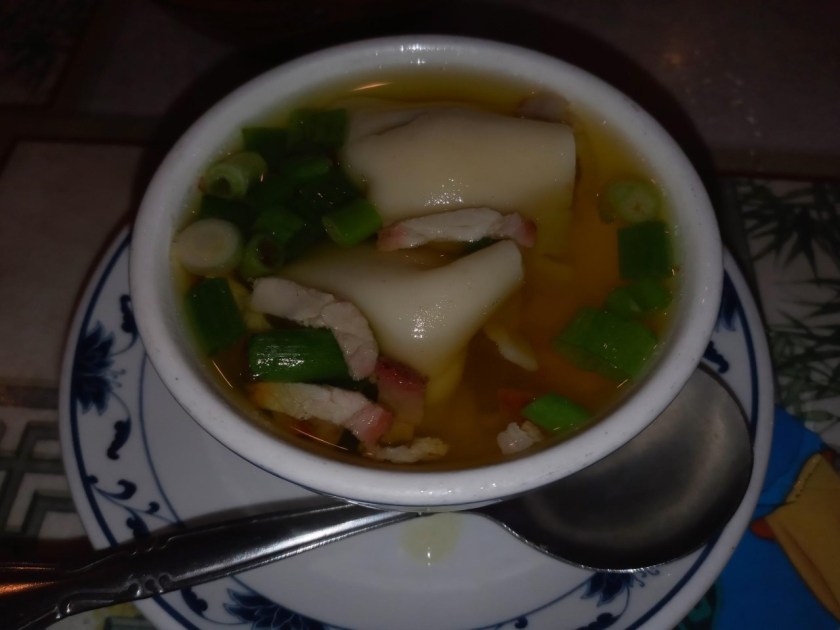
The lunch specials came with plenty of other stuff she couldn’t eat, so like a good friend, I volunteered to eat everything, like this small bowl of wonton soup:

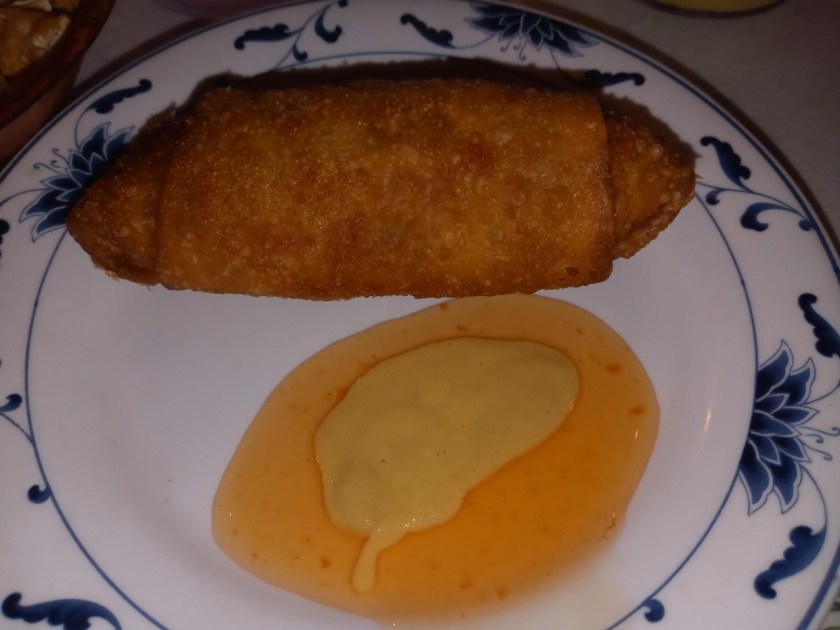
A crispy eggroll:

And a little dish of fried rice:

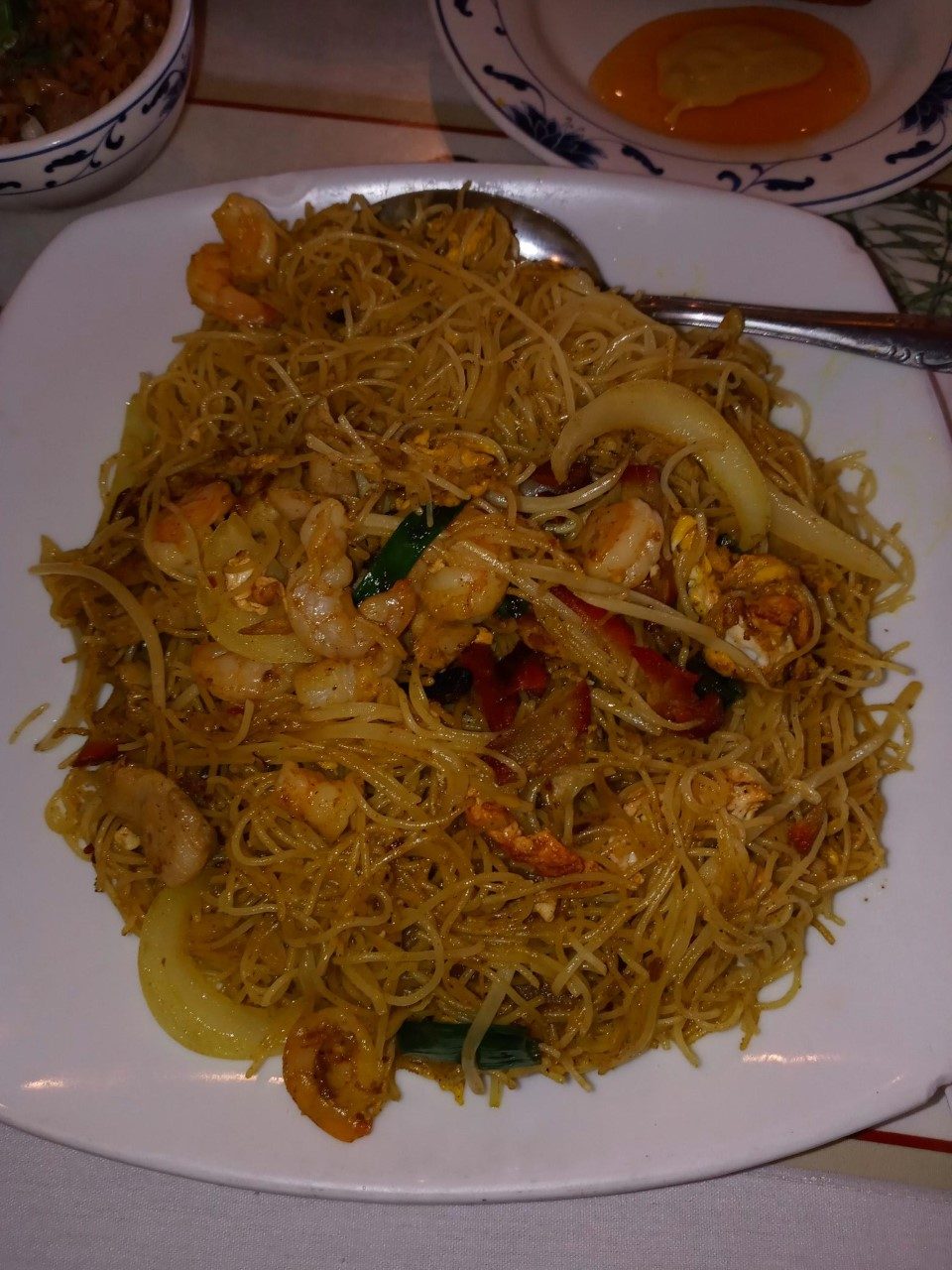
I had a really hard time making a decision, since this was our first time here, so I went with a dish that never disappoints, and definitely didn’t disappoint at Lam’s Garden: Singapore curry rice noodles ($15.95), served with chicken, pork, and shrimp.  It was kind of medium-spicy and so flavorful, with the thin, tender noodles.

I would be tempted to order this again and again, but after finally visiting Lam’s Garden, I definitely want to start working my way through the large menu on future trips.  Lam’s might very well be the oldest Chinese restaurant in Orlando, and since it has been proven to have staying power, I look forward to trying other dishes, making up for lost time.

Chain Reactions: Krispy Krunchy Chicken

Krispy Krunchy Chicken (https://krispykrunchy.com/) is a unique fried chicken chain with a distinct Cajun accent, founded in Lafayette, Louisiana, in 1989.  It is a unique chain because most of the locations are inside gas station convenience stores, but anyone who reads my blog knows you can often find great food in the most humble-looking and unlikely of places.

Take, for example, the Citgo station at 3025 East Colonial Drive, 32803, in Orlando, on the corner of East Colonial Drive and Maguire Road.  This is on the edge of a couple of the best foodie neighborhoods in the city: the Milk District and Mills 50.  I’ve been driving past this gas station for years, and only recently noticed a sign that it offered Krispy Krunchy Chicken inside.  I had to try it, for the sake of journalism and a librarian’s desire to share information.  I’m not sorry I did.

When you place your order, you ask for the chicken you want from under the heat lamps, and a nice lady will bag it up for you.  It was all very fresh.

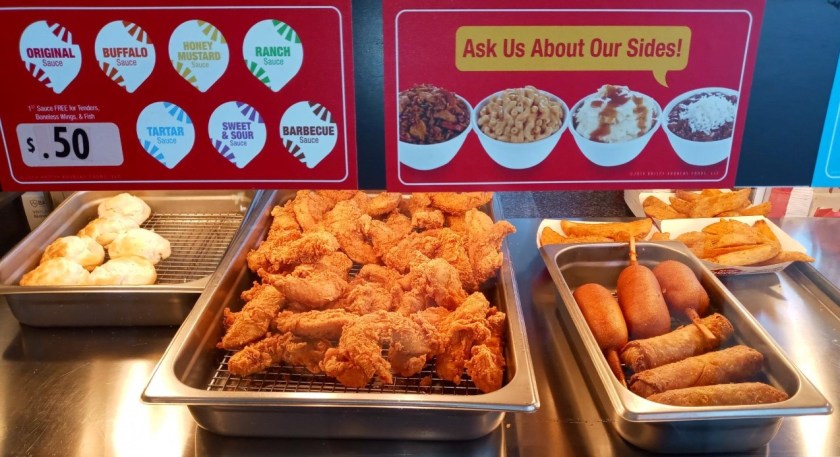
The sides are self-serve (you just grab them yourself).  This sign lists prices for single pieces of chicken:
Breast: $3.19
Wing: $1.89
Thigh: $2.09
Leg: $2.09
Tender: $1.89

Here’s a close-up of that bottom shelf, which includes honey butter biscuits, boneless chicken tenders, corn dogs, and egg rolls.  Sauces are 50 cents each (original, buffalo, honey mustard, ranch, tartar, sweet and sour, and barbecue), but as much as I love sauces and condiments, I was trying this chicken for the first time, so I didn’t want to overwhelm my palate or distract from the main mission with too many variables.

I ordered a two-piece meal ($7.99) with a leg, a thigh, a side (see below), and a honey butter biscuit, and had a little picnic in my car.  Totally worth it.  The chicken was juicy and the breading was thick and crunchy, but not as Cajun-spicy as I was hoping.  Still, you can’t ask for much more than that, especially from a gas station convenience store setup!  The biscuit was a real standout.  Not in the same league as Se7en Bites, Orlando’s beloved Southern bakery and restaurant moments away, which is home of the best biscuits ever, but perfectly fine to accompany this chicken.

I couldn’t resist getting an order of fried chicken gizzards too.  (I don’t remember how much this was.)  Now I LOVE chicken livers (chopped liver is one of the foods of my people!) and hearts, but I didn’t remember ever trying gizzards before.  They were REALLY chewy.  That’s the most I can say about them.

The macaroni and cheese tasted a lot better than it looks here, flattened down by the lid on this styrofoam cup.  But I don’t even think it looks bad.  It looks and tastes like typical macaroni and cheese you would get as a side at any number of barbecue joints or Southern restaurants.  So maybe not Orlando’s best (for that, check out Pom Pom’s Teahouse and Sandwicheria, nearby in the Milk District, and also Se7en Bites again!), but very pleasing nonetheless.

Since this was my first visit to a Krispy Krunchy Chicken location, I got two additional sides while I was there.  These red beans and rice were suitably smoky, salty, and creamy, but you just can’t beat Popeyes red beans and rice.  That’s the quintessential version right there, the one that even chefs (like David Chang) cite as the best.

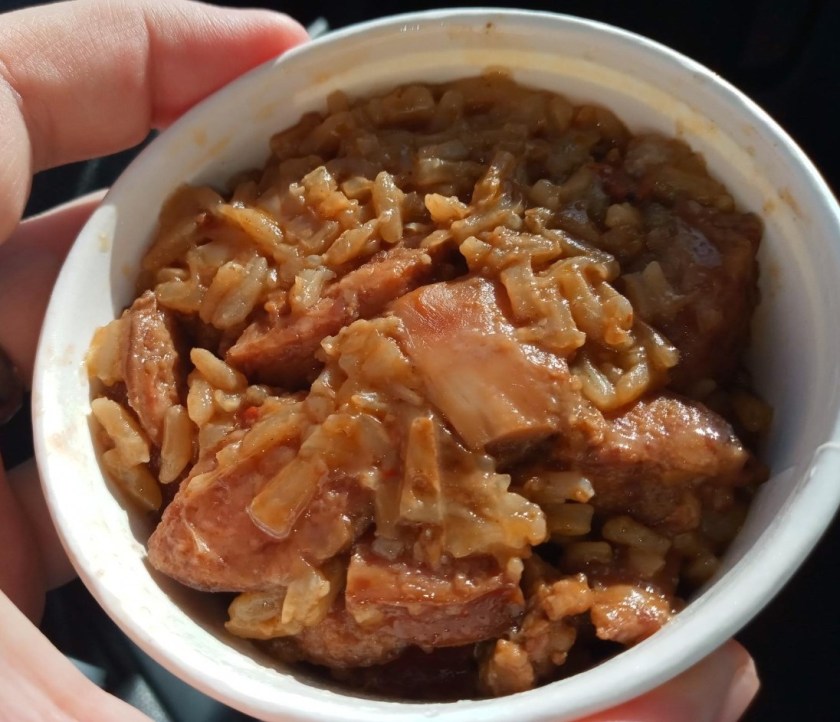
But my favorite side was the jambalaya, saucy rice with chunks of (andouille?) sausage and ham.  I always like jambalaya, whether it’s from an old restaurant in the French Quarter or a box from Zatarain’s.  This was somewhere in between, quality-wise, but closer to the French Quarter than the box.   I didn’t expect it to be as good as it was.

Would I go back?  Absolutely I would.  As much as I generally like Popeyes for bone-in fried chicken, they can be hit-or-miss with both food quality and service.  And this particular Krispy Krunchy Chicken gas station location is a lot more convenient for me than the always-excellent Theo’s Kitchen.  This was solid fried chicken, but I think the thing I liked the most was the jambalaya.  It was so tasty and hearty and full of meat, I could happily make it the centerpiece of a meal some other day, when I’m in the mood for such a thing again.

CLOSED: Thai Singha

UPDATE: Apparently Thai Singha closed in April 2023, and I am very sad about it.

***

Thai Singha (https://thaisingha.net/) is the first Thai restaurant I ever visited in Orlando, shortly after meeting my wife and starting to date her, back in 2006.  It is out in the sprawling Waterford Lakes shopping center in East Orlando, south of the University of Central Florida.  The area is full of restaurants, but not many stand out and draw attention.  Thai Singha definitely does, or at least it should.

We realized it had been years since we had gone together, especially after discovering newer favorites like Mee Thai and Naradeva Thai, both wonderful places.  But you never forget your first, especially since Thai Singha is where I discovered my favorite Thai dish that is now my benchmark order at any new Thai restaurant, to compare and contrast them all.

My wife started with hot ginger tea ($2.95), which smelled really good and came in a neat-looking receptacle:

Then she ordered one of her favorite dishes, that she also introduced me to at Thai Singha over 15 years ago: mee grob ($6.95).  Some restaurants call it mee krob or meekrob, but many around Orlando don’t serve it at all.  It is a veritable mountain of crispy rice noodles, shrimp, pork, and tofu, tossed in a tangy sweet sauce and garnished with scallions and bean sprouts.  It is awesome, folks.  It is very sticky, crunchy, sweet, salty, and sour — a feast for all the senses.  The shrimp is fried so nicely that you can even crunch and swallow the crispy tails.  It is one of the only places where I like tofu, but I fully admit I haven’t had enough tofu to discount it completely.  Maybe everyone is already wise to the joys of mee grob, but if ya don’t know, now you know.

My wife ordered her favorite entree as well: late night noodles with a combination of shrimp, scallops, and squid ($16.95).  You can choose any of the options from the “Favorite Dishes” section of the menu to come with mixed vegetables, tofu, chicken, beef, or pork for $11.50, shrimp for $14.50, or a meat combo or this seafood combo for $16.95.The late night noodles are soft, chewy rice noodles stir-fried to perfection, then tossed in a light soy sauce with eggs, the shrimp, the buttery little bay scallops, and the tender squid, and served over a bit of lettuce.  She loves it.

And this is my favorite Thai dish, made with the same flat, wide, perfectly chewy rice noodles: drunken noodles, also known as pad kee mao or pad kee mow.  I got mine with tender pork for $11.50, and I always wish the portion was bigger here, because it is so incredibly delicious.  Drunken noodles are stir-fried with onions, green bell peppers, fresh Thai basil leaves, and a sweet chili paste sauce.  It is always sweet and spicy at once, which I just love in any cuisine, and the Thai basil brings such a unique herby flavor — very different than the typical basil in Italian recipes.  Despite the name, there is no alcohol in this dish, but it is a common, beloved Thai street food for drunken revelers.  I’m sure the late night noodles have a similar origin story from nocturnal hawkers and their grateful post-partying clientele.

So that’s our first Thai restaurant we were able to share with each other, Thai Singha.  I am pleased to report we enjoyed it as much as ever after being away for far too long.  I was just sad to see it dimly lit and not busy, despite it always bustling during our past visits, too long ago.  We got there in the late afternoon on a recent Friday, too early for the dinner hour, but we were the only diners in the place, while others popped in and out to pick up sporadic takeout orders.  It is difficult to get to Waterford Lakes, and we rarely end up on that east side of Orlando anyway, but it remains a treasure well worth braving UCF-area traffic to return to from time to time.  Over the years we’ve been together, we have ordered other dishes on the menu that are always solid, but we are always a little disappointed when we don’t go with our favorites here.  Now you’ve seen our go-to dishes, so pay it a visit, decide on your own favorites, and let me know what they are!

Ming’s Bistro

I recently met a friend at the Chinese restaurant Ming’s Bistro (https://www.mingsbistro.net/), in the heart of Orlando’s Mills 50 district, full of Asian restaurants, markets, and shops centered around the busy intersection of East Colonial Drive and Mills Avenue, near downtown Orlando.  This was our first time at Ming’s Bistro, but we had both heard for years that it specialized in dim sum, and that’s what lured us out there — better late than never.

What is dim sum, you ask?  It’s a Cantonese tradition that started in teahouses that served little snacks with the tea, now most commonly served as brunch (yum cha).  A lot of restaurants push carts around the dining room, allowing diners to point and grab what they want, while other places have you check off your choices on a paper menu, like how some sushi restaurants do it.  Ming’s Bistro mostly does it the latter method, with an illustrated menu to give you ideas and a paper menu you check off next to each item.  The prices are listed, which helps, since you can get in some real trouble grabbing too many dishes off the rolling carts.  But they push some carts around too, and we picked a few random things that came by our table, just because they looked good.  And just to clarify, Ming’s also offers a whole regular menu of Chinese food to choose from, in addition to the dim sum menu.  So all your usual favorites are probably available here, too.

Ming’s opens at 10:45 AM (every day except Thursdays, when it is closed), and I was there right when it opened to grab a table.  We didn’t have to wait at all, and it was slammed by the time we left, a little after noon.  I have written many times that I’m not a brunch person, but dim sum is a unique brunch experience, where you ideally go with a group, hang out for a long time, order a bunch of small plates, and share everything, including good times.  Even though it was only two of us, we shared nine different dim sum items, and we chose wisely.  There wasn’t a dud in the whole bunch!

We started out with an order of steamed roast pork buns (top; $4.50) and an order of baked pineapple buns (bottom).  The roast pork buns are a dim sum classic for good reason.  For the uninitiated, the steamed buns are kind of like soft, bready rolls, and the pork inside is in a red sauce, savory but also slightly sweet.I love pineapple anything, and these baked pineapple buns were a subtly sweet treat that would have been ideal as a dessert, but they came out early, so we enjoyed them early in the meal.  I was expecting something more like sticky pineapple preserves in the centers, but it was creamier than I thought.  Still good, though.
EDITOR’S NOTE: Two sharp-eyed Saboscrivnerinos confirmed my suspicion that dim sum pineapple buns don’t contain any pineapple, but get their name from the crackly crust.  I still liked them, but thought it was odd they were generically sweet without any obvious pineapple!

We didn’t even order these, but a nice lady wheeled a cart next to our table, loaded up with several dim sum dishes already on plates, and asked if we wanted any.  These looked like jalapeño peppers stuffed with something, which is all good with me, so we went for it.  It turned out to be a shrimp filling, but the shrimp was processed into a soft, savory paste, and the peppers were lightly roasted.  I make similar roasted jalapeños once or twice a year, stuffed with light cream cheese and sometimes topped with bacon, chorizo, or prosciutto.  They are a delicious, keto-friendly snack, and these were equally delicious.  I’m not sure what the sauce on top was, but it added to the experience of flavors and textures without overpowering the shrimp or the peppers.  They weren’t very spicy at all, so don’t worry about that if you’re the type who sweats when the heat is on.

These are pan-fried pork pot stickers ($5.50), which had a wonderful crispy shell and a strong ginger flavor inside.  I always appreciate pot stickers, but my friend liked these even more than I did, so I only had one.   

Another foodie friend introduced me to rice paste dim sum during a feast at another great local Chinese restaurant, Peter’s Kitchen, a few years ago.  I probably never would have tried them on my own, but now I recommend them to everyone else.  This is beef rice paste ($4.75), where the rice paste itself is kind of a slippery, chewy crepe wrapped around a filling — almost like a thicker and more slippery manicotti pasta.  I’m not a fan of things that are too chewy and starchy, like certain bao buns and Jamaican boiled dumplings, but these are terrific, especially swimming in the soy-based sauce.  It’s a challenge to keep them from sliding out of your chopsticks, but we both persevered like the functional adults we are!

We also randomly picked these off a later cart that came by our table.  Some kind of fried dumplings that are both crispy and chewy.  I think they are crispy taro dumplings ($4.75), and they were yet another pleasant surprise.

Here’s a cross-section of one of them.  They were stuffed with shrimp and green vegetables, and we joked that these were the healthiest part of our dim sum brunch, despite obviously being fried.  
EDITOR’S NOTE: A sharp-eyed Saboscrivnerino informed me these might have been pan-fried chive dumplings ($5.50).

I always like beef short ribs — I rank them up there near oxtails on a list of favorite meats.  This was beef short ribs with black pepper ($5.80), which I enthusiastically ordered, despite not knowing exactly what to expect.  It was great.  It was a relatively small portion, like so many of these diverse dishes, but still plenty for two people to share.  The short ribs came chopped into tiny chunks of rich, succulent, moist, fatty meat, braised until they were very soft and easy to pull off the shards of bone.  They were extremely flavorful and easier to eat than I expected.  I wished I had saved some of the doughier buns and dumplings to dip into the short ribs’ sauce.

I ordered us the pan-fried sticky rice ($5.50) because the couple at the table next to us got it, and it looked good.  That was another pro move on my part.  It was sticky and savory, with maybe the tiniest bit of subtle sweetness you get from Chinese five-spice powder, a blend of Chinese cinnamon, fennel seed, star anise, cloves, and peppercorns (or sometimes ginger).  It also would have been good to soak up some of the short rib sauce, but the rice was so flavorful, we ate it on its own. 

The last dim sum dish we ordered was another winner: fried meat dumplings ($4.75).  I can’t tell you if the meat was beef or pork, or maybe a combination of both, or something else entirely.  It was ground, spiced (but not spicy), and saucy, and served in these awesome dumplings that reminded me of Indian batura, Native American fry bread, hand pies, lightly fried empanadas, or even funnel cakes at a fair.  That perfect flaky dough that is lightly crispy but mostly soft, that leaves your fingers greasy and your soul happy.  

Like I said, not a bad dish in the bunch.  It was a great meal, and while we probably could have done more damage, it was the perfect amount of food for two people, with some leftovers at the end.  I’m guessing most of my readers are already familiar with the joy of a communal dim sum brunch, and many know the wonders of Ming’s Bistro.  But if you don’t know, now you know!  I hated crowds and lines long before there was a pandemic, so in addition to recommending all these delicious dishes we tried, I also strongly suggest getting to Ming’s early — ideally in that golden half hour between 10:45 and 11:15 AM — to beat the lunch rush and avoid having to wait.

Mynt Fine Indian Cuisine

Mynt Fine Indian Cuisine (https://www.myntorlando.com/) is an Indian restaurant in Winter Park that I’ve wanted to go to for years.  I finally made it there with my two closest former co-workers from my librarian days, which are really not that long ago.  We used to go out to lunch every once in a while, usually on Fridays if at all, but I would at least see them every day, throughout the day.  Now those sightings are few and far between, and the lunches even moreso.  So going out to Mynt was a rare and wonderful treat, especially sitting outdoors on a gorgeous February day with these two brilliant people.

I didn’t even realize that Mynt had lunch specials, but they do.  They come with basmati rice (of course), yellow lentil dal that I ate with a spoon like a soup, and a cute little samosa, with the most savory potato filling and the perfect, delicate, flaky crust, served with tamarind and mint chutneys.  Everything came in round metal containers called tiffins.

Mynt also served the most delicious garlic naan I’ve ever had.  This was for the table to share, but I could have easily and happily gone through a few baskets of it myself.

My vegetarian co-worker ordered vegetable korma ($10), with mixed vegetables and paneer cheese in a creamy onion cashew sauce.  She let me spear the last chunk of tender potato at the end, so I could try the sauce for the first time.

My dieting co-worker ordered the vegetable biryani ($11), the most beautiful dish of garden vegetables and paneer cheese over spiced saffron rice.  I didn’t ask to try his, but look at how gorgeous this presentation was:

Since this was my first time at Mynt, I ordered one of my favorite dishes, lamb vindaloo ($12), with tender chunks of boneless lamb and potatoes in a spicy, tomatoey, vinegary curry.  I asked for it spicy, and it sure was spicy, but I could handle it just fine.  I loved it, but whenever I make it back to Mynt, I would try something new just because I eventually want to expand my palate with Indian cuisine.

And me being me, I also ordered aaloo gobhi ($10) for the table — a vegetarian dish of potatoes and cauliflower (currently one of my favorite vegetables to cook and eat) in an onion gravy.  I asked for it medium, so they could also enjoy it, and it was so flavorful and good.  This was a new dish for me, and I loved it too.

I hadn’t eaten at a restaurant since December, when I met another friend on the opening day of bb.q Chicken.  It felt so nice and normal, and I think this outdoor lunch at Mynt was the happiest and most upbeat I’ve felt in a while.  The company was great, the surroundings were beautiful, the weather could not have been nicer, and every dish we ordered was prettier and tastier than the last.  I would totally return, especially to try the expanded dinner menu or the weekend brunch buffet.

Phở Vinh

Phở Vinh (http://www.phovinhorlando.com/) is one of the many Vietnamese restaurants east of downtown Orlando, but it is slightly east of the main Vietnamese neighborhood, Mills 50, in an adjoining neighborhood known as the Milk District, due to the presence of the T.G. Lee Dairy headquarters.  Some of my favorite restaurants in Orlando are in the Milk District, and I’m happy to add another one to that number.

Our wonderful next-door neighbors took us to dinner at Pho Vinh several years ago, and we all liked it, but my wife and I kept returning to our usual Vietnamese restaurants, Phở 88 and Little Saigon, in the subsequent years.  Both are very good, but I recently felt like a change, so I recently called in a takeout order with Phở Vinh, brought it home, and unpacked deliciousness that even exceeded that dinner way back when.

Since the name of the place is Phở Vinh, we both decided to order phở, the classic Vietnamese beef noodle soup that we love so much.  Even though “beef noodle soup” sounds heavy, it is surprisingly light and refreshing, despite still being hearty and filling.

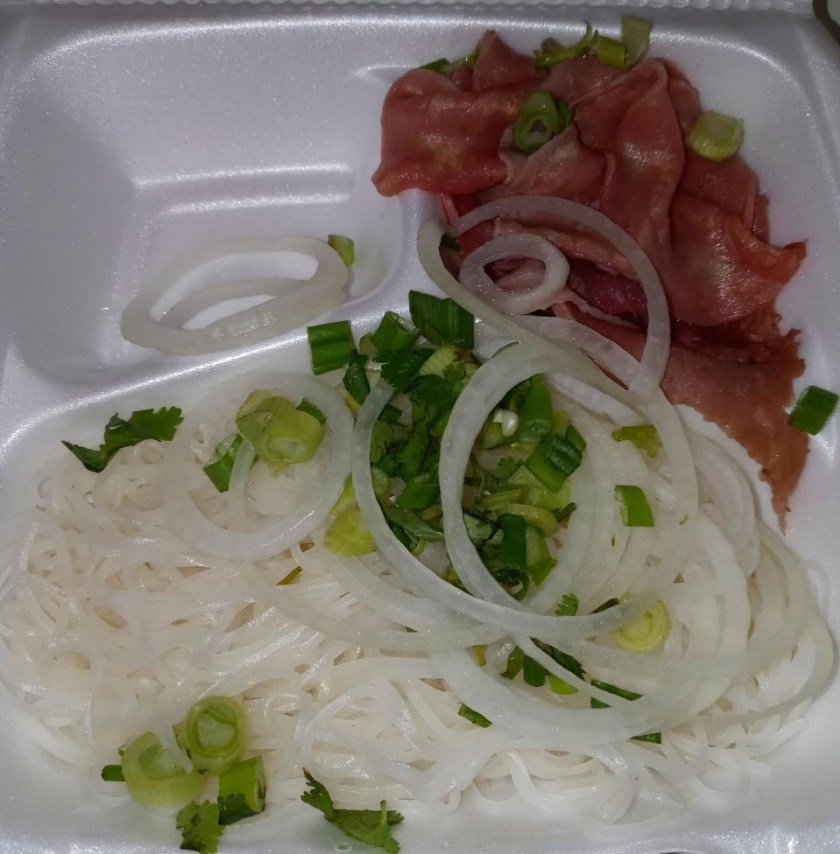
When we go to our usual Vietnamese restaurants, my wife always orders phở tai ($9.95), with thin slices of rare beef that cook in the hot, fragrant, clear broth.  Phở Vinh does what most Vietnamese restaurants do, packing the meat, noodles, and aromatics in one container, and the broth in a separate container, so the meat doesn’t get fully cooked and the noodles don’t turn to mush on the drive home.  We order takeout a lot more often than we dine out, especially these days, so we appreciate this very much.

I got what I normally order at other Vietnamese restaurants, the phở xe lưa ($13.95), with thin slices of rare beef, brisket, flank steak, tendon (rich, unctious, and chewy — I love it), and tripe (not my favorite, but it’s always included with the other meats in the combination phở). 

Here is the phở broth.  We both got identical containers, which are pretty generous.

And here is a shot of my steaming soup, all the meats and noodles simmering with torn basil leaves, paper-thin sliced onions, scallions, and fresh jalapeño peppers with all the fiery seeds and ribs intact. I squirted in a bit of lime juice from lime wedges (also included), but I rarely alter my phở beyond that, despite the option of sauces like hoisin and sriracha.  It is better to taste it as intended, especially when visiting a new restaurant for  the first time, or in our case, the first time in a long time.   It was wonderful.  So fresh and fragrant, and like I said, never a heavy meal.

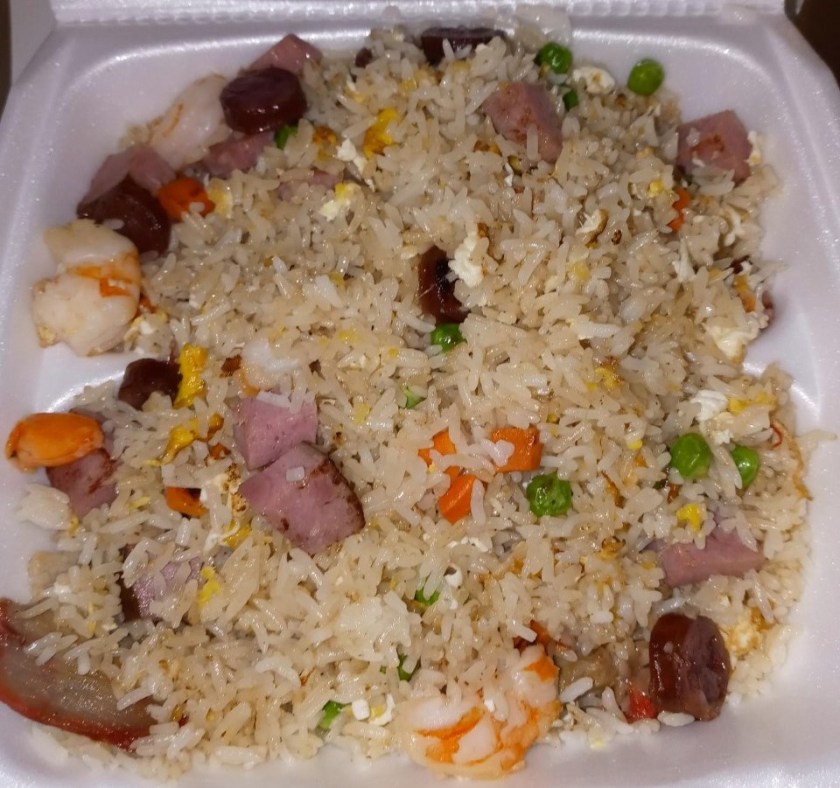
I also got an order of cơm chiên dương châu ($11.95), fried rice with shrimp, roast pork, ham, and sweet, chewy Chinese sausage called lap cheong or lap xeong, which I love.  They should call this dish the “kosher special”!  I was hoping to share it with my wife, but figured she might not like it, so I’d have more for myself to pack for lunch the next day.  But she thrilled me by loving the fried rice, even the Chinese sausage, which I definitely wasn’t expecting.

Guessing wrongly that she wouldn’t be into the fried rice, I ordered my wife a second whole meal for the next day, since I was going to be at work, and she doesn’t cook.  After phở tai, this is her favorite Vietnamese dish to order: bún bò nướng, or charbroiled beef with rice vermicelli (the bún).  At Phở Vinh, this also came with a crispy fried spring roll, so the dish was called bún bò nướng chả giò ($12.95).  I thought she might like to try the spring roll (the chả giò), but she wasn’t interested in it, so I ate it while it was hot and fresh.  We almost never get spring rolls, and I was reminded how much I like them.  I didn’t try any of the rest, but she ate it all, which means she liked it.  (If she didn’t, she wouldn’t!)

My next visit to Phở Vinh to bring home more takeout was two weeks later, on a recent drizzly, dreary Friday evening.  I got my wife the summer rolls she greatly prefers (an order or two for $3.95).  Unlike the crispy fried spring rolls, summer rolls are wrapped in a thin, chewy, sticky rice crepe, stuffed with pork, shrimp, rice vermicelli, and vegetables, and served chilled.  I’m never into these, but she loves ’em, especially the sweet, sticky peanut sauce they are always served with.

She got her usual phở tai again, but I switched it up and got a different kind of noodle soup, the very spicy bún bò huế ($11.95), with slices of beef and pork in an intensely hot broth.  As usual, the meats, noodles, and vegetables were packaged separately from the orangey-red broth. 

And here’s the gleaming, glistening soup, perfect for warming me up (and making my eyes water and nose run) on a surprisingly chilly, rainy evening. 

Finally, I got bánh mì bò kho ($11.95), a rich Vietnamese take on classic beef stew, served with half a loaf of crusty French bread.  I didn’t eat this until the following Sunday, two days later, when it was even chillier, but it heated up great and tasted delicious.  It was thicker than the phở and bún bò huế, but not nearly as thick as some beef stew I’ve had.  There were plenty of big chunks of soft carrot, thin slices of onion, and huge pieces of tender beef that were a perfect, soft consistency — not that different from oxtails, which are one of my favorite foods.  That got me thinking about how awesome a Vietnamese oxtail soup or stew would be.   
Unfortunately, the French bread was burnt, as you can see.  I still ate it, don’t get me wrong!  I heated it up in the toaster oven, but had I been at the restaurant, I would probably have asked for another piece.

So as you can see, Phở Vinh won us over.  With this stupid weather we’ve been having, alternating between days in the 80s and nights in the 50s, you can imagine how good nice, hot soups and stews would be.  If you’ve lived in Orlando for a while, you probably have a favorite Vietnamese restaurant.  We sure did, but I’m glad we branched out and tried Phở Vinh.  It is definitely a regular in our rotation now, and we will definitely return.

Chain Reactions: bb.q Chicken

This past Tuesday was the grand opening of Orlando’s first bb.q Chicken (https://bbdotqchicken.com/), a Korean chain restaurant that was founded in 1995 and expanded into the U.S. in 2014, with franchise locations in 19 states so far and continuing to grow rapidly.  This was the first of many planned locations in Florida, right in our Mills 50 district, one of the best food neighborhoods in Orlando (in the old Tasty Wok location on the corner of East Colonial Drive and Shine Avenue, no less).

The restaurant name is a bit misleading, because bb.q Chicken does not sell barbecued chicken.  No grilling or smoking here!  The name is an acronym for “Best of the Best Quality” chicken, so if you go in expecting barbecued chicken, you’ll be confused or disappointed (although some of the sauces are sticky, tangy, sweet, and/or spicy, as many barbecue sauces and glazes are).  The chain specializes in Korean-style fried chicken wings and “boneless” chicken — think chicken tenders, strips, or fingers.  They are made of white meat from chicken breasts, so I appreciated them not being called “boneless wings,” which always annoys me for its inaccuracy.  Anyway, this is masterful fried chicken, with the perfect texture and so many different flavors to choose from.

The menu is on the website linked above, but I’ve taken the liberty of scanning the menu for this particular Orlando location, with prices that were accurate on the opening day: December 14, 2021:

I arrived a few minutes after it opened, after taking a while to find parking.  I met two other guys from the Orlando Foodie Forum presented by Tasty Chomps!, a Facebook group that has been my best source of local food news and reviews for many years, where I try to contribute and share all the information I can, along with asking questions of my own from time to time.  One of these guys is my local food guru — a guy who knows even more good places than I do, who never steers me wrong.  They arrived slightly before me, placed their orders, and got their lunches before I got mine, but we all shared our food — a perfect opportunity to try as many new things as possible.

These are someone else’s soy garlic boneless chicken strips — a small order of eight pieces for $12.  We all tried them and thought they were tasty, with a really nice, crispy, crunchy breading.  If you’ve never had Korean fried chicken before, it is truly fried to perfection, with a different kind of breading than Southern-style fried chicken that we automatically think of, like Popeyes or K-Fry-C.  It is both light and airy while also being really crunchy, even holding up well under sticky sauces. 

These were the Golden Original wings (an order of eight for $14), served with no sauce.   Yes, maybe that seems a little high, but chicken wing prices are much higher everywhere this year due to nationwide supply chain issues — this isn’t completely new, and isn’t unique to bb.q Chicken, either.  I didn’t actually try these at the time, because I had plenty of my own food coming, and I was all about sampling the different flavors while I could.  Just like with chips, I’ll rarely settle for plain when I can try all the different versions and varieties.   

One of my fellow diners ordered the rosé ddeok-bokki, a traditional Korean dish of chewy rice cakes and fish cakes in a spicy sauce ($12.95).  It was a huge portion, but I think I was more into it than either of them.  I’ve only ever had these kinds of rice cakes once before, mixed in with a Korean brand of instant ramen noodles I ate out of the pot while standing up over my kitchen sink, like a very civilized adult.   
As you can guess, these are completely different from the “rice cakes” you may be thinking of right now — hockey puck-shaped patties of crunchy white Styrofoam that our dieting moms snacked on back in the 1980s.  To this day, it never occurs to me to seek these out, just because when I think of rice cakes, I think of one of the worst snacks ever.  These ddeok-bokki (sometimes called tteokbokkiare very different — extremely chewy, with a texture like a cross between al dente pasta and Starburst candy, if that makes any sense at all.  They usually take on the flavor of their sauce, which is usually a bright red, very spicy sauce.  This rosé version scaled back the heat from the traditional version, but the orange sauce that resembled Italian vodka cream sauce was still moderately spicy.  I was the only person at lunch who is really into spicy food, but I don’t have a lot of experience with the spices used in Korean cuisine.  I was already curious about this dish, and so relieved someone else ordered it so I was able to try it!

The ddeok-bokki also included some tender cabbage and flat things that turned out to be fish cakes — not as chewy as the baby carrot-shaped rice cakes, but still chewy, with a pleasant processed-seafoody taste like surimi (or “krab,” if you prefer).   Oh, and there was half a hard-boiled egg in there too, as you can see, but the guy who ordered it got the egg.  He deserved that egg.

My friend also got a side order of these fried dumplings ($8.95) for us to share, which came with some kind of soy-based dipping sauce that may have been just plain soy sauce.  I didn’t get to try the sauce, but the dumpling on its own was pretty good.  You can’t ever go too wrong with crispy fried dumplings, unless someone sneaks mushrooms into them, in which case I might as well just throw them directly into the toilet, cutting out the middleman.  But I am relieved to report there were no mushrooms in these! 

These guys were kind enough to share their food while I waited for mine, and I was overjoyed when all of my stuff came out at once.  I picked up a tray from the front of the fast-casual restaurant, starting with a small eight-piece order of the galbi chicken strips ($12).  I know galbi (sometimes kalbi) refers to Korean-style barbecued or grilled short ribs, cut into thin slices across the bone, and marinated in a sweet, sticky, soy-based barbecue sauce.  So this is how these crispy chicken strips were seasoned, tossed in a galbi glaze and topped with green onions and sesame seeds, similar to how short ribs might be served.  Everyone at the table liked these.

I am not good at giving myself credit for accomplishments, but I don’t mind saying that I chose the best stuff of all of us, especially these outstanding Gangnam Style wings (an order of eight for $14.95).  I think these were the unanimous favorite at the table, tossed in “a sweet aromatic black pepper sauce sautéed with green onions, garlic, and peppers,” according to the menu.  They were sweet, savory, and just barely spicy, but they were the absolute best of the four kinds of chicken we shared.  They were definitely the most flavorful chicken we all tried, and also the crunchiest.These wings made me think of “Gangnam Style,” the one U.S. hit by Korean pop performer Psy, for the first time in many years.  It is an interesting footnote in music history that the frenetic dance-pop bop “Gangnam Style” is very likely the first song that most Americans ever heard by a Korean recording artist, a whopping nine years ago, long before K-Pop exploded here and became a major cultural phenomenon.

Oh yeah, RING THE ALARM, because bb.q Chicken also serves onion rings ($6.95), and they were terrific.  Large, firm, golden-brown, beer-battered onion rings — the kind I love — but they also had a light, airy texture and weren’t dripping with grease, no scorched spots, no rings falling apart.  Like I said, they fry everything to perfection here, even in their first hour open for business.  Even sharing my food with two other hungry guys, I had some leftovers to take home, including  a few assorted pieces of chicken and the vast majority of the onion rings!  Hey, I filled up on ddeok-bokki, which is the first time I’ve ever written that, but it may not be the last.

Finally, all of our meals came with plastic cups of pickled daikon radish, chopped into cubes.  I absolutely love most pickled vegetables, including these.  They are sweet and crunchy and cool with the slightest vinegary tang, perfect for cutting the rich, sweet, spicy flavors of Korean fried chicken.  I’ve only ever had pickled radish like this once before, from another Korean wing chain that I didn’t enjoy nearly as much as bb.q Chicken.  Those wings from the other place didn’t strike me as anything special, and the pickled radish was my favorite part!  Here at bb.q Chicken, the radish was just one more element that made this a winning lunch and a great new addition to Orlando’s dining scene.   My dining companions weren’t into these at all, so I ended up with almost four full cups of the pickled radishes to take home and enjoy later, along with the leftover wings and rings.  The next evening, I heated everything back up in the toaster oven (no fancy air fryer for me!), and they crisped back to life rather well.  Even my wife, who was skeptical because she despises anything spicy, was really impressed by the flavors (which weren’t spicy at all) and crispy fried coating on both kinds of chicken, even 24 hours in the fridge and a reheating later.
So bb.q Chicken was a big hit with me and the three people I shared my food with, and I think it will be a huge success in Orlando’s Milk District.  Score!  Or should I say: “OPPA GANGNAM STYLE!”

Meng’s Kitchen

EDIT: It is the year 2025, and Meng’s Kitchen currently resides inside iFresh Supermarket on the corner of East Colonial Drive and Bumby Avenue.  It moved there from its original location a couple of years ago.  Okay, on with the review from 2021!

***

Meng’s Kitchen (https://www.mengskitchensorlando.com/) is one of my favorite kinds of restaurants: a bit of a secret because it’s a restaurant inside something else — in this case, inside another restaurant, U-Roll Sushi on East Colonial Drive, directly east of Goldenrod Road (which I really need to review some other time).

When you crave Chef AJ’s eclectic comfort food with origins in China, Thailand, and India, you have to place an online order on the website above, then pick it up from U-Roll Sushi or make a note that you’re going to eat it there, as I did recently.  I met one of my closest foodie friends here in Orlando, a true bon vivant who knows even more good local places to eat than I do, and also one of the most upstanding, civic-minded, honorable people I know.  He has been a Meng’s mark for a while now, and I was glad to finally catch up with him over lunch on a workday, to see what all the hype was about.  This guy has never steered me wrong, and he definitely helped me choose wisely this time.

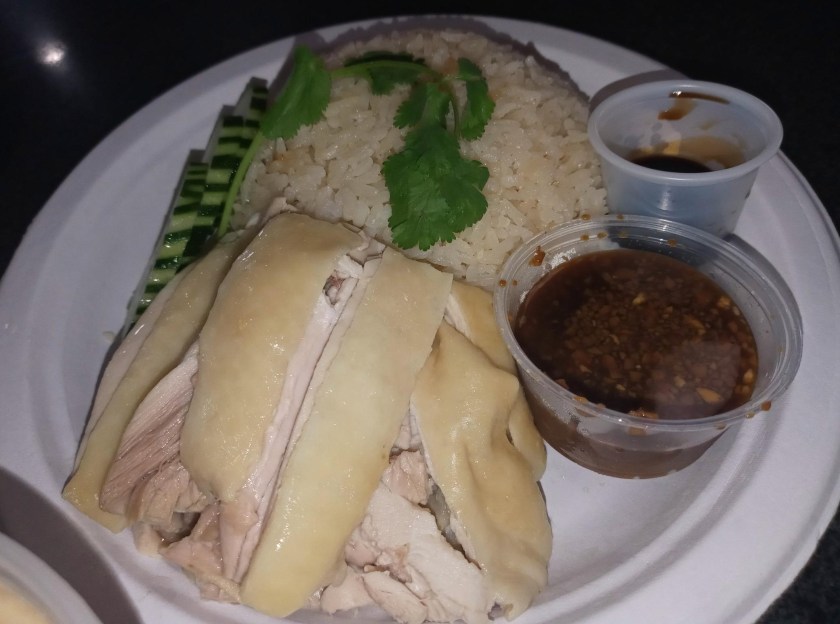
This is Chef AJ’s famous Hainanese chicken and rice ($10) — poached chicken served over Hainanese style rice pilaf with the most amazing ginger, garlic and soy dipping sauce.  The online ordering system gives a choice of white or dark meat, and I will always choose dark meat, 100% of the time.  It came boneless and fully sliced, with the soft skin on.  It also came with a side of broth that I forgot to photograph.  It looked like plain broth, just like this looks like plain chicken, but looks are deceiving, because everything had so much incredible flavor, I was blown away. 

My wise and worldly friend chose the chicken, so I had to make a decision.  With so many intriguing and unfamiliar options, I chose the braised pork Hunglay curry ($10) — marinated pork belly and pork shoulder with toasted garam masala, slowly braised with Hunglay curry paste, shallots, pickled garlic, fresh mango and ginger, and tamarind paste.  It was one of the best things I’ve eaten all year, so I chose wisely too.  Every piece of pork was tender enough to cut with our plastic forks, and they just melted in my mouth.  I’m such a fan of saucy, braised meats, and this was an outstanding dish, full of strong flavors I wasn’t overly familiar with, but they all worked so well together.   

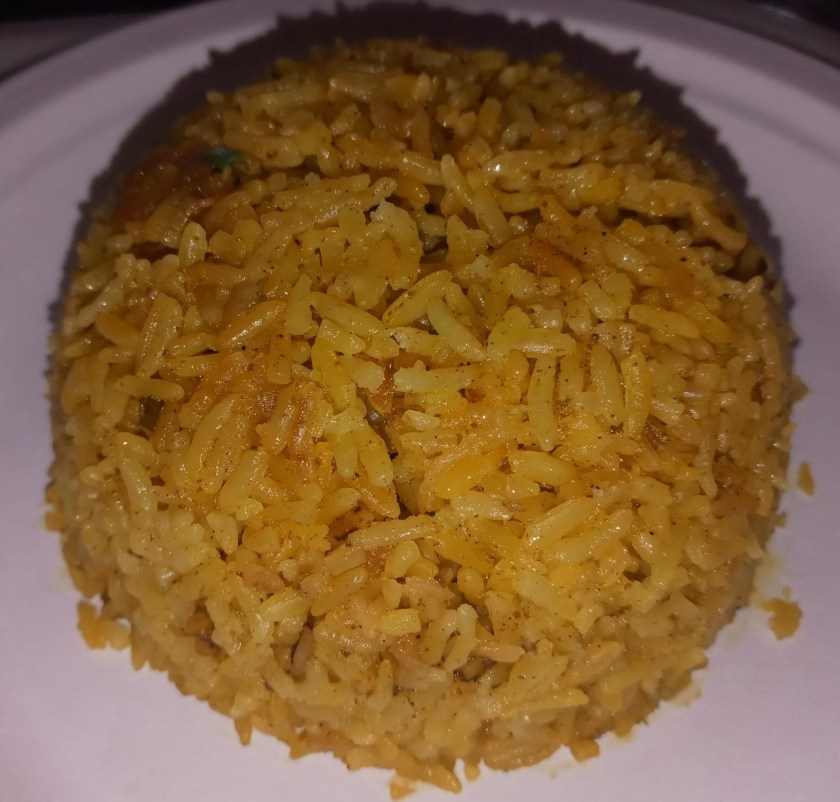
The online menu said this braised pork curry came with steamed jasmine rice, but I requested a substitution of the spiced yellow rice that came with some other dishes, and I noted that it was okay if Chef AJ couldn’t substitute it.  Well, he did, and the spiced yellow rice was triumphant as well.  I have a rice cooker at home, and I can still NEVER cook rice as well as Asian and Latin restaurants.  But both this rice and the Hainanese rice pilaf that came with the chicken were something really special.  Spooning some of the pork curry sauce, which was savory but not spicy at all, over both kinds of rice opened up whole new worlds of flavor.   

My friend ordered this cucumber salad ($4) for us to share — chunks of cucumber and tomato and thin slivers of red onion in Thai sweet and sour dressing.  It might not have occurred to me to order this, but I’m so glad he did, and I’d get it again.  It was crisp and crunchy and sweet and spicy and cool and refreshing, especially with the heavy chicken, pork, and rice and the rich sauces they came with.  The sweet and sour dressing reminded me of Thai sweet chili sauce, a beloved condiment, but not as thick, sticky, and jelly-like.  True to its name, there was also a sour, slightly pungent component in the dressing that played well with the cucumbers.

My friend also ordered tom kha gai ($5), a Thai soup made with coconut milk, curry paste, lemongrass, kaffir lime leaves, and big ol’ chunks of mushrooms, which I cannot eat.  Normally I like to try everything, but I am allergic or intolerant or something.  It always ends badly for me, so I passed.  But the soup looked and smelled good, and he seemed to like it. 

So far, this was my only visit to Meng’s Kitchen, but I need to return sooner rather than later for more Hainanese chicken and rice, more of that incredible braised pork Hunglay curry, and to eventually make my way through the menu and try everything else (as long as it doesn’t contain mushrooms).  It was terrific — one of those hidden gems that are all over Orlando, if you just give them a chance.

Tajine Xpress

Tajine Xpress (http://tajinexpress.com/) is a fast-casual Moroccan restaurant that opened earlier this year on Goldenrod Road on the east side of Orlando, south of East Colonial Drive.  It didn’t seem like the most propitious location until I noticed it is close to a mosque with a school, as well as a Middle Eastern grocery store and a Muslim clothing store.  It should do really well in that area, which is luckily close to my job as well.

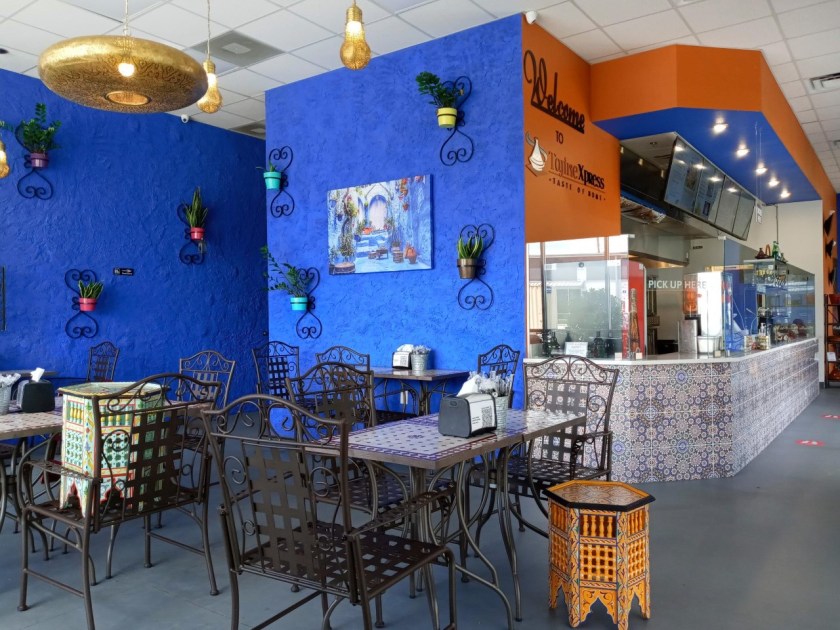
By fast-casual, I mean you order at the front counter, then sit down and wait for it.  When I went with a work colleague for lunch a month or so ago, it wasn’t busy, and a nice lady walked our food out to our table.  But there is also a pickup area right in the corner of the glass section below.  As a double-Gator, I appreciated the orange and blue décor, and I really liked the rich royal blue color of the walls.  The chairs are large and made of metal.  They don’t fit terribly well under the tables, so I found myself literally on the edge of my seat as a whole new, unfamiliar regional cuisine presented itself to us.  My colleague has eaten at the Moroccan restaurant at Epcot, but for me, it was completely new.  I was excited!
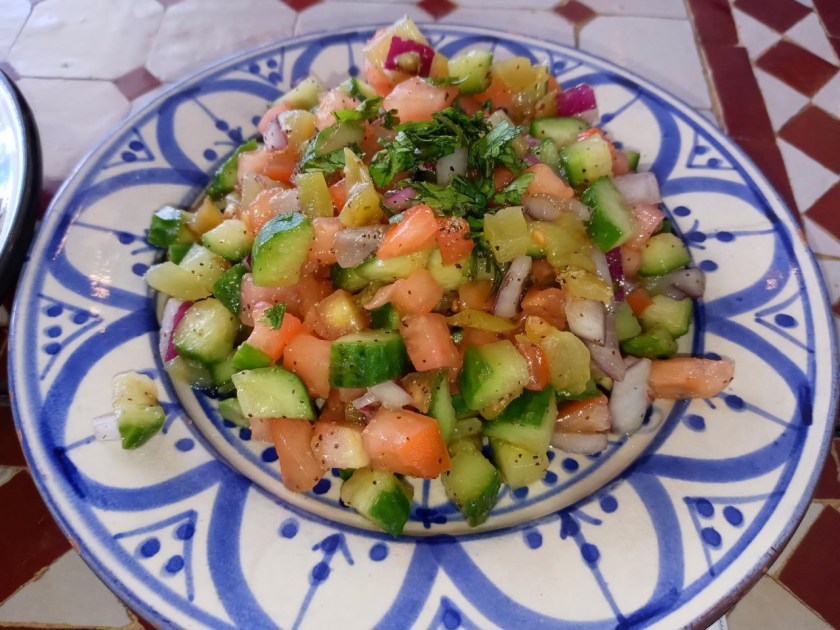
She is vegetarian, so she ordered the Moroccan salad ($3.98), with diced tomatoes, cucumbers, onions, and herbs and spices dressed in olive oil and herbs.

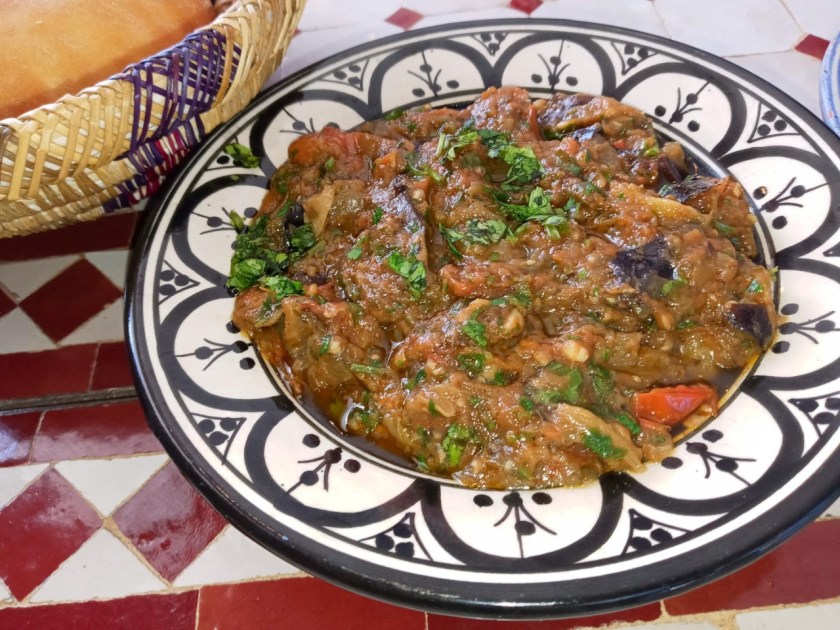
She also got zaalouk ($3.98), a chilled eggplant and tomato salad.  She seemed to really like both of those dishes.

It came with round bread that was crusty on the outside and softer on the inside.  It wasn’t anything like pita bread, and we both agreed it didn’t have a lot of flavor.  I imagined it would have been better if she dipped pieces of it in those two salads.

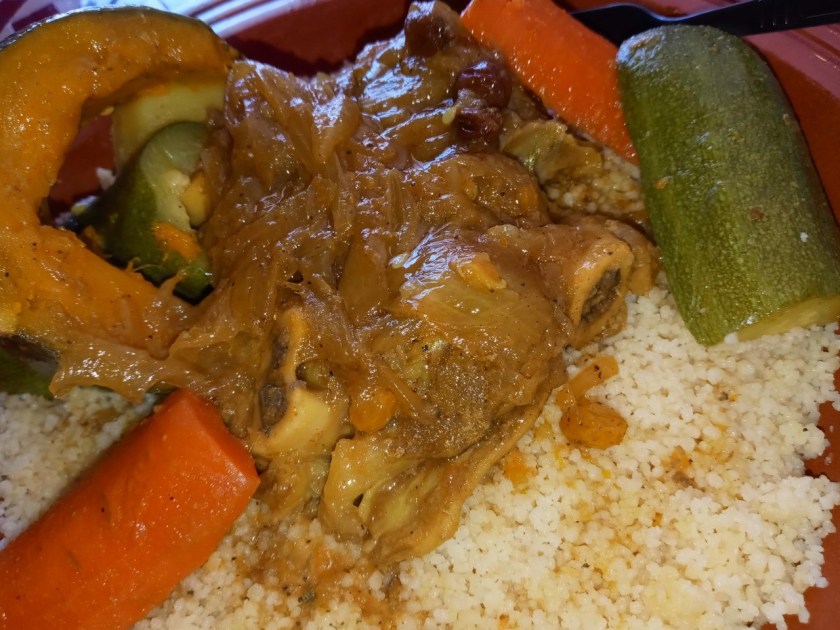
We went on a Friday, so Tajine Xpress was offering its weekend-only couscous platters.  I love lamb and couscous, so I couldn’t resist ordering the lamb couscous ($15.98).  It arrived on a platter that was absolutely HUGE, with some soft, tender vegetables: potatoes, carrots, zucchini, and a squash I wasn’t familiar with.  My research shows it might have been an acorn or kabocha squash, with the green rind and tender orange flesh inside.

Underneath the mystery squash, the lamb had been stewed until it was fork-tender, and they left some bones in there to impart even more flavor.  It was salty and oniony and so delicious.  I wish there had been a little more of the lamb atop the tender, al dente couscous, but you’ll never catch The Saboscrivner wishing a dish had less meat.

Tajine Xpress makes two kinds of spring rolls called briwates — beef and seafood — and you get two per order.  OR, you can be like me and order the briwates sampler platter, which gives you one beef briwat and one seafood briwat ($9.98).  They were served with harissa, the spicy sauce that explains it all.  The briwates looked and smelled so good, but they were both stuffed with mushrooms, my old enemy, a tasty ingredient that chefs love to cook with, but I just cannot eat. 
Undeterred, I cut these open, picked out all the mushrooms, and ate whatever was left, which was not my best idea ever.  It ended up being a very long afternoon at work.  But you have to understand, my vegetarian co-worker couldn’t eat them, and I can’t stand to waste food.  I definitely won’t order these again because of the mushrooms, but you normal, non-afflicted people reading this will probably like the briwates.

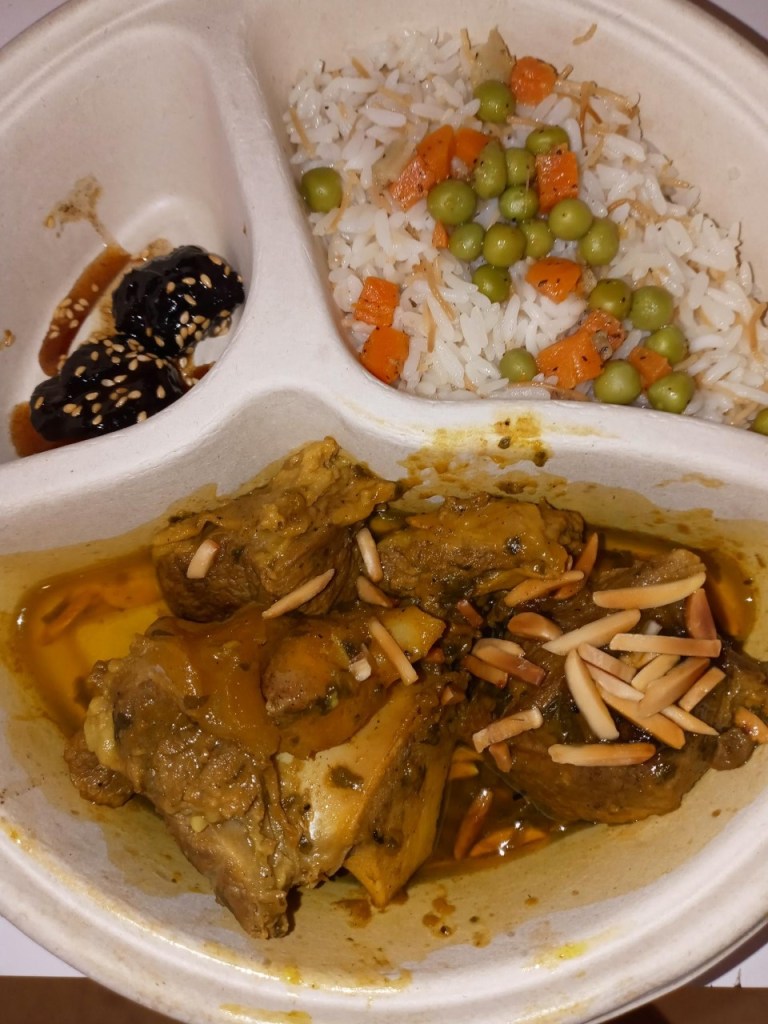
It took me a while to return, but I had really wanted to try the beef with prunes tajine ($12.98), because I love savory and sweet flavors together.  I went for lunch today and ordered it to go, so it came in a round cardboard tray with separate compartments for the huge chunks of tender braised beef topped with slivers of toasted almonds, my side order of rice pilaf (mixed with tiny bits of vermicelli and topped with peas and diced carrots), and only two prunes, sticky-sweet and covered with sesame seeds.
My wife instinctively made a face when I told her I ordered beef with prunes, but I showed her the two prunes were separated in the to-go container and offered her one.  Even she liked it, but I was a little sad we each only got a single prune.  I definitely would have liked more prunes, and it would have been interesting to taste them swimming in the meat juices.  I assumed they would be cooked and served together, but what do I know?  The beef had a lot of flavor and was so tender, I didn’t even need a knife to cut it.  A couple of the pieces had thick bones attached with some tender fat, like one of my favorite meats to eat, oxtails.  But all the meat easily pulled right off the smooth bones, which is one of the joys of braising, stewing, and slow-cooking.  The rice was a little bland, so I mixed all of it into the juices the beef came with, although I would have liked more of that rich, flavorful liquid too.
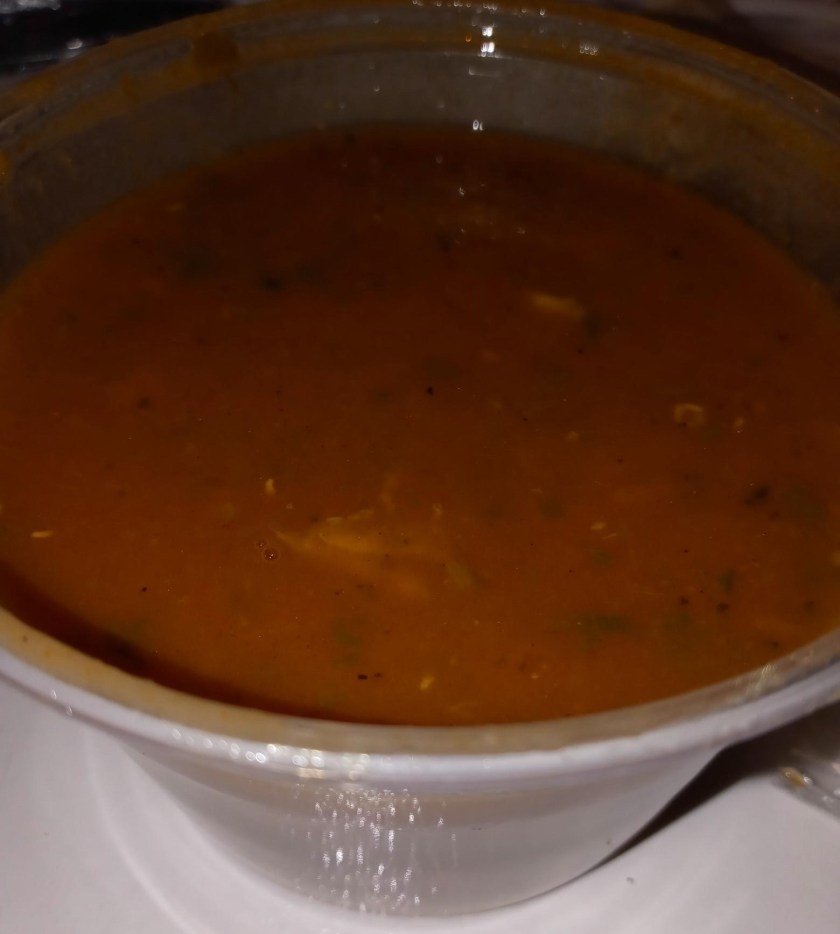
Today has been a dark, dreary, drizzly day, which is a perfect day for soup.  At the last minute, I also ordered the harira soup, with tomatoes, onions, lentils, chickpeas, vermicelli, and beef ($3.98).  It was a tasty twist on a tomato-based vegetable beef soup, as I expected.

The harira came with another round piece of bread, which I made sure to dip in the soup to add some flavor and soften it up.  But I already consumed some carbs from the rice, so I realized I’m just not into this bread and didn’t have to eat all of it.

The menu at Tajine Xpress isn’t huge, but now I’ve covered the two dishes that sounded the best to me: the lamb couscous (available Friday through Sunday only) and the beef with prunes tajine.  I would recommend both of those for sure.  As I said, I wish you got more meat with both of dishes, especially because the meats are so good.  I don’t love that round bread, and I’m wondering if the other side order options of fries and beans would be better than the rice I got today.  I think they would have to be.  I just figured fries would be cold by the time I got them home, but if you go and try the fries, let me know how they were!

CLOSED: Uncle Dendog’s

UPDATE: Sadly, Denni Cha, the chef-owner of Uncle Dendog’s, moved his family to Austin, Texas, in 2022, so Uncle Dendog’s is no more.  Orlando’s loss is definitely Austin’s gain.

Ever since I was a little kid, I’ve been obsessed with comic books, to the point of making it a serious field of academic study.  Heck, this food blog is even inspired by a comic book series called Chew.  (Check the page heading, in case you’ve never glanced at it before.)  But as much as I love the characters, I focus the most on the creators who write and draw them, and I can always identify their unique, defining styles.  For example, the legendary Jack Kirby (co-creator of most of the Marvel characters you would recognize) specialized in burly, square-jawed heroes and imposing alien technology surrounded by crackling energy.  Jim Lee‘s human figures look like flawless gods and goddesses.  Arthur Adams draws huge monsters and super-cute women, always with extraordinary attention to detail.  Kevin Maguire and Steve Lieber are masters of expressive faces, who can convey so much emotion — and especially humor — with just a look.

Where am I going with this?  Well, as a self-proclaimed food writer, I don’t pretend to be the expert on food that I am on comics, but I feel like I’m at a point where I recognize the signature styles and flourishes of some of the talented chefs who prepare the food I love so much.  I can always identify the best comic creators by their written voices and artwork, whether they work on a mainstream superhero comic, a crime graphic novel for “mature readers,” or a deeply personal, autobiographical, self-published story, and some chefs stand out to me the same way, even when they transcend cuisines.

Orlando is home to some real innovators and creative dynamos who have built a strong culinary culture here, and one of my favorite local chefs is Denni Cha.  He has been cooking since he was nine years old, ever since his grandmother taught him to cook in the kitchen of her Korean restaurant.  I first discovered his food in the summer of 2020, when he ran a Japanese pop-up called Itamae Densho out of The Local Butcher, the Winter Park meat market that also hosts previous Saboscrivner review subject Swine & Sons and Da Kine Poke.  I reviewed the gorgeous, almost otherworldly looking chirashi bowls I brought home from Itamae Densho — maybe the most beautiful things I saw in 2020, an otherwise ugly and stressful year.  They were like little landscapes in a bowl — multiple kinds of fresh fish and vegetables over rice, even adorned with edible flowers and ziggurats of fractal romanesco jutting past gleaming orbs of salmon roe.

Unfortunately, Itamae Densho is no more, but Chef Denni is back with his latest venture, something far removed from chirashi bowls but still totally in character and on brand: Uncle Dendog’s (https://www.instagram.com/uncle.dendogs/), a food truck (really a trailer) that specializes in Korean corn dogs and other street foods with a foreign, fusiony focus.  Follow his Instagram page to see where he’s going to turn up next!

I was the first person to arrive at Uncle Dendog’s this past Friday night, set up outside Orlando Brewing, the brewery and taproom south and west of downtown Orlando.  Not being a drinker, I had never been there before, so I didn’t know how busy it would get later or how the parking situation would be.  But I do prefer to grab my food on the early side, especially since I was bringing it home after work. 

I have taken the liberty of posting photos of the menu, although it may change from week to week or even night to night.  I knew I had to try one of Uncle Dendog’s signature K-Dawgs, so it was just a question of choosing which one.   
But I knew he had a new special, just weeks after opening for the first time, and that was what drew me out on this rainy evening.

This was it: “Not-So Native Fry Bread Tacos.”  For many years, I’ve heard and read about Navajo-style tacos, a Southwestern delicacy of meat, cheese, peppers, corn, beans, sauces, and more, served on crispy, pillowy, salty, greasy fry bread, a traditional staple food of Native Americans throughout the American Southwest.

Fry bread may be delicious, but it has a fraught, controversial history in Navajo culture due to the lasting effects of colonialism, when the U.S. government gave the Navajo people flour, sugar, salt, and lard as they were forced to relocate onto desolate, dusty reservations where they could no longer grow traditional, healthy crops like corn, beans, and squash.  There is a schism within the Native American community, and even among Native American chefs, about whether fry bread is an unhealthy, lasting symbol of oppression or a tasty treat born out of resistance and resilience.  It is absolutely not my place to decide or judge which side is right, but I can say a few non-controversial things with certainty, though:
1.) Chef Denni Cha is of Native American (and Korean) descent,
2.) He told me a while back that he planned to offer fry bread tacos as a tribute to his Native American heritage, so I’ve been looking forward to them ever since, and
3.) They were one of the best things I’ve ever eaten.  Yes, in my LIFE.

But first things first: I asked Chef Denni’s lovely wife and partner, Monica, which K-Dawg (Korean corn dog) she recommended, and she told me to go with the Korean in Bogota ($10), a massive meat treat with the lightest, crispiest batter coating a perfect, smoky, salty sausage.  Korean corn dogs are definitely Internet- and Instagram-trendy right now because of how photogenic and eye-catching they are, and this one was no exception.  It was a true fusion: an all-beef Nathan’s hot dog lovingly skewered, dipped in a special batter, and fried until it is crispy outside and lusciously soft inside — an archetypal Korean corn dog even if I had ordered it plain.  But Colombian hot dogs and hamburgers are famous for being served with lots of condiments and toppings, so this was a tribute to those — hence “Korean in Bogota.”  More fusion.  More loving, respectful tribute.  Just like in comic books, this was a legit crossover.     
As the menu said, the corn dog is topped with shiso-cilantro garlic aioli, salsa rosada, pineapple salsa, and crunchy potato sticks, and sprinkled with sugar, for a variety of colors, flavors, and textures — salty, crunchy, spicy, creamy, fruity, greasy, soft, cool, sweet, hot.  (When I asked about the sugar, Denni said “Korean Hotdogs usually get heavily dusted in sugar. We do so much else with them that we just lightly sprinkle it.”)  Anyway, I’m glad I took this home and ate it over a table, because it would have been really messy eating standing up at the brewery or in the parking lot outside.

Next up, I brought home an order of lightly breaded wings ($9).  My wife loves wings, but as much as I appreciate sauces and condiments, she isn’t big on them, so I got these plain with her in mind.  The order came with six huge wings in crispy golden-brown batter, and they were really good.  The battered exterior was still crunchy and warm by the time I got home.  I asked, and this batter for the wings is different from the batter he uses for the corn dogs and fry bread.   

If you want something a little more exciting than plain wings, the other alternative is to get them tossed in a sweet, sticky kimchi sauce.  When Chef Denni kindly asked if I wanted a little ramekin of the sauce on the side, I said YES, which is what you say if someone asks if you are a god, or if you want some sauce on the side.  That sauce was so good, we poured it over the four and a half wings we hadn’t eaten yet, and it made them even better.  Even after saucing, they stayed crunchy and never got soggy, even after reheating some leftover wings in the toaster oven the next day!   
I don’t have a lot of experience eating kimchi, which is weird, because I love pickled vegetables, I’ll eat sauerkraut straight out of the jar or can, and I regularly cook braised cabbage at home.  I need to develop my taste for kimchi, just like I did for pickles.  But this sweet kimchi sauce made these fine wings even finer.

I saved the best for last, which speaks volumes, considering how great the corn dog and the wings were.  I ordered two of the Not-So Native fry bread tacos ($10 each), one for each of us.  They came in the same box and looked like the stuff that dreams are made of.  Topped with braised beef, beer cheese, cilantro-garlic aioli, salsa, corn, black beans, and more potato sticks, they were another amazing, astonishing amalgam of fantastic, fabulous flavors and terrific, tantalizing textures.  But what really took these from tasty street food to next-level works of art was the fry bread itself.  
Chef Denni was very forthcoming when I asked him about the fry bread later on.  He uses the same batter he uses for the K-Dawgz (corn dogs), only he lets it proof longer, for a total of 48 hours, to get to the right consistency for his fry bread.  My wife described the texture of being like a really good, really thick “old-fashioned” doughnut (those wrinkly glazed ones, sometimes called sour cream cake doughnuts), only crispy on the outside.  Denni agreed, saying he has compared them to “savory doughnuts” before, but more airy and fluffy.  I swear, you’ve never had tacos like this before, and I’m 100% sure nobody else in Orlando is making these.  The closest thing I could compare them to are sopes, but they are way better than any sopes my wife and I have ever tried.  I can’t imagine anyone not liking these, unless you keep kosher (in which case, ask to hold the warm, gooey beer cheese) or are a vegetarian (in which case, ask to hold the delicious, tender, savory braised beef).  Heck, even going to town on some plain fry bread would be a treat, maybe with some hot honey squirted on it like the best sopapilla ever.  But don’t miss these Not-So Native tacos!

And here’s a mediocre photo of Uncle Dendog himself, Denni Cha, hard at work in the trailer, packing up my takeout order in his panda sushi apron.  He actually took a moment to pose for me, but I said “Thank you!” like a boob before actually taking the picture, so he moved, and this is what I got — totally my fault.  I’m sorry, Chef.

So what does this have to do with the comic book artists?  Well, I told you I’m starting to identify local chefs from their styles, just like the artists I’ve admired for decades.  And after having Chef Denni’s chirashi bowls at Itamae Densho and now his Colombian-inspired Korean corn dogs and Native American fry bread tacos, I think the common element that identifies and unifies his style as a chef is the sheer beauty of it.  His serving dishes are the canvases of an iconoclastic visionary artist, whether they’re bowls with a base of rice or takeout boxes with paper trays inside.  And he builds these mixed-media structures, assembling them from diverse, colorful, fresh, dazzling ingredients that you might not even think belong together, but that’s only because we don’t think like he does.  Especially here in Uncle Dendog’s trailer/studio, he’s creating cross-cultural culinary mashups and remixes — appropriate, because he is also a musician — and elevating humble, familiar street food to eye-catching, awe-inspiring fine art.  You’ll know it when you see it, because you won’t forget it… especially once you taste it.