Wa Sushi

Wa Sushi (https://www.facebook.com/WaSushiCasselberry/) is a real treasure in the Seminole County suburb of Casselberry, 20 minutes north of downtown Orlando.  The small, serene location is located in a nondescript shopping plaza between an Ollie’s Bargain Outlet and a store called Sports & Pokemon (the two genders?), but it boasts some of the finest sushi and Japanese food in the Orlando area.

Wa Sushi used to be in another, even less auspicious location elsewhere in Casselberry, pretty far out of the way and hard to find, and our very cool next-door neighbors invited us there once.  It was good, but for whatever reason, we didn’t return until recently — our first visit in years, and the first to this new location.

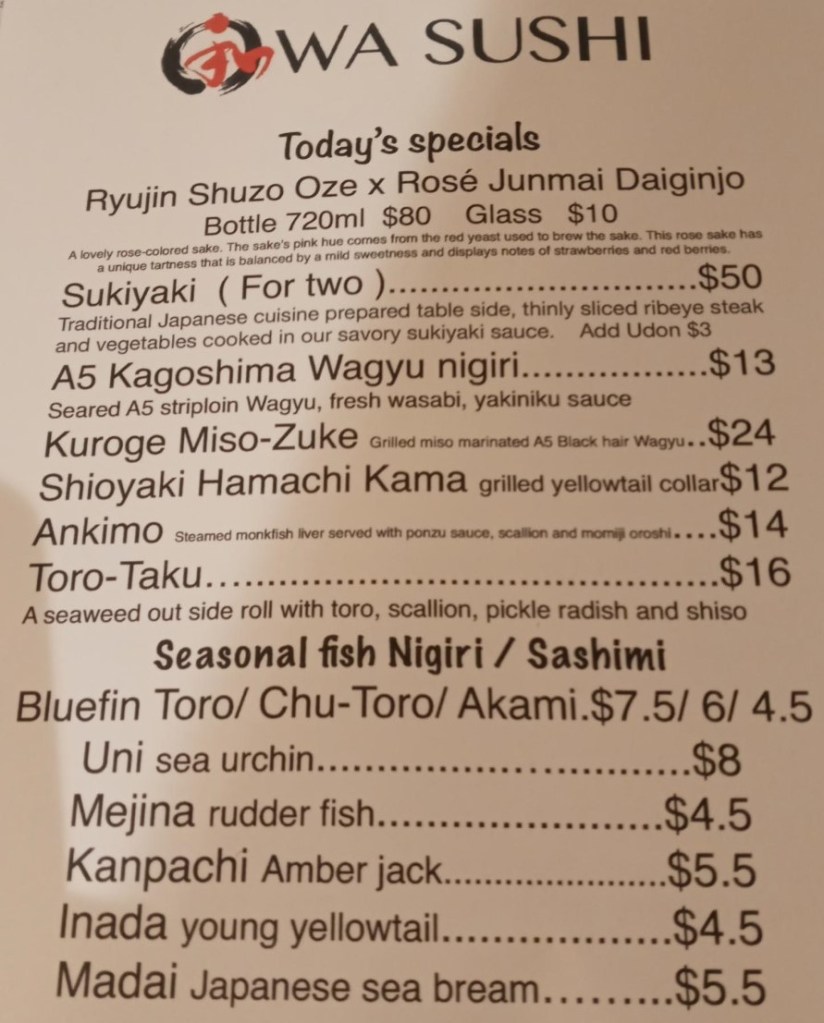
You can find Wa Sushi’s menu on the Facebook page above, but they had a menu of specials when I took my wife there recently, for our first real date night in a while:

This was one of the last evenings of 2022, and we saw Wa was offering another special of toshikoshi soba, or “year-crossing noodles,” traditionally meant to be eaten on New Year’s Eve to let go of the hardships of the past year (since soba noodles are so soft and easily cut).  Well, we figured we could both use some of that.

Rather than try the version in broth, we ordered the toshikoshi ten zaru soba ($16), cold soba noodles served with a dashi soy dipping sauce and a side order of tempura-battered and fried shrimp and vegetables.  It was beautifully plated, and really good too, although I probably would not have ordered it if the dish wasn’t associated with the tradition of letting go of the hard times of the past year.

Close-up of the tempura shrimp and vegetables.  My wife ate the tempura sweet potato, and I had the onion and shishito peppers.

Here are the cold soba noodles, made from buckwheat and topped with some fine shreds of nori (seaweed).  They didn’t have much flavor at all, kind of like eating plain, cold spaghetti, but earthier.  The dashi dipping sauce helped immensely, as did the finely-diced scallions that also came on the side.   

Something we ordered came with the obligatory wee house salad with sesame dressing and miso soup, which I enjoyed:

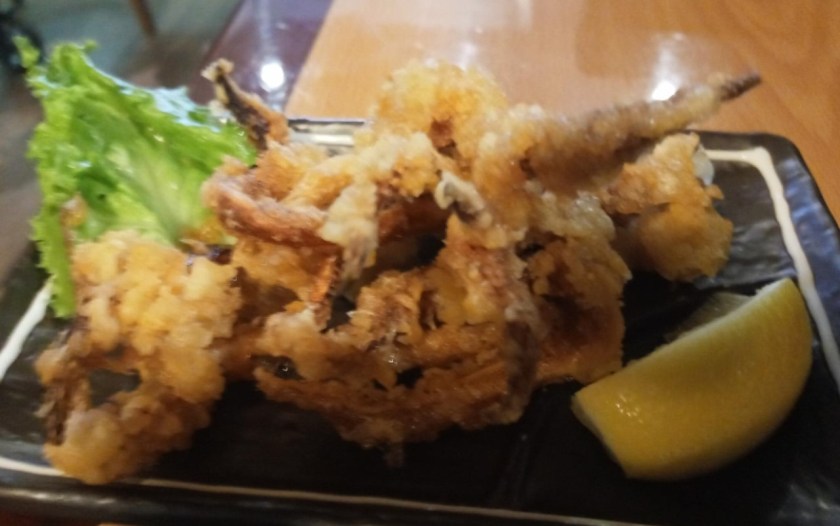
This was ika geso ($11), a small plate of deep-fried squid legs from the Hot Tasting section of the menu.  After how tender and fried to perfection the shrimp were, we thought we would double down on the tempura shellfish.  These were chewier than a lot of fried calamari we have ordered around town, but I have a feeling this squid was a lot fresher, as opposed to some restaurants that may use frozen calamari.  They definitely tasted fresh.

My wife always loves a good selection of sashimi, or in this case, a beautiful portion of chirashi ($33) — select cuts of raw fish, selected by the chef.  There was salmon in here, ebi (shrimp), tako (octopus, one of her favorites, whether raw or cooked), ikura (orange globes of salmon roe), tamago (perfectly cooked and sliced egg), and unagi (eel).  I always love eel in sushi, but this was her first time trying it, and she liked it.  I’m always impressed by her willingness to try almost anything.

And we ordered three beautiful rolls to share:

In the foreground, you can see the ultimate tuna roll ($16): spicy tuna and cucumber inside the rice, topped with  tuna, wasabi-infused tobiko (fish eggs), and sweet chili sauce.  This one was awesome, but I’m always a fan of spicy tuna in any form. 

Here you can see the inferno roll ($14) in the front, and the mango tango roll ($13) in the back.  In the very front are slices of escolar sashimi ($2.50), just for her — a big fan of the butterfish.  The inferno roll features spicy salmon and cucumber topped with yellowtail, spicy mayo, and paper-thin slices of fresh jalapeño pepper.  Awesome combination.   
The mango tango roll in the back features tempura-battered and fried shrimp, mango, and cucumber, topped with crab salad.  I believe this was real crabmeat and not surimi (processed fish sometimes called “krab,” even though I like that stuff too).

I was really impressed by Wa Sushi, once again, all these years later, in a much more convenient location.  Last summer I wrote a review of Kabuto Sushi & Grill, another friendly neighborhood sushi spot close to our home, just on the Winter Springs side rather than the Casselberry side.  I even listed one of Kabuto’s dishes in my Top Ten Tastes of 2022, which came out in the last Orlando Weekly issue of the year.  Sadly, that very week, the last week of 2022, Kabuto announced it was closing permanently.  That’s when I resolved to get us back to Wa, to support them as much as we could moving forward, to help spare it a similar fate.  I know lots of local foodies already know how fine Wa Sushi is, and common consensus is that it is one of the best sushi establishments in the greater Orlando area.  It absolutely is, and to have it so close to home, a true treasure in Casselberry, of all places, means we have to protect it, support it, and shout our praise from the rooftops, both real and virtual.  So here’s my praise and my protection.  Let’s support all of our favorite restaurants as much as we can this year, especially those friendly neighborhood favorites we are lucky to have so near and dear to us.

Jaleo

Jaleo (https://www.jaleo.com/location/jaleo-disney-springs/) is an upscale Spanish restaurant, founded by the successful celebrity chef, restauranteur, and humanitarian Jose Andres.  When he’s not feeding people in international crisis zones with his World Central Kitchen charity, he runs several other restaurants, including China Chilcano, the Peruvian-Chinese-Japanese restaurant in Washington, D.C., which I ate at and reviewed in 2019.  But Jaleo, featuring the tastes of his native Spain, is probably his most famous, with locations in D.C., Chicago, Las Vegas, and right here in Orlando.

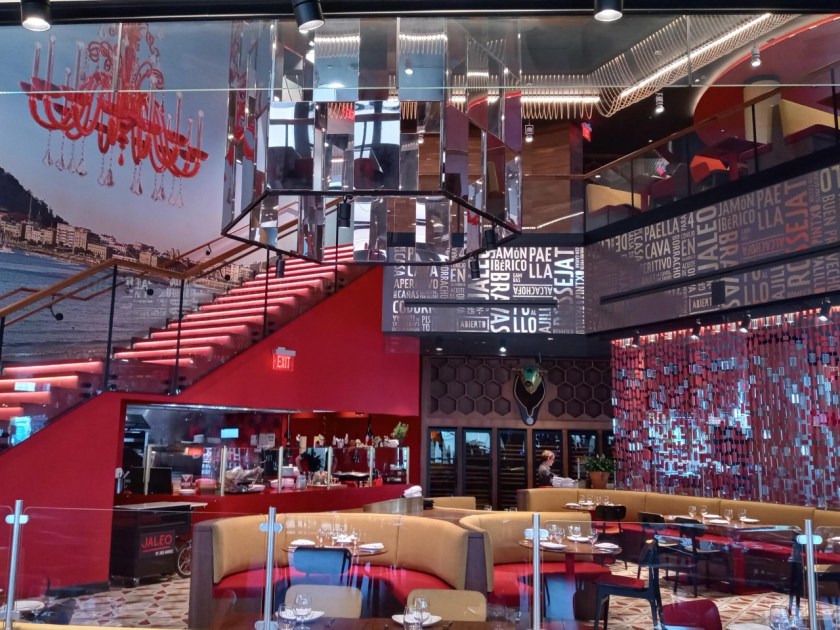
The two-story Jaleo location at Disney Springs is absolute huge and beautiful.  It is almost like sensory overload in there, with so much to look at even before your senses are overwhelmed by the tapas coming your way. 

The design really is busy, but stunning.

Peep these gorgeous hanging hams.  As Michael Jackson might have said, “JAMON!”

This location opened in March 2019, and I had been wanting to go since the beginning.  But with COVID, major medical stuff, a job change, and lots of other life stuff getting in the way, I finally made it to Jaleo earlier this year, back in May, which seems like a lifetime ago.   I went for a leisurely lunch with three colleagues from work, all top-notch librarians I don’t get to work directly with anymore, but I think the world of them.  None of us had ever been here before, so we shared almost everything, which is the best way to do Jaleo — in a group with friends who understand sharing is caring.  Each of us ordered a few dishes and paid our own way, so I will present our epic meal more of less in order of how things came out from the kitchen.

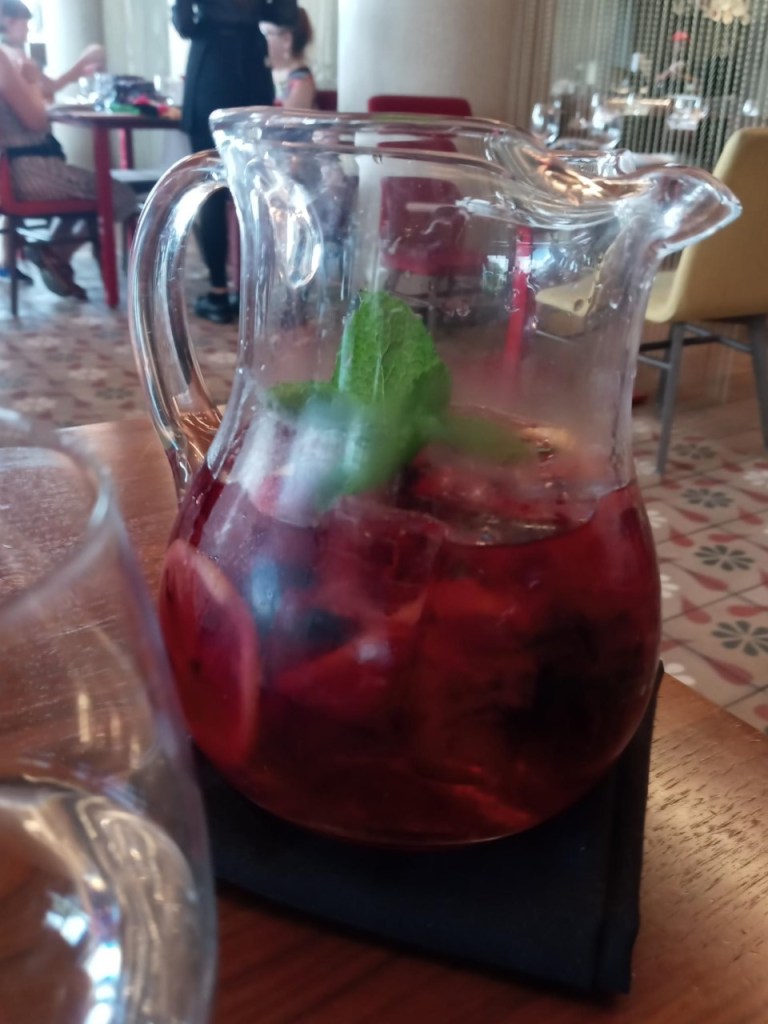
Two colleagues shared this pitcher of sangria, which they seemed to like.  I don’t know how much it cost and didn’t try it because I don’t drink, but it’s Spanish red wine mixed with fruit, so I’m sure you can’t go too wrong.

This is pan con tomate ($14), toasted slices of bread rubbed with fresh tomato, which sounds too simple to be good, and definitely too simple to be worth $14.  But it was worth it, even split four ways.  Better than tomato-rubbed toast has any right to be!  It was so good, another person in my party ordered a second portion for the table.

This was the coca Idiazabal ($10), a handmade rosemary and olive oil cracker topped with membrillo (a jelly-like paste made of the quince fruit, so rich, sticky, and sweet!) and Idiazabal cheese, grated into soft, silky strands.  I had never had quince before, but it reminded me of the guava paste that is ubiquitous in pastelitos and other Cuban desserts from growing up in Miami.  We cracked the coca cracker into quarters as best we could and enjoyed the blend of sweet and salty, crunchy and gooey.   

This was my vegetarian colleague’s manzanas con hinojo y queso Manchego ($13), a salad of sliced apples, fennel, Manchego cheese (a Spanish cheese made from sheep milk), walnuts, and sherry dressing.  I don’t remember much about the bite I got, but I do love fragrant fennel (I like to use it in pasta con la sarde, a dish of pasta and sardines) and salty Manchego.   It would be a great palate cleanser to take bites of between heavier, richer, meaty dishes.   

I definitely ordered this dish, which I swear looked a lot more appetizing in person: the cebolla asada ($11), a huge roasted sweet onion topped with pine nuts and funky-but-delicious Valdeón blue cheese.  Everyone knows how much I love onions, especially when they are marinated and/or caramelized.  This was magnificent, especially with the blue cheese on top.  Part of me imagined enjoying a gigantic, juicy burger topped with this bad boy, but that wouldn’t be Jaleo’s style.

So many months have passed, I think this soup my one vegetarian colleague ordered is the gazpacho de remolacha con queso de cabra ($11), red beet gazpacho with goat cheese, oranges, and pistachios.  It was the only thing on the table I did not sample, but if that’s indeed what it is, it sounds good enough to even win over Lisa Simpson’s gazpacho-mocking family at that one cookout.

Me being the connoisseur of cured meats, I couldn’t go to Jaleo and not order the jamon Serrano ($13), a platter of the most delicious Serrano ham, cured for 24 months.  These paper-thin slices were served with these delightful little crispy bread twists to wrap them around.  Like the best prosciutto, this jamon was salty and unctuous and could melt away in your mouth.  My one male colleague seemed to like it; the ladies wanted nothing to do with it, so more for me!

This was the espinacas a la Catalana ($14), sautéed spinach with pine nuts, raisins and apples.  Once again, I can’t take credit for ordering such a healthy, wholesome dish, but it was so amazing.  I think we had leftovers of a few things at the end of our lunch, including this, and I took them all home because I am shameless.  My wife tried it and loved it, and I attempted a copycat recipe not long after that was okay, but not nearly as good as this.  I mean, look at this!   I do love cooked greens, and the slight sweetness from the fruit made such a difference, especially with the tender crunch of the apples and the chewiness of the raisins (“Nature’s candy,” as my mom would say, trying desperately to convince my brother and I as little kids, and probably herself as well.)

Next up we have the gambas al ajillo ($19), or according to the menu, “The very, very famous tapa of shrimp sautéed with garlic.”  I don’t really care how famous they are, but they were some of the tastiest shrimp I’ve ever had.  I can’t rave enough about how perfectly every dish in this epic lunch was seasoned, and the gambas were no exception.

My mighty colleague ordered this paella of the day for himself, and our patient server warned us it would take about 45 minutes.  It came toward the end of the meal, when we were all visibly fatigued, but I honorably and dutifully helped him get through it.  Constant readers, I wish I could tell you what this exact paella of the day was, but that memory is lost in time, like tears in the rain.  The menu narrows down the kind of rice to “Bomba rice from Valencia or Calasparra from Murcia,” and it definitely included tender chicken, some kind of pork, and also shrimp, with a swirl of garlic aioli on the plate, as if it wasn’t rich enough already.  Not everything is worth the wait, but this paella was.This is where I admit I’ve had bad experiences with paella elsewhere.  Usually you pay a lot and wait a long time, and the rice comes out underdone.  Just disheartening experiences overall, which is why I didn’t order a traditional rice-based paella for myself, even in this temple of Spanish cuisine, with a menu created by one of the greatest chefs in the world.  Because the rice was tender and everything came together, it was probably the best paella I’ve ever had.

This was the last dish I ordered myself: rossejat negra ($32), a different kind of paella made with toasted Catalonian fideos pasta instead of rice, head-on shrimp, squid ink, calamari sofrito, and dollops of creamy, garlicky aioli.  The picture isn’t great, because it looks like some burnt crud on the pan, but that was actually pasta dyed black with squid ink, a gourmet treat that always impresses my wife and me whenever we see it, maybe because we are goths at heart.  I cannot vouch for the placement of the huge shrimp in this dish, but I’m sure there was no ill intent.  The pasta was al dente in places, but the edges that touched the pan were crispy like pegao, the crispy rice from the bottom of the rice cooker that some people dismiss but others (like my wife) love.  The dollops of creamy, garlicky aioli stood out against the blackness of the pasta and the blackness of the pan, reminding me of a line Alan Moore wrote in the comic book Top Ten #8, later plagiarized by Nic Pizzolatto in the first season finale of True Detective, about seeing stars shining in the night sky, and how there is so much darkness out there, but just to see any light at all means the light is winning.  Well, nobody else wanted anything to do with my rossejat negra, which means I was definitely winning!
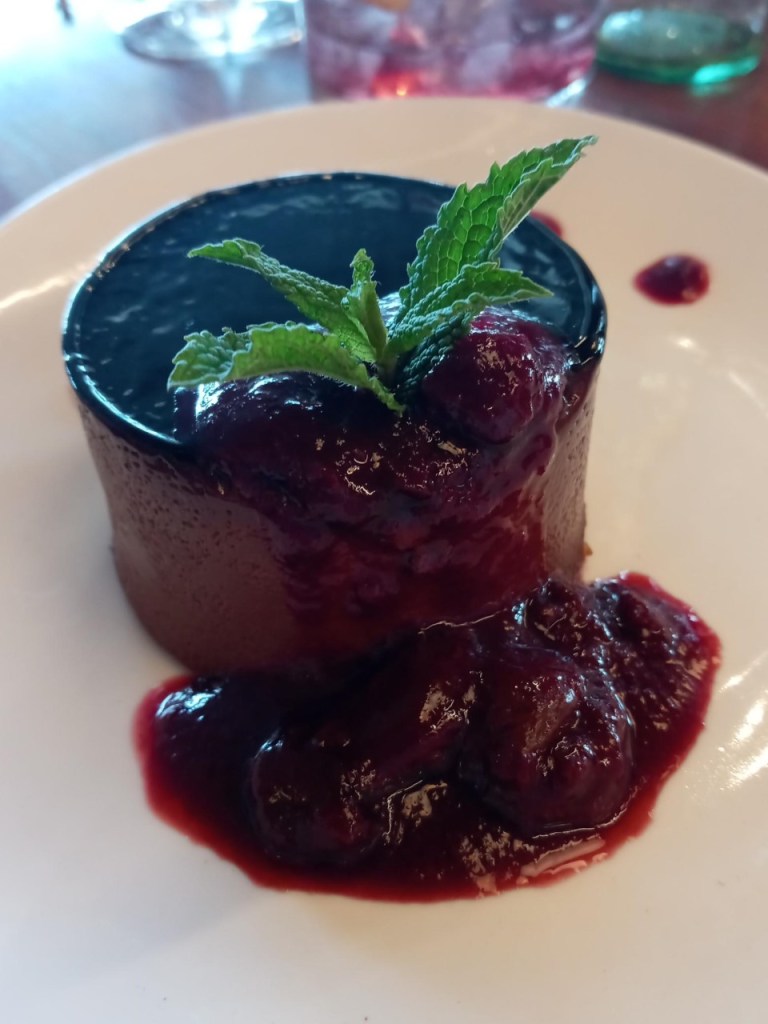
My colleague who is a huge Disney fan ordered this dessert, and I honestly don’t remember if I tried a bite or not.  It is the Selva Negra ($14), created to celebrate Walt Disney World’s 50th anniversary, lasting throughout 2022 and into March 2023.  The menu describes “a decadent mousse made of Manjari 64% chocolate atop a crunchy feulletine base with black cherry chocolate sponge cake and topped with a chocolate glace.”  That’s pretty impressive to me, considering my favorite dessert is a creamy citrus pie in a crust made of crushed Ritz crackers.  This right here is some serious gourmet… stuff.

I don’t know why it has taken me over half a year to finish writing this review.  Needless to say, the four of us ate like royalty this day.  But the fact that it was four generous and mostly adventurous people made it the ideal situation at Jaleo.  The tapas-style portions aren’t gigantic, but most are bigger than you think, definitely big enough to share with a group this size.  And that’s the way to do tapas correctly — to order a bunch of different things and share them.  Share with friends, with family, with dates and mates, even with former co-workers.  A meal like this lends itself to sharing, so as many people as possible can experience the majestic flavors of Spain and the creative brilliance and love of Chef Jose Andres and his talented kitchen staff.  You could go alone and order a couple of dishes, but I don’t know if that experience would be the same.  That’s why it took me so long to finally make it to Jaleo, and why I won’t return until the circumstances are right, and I can bring more people I care about to share with.  Sharing food (and even information about food) is one of my love languages for sure (you’re welcome!), and one of Chef Andres’ too, as he continues to lead World Central Kitchen to feed people at disaster sites and war zones around the world.  He’s a true mensch, and he deserves our support.  You can donate to World Central Kitchen, AND you can also enjoy a sumptuous, unforgettable meal at Jaleo next time you’re down near Disney.

Friends Indian Cuisine

Friends Indian Cuisine (https://friendsindiancuisine.com/) is a new halal Indian restaurant on South Semoran Boulevard, just north of Curry Ford Road in South Orlando, south of State Road 408.  It opened earlier this year (2022) and is building a loyal following due to excellent word of mouth.  The location has hosted a handful of restaurants before, but hopefully Friends is here to stay.  I have dined in twice and brought home takeout another time, so I couldn’t wait on this review any longer.  The short version: Friends is fantastic.  It’s another great recommendation to Orlando’s Indian restaurant scene, which I am slowly but surely working my way through.

From my first takeout trip, I brought home the two dishes I know my wife likes: butter chicken (left; $13.99) and palak paneer (right; $12.99) — both mild, for her sake.  The butter chicken is a delicious dish that was her gateway to appreciating Indian food: shredded dark meat chicken (all leg meat) stewed in a creamy tomato sauce.  It is very similar to chicken tikka masala (also on the menu for $14.99), but I’ve brought both to my wife before, and she prefers the butter chicken.  I love it too.  The palak paneer is cubes of cottage cheese (the paneer part) cooked with spinach in a creamy sauce.  It is another great gateway dish for people unfamiliar with Indian cuisine, especially vegetarians.  I’ve ordered an extremely similar dish called saag paneer at other Indian restaurants, but I just researched the difference: palak paneer is always made with spinach, while saag paneer can be made with spinach and/or any other leafy greens, particularly mustard greens.  Mystery solved!

I ordered lamb karahi ($14.99) for myself: boneless lamb strips cooked with tomatoes, onions, and green bell peppers in a curry sauce, served over basmati rice that came on the side.  Normally I order hot lamb vindaloo at Indian restaurants, but I switched it up to try the karahi for the first time.  I still got it hot, but it was a lot less vinegary and pungent than the vindaloo.   

I brought home an appetizer portion of vegetable pakoras ($4.99), a serving of six mixed vegetable patties dipped in chickpea batter and fried until golden-brown and crispy.  I thought my wife would like them too, but I ended up enjoying them more than she did, especially with tamarind sauce for dipping.

This was an order of tandoori paratha (top; $3.49), which is whole wheat bread layered with butter, and regular butter naan (bottom; $2.49, or you can get it with your entree as an alternative to plain basmati rice).  I wanted my wife to be able to compare and contrast them, but they were very similar.  Both breads were soft and warm from having been baked in a clay oven called a tandoor, and we really enjoyed both.  I am more used to buttery, flaky Malaysian-style parathas than the Indian variety, so this tandoori paratha was much more naan-like.  But trust me — I could eat these naan-stop.

If you don’t feel like ordering off the menu, or if you’re a newer convert to the wonderfulness of Indian food, Friends Indian Cuisine offers a daily all-you-can-eat lunch buffet for $12.99 on weekdays and $14.99 on weekends, from 11:30 AM until 3:30 PM.  I’ve had the lunch buffet twice now, and it is terrific.  The dishes on the buffet are all mildly spiced for a wide range of palates.

Here are all the options from my most recent visit:

You grab your plate near the naan bread, aloo pakora (crispy battered and fried potatoes that were replenished right after I took this photo, of course), a lentil soup, that I did not try, and sweet gulab jamon, a dessert dish of cake-like balls in a sugary syrup.

Here you have plain white basmati rice, palak paneer (which we have already established is awesome), mixed vegetable curry, and aloo cholay, a dish with cubed potatoes and chickpeas cooked in a spicy curry sauce.

Moving down the line, they offer vegetable rice pilaf, chicken biryani (terrific), chicken curry, chicken korma in a creamy cashew sauce, butter chicken (I love this so much), and moist and tender tandoori chicken thighs and legs.

And finally, you can get cool, creamy raita (a yogurt sauce that is perfect for neutralizing spicy dishes), green chutney, tangy-sweet tamarind sauce, intimidating-looking green chili peppers, chopped red onion, lemon and orange wedges, a green salad, and rice pudding, another sweet dish.

This was my first plate, where I sampled a little bit of everything.  The butter chicken, tandoori chicken, palak paneer, and chicken biryani were my favorites from the lunch buffet.

On my most recent trip to the buffet with two work colleagues, I got an order of vegetable samosas ($4.99) for us to share.  These were perfect potato pyramids, with seasoned potatoes and peas in lightly fried, crispy crusts.  They split one and liked it, and I was too full to try mine until the next morning at home, but it was still great then.

Since Friends Indian Cuisine is so convenient to my job, I look forward to becoming more of a regular over the months and years, even as I branch out and continue to try other Indian restaurants throughout Orlando.  My family NEVER ate Indian food when I was growing up in Miami, and I never ate it that often until the last few years, in my quest to discover the best food anywhere and everywhere and share my thoughts on it.  Now I’m making up for lost time, and I’m thrilled to recommend one more great local Indian restaurant to expand my palate and my experience.

And hey, if you were expecting a Friends reference since I always make pop culture references in my restaurant reviews, sorry to disappoint you, but I always hated that show.

Lam’s Garden

Lam’s Garden (https://www.lams-garden.com/) is a respected and venerated Chinese restaurant in Orlando, on the border of two of the city’s best foodie neighborhoods, Mills 50 and the Milk District.  It is in the shopping plaza with iFresh Market (a really good Asian grocery store, not to be confused with Fresh Market) and my beloved Chicken Fire, on the northeast corner of East Colonial Drive and Bumby Avenue.

But me being a lifelong late bloomer, I only recently visited Lam’s Garden for the first time.  (I told an older man that after my meal, and he said “How?  We’ve been here since 1975!”)  Well, better late than never, because it was really good.

I thought it was very old-school to get a bowl of crunchy fried noodles to snack on while we waited for our orders to come out.  This took me right back to all the Chinese restaurants my dad took me to in Miami, growing up in the ’80s, where he knew all the owners and they all knew him because he taught their children and grandchildren. 

At first, they just presented us with a laminated menu of lunch specials, but I asked for a longer menu if they had one.  They brought us two additional menus, with standard Americanized Chinese food favorites and another with Chinese “home cooking,” as the server described it.  Whenever you go, make sure they give you all the different menus to maximize your choices!

My vegetarian colleague ordered Buddha’s delight off the lunch specials menu ($9.95), and got a huge plate of broccoli, crisp snow peas, bok choy, baby corn, onions, mushrooms, water chestnuts, and bamboo shoots, in a brown sauce.  Her white rice was served on the side.

The lunch specials came with plenty of other stuff she couldn’t eat, so like a good friend, I volunteered to eat everything, like this small bowl of wonton soup:

A crispy eggroll:

And a little dish of fried rice:

I had a really hard time making a decision, since this was our first time here, so I went with a dish that never disappoints, and definitely didn’t disappoint at Lam’s Garden: Singapore curry rice noodles ($15.95), served with chicken, pork, and shrimp.  It was kind of medium-spicy and so flavorful, with the thin, tender noodles.

I would be tempted to order this again and again, but after finally visiting Lam’s Garden, I definitely want to start working my way through the large menu on future trips.  Lam’s might very well be the oldest Chinese restaurant in Orlando, and since it has been proven to have staying power, I look forward to trying other dishes, making up for lost time.

Chain Reactions: Krispy Krunchy Chicken

Krispy Krunchy Chicken (https://krispykrunchy.com/) is a unique fried chicken chain with a distinct Cajun accent, founded in Lafayette, Louisiana, in 1989.  It is a unique chain because most of the locations are inside gas station convenience stores, but anyone who reads my blog knows you can often find great food in the most humble-looking and unlikely of places.

Take, for example, the Citgo station at 3025 East Colonial Drive, 32803, in Orlando, on the corner of East Colonial Drive and Maguire Road.  This is on the edge of a couple of the best foodie neighborhoods in the city: the Milk District and Mills 50.  I’ve been driving past this gas station for years, and only recently noticed a sign that it offered Krispy Krunchy Chicken inside.  I had to try it, for the sake of journalism and a librarian’s desire to share information.  I’m not sorry I did.

When you place your order, you ask for the chicken you want from under the heat lamps, and a nice lady will bag it up for you.  It was all very fresh.

The sides are self-serve (you just grab them yourself).  This sign lists prices for single pieces of chicken:
Breast: $3.19
Wing: $1.89
Thigh: $2.09
Leg: $2.09
Tender: $1.89

Here’s a close-up of that bottom shelf, which includes honey butter biscuits, boneless chicken tenders, corn dogs, and egg rolls.  Sauces are 50 cents each (original, buffalo, honey mustard, ranch, tartar, sweet and sour, and barbecue), but as much as I love sauces and condiments, I was trying this chicken for the first time, so I didn’t want to overwhelm my palate or distract from the main mission with too many variables.

I ordered a two-piece meal ($7.99) with a leg, a thigh, a side (see below), and a honey butter biscuit, and had a little picnic in my car.  Totally worth it.  The chicken was juicy and the breading was thick and crunchy, but not as Cajun-spicy as I was hoping.  Still, you can’t ask for much more than that, especially from a gas station convenience store setup!  The biscuit was a real standout.  Not in the same league as Se7en Bites, Orlando’s beloved Southern bakery and restaurant moments away, which is home of the best biscuits ever, but perfectly fine to accompany this chicken.

I couldn’t resist getting an order of fried chicken gizzards too.  (I don’t remember how much this was.)  Now I LOVE chicken livers (chopped liver is one of the foods of my people!) and hearts, but I didn’t remember ever trying gizzards before.  They were REALLY chewy.  That’s the most I can say about them.

The macaroni and cheese tasted a lot better than it looks here, flattened down by the lid on this styrofoam cup.  But I don’t even think it looks bad.  It looks and tastes like typical macaroni and cheese you would get as a side at any number of barbecue joints or Southern restaurants.  So maybe not Orlando’s best (for that, check out Pom Pom’s Teahouse and Sandwicheria, nearby in the Milk District, and also Se7en Bites again!), but very pleasing nonetheless.

Since this was my first visit to a Krispy Krunchy Chicken location, I got two additional sides while I was there.  These red beans and rice were suitably smoky, salty, and creamy, but you just can’t beat Popeyes red beans and rice.  That’s the quintessential version right there, the one that even chefs (like David Chang) cite as the best.

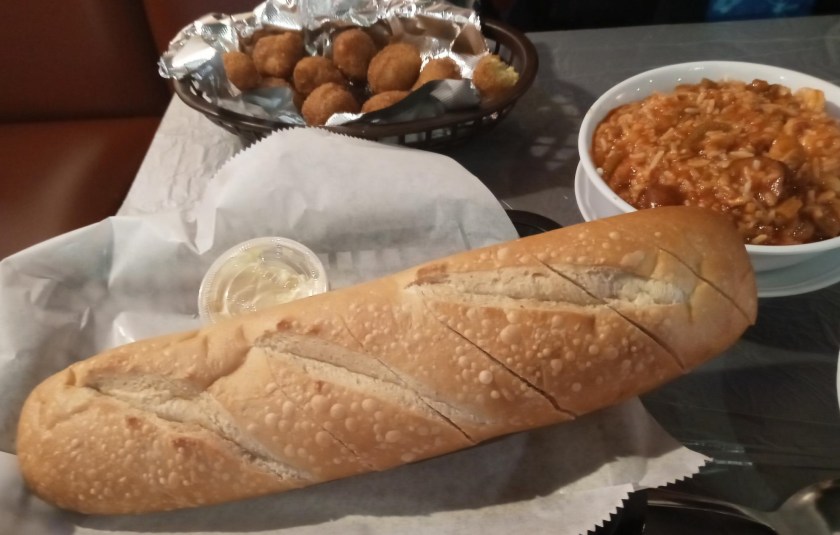
But my favorite side was the jambalaya, saucy rice with chunks of (andouille?) sausage and ham.  I always like jambalaya, whether it’s from an old restaurant in the French Quarter or a box from Zatarain’s.  This was somewhere in between, quality-wise, but closer to the French Quarter than the box.   I didn’t expect it to be as good as it was.

Would I go back?  Absolutely I would.  As much as I generally like Popeyes for bone-in fried chicken, they can be hit-or-miss with both food quality and service.  And this particular Krispy Krunchy Chicken gas station location is a lot more convenient for me than the always-excellent Theo’s Kitchen.  This was solid fried chicken, but I think the thing I liked the most was the jambalaya.  It was so tasty and hearty and full of meat, I could happily make it the centerpiece of a meal some other day, when I’m in the mood for such a thing again.

CLOSED: Thai Singha

UPDATE: Apparently Thai Singha closed in April 2023, and I am very sad about it.

***

Thai Singha (https://thaisingha.net/) is the first Thai restaurant I ever visited in Orlando, shortly after meeting my wife and starting to date her, back in 2006.  It is out in the sprawling Waterford Lakes shopping center in East Orlando, south of the University of Central Florida.  The area is full of restaurants, but not many stand out and draw attention.  Thai Singha definitely does, or at least it should.

We realized it had been years since we had gone together, especially after discovering newer favorites like Mee Thai and Naradeva Thai, both wonderful places.  But you never forget your first, especially since Thai Singha is where I discovered my favorite Thai dish that is now my benchmark order at any new Thai restaurant, to compare and contrast them all.

My wife started with hot ginger tea ($2.95), which smelled really good and came in a neat-looking receptacle:

Then she ordered one of her favorite dishes, that she also introduced me to at Thai Singha over 15 years ago: mee grob ($6.95).  Some restaurants call it mee krob or meekrob, but many around Orlando don’t serve it at all.  It is a veritable mountain of crispy rice noodles, shrimp, pork, and tofu, tossed in a tangy sweet sauce and garnished with scallions and bean sprouts.  It is awesome, folks.  It is very sticky, crunchy, sweet, salty, and sour — a feast for all the senses.  The shrimp is fried so nicely that you can even crunch and swallow the crispy tails.  It is one of the only places where I like tofu, but I fully admit I haven’t had enough tofu to discount it completely.  Maybe everyone is already wise to the joys of mee grob, but if ya don’t know, now you know.

My wife ordered her favorite entree as well: late night noodles with a combination of shrimp, scallops, and squid ($16.95).  You can choose any of the options from the “Favorite Dishes” section of the menu to come with mixed vegetables, tofu, chicken, beef, or pork for $11.50, shrimp for $14.50, or a meat combo or this seafood combo for $16.95.The late night noodles are soft, chewy rice noodles stir-fried to perfection, then tossed in a light soy sauce with eggs, the shrimp, the buttery little bay scallops, and the tender squid, and served over a bit of lettuce.  She loves it.

And this is my favorite Thai dish, made with the same flat, wide, perfectly chewy rice noodles: drunken noodles, also known as pad kee mao or pad kee mow.  I got mine with tender pork for $11.50, and I always wish the portion was bigger here, because it is so incredibly delicious.  Drunken noodles are stir-fried with onions, green bell peppers, fresh Thai basil leaves, and a sweet chili paste sauce.  It is always sweet and spicy at once, which I just love in any cuisine, and the Thai basil brings such a unique herby flavor — very different than the typical basil in Italian recipes.  Despite the name, there is no alcohol in this dish, but it is a common, beloved Thai street food for drunken revelers.  I’m sure the late night noodles have a similar origin story from nocturnal hawkers and their grateful post-partying clientele.

So that’s our first Thai restaurant we were able to share with each other, Thai Singha.  I am pleased to report we enjoyed it as much as ever after being away for far too long.  I was just sad to see it dimly lit and not busy, despite it always bustling during our past visits, too long ago.  We got there in the late afternoon on a recent Friday, too early for the dinner hour, but we were the only diners in the place, while others popped in and out to pick up sporadic takeout orders.  It is difficult to get to Waterford Lakes, and we rarely end up on that east side of Orlando anyway, but it remains a treasure well worth braving UCF-area traffic to return to from time to time.  Over the years we’ve been together, we have ordered other dishes on the menu that are always solid, but we are always a little disappointed when we don’t go with our favorites here.  Now you’ve seen our go-to dishes, so pay it a visit, decide on your own favorites, and let me know what they are!

Ming’s Bistro

I recently met a friend at the Chinese restaurant Ming’s Bistro (https://www.mingsbistro.net/), in the heart of Orlando’s Mills 50 district, full of Asian restaurants, markets, and shops centered around the busy intersection of East Colonial Drive and Mills Avenue, near downtown Orlando.  This was our first time at Ming’s Bistro, but we had both heard for years that it specialized in dim sum, and that’s what lured us out there — better late than never.

What is dim sum, you ask?  It’s a Cantonese tradition that started in teahouses that served little snacks with the tea, now most commonly served as brunch (yum cha).  A lot of restaurants push carts around the dining room, allowing diners to point and grab what they want, while other places have you check off your choices on a paper menu, like how some sushi restaurants do it.  Ming’s Bistro mostly does it the latter method, with an illustrated menu to give you ideas and a paper menu you check off next to each item.  The prices are listed, which helps, since you can get in some real trouble grabbing too many dishes off the rolling carts.  But they push some carts around too, and we picked a few random things that came by our table, just because they looked good.  And just to clarify, Ming’s also offers a whole regular menu of Chinese food to choose from, in addition to the dim sum menu.  So all your usual favorites are probably available here, too.

Ming’s opens at 10:45 AM (every day except Thursdays, when it is closed), and I was there right when it opened to grab a table.  We didn’t have to wait at all, and it was slammed by the time we left, a little after noon.  I have written many times that I’m not a brunch person, but dim sum is a unique brunch experience, where you ideally go with a group, hang out for a long time, order a bunch of small plates, and share everything, including good times.  Even though it was only two of us, we shared nine different dim sum items, and we chose wisely.  There wasn’t a dud in the whole bunch!

We started out with an order of steamed roast pork buns (top; $4.50) and an order of baked pineapple buns (bottom).  The roast pork buns are a dim sum classic for good reason.  For the uninitiated, the steamed buns are kind of like soft, bready rolls, and the pork inside is in a red sauce, savory but also slightly sweet.I love pineapple anything, and these baked pineapple buns were a subtly sweet treat that would have been ideal as a dessert, but they came out early, so we enjoyed them early in the meal.  I was expecting something more like sticky pineapple preserves in the centers, but it was creamier than I thought.  Still good, though.
EDITOR’S NOTE: Two sharp-eyed Saboscrivnerinos confirmed my suspicion that dim sum pineapple buns don’t contain any pineapple, but get their name from the crackly crust.  I still liked them, but thought it was odd they were generically sweet without any obvious pineapple!

We didn’t even order these, but a nice lady wheeled a cart next to our table, loaded up with several dim sum dishes already on plates, and asked if we wanted any.  These looked like jalapeño peppers stuffed with something, which is all good with me, so we went for it.  It turned out to be a shrimp filling, but the shrimp was processed into a soft, savory paste, and the peppers were lightly roasted.  I make similar roasted jalapeños once or twice a year, stuffed with light cream cheese and sometimes topped with bacon, chorizo, or prosciutto.  They are a delicious, keto-friendly snack, and these were equally delicious.  I’m not sure what the sauce on top was, but it added to the experience of flavors and textures without overpowering the shrimp or the peppers.  They weren’t very spicy at all, so don’t worry about that if you’re the type who sweats when the heat is on.

These are pan-fried pork pot stickers ($5.50), which had a wonderful crispy shell and a strong ginger flavor inside.  I always appreciate pot stickers, but my friend liked these even more than I did, so I only had one.   

Another foodie friend introduced me to rice paste dim sum during a feast at another great local Chinese restaurant, Peter’s Kitchen, a few years ago.  I probably never would have tried them on my own, but now I recommend them to everyone else.  This is beef rice paste ($4.75), where the rice paste itself is kind of a slippery, chewy crepe wrapped around a filling — almost like a thicker and more slippery manicotti pasta.  I’m not a fan of things that are too chewy and starchy, like certain bao buns and Jamaican boiled dumplings, but these are terrific, especially swimming in the soy-based sauce.  It’s a challenge to keep them from sliding out of your chopsticks, but we both persevered like the functional adults we are!

We also randomly picked these off a later cart that came by our table.  Some kind of fried dumplings that are both crispy and chewy.  I think they are crispy taro dumplings ($4.75), and they were yet another pleasant surprise.

Here’s a cross-section of one of them.  They were stuffed with shrimp and green vegetables, and we joked that these were the healthiest part of our dim sum brunch, despite obviously being fried.  
EDITOR’S NOTE: A sharp-eyed Saboscrivnerino informed me these might have been pan-fried chive dumplings ($5.50).

I always like beef short ribs — I rank them up there near oxtails on a list of favorite meats.  This was beef short ribs with black pepper ($5.80), which I enthusiastically ordered, despite not knowing exactly what to expect.  It was great.  It was a relatively small portion, like so many of these diverse dishes, but still plenty for two people to share.  The short ribs came chopped into tiny chunks of rich, succulent, moist, fatty meat, braised until they were very soft and easy to pull off the shards of bone.  They were extremely flavorful and easier to eat than I expected.  I wished I had saved some of the doughier buns and dumplings to dip into the short ribs’ sauce.

I ordered us the pan-fried sticky rice ($5.50) because the couple at the table next to us got it, and it looked good.  That was another pro move on my part.  It was sticky and savory, with maybe the tiniest bit of subtle sweetness you get from Chinese five-spice powder, a blend of Chinese cinnamon, fennel seed, star anise, cloves, and peppercorns (or sometimes ginger).  It also would have been good to soak up some of the short rib sauce, but the rice was so flavorful, we ate it on its own. 

The last dim sum dish we ordered was another winner: fried meat dumplings ($4.75).  I can’t tell you if the meat was beef or pork, or maybe a combination of both, or something else entirely.  It was ground, spiced (but not spicy), and saucy, and served in these awesome dumplings that reminded me of Indian batura, Native American fry bread, hand pies, lightly fried empanadas, or even funnel cakes at a fair.  That perfect flaky dough that is lightly crispy but mostly soft, that leaves your fingers greasy and your soul happy.  

Like I said, not a bad dish in the bunch.  It was a great meal, and while we probably could have done more damage, it was the perfect amount of food for two people, with some leftovers at the end.  I’m guessing most of my readers are already familiar with the joy of a communal dim sum brunch, and many know the wonders of Ming’s Bistro.  But if you don’t know, now you know!  I hated crowds and lines long before there was a pandemic, so in addition to recommending all these delicious dishes we tried, I also strongly suggest getting to Ming’s early — ideally in that golden half hour between 10:45 and 11:15 AM — to beat the lunch rush and avoid having to wait.

Mynt Fine Indian Cuisine

Mynt Fine Indian Cuisine (https://www.myntorlando.com/) is an Indian restaurant in Winter Park that I’ve wanted to go to for years.  I finally made it there with my two closest former co-workers from my librarian days, which are really not that long ago.  We used to go out to lunch every once in a while, usually on Fridays if at all, but I would at least see them every day, throughout the day.  Now those sightings are few and far between, and the lunches even moreso.  So going out to Mynt was a rare and wonderful treat, especially sitting outdoors on a gorgeous February day with these two brilliant people.

I didn’t even realize that Mynt had lunch specials, but they do.  They come with basmati rice (of course), yellow lentil dal that I ate with a spoon like a soup, and a cute little samosa, with the most savory potato filling and the perfect, delicate, flaky crust, served with tamarind and mint chutneys.  Everything came in round metal containers called tiffins.

Mynt also served the most delicious garlic naan I’ve ever had.  This was for the table to share, but I could have easily and happily gone through a few baskets of it myself.

My vegetarian co-worker ordered vegetable korma ($10), with mixed vegetables and paneer cheese in a creamy onion cashew sauce.  She let me spear the last chunk of tender potato at the end, so I could try the sauce for the first time.

My dieting co-worker ordered the vegetable biryani ($11), the most beautiful dish of garden vegetables and paneer cheese over spiced saffron rice.  I didn’t ask to try his, but look at how gorgeous this presentation was:

Since this was my first time at Mynt, I ordered one of my favorite dishes, lamb vindaloo ($12), with tender chunks of boneless lamb and potatoes in a spicy, tomatoey, vinegary curry.  I asked for it spicy, and it sure was spicy, but I could handle it just fine.  I loved it, but whenever I make it back to Mynt, I would try something new just because I eventually want to expand my palate with Indian cuisine.

And me being me, I also ordered aaloo gobhi ($10) for the table — a vegetarian dish of potatoes and cauliflower (currently one of my favorite vegetables to cook and eat) in an onion gravy.  I asked for it medium, so they could also enjoy it, and it was so flavorful and good.  This was a new dish for me, and I loved it too.

I hadn’t eaten at a restaurant since December, when I met another friend on the opening day of bb.q Chicken.  It felt so nice and normal, and I think this outdoor lunch at Mynt was the happiest and most upbeat I’ve felt in a while.  The company was great, the surroundings were beautiful, the weather could not have been nicer, and every dish we ordered was prettier and tastier than the last.  I would totally return, especially to try the expanded dinner menu or the weekend brunch buffet.

Phở Vinh

Phở Vinh (http://www.phovinhorlando.com/) is one of the many Vietnamese restaurants east of downtown Orlando, but it is slightly east of the main Vietnamese neighborhood, Mills 50, in an adjoining neighborhood known as the Milk District, due to the presence of the T.G. Lee Dairy headquarters.  Some of my favorite restaurants in Orlando are in the Milk District, and I’m happy to add another one to that number.

Our wonderful next-door neighbors took us to dinner at Pho Vinh several years ago, and we all liked it, but my wife and I kept returning to our usual Vietnamese restaurants, Phở 88 and Little Saigon, in the subsequent years.  Both are very good, but I recently felt like a change, so I recently called in a takeout order with Phở Vinh, brought it home, and unpacked deliciousness that even exceeded that dinner way back when.

Since the name of the place is Phở Vinh, we both decided to order phở, the classic Vietnamese beef noodle soup that we love so much.  Even though “beef noodle soup” sounds heavy, it is surprisingly light and refreshing, despite still being hearty and filling.

When we go to our usual Vietnamese restaurants, my wife always orders phở tai ($9.95), with thin slices of rare beef that cook in the hot, fragrant, clear broth.  Phở Vinh does what most Vietnamese restaurants do, packing the meat, noodles, and aromatics in one container, and the broth in a separate container, so the meat doesn’t get fully cooked and the noodles don’t turn to mush on the drive home.  We order takeout a lot more often than we dine out, especially these days, so we appreciate this very much.

I got what I normally order at other Vietnamese restaurants, the phở xe lưa ($13.95), with thin slices of rare beef, brisket, flank steak, tendon (rich, unctious, and chewy — I love it), and tripe (not my favorite, but it’s always included with the other meats in the combination phở). 

Here is the phở broth.  We both got identical containers, which are pretty generous.

And here is a shot of my steaming soup, all the meats and noodles simmering with torn basil leaves, paper-thin sliced onions, scallions, and fresh jalapeño peppers with all the fiery seeds and ribs intact. I squirted in a bit of lime juice from lime wedges (also included), but I rarely alter my phở beyond that, despite the option of sauces like hoisin and sriracha.  It is better to taste it as intended, especially when visiting a new restaurant for  the first time, or in our case, the first time in a long time.   It was wonderful.  So fresh and fragrant, and like I said, never a heavy meal.

I also got an order of cơm chiên dương châu ($11.95), fried rice with shrimp, roast pork, ham, and sweet, chewy Chinese sausage called lap cheong or lap xeong, which I love.  They should call this dish the “kosher special”!  I was hoping to share it with my wife, but figured she might not like it, so I’d have more for myself to pack for lunch the next day.  But she thrilled me by loving the fried rice, even the Chinese sausage, which I definitely wasn’t expecting.

Guessing wrongly that she wouldn’t be into the fried rice, I ordered my wife a second whole meal for the next day, since I was going to be at work, and she doesn’t cook.  After phở tai, this is her favorite Vietnamese dish to order: bún bò nướng, or charbroiled beef with rice vermicelli (the bún).  At Phở Vinh, this also came with a crispy fried spring roll, so the dish was called bún bò nướng chả giò ($12.95).  I thought she might like to try the spring roll (the chả giò), but she wasn’t interested in it, so I ate it while it was hot and fresh.  We almost never get spring rolls, and I was reminded how much I like them.  I didn’t try any of the rest, but she ate it all, which means she liked it.  (If she didn’t, she wouldn’t!)

My next visit to Phở Vinh to bring home more takeout was two weeks later, on a recent drizzly, dreary Friday evening.  I got my wife the summer rolls she greatly prefers (an order or two for $3.95).  Unlike the crispy fried spring rolls, summer rolls are wrapped in a thin, chewy, sticky rice crepe, stuffed with pork, shrimp, rice vermicelli, and vegetables, and served chilled.  I’m never into these, but she loves ’em, especially the sweet, sticky peanut sauce they are always served with.

She got her usual phở tai again, but I switched it up and got a different kind of noodle soup, the very spicy bún bò huế ($11.95), with slices of beef and pork in an intensely hot broth.  As usual, the meats, noodles, and vegetables were packaged separately from the orangey-red broth. 

And here’s the gleaming, glistening soup, perfect for warming me up (and making my eyes water and nose run) on a surprisingly chilly, rainy evening. 

Finally, I got bánh mì bò kho ($11.95), a rich Vietnamese take on classic beef stew, served with half a loaf of crusty French bread.  I didn’t eat this until the following Sunday, two days later, when it was even chillier, but it heated up great and tasted delicious.  It was thicker than the phở and bún bò huế, but not nearly as thick as some beef stew I’ve had.  There were plenty of big chunks of soft carrot, thin slices of onion, and huge pieces of tender beef that were a perfect, soft consistency — not that different from oxtails, which are one of my favorite foods.  That got me thinking about how awesome a Vietnamese oxtail soup or stew would be.   
Unfortunately, the French bread was burnt, as you can see.  I still ate it, don’t get me wrong!  I heated it up in the toaster oven, but had I been at the restaurant, I would probably have asked for another piece.

So as you can see, Phở Vinh won us over.  With this stupid weather we’ve been having, alternating between days in the 80s and nights in the 50s, you can imagine how good nice, hot soups and stews would be.  If you’ve lived in Orlando for a while, you probably have a favorite Vietnamese restaurant.  We sure did, but I’m glad we branched out and tried Phở Vinh.  It is definitely a regular in our rotation now, and we will definitely return.

Chain Reactions: bb.q Chicken

This past Tuesday was the grand opening of Orlando’s first bb.q Chicken (https://bbdotqchicken.com/), a Korean chain restaurant that was founded in 1995 and expanded into the U.S. in 2014, with franchise locations in 19 states so far and continuing to grow rapidly.  This was the first of many planned locations in Florida, right in our Mills 50 district, one of the best food neighborhoods in Orlando (in the old Tasty Wok location on the corner of East Colonial Drive and Shine Avenue, no less).

The restaurant name is a bit misleading, because bb.q Chicken does not sell barbecued chicken.  No grilling or smoking here!  The name is an acronym for “Best of the Best Quality” chicken, so if you go in expecting barbecued chicken, you’ll be confused or disappointed (although some of the sauces are sticky, tangy, sweet, and/or spicy, as many barbecue sauces and glazes are).  The chain specializes in Korean-style fried chicken wings and “boneless” chicken — think chicken tenders, strips, or fingers.  They are made of white meat from chicken breasts, so I appreciated them not being called “boneless wings,” which always annoys me for its inaccuracy.  Anyway, this is masterful fried chicken, with the perfect texture and so many different flavors to choose from.

The menu is on the website linked above, but I’ve taken the liberty of scanning the menu for this particular Orlando location, with prices that were accurate on the opening day: December 14, 2021:

I arrived a few minutes after it opened, after taking a while to find parking.  I met two other guys from the Orlando Foodie Forum presented by Tasty Chomps!, a Facebook group that has been my best source of local food news and reviews for many years, where I try to contribute and share all the information I can, along with asking questions of my own from time to time.  One of these guys is my local food guru — a guy who knows even more good places than I do, who never steers me wrong.  They arrived slightly before me, placed their orders, and got their lunches before I got mine, but we all shared our food — a perfect opportunity to try as many new things as possible.

These are someone else’s soy garlic boneless chicken strips — a small order of eight pieces for $12.  We all tried them and thought they were tasty, with a really nice, crispy, crunchy breading.  If you’ve never had Korean fried chicken before, it is truly fried to perfection, with a different kind of breading than Southern-style fried chicken that we automatically think of, like Popeyes or K-Fry-C.  It is both light and airy while also being really crunchy, even holding up well under sticky sauces. 

These were the Golden Original wings (an order of eight for $14), served with no sauce.   Yes, maybe that seems a little high, but chicken wing prices are much higher everywhere this year due to nationwide supply chain issues — this isn’t completely new, and isn’t unique to bb.q Chicken, either.  I didn’t actually try these at the time, because I had plenty of my own food coming, and I was all about sampling the different flavors while I could.  Just like with chips, I’ll rarely settle for plain when I can try all the different versions and varieties.   

One of my fellow diners ordered the rosé ddeok-bokki, a traditional Korean dish of chewy rice cakes and fish cakes in a spicy sauce ($12.95).  It was a huge portion, but I think I was more into it than either of them.  I’ve only ever had these kinds of rice cakes once before, mixed in with a Korean brand of instant ramen noodles I ate out of the pot while standing up over my kitchen sink, like a very civilized adult.   
As you can guess, these are completely different from the “rice cakes” you may be thinking of right now — hockey puck-shaped patties of crunchy white Styrofoam that our dieting moms snacked on back in the 1980s.  To this day, it never occurs to me to seek these out, just because when I think of rice cakes, I think of one of the worst snacks ever.  These ddeok-bokki (sometimes called tteokbokkiare very different — extremely chewy, with a texture like a cross between al dente pasta and Starburst candy, if that makes any sense at all.  They usually take on the flavor of their sauce, which is usually a bright red, very spicy sauce.  This rosé version scaled back the heat from the traditional version, but the orange sauce that resembled Italian vodka cream sauce was still moderately spicy.  I was the only person at lunch who is really into spicy food, but I don’t have a lot of experience with the spices used in Korean cuisine.  I was already curious about this dish, and so relieved someone else ordered it so I was able to try it!

The ddeok-bokki also included some tender cabbage and flat things that turned out to be fish cakes — not as chewy as the baby carrot-shaped rice cakes, but still chewy, with a pleasant processed-seafoody taste like surimi (or “krab,” if you prefer).   Oh, and there was half a hard-boiled egg in there too, as you can see, but the guy who ordered it got the egg.  He deserved that egg.

My friend also got a side order of these fried dumplings ($8.95) for us to share, which came with some kind of soy-based dipping sauce that may have been just plain soy sauce.  I didn’t get to try the sauce, but the dumpling on its own was pretty good.  You can’t ever go too wrong with crispy fried dumplings, unless someone sneaks mushrooms into them, in which case I might as well just throw them directly into the toilet, cutting out the middleman.  But I am relieved to report there were no mushrooms in these! 

These guys were kind enough to share their food while I waited for mine, and I was overjoyed when all of my stuff came out at once.  I picked up a tray from the front of the fast-casual restaurant, starting with a small eight-piece order of the galbi chicken strips ($12).  I know galbi (sometimes kalbi) refers to Korean-style barbecued or grilled short ribs, cut into thin slices across the bone, and marinated in a sweet, sticky, soy-based barbecue sauce.  So this is how these crispy chicken strips were seasoned, tossed in a galbi glaze and topped with green onions and sesame seeds, similar to how short ribs might be served.  Everyone at the table liked these.

I am not good at giving myself credit for accomplishments, but I don’t mind saying that I chose the best stuff of all of us, especially these outstanding Gangnam Style wings (an order of eight for $14.95).  I think these were the unanimous favorite at the table, tossed in “a sweet aromatic black pepper sauce sautéed with green onions, garlic, and peppers,” according to the menu.  They were sweet, savory, and just barely spicy, but they were the absolute best of the four kinds of chicken we shared.  They were definitely the most flavorful chicken we all tried, and also the crunchiest.These wings made me think of “Gangnam Style,” the one U.S. hit by Korean pop performer Psy, for the first time in many years.  It is an interesting footnote in music history that the frenetic dance-pop bop “Gangnam Style” is very likely the first song that most Americans ever heard by a Korean recording artist, a whopping nine years ago, long before K-Pop exploded here and became a major cultural phenomenon.

Oh yeah, RING THE ALARM, because bb.q Chicken also serves onion rings ($6.95), and they were terrific.  Large, firm, golden-brown, beer-battered onion rings — the kind I love — but they also had a light, airy texture and weren’t dripping with grease, no scorched spots, no rings falling apart.  Like I said, they fry everything to perfection here, even in their first hour open for business.  Even sharing my food with two other hungry guys, I had some leftovers to take home, including  a few assorted pieces of chicken and the vast majority of the onion rings!  Hey, I filled up on ddeok-bokki, which is the first time I’ve ever written that, but it may not be the last.

Finally, all of our meals came with plastic cups of pickled daikon radish, chopped into cubes.  I absolutely love most pickled vegetables, including these.  They are sweet and crunchy and cool with the slightest vinegary tang, perfect for cutting the rich, sweet, spicy flavors of Korean fried chicken.  I’ve only ever had pickled radish like this once before, from another Korean wing chain that I didn’t enjoy nearly as much as bb.q Chicken.  Those wings from the other place didn’t strike me as anything special, and the pickled radish was my favorite part!  Here at bb.q Chicken, the radish was just one more element that made this a winning lunch and a great new addition to Orlando’s dining scene.   My dining companions weren’t into these at all, so I ended up with almost four full cups of the pickled radishes to take home and enjoy later, along with the leftover wings and rings.  The next evening, I heated everything back up in the toaster oven (no fancy air fryer for me!), and they crisped back to life rather well.  Even my wife, who was skeptical because she despises anything spicy, was really impressed by the flavors (which weren’t spicy at all) and crispy fried coating on both kinds of chicken, even 24 hours in the fridge and a reheating later.

So bb.q Chicken was a big hit with me and the three people I shared my food with, and I think it will be a huge success in Orlando’s Milk District.  Score!  Or should I say: “OPPA GANGNAM STYLE!”