“Born sinner, the opposite of a winner
Remember when I used to eat sardines for dinner”
–The Notorious B.I.G., “Juicy” (1994)
I’ve been putting this off for a long time, but we’re into July now, so for Floridians, hurricane season is starting to feel like a real, existential threat. As I put the finishing touches on this piece, a tropical storm named Elsa is currently days away from our big, stupid peninsula, and I wish we could all just let it go, am I right? But we don’t have that luxury. We need to stock up on serious supplies and shelf-stable snacks in the days to come, so this is the right moment for my latest review. Trust me. If nothing else, it will be a deep dive into uncharted waters. But it could just save your life!
Most of this food blog is dedicated to reviewing and recommending restaurants in and around Orlando, Florida, and my occasional travels out of town, which I look forward to resuming. But how do most of us eat most of the time? We buy groceries and prepare simple meals at home, right? (I know, I know, your meals are not simple, how dare I?) As much as I like getting takeout, and as much as I’m loving eating at restaurants again, I still do meal prep, pack lunches for work, and cook food in large batches so I can eat leftovers for a few days before the cycle repeats. I enjoy the process of grocery shopping, even when every trip out of the house felt like putting on the ol’ hazmat suit and wandering out into the wild wastelands. So last year I created a new recurring feature on The Saboscrivner called Grocery Grails, where I review some of my favorite supermarket and grocery store finds. So far, Grocery Grails have covered potato chips (the recurring Tight Chips features), pickles, mustards, and ramen noodles.
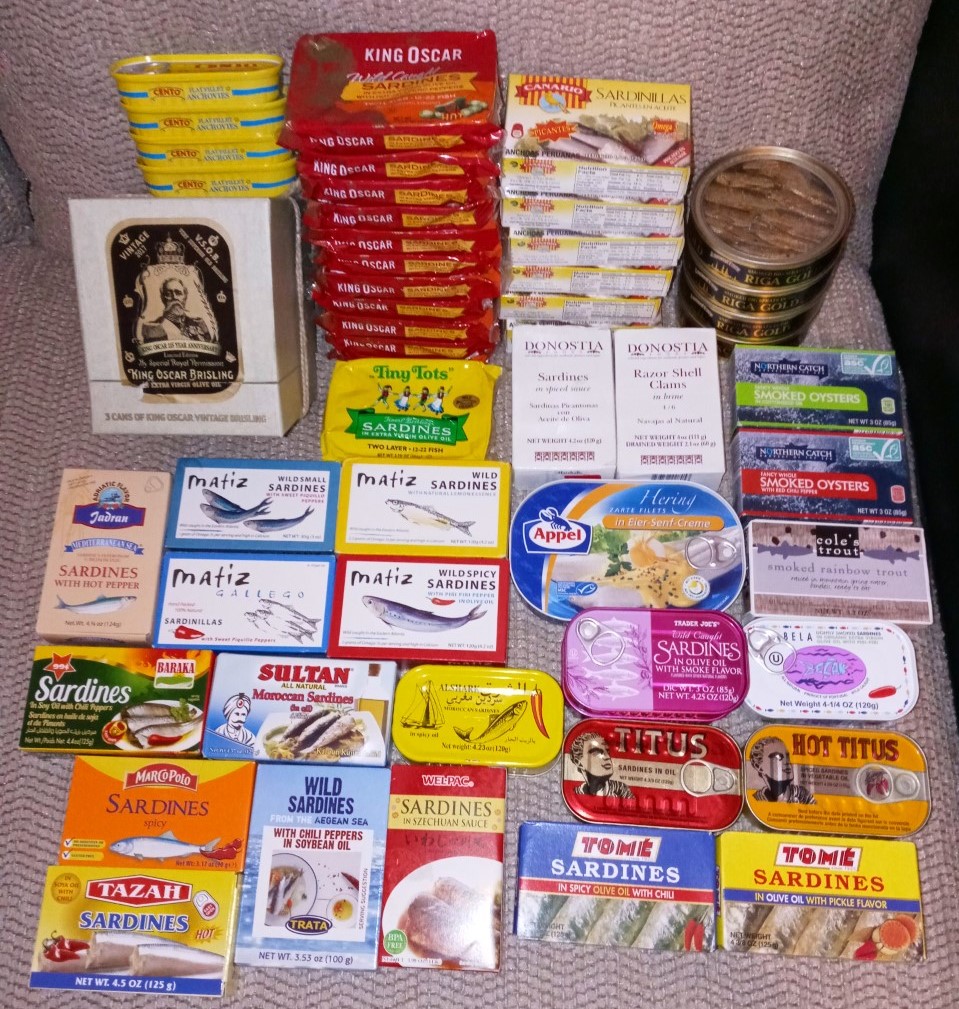
And now Grocery Grails has a second spinoff (after the aforementioned Tight Chips), a fabulous, fantastic feature devoted to one of my staple foods, sardines — delicious and healthy, but also unglamorous and relatively intimidating for the uninitiated. It’s a little feature I like to call The ‘Dines List, and it is a crash course in appreciating canned sardines and other canned seafood, which I collect and eat all the time. I will use The ‘Dines List to demystify, review, and recommend sardines, since I consider myself a connoisseur of the canned, a professor of the preserved, a dean of sardines, if you will. This isn’t the first sardine review blog out there — Mouth Full of Sardines and Society for the Appreciation of the Lowly Tinned Sardine are out there, fully dedicated to reviewing sardines, whereas this is just going to be a recurring feature here on The Saboscrivner, as a palate cleanser between my restaurant reviews, just like Tight Chips and Grocery Grails.
So here’s The ‘Dines List 101: my freshman feature on the best canned sardines out there. Don’t get me wrong, there are some gross sardines on supermarket shelves, and those may have turned people off to the entire concept of tinned seafood. Here are a few helpful hints to get you started with this sardine syllabus, just based on my own personal preferences:
- Smaller sardines taste better to me than larger ones. If you can find a can that advertises itself as “two layer,” “dual layer,” “double layer,” or “cross pack,” you have tinier fish, literally packed in like sardines. Bigger fish that are packed two to four in a can usually don’t taste as good to me, although there are always exceptions.
- Stick to sardines packed in oil. Feel free to drain the oil (not down the sink!), but I guarantee they will smell and taste better than sardines packed in water, which even I don’t like. The same goes for canned tuna, which I ate my entire life until I met my wife, because she hated the smell so much when I opened a can of tuna. She doesn’t share my love of sardines, but at least the smell of an open sardine can never seems to bother her the same way.
- I never like skinless and/or boneless sardines. Don’t be afraid of the shimmering silvery skin or the bones. Those ‘dines always taste better than skinless and boneless varieties, which are always blander, and their textures aren’t as pleasant. The bones are usually removed anyway, but they are a good source of calcium. And yes, sardine tails are so teeny-tiny, you can eat them with no problem. Don’t worry — nothing is going to crunch in your mouth or get caught in your throat.
- Really large, oval-shaped cans of sardines never taste that great to me. You will often see these in the “ethnic foods” aisle in the supermarket, rather than with the rest of the canned meat and seafood.
- I love spicy sardines, and there are a lot of terrific spicy varieties out there. But as much as I love tomato sauce and mustard as ingredients in so many foods, I almost never like sardines packed in tomato sauce or mustard. They are always watery and low-quality, imparting a funky flavor to everything (or more likely, attempting to cover up the funky flavor of the fish). Add your own condiments and accompaniments! Sardines are very much a blank canvas that allow you to get creative.
- On that note, sardines are versatile, and you can do almost anything you want to them. Personally, I like them best on some kind of bread or crackers or in a sandwich, but I definitely eat them straight out of the can sometimes, usually standing over a sink (dad-style) to avoid dripping the oil everywhere. But you can put them on a salad, serve them over pasta or rice, and even mash them up and make “sardine salad” the way you might make tuna salad with canned tuna. If you elect to preserve the oil, you might consider sautéing vegetables in it and mashing up some ‘dines for an umami punch (I do this with canned anchovies much more frequently), or even using it for a quick vinaigrette dressing.
- Sardines are practically health food! They are full of omega-3 fatty acids to help prevent heart disease, and they are pure protein, fantastic for a meal or a snack if you are trying to cut carbs. Legend has it that my favorite actor, the great thespian Nicolas Cage, bulked up for the 1997 action movie Con Air while working with a trainer and eating nothing but sardines. (Con Air is a fun ride, but doesn’t even make my Top Ten Nicolas Cage films. Cage is at his best when he’s full Method and completely unhinged, but I digress.)
- Being so low on the food chain and plentiful in wild waters, sardines are extremely ecologically sustainable and low in mercury, much moreso than larger fish like tuna, or farmed fish. The Monterey Bay Aquarium has a lot of interesting and important information about choosing sustainable seafood.
- Finally, while sardines have been dismissed as food for broke people and dads, apparently they are the “new hotness.” I don’t know where you’ve been, but these days, hip bars and gastropubs like my friend’s Baltimore bar The Back Yard are serving up fancy tinned seafood, inspired by bars in Spain offering canned conservas on tapas menus. They’re elegant! They’re continental! And if that don’t beat all, the fashionable website Nylon just named tinned fish “the hot girl snack of the summer.” Well, I had no idea I’d be up on some hot girl shit, but I’ve always been ahead of my time (and mostly unappreciated as a trendsetter).
So since I’m highlighting personal favorites, I figured I’d start you out with the ‘dines that earn consistently high marks on my ‘Dines List: wild-caught brisling sardines from King Oscar. The Norwegian company was founded in 1873, but has been using King Oscar II’s name and likeness “by special royal permission” since 1902, and exporting its delicious ‘dines to the U.S. since 1903. King Oscar is known for its high-quality, sustainable sardines from Norway’s icy waters. They market several varieties and flavors, and cans typically run between $2 and $4 at most major supermarkets, including Publix, Winn-Dixie, and Walmart. You can find cheaper sardines from other brands, and some of them are also good, but many are not.
My favorite King Oscars are the two layer jalapeño sardines, which are actually packed in Poland since 2008. They are easy to find, cheap, and delicious in anything, or alone. I always have a huge stash of these at home:
They actually pack sliced jalapeños inside the can to impart their spicy flavor into the extra virgin olive oil and the ‘dines:

I enjoyed this particular can on some toasted Cheesecake Factory brown bread. Did you know you can buy that bread as a sandwich loaf or a pair of mini-baguettes at Publix and Winn-Dixie? I also spread on some homemade tzatziki sauce made with Greek yogurt, cucumbers, garlic, dill, and coarse sea salt.
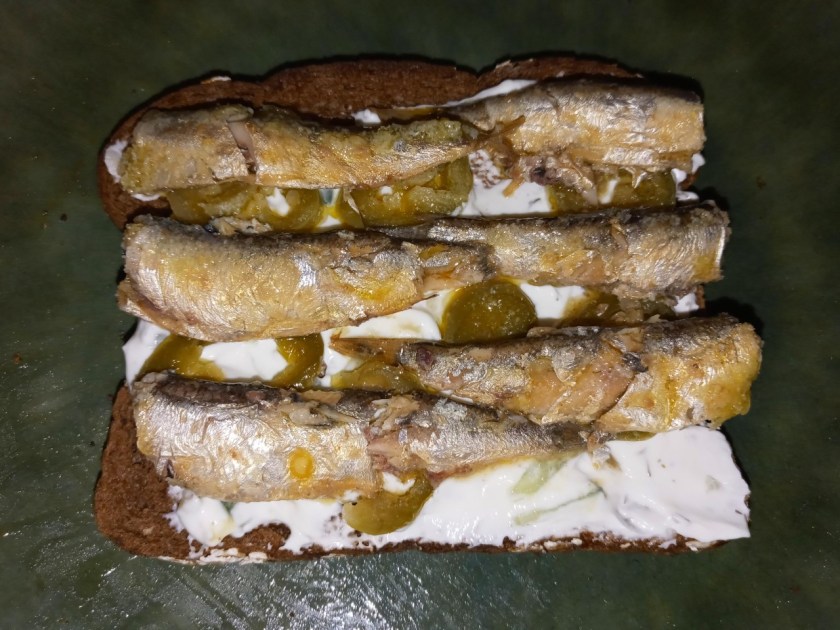
Since I had more sardines left in this can but no more jalapeños, I made a second slice of toast with thin-sliced cucumbers. Now I’m just waiting for some Boomer to complain about my sardine toast, but maybe they won’t find it as inexplicably offensive as avocado toast.

If you don’t like spicy, you can buy regular, plain two layer sardines, also packed in EVOO:

From a different day, here are King Oscar’s single layer Mediterranean style sardines, also packed in EVOO and seasoned with herbs de Provence, red bell pepper, black olives, and garlic.

They weren’t kidding:

Here are some of these slightly larger Mediterranean ‘dines on toasted pita points:
 I’m not a big fan of black olives, so I bought this can specifically to review here on The ‘Dines List. You’re welcome! I ate the whole can, though — olives and all, to get the full Mediterranean experience.
Next up, we have the King Oscar cross-pack, their smallest sardines of all.
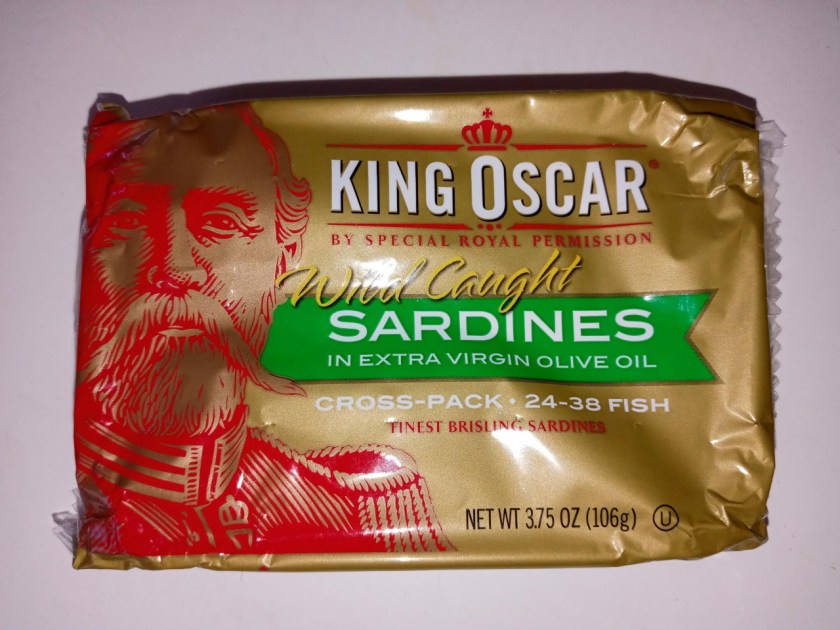
The can says it holds 24-38 ‘dines, and I counted 24 exactly. Yes, there is an entire layer underneath the ones you can see here.
 The cross-pack is usually about a dollar more expensive than the other varieties, but I don’t like them quite as much. Don’t get me wrong, they are fine, and might even be a good “gateway” sardine for the uninitiated, but I just prefer the taste of the jalapeño two layer variety. The cross-pack ‘dines are definitely blander, but you can include them in some really creative recipes and jazz them up that way.
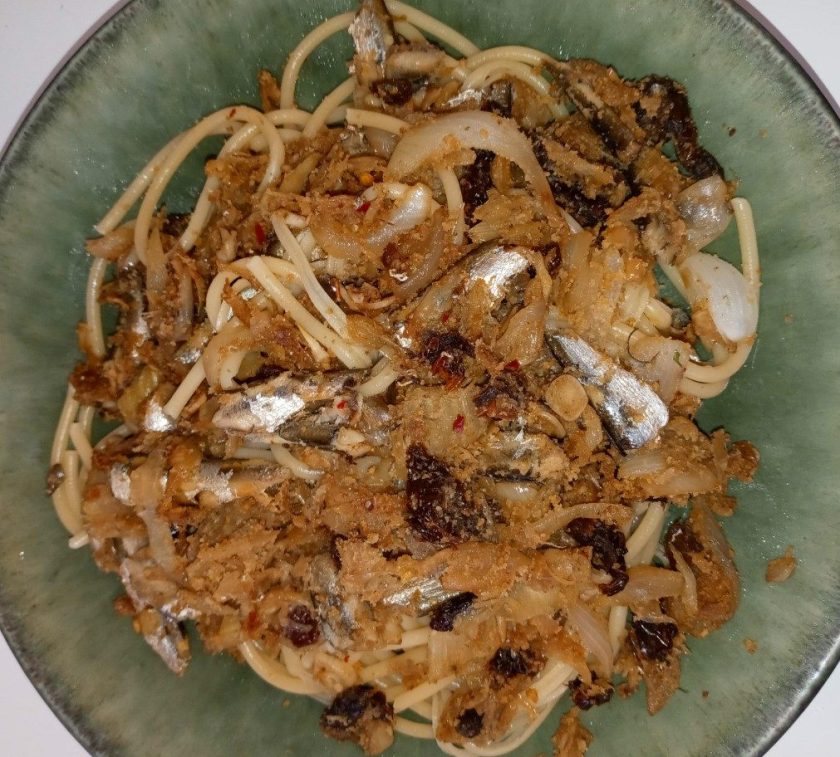
This was a dish I concocted recently — my own take on pasta con le sarde, with shaved fennel bulb, onions, garlic, smoked sun-dried tomatoes, raisins, chili flakes, Italian-seasoned bread crumbs, and King Oscar cross-pack sardines, all sautéed together in extra virgin olive oil and served over bucatini pasta. It was damn delightful, and I will make it again for sure, maybe when I have golden raisins on hand in the future.
In the interest of really comparing and contrasting, dear readers, I opened three cans from my stash at once to take these comparison photos on pita strips I toasted until they were crunchy and firm. The top row is plain two layer King Oscar sardines (exactly the same as the jalapeño variety, just minus the jalapeños), the three in the middle are the slightly larger one layer Mediterranean ‘dines, and the bottom row is the cross-pack ‘dines. Funny, looking at them laid out on a cutting board like this, they really don’t look that different from each other!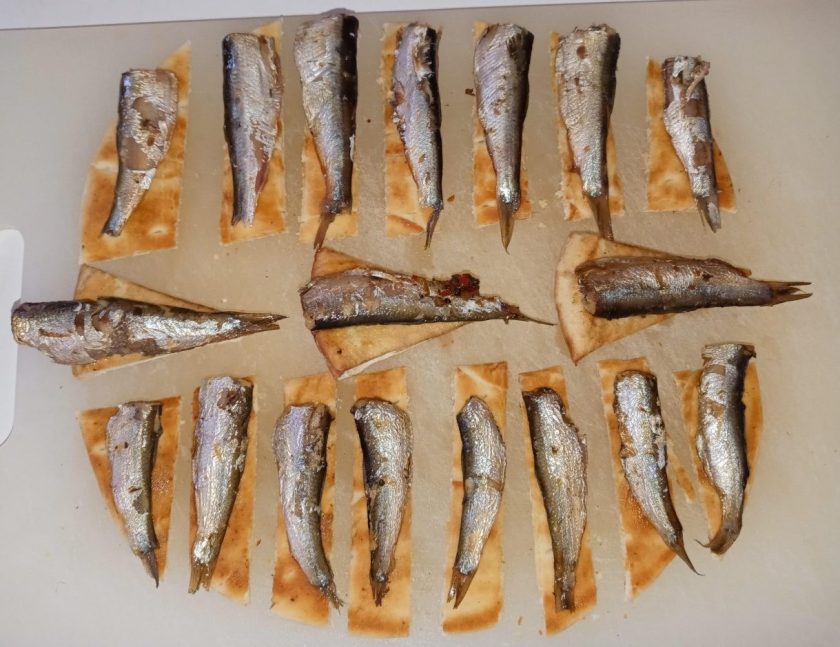
Moving past King Oscars, I want to introduce you to some other good brands of canned ‘dines. These are the only other kind I stockpile in our pantry, in addition to the King Oscar jalapeño ‘dines. They are from the Canario brand, and there is almost no information about this company on the Internet. But I absolutely love their sardinillas picantes en aceite (“small sardines in oil spiced piquant”).


These Peruvian-caught fish have a rich, meaty flavor and consistency, and a pleasing amount of spice. I only ever see these at Latin grocery stores, so I stock up whenever I’m at Bravo Supermarket or Fancy Fruit and Produce, both of which have multiple locations around Orlando. Canario usually costs around $1.59 per can, so they are cheaper than King Oscar. And I really, really like them. 
Here are the Canario sardinillas on a soft, crispy, flaky paratha, an Indian flatbread that is like the beautiful love child of a flour tortilla and a croissant. I spread on more of my homemade tzatziki sauce here to make a really delicious lunch. 
Here is another serving of Canario ‘dines from a different meal, this time on rye avocado toast. (Here come the Boomers, oh nooooo!)

Some of the most luxurious tinned fish I’ve ever found are Riga Gold sprats, which are very similar to sardines, but slightly larger. These Latvian-caught fish have a terrific smoky flavor, taking on a golden glow from the smoking process. The only places I’ve ever found them in Orlando are at International Food Club, a sprawling supermarket on L.B. McLeod Road, boasting food from over 20 countries around the world, and Tima’s House, a smaller Euro-Balkan grocery store in Longwood, much closer to home. International Food Club in particular is such a fun place to shop, browse, discover new things, and treat yourself.

You can see that the round Riga Gold cans have a clear plastic pull-top to allow you to inspect the glorious golden sprats inside. Da, tovarisch! By the White Wolf! 
I ate these on some leftover rye bread from The Pastrami Project, with more of that homemade tzatziki — something creamy and cool to cut the salty smokiness of the sprats. It was an inspired combination. Riga Gold sprats are really terrific, especially if you like smoked fish dip, whitefish salad, and other smoked fish delicacies. 
I strongly recommend these sprats, even if you’ve tried sardines before and didn’t like them. Especially if you’ve tried sardines before and didn’t like them! If you like whitefish salad, that smoky Jewish deli delicacy made from golden smoked chubs, the Riga Gold sprats might fill that void, and you won’t have to pick out dozens of tiny, hair-thin, transparent, plastic-like bones while preparing it.
But if you don’t live close to a cool international market that sells Riga Gold smoked sprats, WALMART sells the Polar brand of smoked brisling sardines, which come in a very familiar, flat, round can with a clear plastic top, and they are also from Latvia! Are they a repackaged version of Riga Gold? They sure look and taste similar, they would be a heck of a lot easier to find, and for only $2 for a can, you can’t go wrong.
Here are the Polar sardines on rye-pumpernickel swirl toast, over thin-sliced cucumbers, and there is tarragon herb mustard (one of the seven mustards I reviewed in my first Cutting the Mustard feature) underneath them. Despite being slightly smaller than the Riga sprats, these were very similar in smoky flavor, firm texture, and golden appearance, and I mean that in the best possible way. 
Well hey there, sailor! Congratulations! You passed The ‘Dines List 101, a rundown of most of my favorite canned sardines. I have no idea how this is going to go over, if I have somehow alienated my already small readership. Most people dismiss sardines as stinky, funky, fishy, gross, and depressing. Biggie Smalls sure did, and that guy loved to eat! Remember Biggie’s breakfast of champions from “Big Poppa”: “A T-bone steak, cheese, eggs, and Welch’s grape!” (Or did he mean “cheese eggs,” like the eggs are served with cheese on them?) But again, I digress.
Some sardines are certainly better than others, but trust me — I’ve tried so many ‘dines over the decades, and I’m sharing the best ones with you here. And by the way, why is “fishy” so bad when we’re talking about fish? Frankly, I’d be a little disappointed and concerned if my fish didn’t taste fishy. But for people who crave the mild, bland taste of white fish like tilapia, these oily little fellas have so much more flavor, they’re cheap, they’re sustainable, they’re good for you, they’re great to nosh on when hurricanes knock our power out (hopefully not this summer!), they’re currently making hot girls swoon, and you might be pleasantly surprised by how tasty they are and how creative you can get with them. (The sardines, not the hot girls! Okay, why not both?)

I promise that next week I’ll review another good local restaurant, but I definitely plan to continue The ‘Dines List right here on The Saboscrivner. I have two more installments already partially written, and I’m taking care to try new ‘dines to review, rather than falling back on old favorites already covered above. Readers, reach out if you have any review requests or recommendations for sardines and other tinned seafood. If there are specific ‘dines or other canned fish you love, recommend, and would like to send my way to sample and review, challah at your boy!

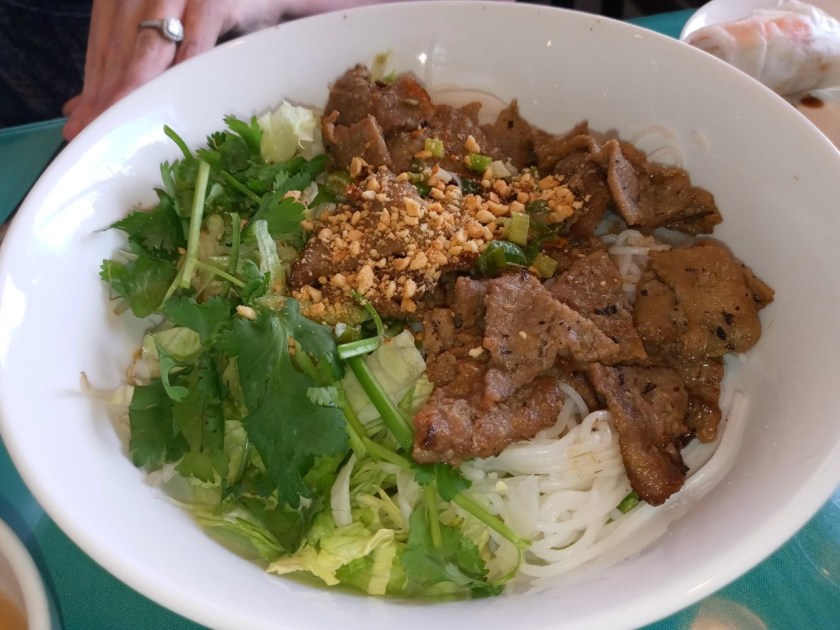

 Any Vietnamese restaurant will serve phở with a plate of several fresh herbs and additional ingredients to add, so diners can customize their soup to their hearts’ content. I always tear up fragrant fresh basil leaves and crunchy sliced jalapeño peppers (these are fresh; much spicier than the pickled kind from a jar, so don’t touch your eyes!), but I prefer to leave the crispy bean sprouts out of my phở. If I get lime wedges, I’ll usually squeeze some lime into my phở and some more into my glass of water. Then there are condiments: hoisin sauce, sriracha (overrated hot sauce), and sambal oelek (thicker, chunkier hot sauce). I’ll usually add just a tiny spoonful of sambal too, but only after tasting the pure, unadulterated broth first. As you might have guessed, my wife prefers plain phở, just as it comes out of the kitchen… but with as many onions fished out as possible.

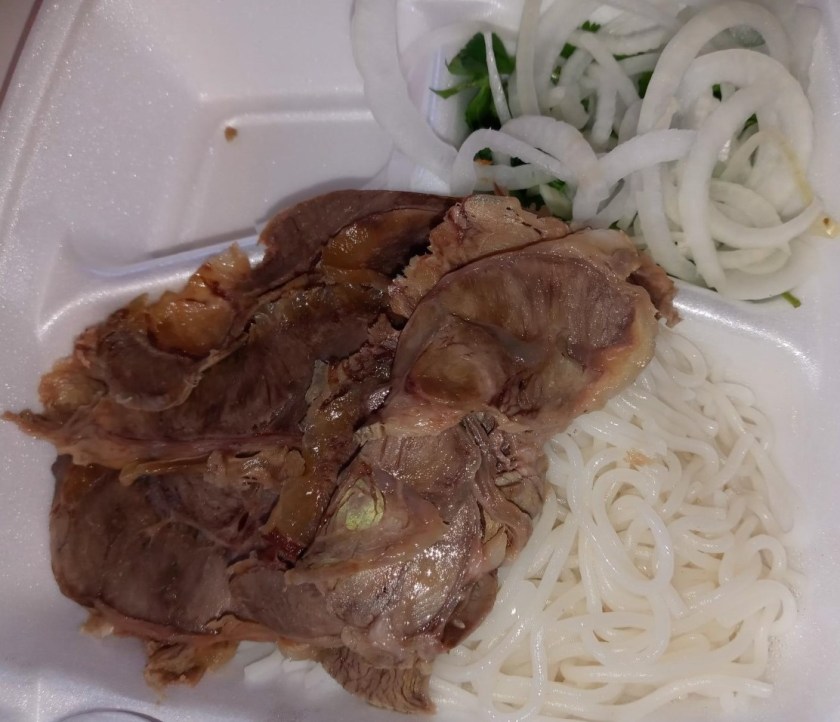

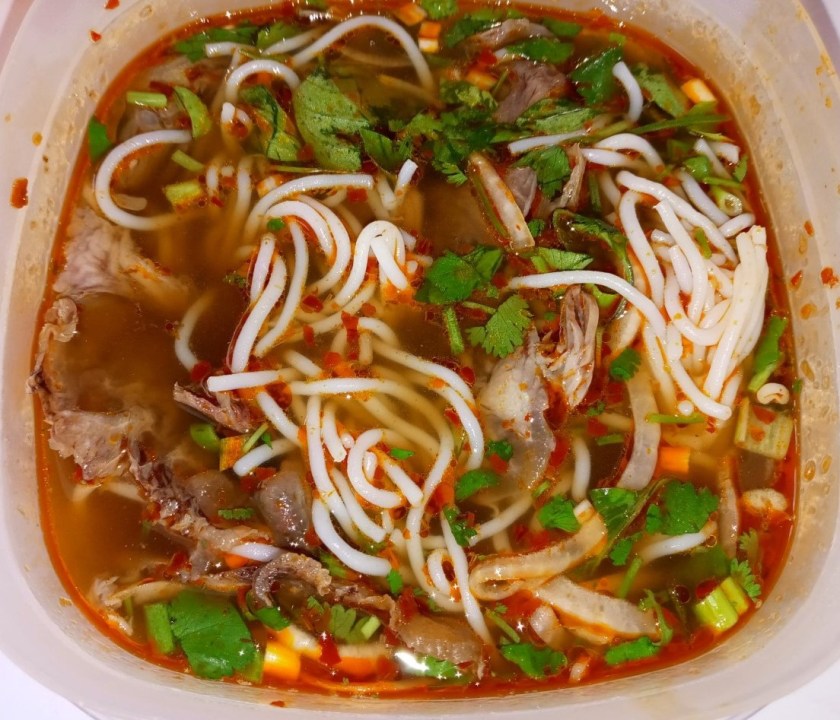





 If someone from Nutritional Services manages to catch a patient in her room (between physical and occupational therapy appointments, in my wife’s case), they will take her order for all three meals for the next day, entering her choices on a tablet. If not, the patient will just get whatever the daily specials are. Since my wife really has to be in the mood for specific foods even when she isn’t distracted by chronic pain, post-surgical pain, and new pain from grueling therapy, I ended up helping her eat a lot of meals she wasn’t in the mood for and didn’t want anything to do with. Also, I obsessively saved condiment and seasoning packets in our room, much like I imagine prisoners doing to make prison food more tolerable.







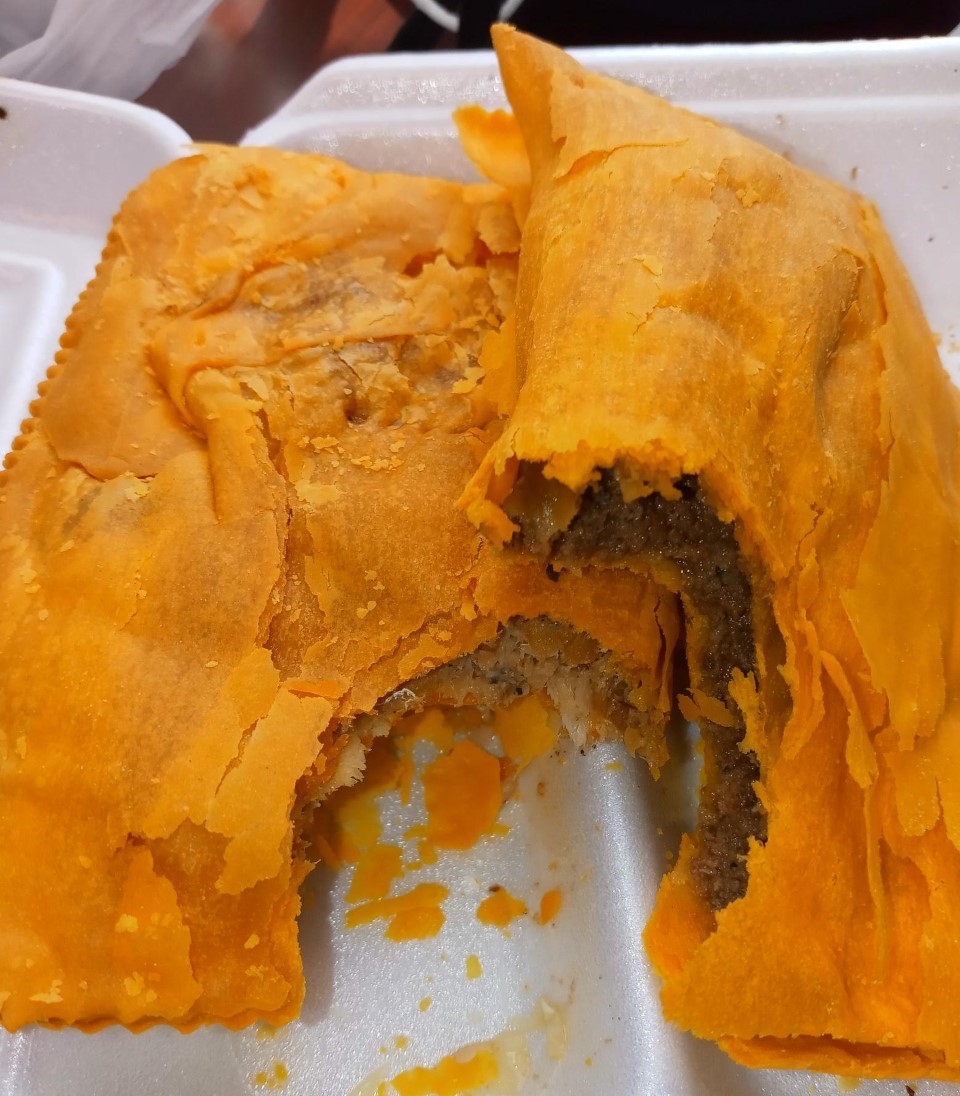




 I traded a piece of my jerk pork for a piece of her brown stew chicken, and all three of us who tried it agreed how good it was.
 Never mind the chicken wing on top of the cabbage in the picture above — you won’t get that in a jerk pork meal unless you trade some food with your friend.

 I just heat up the frozen pretzel sticks on a tray in the toaster oven for nine minutes at 350 degrees, and they come out crackly and crispy on the outside, soft and fluffy on the inside. They are way better than you’d think frozen pretzels could possibly be — better than many fresh soft pretzels I’ve had. Plus, pretzels are a perfect mustard delivery device, so let the grand experiment begin! On to the mustards!
 I have never been a huge fan of any Dijon mustards for everyday use on things like sandwiches, hot dogs, or burgers, so I wasn’t enamored with a big dollop of Sir Kensington’s Dijon on the soft pretzel here. If you’ve had the more famous Grey Poupon (but of course!) or even a cheap store-brand Dijon, you know what you’re trying here — smooth texture, a little flavor from white wine, a little spice you can feel in your nostrils. But I keep this particular mustard on hand for one purpose: LAMB. Dijon goes so well with the rich and slightly gamey flavor of lamb, which my wife and I both love. I buy thick-cut lamb loin chops at Costco, rub them with Dijon mustard, sprinkle with salt and pepper and whatever herbs I feel like using, and roast them until they are rare. It’s a winning flavor combination, and one of the only situations where my wife tolerates any form of mustard.
 I don’t think Mild & Creamy Dijon is spicy or pungent enough to complement hot dogs or classic Jewish deli-style sandwiches like pastrami, corned beef, or tongue, where the salted, cured meats usually beg for something tangy, spicy, or garlicky. But for more everyday sandwiches, it’s a wonderful choice, and I did not mind having some straight up on the soft pretzel.
 I haven’t eaten enough tarragon in my lifetime to confidently, competently describe what it tastes like on its own, and it isn’t terribly garlicky either. Think of this as a yellow mustard that isn’t as “bright,” tangy, vinegary, or salty as you’re used to from a lifetime of cookouts. There is an extremely subtle sweetness to it that isn’t there in regular yellow mustard. I’ve tried it in several sandwiches since my first taste, including with some sardines, and also mixed it into chicken salad, where it is pretty inoffensive. I didn’t love it, but didn’t hate it either. At least the price was right.
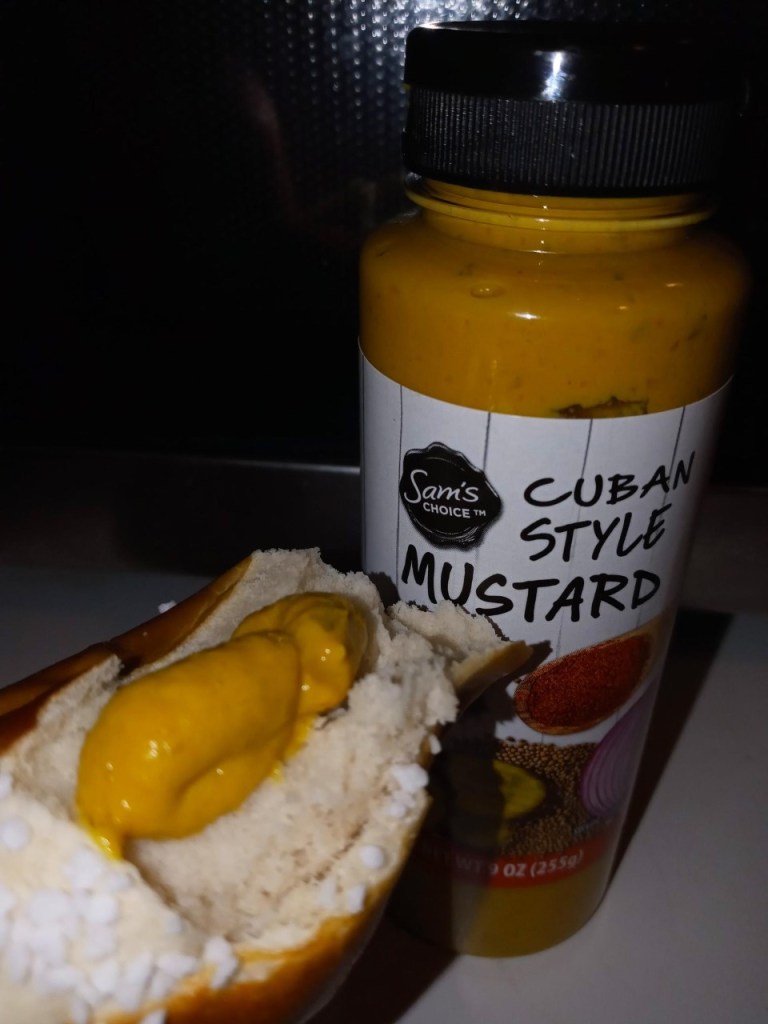 I stocked up on a few bottles of this, because I don’t go to Walmart that often, but it is really good. Publix doesn’t carry any equivalent of this, and Winn-Dixie carries a Cuban mustard from the Plochman’s brand, which is a few dollars more than the Sam’s Choice. I haven’t tried the Plochman’s Cuban yet, but at least I know I like this one a lot for anything that normally calls for yellow mustard.
 It’s on the creamy side, and very pickley. It tastes more like sour pickles than dill. Normally I’d put mustard and pickles on burgers or sandwiches, so I’m trying to think of uses where you might want this mustard to cover both bases, without making it redundant by using actual pickles. I also dipped some homemade sweet potato oven fries in it and mixed a lot of it into some chicken salad, and those worked okay. I think I’d rather use other mustards and then just add
  I think it would work well in a sandwich with savory meats like roast beef and turkey. It would be an inspired main ingredient in a glaze if you were baking a ham (and then you could leave out some sugar), but it might be a little much spread onto a sweet ham sandwich. It would be great as a dip for heavy, salty fried foods like french fries or fried chicken, or made into a barbecue sauce.
 This mustard would go well on or in anything. If you can find a jar, treat yourself and pick one up, even at regular Robert Rothschild prices. I give it my highest possible Saboscrivner recommendation.


 Each of these beauties was $1.79, except for the fish taco that was $3.49. The plate came garnished with a lime wedge to squirt over each taco, soft marinated carrot slices (delicious), and crispy sliced radishes. I ran out of steam and couldn’t eat the carne asada, but I mostly ordered that one for my wife to try, since that is usually her go-to Mexican meat.
 She always orders sopes at one of our favorite establishments,




 *We got them without cream, the way my wife likes. Fellas, consider this a teaching moment.


 The whimsical plating in the little cart adds to the pani puri party atmosphere here. Since there were eight pani puri puffs, I was methodical and tried two plain, two splashed with the sweet water, two splashed with the spicy water, and two splashed with both. I couldn’t even tell you which one was best, because I loved every possible permutation.
 Looking it up later, I learned that “pav” just means bread, but it comes from the Portuguese word “pão” for bread, since Portuguese explorers (colonizers) brought their bread recipes to India. I have enjoyed all the Indian breads I’ve tried before — naan, roti, parathas, and kulcha — but pav was completely new to me, and yet completely familiar.


 We all pulled pieces off this colossal crepe, and dipped our divided dosa in a lentil-based vegetable curry called sambar, along with coconut chutney (in the smaller cup). No double-dipping was done.




 The Saboscrivner